6.1 The residual network with costs
Part 3 · Flows · Chapter 6 · Chapter 6: Minimum cost flow · Lecture notes, volume 3 (PDF) · Exercises: Minimum cost flow
-
In this chapter the network \(G=(N,A)\) has balances \(b_i\) with \(\sum_{i \in N} b_i=0\), lower bounds \(l_{ij}\), capacities \(u_{ij}\) (finite or \(+\infty\)) and costs \(c_{ij}\), as in Chapter 4. The arcs are numbered \(a_1,a_2,\dots,a_m\) in lexicographic order.
-
The set \(A\) has no pair of opposite arcs \((i,j)\), \((j,i)\). An arc \((j,i)\) opposite to \((i,j)\) can be replaced by the arcs \((j,k)\) and \((k,i)\) through a new transshipment node \(k\), both with the bounds of \((j,i)\), the first with its cost and the second with cost \(0\): the flows and their costs do not change.
Definition 6.1: residual network
Let \(\vet{x}\) be a vector with \(l_{ij} \le x_{ij} \le u_{ij}\) for every arc. The residual network \(G(\vet{x})=(N,A(\vet{x}))\) has, for every arc \((i,j) \in A\):
-
the forward arc \((i,j)\), if \(x_{ij}<u_{ij}\), with residual capacity \(r_{ij}=u_{ij}-x_{ij}\) and cost \(c_{ij}\);
-
the backward arc \((j,i)\), if \(x_{ij}>l_{ij}\), with residual capacity \(r_{ji}=x_{ij}-l_{ij}\) and cost \(-c_{ij}\).
We write \(c^x_{ij}\) for the cost of the arc \((i,j)\) of \(G(\vet{x})\).
-
A forward arc can carry \(r_{ij}\) more units on \((i,j)\). A backward arc \((j,i)\) sends units back from \(j\) to \(i\) by decreasing \(x_{ij}\), and saves \(c_{ij}\) per unit.
-
An arc of \(A\) gives two arcs of \(G(\vet{x})\) exactly when \(l_{ij}<x_{ij}<u_{ij}\). With \(\vet{l}=\vet{0}\) and without the costs, \(G(\vet{x})\) is the residual network of Chapter 5 «Maximum flow».
Definition 6.2: cycles of the residual network
Let \(W\) be a directed cycle of \(G(\vet{x})\). Its cost and its residual capacity are
and \(W\) is a negative cycle if \(c(W)<0\). Augmenting \(\vet{x}\) along \(W\) by \(\theta\), with \(0<\theta \le r(W)\), means increasing \(x_{ij}\) by \(\theta\) for every forward arc \((i,j)\) of \(W\), and decreasing \(x_{ij}\) by \(\theta\) for every arc \((i,j) \in A\) whose backward arc \((j,i)\) is in \(W\).
Proposition 6.3: augmenting along a cycle
Let \(\vet{l} \le \vet{x} \le \vet{u}\), let \(W\) be a cycle of \(G(\vet{x})\) and \(0<\theta \le r(W)\), and let \(\vet{x}'\) be \(\vet{x}\) augmented along \(W\) by \(\theta\). Then \(\vet{l} \le \vet{x}' \le \vet{u}\), every node has the same outflow minus inflow in \(\vet{x}'\) and in \(\vet{x}\), and
Proof
We check the three claims arc by arc.
-
Bounds. On a forward arc, \(x'_{ij}=x_{ij}+\theta \le x_{ij}+r_{ij}=u_{ij}\). If the backward arc \((j,i)\) is in \(W\), then \(x'_{ij}=x_{ij}-\theta \ge x_{ij}-r_{ji}=l_{ij}\).
-
Balances. Augmenting by \(\theta\) along an arc \((i,k)\) of \(G(\vet{x})\) raises the outflow minus inflow of \(i\) by \(\theta\) and lowers that of \(k\) by \(\theta\): a forward arc sends more flow from \(i\) to \(k\), a backward arc sends less flow from \(k\) to \(i\). Every node of \(W\) is the tail of one arc of \(W\) and the head of another one, so the changes cancel.
-
Cost. A forward arc changes the cost by \(c_{ij}\theta=c^x_{ij}\theta\); a backward arc \((j,i)\) changes it by \(-c_{ij}\theta=c^x_{ji}\theta\). Adding up along \(W\) gives \(\theta\, c(W)\). □
- If \(\vet{x}\) is a feasible flow, so is \(\vet{x}'\). Along a negative cycle the cost decreases by \(\theta\, |c(W)|\).
Example 6.1: the residual network of the most expensive flow
We use the reference network of Chapter 4, with zero lower bounds, the balances \(\vet{b}=(5,2,0,-3,0,-4)\), and the costs and capacities
| arc | \((1,2)\) | \((1,3)\) | \((2,4)\) | \((3,2)\) | \((3,5)\) | \((4,3)\) | \((4,6)\) | \((5,4)\) | \((5,6)\) |
|---|---|---|---|---|---|---|---|---|---|
| \(c_{ij}\) | \(2\) | \(2\) | \(5\) | \(2\) | \(3\) | \(3\) | \(5\) | \(5\) | \(3\) |
| \(u_{ij}\) | \(4\) | \(4\) | \(4\) | \(2\) | \(4\) | \(3\) | \(5\) | \(3\) | \(2\) |
Its most expensive feasible flow, computed with Gurobi by maximizing the cost, is
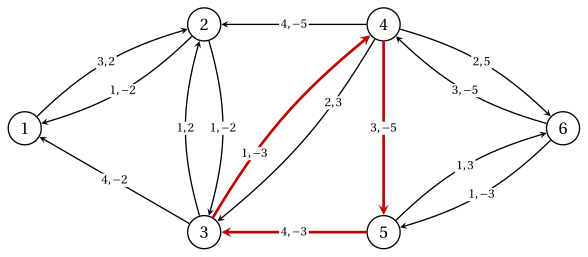
with the entries in the order of the arcs; it is the only flow of cost \(80\), as the enumeration of the \(12\) integer feasible flows confirms. Each arc gives the following arcs of \(G(\vet{x}^0)\), with residual capacity and cost:
| arc \((i,j)\) | \((1,2)\) | \((1,3)\) | \((2,4)\) | \((3,2)\) | \((3,5)\) | \((4,3)\) | \((4,6)\) | \((5,4)\) | \((5,6)\) |
|---|---|---|---|---|---|---|---|---|---|
| \(x^0_{ij}\) | \(1\) | \(4\) | \(4\) | \(1\) | \(4\) | \(1\) | \(3\) | \(3\) | \(1\) |
| forward \((i,j)\): \(r,c\) | \(3,2\) | – | – | \(1,2\) | – | \(2,3\) | \(2,5\) | – | \(1,3\) |
| backward \((j,i)\): \(r,c\) | \(1,-2\) | \(4,-2\) | \(4,-5\) | \(1,-2\) | \(4,-3\) | \(1,-3\) | \(3,-5\) | \(3,-5\) | \(1,-3\) |
In the figure each arc of \(G(\vet{x}^0)\) carries the pair \(r_{ij},c^x_{ij}\); the cycle \(W=4,5,3,4\) is red.
-
The cycle \(W=4,5,3,4\) uses the backward arcs of \((5,4)\), \((3,5)\) and \((4,3)\):
\[ c(W)=-5-3-3=-11, \qquad r(W)=\min\{3,4,1\}=1. \] -
Augmenting by \(\theta=1\) decreases \(x_{54}\), \(x_{35}\) and \(x_{43}\) by one unit. The new flow \(\vet{x}^1=(1,4,4,1,3,0,3,2,1)\) is feasible and costs \(80-11=69\): the unit that went around the directed cycle \(3,5,4,3\) of \(G\) cost \(11\) and delivered nothing.
The residual network \(G(\vet{x})\) has a forward arc of cost \(c_{ij}\) where \(x_{ij}\) can grow and a backward arc of cost \(-c_{ij}\) where \(x_{ij}\) can decrease. Augmenting along a cycle of \(G(\vet{x})\) keeps the bounds and the balances, and changes the cost by \(\theta\, c(W)\).