5.5 The Ford–Fulkerson algorithm
Part 3 · Flows · Chapter 5 · Chapter 5: Maximum flow · Lecture notes, volume 3 (PDF) · Exercises: Maximum flow · App: Maximum flow: Ford–Fulkerson and Edmonds–Karp
- By Theorem 5.8, a flow can be improved as long as its residual network has an augmenting path. The Ford–Fulkerson algorithm starts from the zero flow and augments along such paths until none is left.
Algorithm: Ford–Fulkerson algorithm
STOP: \(\vet{x}\) is a maximum flow, and \(S\) is the set of the labelled nodes.-
Step 1 can use any search of Chapter 1, Section «Graph search». In this module the Ford–Fulkerson algorithm uses the depth-first search: \(\mathit{LIST}\) is a stack, the residual arcs leaving each node are scanned by increasing index of the head, and the search stops as soon as \(t\) is labelled.
-
When the search does not label \(t\), it has labelled all the nodes reachable from \(s\) (Chapter 1, Theorem «correctness of the search»): they form the set \(S\) of Step 1.
Theorem 5.9: correctness of Ford–Fulkerson
Let the capacities be integer. Then every flow computed by the Ford–Fulkerson algorithm is integer, the algorithm stops after at most \(\tilde{v}\) augmentations, and at the stop \(\vet{x}\) is a maximum flow and \((S,N \setminus S)\) is a minimum cut.
Proof
We use Lemma 5.7 and Theorem 5.8.
-
Integrality. The zero flow is integer. If \(\vet{x}\) is integer, all residual capacities are integer, so \(\delta\) is a positive integer and the augmented flow is integer.
-
Termination. Every flow is feasible, and every augmentation raises the value by \(\delta \ge 1\). No value exceeds \(\tilde{v}\), so there are at most \(\tilde{v}\) augmentations.
-
Optimality. At the stop \(t\) is not labelled, so \(G(\vet{x})\) has no augmenting path and \(S\) is the set of the nodes reachable from \(s\). The proof of (b) implies (c) gives \(v=u(S,N \setminus S)\): the flow is maximum and the cut is minimum. □
Corollary 5.10: integrality
If all the capacities are integer, there is a maximum flow with integer entries.
Proof
The flow returned by the Ford–Fulkerson algorithm, by Theorem 5.9. □
-
The same conclusion follows from Chapter 4, Theorem «integer vertices»: with the arc \((t,s)\), the \(\mathrm{MF}\) model is a minimum cost flow model with integer data, and its optimum is attained at an integer vertex.
-
Rational capacities become integer after multiplication by a common denominator, which multiplies every flow and every cut by the same factor: the algorithm stops also with rational capacities.
Theorem 5.11: running time of Ford–Fulkerson
With integer capacities, the Ford–Fulkerson algorithm runs in \(O((n+m)\,\tilde{v})\) time, and \(\tilde{v} \le (n-1)\,U\), where \(U\) is the largest capacity.
Proof
Every iteration builds \(G(\vet{x})\) in \(O(m)\) time, searches it in \(O(n+m)\) time, since \(G(\vet{x})\) has at most \(2m\) arcs (Chapter 1, Theorem «running time of the search»), and changes at most \(n-1\) flows along \(P\). There are at most \(\tilde{v}\) iterations with an augmentation, plus the last one.
- By Corollary 5.4 with \(S=\{s\}\), \(\tilde{v} \le u(\{s\},N \setminus \{s\})\), and \(s\) has at most \(n-1\) leaving arcs, each with capacity at most \(U\).
□
- The bound grows with the value \(U\) of the capacities, and not only with the number of their digits, about \(\log_2 U\): the running time is pseudopolynomial. Example 5.7 shows that the number of augmentations can really grow with the capacities.
5.5.1 Ford–Fulkerson on the reference network
Example 5.6: Ford–Fulkerson on the reference network
We run the algorithm on the network of Example 5.1. Each row is an iteration: the augmenting path, the residual capacities of its arcs, the backward arcs it uses, the bottleneck and the new value.
| iteration | augmenting path | \(r_{ij}\) on \(P\) | backward arcs | \(\delta\) | \(v\) |
|---|---|---|---|---|---|
| \(1\) | \(1,2,4,3,5,6\) | \(5,3,2,4,3\) | – | \(2\) | \(2\) |
| \(2\) | \(1,2,4,6\) | \(3,1,4\) | – | \(1\) | \(3\) |
| \(3\) | \(1,3,4,6\) | \(4,2,3\) | \((3,4)\) | \(2\) | \(5\) |
| \(4\) | \(1,3,5,4,6\) | \(2,2,2,1\) | – | \(1\) | \(6\) |
| \(5\) | \(1,3,5,6\) | \(1,1,1\) | – | \(1\) | \(7\) |
The flows after each iteration (\(k=0\) is the zero flow) are:
-
Iteration \(1\) is the depth-first search of Chapter 1, Example «DFS from node \(1\)»: all the arcs are empty, \(G(\vet{0})=G\), and the path goes through the arc \((4,3)\).
-
After iteration \(2\) the flow is \(\bar{\vet{x}}\) of Example 5.1, and iteration \(3\) is the augmentation of Example 5.3: the backward arc \((3,4)\) cancels the two units sent on \((4,3)\) in iteration \(1\).
-
The sixth search labels only the nodes \(1\) and \(2\), and the algorithm stops: the flow is \(\tilde{\vet{x}}\) of Example 5.5, and \(S=\{1,2\}\) gives the minimum cut of capacity \(u_{13}+u_{24}=7\).
-
The algorithm makes \(5\) augmentations, within the bound \(\tilde{v}=7\) of Theorem 5.9.
5.5.2 The number of augmentations
Example 5.7: many augmentations
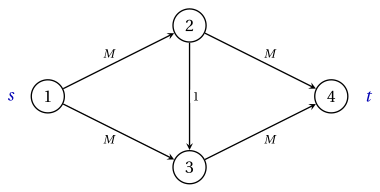
In the network below, \(M\) is a positive integer. The paths \(1,2,4\) and \(1,3,4\) carry \(M\) units each, and the cut \(S=\{1\}\) has capacity \(2M\), so \(\tilde{v}=2M\).
-
The Ford–Fulkerson algorithm allows any augmenting path. If the paths \(1,2,3,4\) and \(1,3,2,4\) alternate, the second one through the backward arc \((3,2)\), every bottleneck is \(\delta=1\), given by the arc \((2,3)\) or by its backward arc: \(2M\) augmentations are needed, two million for \(M=10^6\).
-
With the depth-first search of this module, for \(M \ge 2\), the paths are \(1,2,3,4\), then \(1,2,4\), \(1,3,2,4\) and \(1,3,4\), with \(\delta=1\), \(M-1\), \(1\), \(M-1\): four augmentations.
The Ford–Fulkerson algorithm augments along paths of the residual network until none is left. With integer capacities it stops after at most \(\tilde{v}\) augmentations, with an integer maximum flow and a minimum cut; its running time \(O((n+m)\,\tilde{v})\) is pseudopolynomial.