4.5 Unbalanced instances
Part 3 · Flows · Chapter 4 · Chapter 4: Flow models · Lecture notes, volume 3 (PDF) · Exercises: Flow models
Definition 4.10: unbalanced instance
An instance with \(\sum_{i \in N} b_i>0\) is unbalanced: the total supply exceeds the total demand. Every demand must be met, and every supply node \(i\) sends out at most \(b_i\) units:
with the bounds \(l_{ij} \le x_{ij} \le u_{ij}\) and the objective \(\min \sum_{(i,j) \in A} c_{ij}\,x_{ij}\).
Definition 4.11: dummy node
Let \(P=\{i \in N : b_i>0\}\) be the supply nodes and \(e=\sum_{i \in N} b_i>0\) the excess. The balanced network adds a dummy node \(d\) with balance \(b_d=-e\), and an arc \((i,d)\) for every \(i \in P\) with \(l_{id}=0\), \(u_{id}=+\infty\) and \(c_{id}=0\).
Proposition 4.12: the dummy node
The feasible solutions of the unbalanced instance and the feasible flows of the balanced network correspond, with the same cost: a flow of the balanced network restricted to \(A\) is feasible for the unbalanced instance, and a solution of the unbalanced instance becomes a feasible flow with \(x_{id}=b_i-(\text{outflow}-\text{inflow of } i)\).
Proof
For a vector \(\vet{x}\) on \(A\), let \(s_i(\vet{x})\) be the outflow minus the inflow of node \(i\) along the arcs of \(A\).
-
Let \((\vet{x},(x_{id})_{i \in P})\) be feasible for the balanced network. At \(i \in P\) conservation reads \(s_i(\vet{x})+x_{id}=b_i\) with \(x_{id} \ge 0\), so \(s_i(\vet{x}) \le b_i\); at the other nodes of \(N\) it reads \(s_i(\vet{x})=b_i\).
-
Conversely, let \(\vet{x}\) be feasible for the unbalanced instance, and set \(x_{id}=b_i-s_i(\vet{x}) \ge 0\) for \(i \in P\). Conservation holds at every node of \(N\), and at \(d\) the inflow is
\[ \sum_{i \in P} x_{id}=\sum_{i \in P} b_i-\sum_{i \in N} s_i(\vet{x})+\sum_{i \notin P} s_i(\vet{x}) =\sum_{i \in P} b_i - 0+\sum_{i \notin P} b_i=e, \]since the values \(s_i(\vet{x})\) add up to zero: every arc of \(A\) contributes \(+x_{ij}\) to its tail and \(-x_{ij}\) to its head. Hence \(d\) receives exactly \(-b_d=e\) units.
The dummy arcs cost zero, so the two costs coincide. □
-
The flow on \((i,d)\) is the part of the supply of \(i\) that is not used.
-
If the total demand exceeds the total supply and the demands are upper limits, a dummy node \(d\) with balance \(b_d=-\sum_{i \in N} b_i\) and arcs \((d,j)\) to the demand nodes balances the network in the same way.
Example 4.5: a dummy node on the reference network
In the network of Example 4.1 we raise the supply of node \(2\) to \(b_2=4\). The total supply is \(9\), the total demand is \(7\), and the excess is \(e=2\).
-
The balanced network adds node \(7\) with \(b_7=-2\), and the arcs \((1,7)\) and \((2,7)\) with cost \(0\) and capacity \(+\infty\) (dashed in the figure).
-
Its optimal flow, computed with Gurobi, ships all the \(4\) units of node \(2\) and only \(3\) units of node \(1\): \(x_{17}=2\), \(x_{27}=0\), with optimal value \(56\).
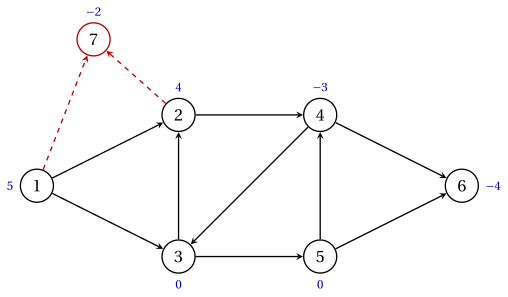
An unbalanced instance becomes a balanced network with a dummy node that absorbs the excess through zero-cost arcs; the flow on a dummy arc is the unused supply of its tail.