2.2 Cuts and cycles
Part 2 · Trees and paths · Chapter 2 · Chapter 2: Spanning trees · Lecture notes, volume 2 (PDF) · Exercises: Spanning trees · App: Minimum spanning trees: Kruskal and Prim
Definition 2.2: cut
Let \(G=(V,E)\) be an undirected graph and \(S \subseteq V\) with \(\emptyset \neq S \neq V\). The cut defined by \(S\) is the set of the edges with exactly one endpoint in \(S\):
An edge of \(\delta(S)\) crosses the cut. For a single vertex, \(\delta(\{v\})=\delta(v)\) is the set of the edges incident to \(v\).
-
A graph is connected if and only if every cut \(\delta(S)\) is nonempty: an empty cut separates \(S\) from \(V \setminus S\), and a path from \(u \in S\) to \(v \notin S\) must use an edge of \(\delta(S)\).
-
In the weighted reference graph, \(\delta(\{1,2,3\})=\{\{2,4\},\{3,4\},\{3,5\}\}\) and \(\delta(\{6\})=\{\{4,6\},\{5,6\}\}\).
Lemma 2.3: a cycle crosses a cut an even number of times
Let \(C\) be a cycle of \(G\) and \(\delta(S)\) a cut. Then \(|C \cap \delta(S)|\) is even. In particular, if a cycle contains an edge of \(\delta(S)\), it contains at least one other edge of \(\delta(S)\).
Proof
Let the cycle visit \(v_0,v_1,\dots,v_k=v_0\). The edge \(\{v_{t-1},v_t\}\) crosses the cut if and only if \(v_{t-1}\) and \(v_t\) lie on different sides. Walking along the cycle, the side changes at every crossing edge and only there; the walk ends at \(v_0\), on the side where it started, so the number of changes is even. □
Definition 2.4: fundamental cut
Let \(T\) be a spanning tree of a connected graph \(G=(V,E)\) and \(e=\{u,v\} \in T\). The graph \(T \setminus \{e\}\) has two connected components; let \(S_e\) be the one that contains \(u\). The fundamental cut of \(e\) is \(\delta(S_e)\).
-
\(T \setminus \{e\}\) has \(n-2\) edges and no cycle, so it has \(n-(n-2)=2\) components (Corollary «edges and components»); \(v\) is not in \(S_e\), otherwise the path from \(u\) to \(v\) in \(T\) would not be unique.
-
The only edge of \(T\) in the fundamental cut of \(e\) is \(e\) itself: every other edge of \(T\) lies inside one of the two components.
Lemma 2.5: exchange
Let \(T\) be a spanning tree of a connected graph \(G=(V,E)\).
-
If \(e \notin T\) and \(f\) is an edge of the fundamental cycle \(C(T,e)\), then \(T \cup \{e\} \setminus \{f\}\) is a spanning tree.
-
If \(f \in T\) and \(e \notin T\) crosses the fundamental cut of \(f\), then \(f \in C(T,e)\), and \(T \cup \{e\} \setminus \{f\}\) is a spanning tree.
Proof
-
The rest of \(C(T,e)\) joins the endpoints of \(f\), so removing \(f\) from the connected graph \(T \cup \{e\}\) leaves it connected. The result is connected with \(n-1\) edges: it is a spanning tree by the characterizations of a tree, (b).
-
The endpoints of \(e\) lie on different sides of the fundamental cut \(\delta(S_f)\). The path between them in \(T\) is part of \(C(T,e)\), and it must cross \(\delta(S_f)\) with an edge of \(T\); the only one is \(f\). Part 1 concludes. □
Example 2.3: cuts and cycles of the reference graph
The figure shows the cut \(\delta(\{1,2,3\})\) (red edges) and the cycle \(3,4,5\) (shaded in blue): the cycle uses the edges \(\{3,4\}\) and \(\{3,5\}\) of the cut, an even number.
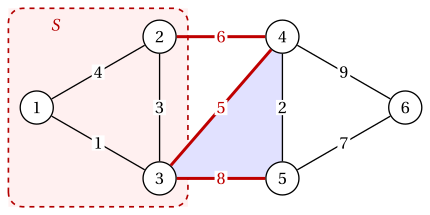
For the minimum spanning tree \(\tilde{F}\) of Example 2.2, the fundamental cut of \(\{3,4\}\) is \(\delta(\{1,2,3\})\), and the fundamental cycle of \(\{3,5\}\) is \(C(\tilde{F},\{3,5\})=3,4,5,3\).
A cycle crosses every cut an even number of times. Adding an edge to a spanning tree and removing any edge of the cycle it closes gives another spanning tree.