EX 15 — The music school timetable
Class: BIP · Links: if and only if, counts · Script: python/ex15_timetable.py
Difficulty: ★★★★☆ · Time: 45–60 min

One of the fifteen numerical models, of the assignment and scheduling family. It is the model where it is clearest what happens when a link is written one way only.
EX 15
A music school has to build its weekly timetable. There are two afternoons (Monday and Tuesday), each of two hours. \(2\) hours of guitar and \(2\) of violin must be placed. Every day must include lessons of at least two different instruments.
Each of the two teachers has one preference, to be respected if possible: the guitar teacher would rather not come on Tuesday, the violin teacher would rather not come on Monday. The number of hours violating a preference is to be minimised.
Model
Two families of binary variables:
- \(x_{dti} = 1\) if instrument \(i\) is taught at hour \(t\) of day \(d\);
- \(y_{di} = 1\) if instrument \(i\) appears on day \(d\).
They are eight columns for the lessons — one per triple day, hour, instrument — and four for the indicators.
The first two rows count the hours of each instrument. The next four say that at most one lesson happens in each slot. The two after that are the variety: at least two instruments a day. Then come the two directions of the link between lesson and indicator — eight rows for "if there is a lesson the indicator is on" and four for the converse — and at the bottom the two domain rows.
The hours to place are \(2+2 = 4\) and the slots are \(2 \cdot 2 = 4\): the two figures coincide, so every slot holds exactly one lesson.
The variety constraint written one way only is vacuous
It comes naturally to write only the link \(x_{dti} \le y_{di}\), and not its converse. With that direction alone the constraint \(\sum_i y_{di} \ge 2\) is always satisfied: it is enough to set \(y_{di} = 1\) without teaching. Solving the model as written, the solver puts all the guitar on Monday and all the violin on Tuesday — two days with a single instrument each — and declares \(0\) violated preferences, while the true optimum violates \(2\). The wrong model does not merely allow a bad timetable: it also announces a cost that does not exist.
The link \(x_{dti} \le y_{di}\) says "if there is a lesson then the indicator is on", not the converse. What is also needed is
that is the if and only if technique. It is the same mistake, and the same correction, as in problem 10.3: when a constraint counts indicators, the link must hold in both directions.
A feasible solution: the primal bound
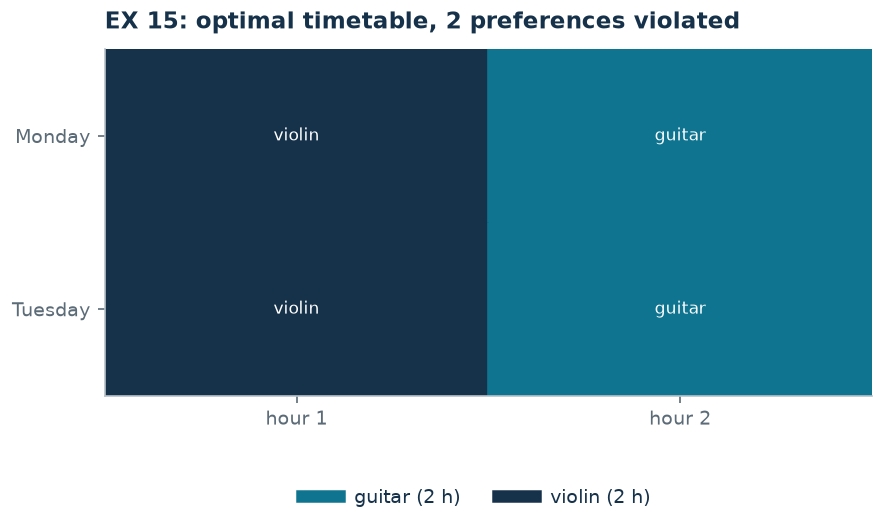
With the corrected model this timetable is built by hand (the asterisk marks a violated preference):
| hour 1 | hour 2 | |
|---|---|---|
| Monday | guitar | violin* |
| Tuesday | guitar* | violin |
Check: \(2\) hours of guitar and \(2\) of violin, two instruments on each day. The variety forces every day to hold both instruments, and every day disappoints one of them: two violated preferences, and one cannot do better.
The lower bound
All the costs \(c_{dti}\) are \(0\) or \(1\), so the objective is a sum of non-negative terms and \(z(\mathit{MILP}) \ge 0\) with no dual needed. The dual of the relaxation confirms that one cannot do better: one variable per family of primal constraints — \(\alpha_i\) free on the hours of each instrument, \(\beta_{dt} \le 0\) on the slots, \(\gamma_d \ge 0\) on the variety, \(\delta_{dti} \le 0\) and \(\varepsilon_{di} \le 0\) on the two directions of the link — and its optimum is \(0\).
Every row is a column of the primal: the first eight are the \(x_{dti}\), where the price of the instrument's hour plus that of the slot, corrected by the two directions of the link, cannot exceed the cost of the slot; the last four are the \(y_{di}\), where switching the indicator on costs the variety and is refunded by the link.
The timetable built by hand was already optimal, but the dual bound does not prove it: between \(0\) and \(2\) a gap is left that only branch and bound closes.
A count that is not a bound on the relaxation
Counting says more: every day holds both instruments, and on each day one of the two teachers would rather not be there; the violations are therefore at least two, and \(z(\mathit{MILP}) \ge 2\). That count, however, uses the integrality of the variables: on the relaxation it does not hold, and indeed \(z(\mathit{LP}) = 0\). It cannot take the place of \(\mathit{LB}\) in the chain of bounds, where every term must hold for the LP as well.
Code
The full script is
python/ex15_timetable.py;
the notebook is
notebooks/ex15_timetable.ipynb.
Show the complete script — python/ex15_timetable.py (241 lines)
"""EX 15 -- Timetable of a music school (family 11).

Four afternoons of three hours each, twelve lesson hours to place: the timetable
is a partition of the twelve slots. The model uses the count of the instruments
per day (technique 3.11), the precedences between consecutive hours (3.9) and the
soft constraints with penalties (3.13).

The starting model contains an instructive mistake: the link between the lesson
and the instrument indicator is written in one direction only, and the variety
constraint becomes empty. We expose it by solving the wrong model, then fix it.

On the data of the exercise, with the corrected model, there is a timetable that
violates no preference: the optimum is zero and the certificate is immediate,
because the costs are all non-negative. The two variants show what happens as soon
as the preferences get tighter: in the first one, counting the available slots
gives a positive lower bound; in the second, the model becomes infeasible.
"""
import gurobipy as gp
import pandas as pd
from gurobipy import GRB

from mip import (ammissibile, due_rilassamenti, frazione, nuovo_modello, risolvi,
                 valuta)
from stile import ARANCIO, BLU, GRIGIO, TEAL, intestazione, plt, salva_dati, salva_figura
from esteso import salva_modello

R = range

# ---------- 1. MODEL AND INSTANCE ----------
intestazione("EX 15. Music school timetable: minimising the violated preferences")
GIORNI = ["Monday", "Tuesday"]
ORE = [1, 2]
STRUM = ["guitar", "violin"]
h14 = [2, 2]                    # hours to place per instrument
nd, nt, ni = len(GIORNI), len(ORE), len(STRUM)
print(f"  Hours to place: {sum(h14)}; slots available: {nd} * {nt} = {nd * nt}.")
print("  The two figures coincide: every slot of the timetable holds exactly one lesson.")


def costi(extra_chitarra=()):
    """c[d][t][i] = 1 if the slot violates a preference of the teacher of i."""
    c = [[[0] * ni for _ in R(nt)] for _ in R(nd)]
    for d in R(nd):
        for t in R(nt):
            if d == 1:
                c[d][t][0] = 1                      # guitar: the teacher does not come on Tuesday
            if t in extra_chitarra:
                c[d][t][0] = 1                      # extra preferences of the guitar
            if d == 0:
                c[d][t][1] = 1                      # violin: the teacher does not come on Monday
    return c


c14 = costi()
salva_dati(pd.DataFrame([{"day": GIORNI[d], "hour": ORE[t], "instrument": STRUM[i],
                          "cost": c14[d][t][i]}
                         for d in R(nd) for t in R(nt) for i in R(ni)]), "ex15_costi")


def modello(h, c, minimo_strumenti=2, legame_doppio=True):
    """With `legame_doppio=False` one gets the model written one way only."""
    mod = nuovo_modello("timetable")
    x = mod.addVars(nd, nt, ni, vtype=GRB.BINARY, name="x")
    y = mod.addVars(nd, ni, vtype=GRB.BINARY, name="y")
    mod.setObjective(gp.quicksum(c[d][t][i] * x[d, t, i]
                                 for d in R(nd) for t in R(nt) for i in R(ni)), GRB.MINIMIZE)
    mod.addConstrs((x.sum("*", "*", i) == h[i] for i in R(ni)), name="hours")
    mod.addConstrs((x.sum(d, t, "*") <= 1 for d in R(nd) for t in R(nt)), name="slot")
    mod.addConstrs((y.sum(d, "*") >= minimo_strumenti for d in R(nd)), name="variety")
    mod.addConstrs((x[d, t, i] - y[d, i] <= 0 for d in R(nd) for t in R(nt) for i in R(ni)),
                   name="activate")
    if legame_doppio:
        # without this direction y_di may be 1 even if instrument i does not appear
        mod.addConstrs((y[d, i] - x.sum(d, "*", i) <= 0 for d in R(nd) for i in R(ni)),
                       name="activate_reverse")
    return mod, x, y


m14, x14, y14 = modello(h14, c14)
salva_modello(m14, "ex15_primale")


def duale(h, c, minimo_strumenti=2):
    """Dual of the LP relaxation (with x, y >= 0 only).

    One variable per family of primal constraints: alpha_i free on the hours of
    each instrument (an equality), beta_dt <= 0 on the slots, gamma_d >= 0 on the
    variety, delta_dti <= 0 and epsilon_di <= 0 on the two directions of the link
    between lesson and indicator.
    """
    d = nuovo_modello("dual_timetable")
    alpha = d.addVars(ni, lb=-GRB.INFINITY, name="alpha")
    beta = d.addVars(nd, nt, lb=-GRB.INFINITY, ub=0.0, name="beta")
    gamma = d.addVars(nd, name="gamma")
    delta = d.addVars(nd, nt, ni, lb=-GRB.INFINITY, ub=0.0, name="delta")
    epsilon = d.addVars(nd, ni, lb=-GRB.INFINITY, ub=0.0, name="epsilon")
    d.setObjective(gp.quicksum(h[i] * alpha[i] for i in R(ni))
                   + gp.quicksum(beta[dd, tt] for dd in R(nd) for tt in R(nt))
                   + minimo_strumenti * gamma.sum(), GRB.MAXIMIZE)
    d.addConstrs((alpha[i] + beta[dd, tt] + delta[dd, tt, i] - epsilon[dd, i] <= c[dd][tt][i]
                  for dd in R(nd) for tt in R(nt) for i in R(ni)), name="rc_x")
    d.addConstrs((gamma[dd] - gp.quicksum(delta[dd, tt, i] for tt in R(nt)) + epsilon[dd, i] <= 0
                  for dd in R(nd) for i in R(ni)), name="rc_y")
    return d


d14 = duale(h14, c14)
salva_modello(d14, "ex15_duale")


def stampa_orario(valore):
    for d in R(nd):
        riga = []
        for t in R(nt):
            chi = [STRUM[i] for i in R(ni) if valore(d, t, i) > 0.5]
            pen = [i for i in R(ni) if valore(d, t, i) > 0.5 and c14[d][t][i]]
            riga.append((chi[0] if chi else "-") + ("*" if pen else ""))
        print(f"    {GIORNI[d]:11s} " + " | ".join(f"{s:10s}" for s in riga))


# ---------- 2. A ONE-WAY VARIETY CONSTRAINT IS EMPTY ----------
intestazione("EX 15. Why the variety constraint needs both directions")
m_err, x_err, y_err = modello(h14, c14, legame_doppio=False)
z_err = risolvi(m_err)
print("  With the link x_dti <= y_di alone the solver returns this timetable:")
stampa_orario(lambda d, t, i: x_err[d, t, i].X)
strumenti_giorno = [sum(1 for i in R(ni) if any(x_err[d, t, i].X > 0.5 for t in R(nt)))
                    for d in R(nd)]
print("  Instruments actually present: "
      + ", ".join(f"{GIORNI[d]} {strumenti_giorno[d]}" for d in R(nd)))
poveri = [GIORNI[d] for d in R(nd) if strumenti_giorno[d] < 2]
print(f"  There are days with a single instrument ({', '.join(poveri)}), and yet the")
print("  constraint sum_i y_di >= 2 is satisfied: it is enough to set y_di = 1 without")
print("  teaching. The link x_dti <= y_di says \"if there is a lesson then the indicator is")
print("  on\", not the converse. One also needs y_di <= sum_t x_dti, that is technique 3.10")
print("  (if and only if).")
assert poveri, "the model without the second direction must allow single-instrument days"
salva_dati(pd.DataFrame({"day": GIORNI, "instruments_wrong_model": strumenti_giorno}),
           "ex15_varieta")

# ---------- 3. A FEASIBLE SOLUTION BUILT BY HAND ----------
# Rule: the guitar fills hours 2 and 3 of the first three days, avoiding hour 1 of
# Monday and Tuesday; the piano goes at hour 1 (never at hour 3); the harp on
# Thursday (never on Tuesday); the violin takes the remaining slots, avoiding hour 2
# of Wednesday and Thursday.
piano_orario = {
    (0, 0): 0, (0, 1): 1,
    (1, 0): 0, (1, 1): 1,
}
sol_eur = {f"x[{d},{t},{i}]": 1 for (d, t), i in piano_orario.items()}
for (d, t), i in piano_orario.items():
    sol_eur[f"y[{d},{i}]"] = 1
assert ammissibile(m14, sol_eur), sol_eur
ub14 = sum(c14[d][t][i] for (d, t), i in piano_orario.items())
print("  Timetable built by hand (the asterisk marks a violated preference):")
stampa_orario(lambda d, t, i: 1 if piano_orario.get((d, t)) == i else 0)
for i in R(ni):
    assert sum(1 for v in piano_orario.values() if v == i) == h14[i]
print(f"  Preferences violated: {ub14}  ->  ub = {frazione(ub14)}")

# ---------- 4. THE LOWER BOUND ----------
lb14 = 0.0
conteggio = nd       # one violated preference per day
print("  All the costs c_dti are 0 or 1, so the objective is a sum of non-negative terms:")
print("  lb = 0 with no dual needed.")
print("  Counting says more: every day holds both instruments, and on each day one of the")
print("  two teachers would rather not be there; the violations are therefore at least")
print(f"  {conteggio}. Careful: that count uses the integrality of the variables, not the")
print("  relaxation --- indeed z(LP) = 0 --- so it cannot take the place of lb in the chain")
print("  of bounds.")
zlp14, zlp14r, _ = due_rilassamenti(m14, d14)
print(f"    lb = {frazione(lb14)}   z(LP) = {frazione(zlp14)}   z(LP+) = {frazione(zlp14r)}")
assert lb14 <= zlp14 + 1e-9 <= zlp14r + 1e-9

# ---------- 5. OPTIMUM OF THE MILP ----------
z14 = risolvi(m14)
print("  Optimal timetable found by the solver:")
stampa_orario(lambda d, t, i: x14[d, t, i].X)
print(f"  ub = {frazione(ub14)}   lb = {frazione(lb14)}   z(LP) = {frazione(zlp14)}   "
      f"z(LP+) = {frazione(zlp14r)}   z(MILP) = {frazione(z14)}")
salva_dati(pd.DataFrame([{"problem": "EX 15 timetable", "ub": ub14, "lb": lb14,
                          "z_lp": zlp14, "z_lp_rafforzato": zlp14r, "z_milp": z14}]),
           "ex15_bound")
salva_dati(pd.DataFrame([{"day": GIORNI[d], "hour": ORE[t], "instrument": STRUM[i]}
                         for d in R(nd) for t in R(nt) for i in R(ni)
                         if x14[d, t, i].X > 0.5]), "ex15_ottimo")
assert lb14 <= z14 and abs(z14 - ub14) <= 1e-9, (lb14, z14, ub14)
assert conteggio <= z14
print("  The hand-built timetable was already optimal, but neither bound proves it:")
print(f"  between {frazione(lb14)} and {frazione(ub14)} a gap is left that only branch and")
print("  bound closes.")

# ---------- 6. VARIANTS ----------
intestazione("EX 15. What happens if the preferences get tighter")
# 14a: the guitar teacher would rather not teach at hours 1 and 2 of any day
c_a = costi(extra_chitarra=(1,))
libere = sum(1 for d in R(nd) for t in R(nt) if c_a[d][t][0] == 0)
print("  14a. The guitar teacher would rather not teach at hour 2 of any day either.")
print(f"       Only {libere} slots stay penalty-free for the guitar, but the hours to place")
print(f"       are {h14[0]}: at least {h14[0] - libere} lessons will violate the preference.")
print("       It is a lower bound read off the data alone.")
m, x, y = modello(h14, c_a)
z_a = risolvi(m)
print(f"       z = {frazione(z_a)}, which matches the bound: the count is exact.")
assert z_a >= h14[0] - libere - 1e-9
# 14b: every day must have at least three different instruments
print("  14b. Every day must have at least three different instruments.")
print("       With three hours a day and three different instruments the guitar can take at")
print(f"       most one slot a day, that is {nd} in total, but the guitar hours are {h14[0]}.")
print("       The model is infeasible, and one proves it by counting.")
m, x, y = modello(h14, c14, minimo_strumenti=3)
m.optimize()
stato = {GRB.INFEASIBLE: "INFEASIBLE", GRB.OPTIMAL: "OPTIMAL"}.get(m.Status, str(m.Status))
print(f"       Gurobi returns the status {stato}, as expected.")
assert m.Status == GRB.INFEASIBLE
salva_dati(pd.DataFrame([{"variant": "14a. guitar free only at hour 3", "z": z_a},
                         {"variant": "14b. three instruments a day", "z": float("nan")}]),
           "ex15_varianti")

# ---------- 7. FIGURE ----------
fig, ax = plt.subplots(figsize=(6.6, 3.0))
colori = {0: TEAL, 1: BLU, 2: ARANCIO, 3: GRIGIO}
for d in R(nd):
    for t in R(nt):
        for i in R(ni):
            if x14[d, t, i].X > 0.5:
                ax.add_patch(plt.Rectangle((t, nd - 1 - d), 1, 1, color=colori[i]))
                ax.annotate(STRUM[i], (t + 0.5, nd - 1 - d + 0.5), ha="center", va="center",
                            fontsize=8, color="white")
for i in R(ni):
    ax.plot([], [], color=colori[i], lw=6, label=f"{STRUM[i]} ({h14[i]} h)")
ax.set_xlim(0, nt)
ax.set_ylim(0, nd)
ax.set_xticks([t + 0.5 for t in R(nt)])
ax.set_xticklabels([f"hour {o}" for o in ORE])
ax.set_yticks([nd - 1 - d + 0.5 for d in R(nd)])
ax.set_yticklabels(GIORNI)
ax.set_title(f"EX 15: optimal timetable, {frazione(z14)} preferences violated")
ax.legend(fontsize=7, loc="upper center", bbox_to_anchor=(0.5, -0.12), ncol=4)
salva_figura(fig, "ex15_orario")
print("Done.")