EX 1 — The eight-seat van
Class: BIP · Links: if-then, capacity · Script: python/ex01_van.py
Difficulty: ★☆☆☆☆ · Time: 30–45 min

One of the fifteen numerical models: the smallest of the course, and the one that shows the whole path in two pages — model, primal bound, dual bound, optimum.
EX 1
A tour operator rents an eight-seat van to take tourists to a scenic spot. On a given day four groups show up, of \(2\), \(3\), \(4\) and \(5\) people. Since the van cannot take them all at once, the operator asks each group (whose members do not want to be split) to make an offer: the four groups offer \(30\), \(50\), \(80\) and \(70\) euros. For organisational reasons at most two groups can be accepted; moreover, if group 2 is accepted then group 4 must be accepted too. The revenue is to be maximised.
| group \(j\) | 1 | 2 | 3 | 4 |
|---|---|---|---|---|
| people | 2 | 3 | 4 | 5 |
| offer (€) | 30 | 50 | 80 | 70 |
Model
There are four groups: one binary variable per group,
The data are all specific to the instance — the sizes, the offers, and above all the implication "if 2, then 4", which links two named groups — so the model is written directly on the data, one column per variable:
The first constraint is the capacity of the van, the second the limit on the number of groups, the third is the implication \(x_2 \Rightarrow x_4\) in the if-then form \(x_2 - x_4 \le 0\). The last row defines the variables of the model.
Constructive heuristic: the primal bound
This is a maximisation, so a feasible solution gives a lower bound. The groups are scanned by decreasing offer and a group is accepted only if all constraints remain satisfied, the implication included. The order is \(3, 4, 2, 1\):
- group 3 (offer \(80\)): accepted — \(4\) seats used, \(1\) group;
- group 4 (offer \(70\)): rejected, it would need \(9\) seats out of \(8\);
- group 2 (offer \(50\)): rejected, it would force group 4 in as well, and the groups would become three;
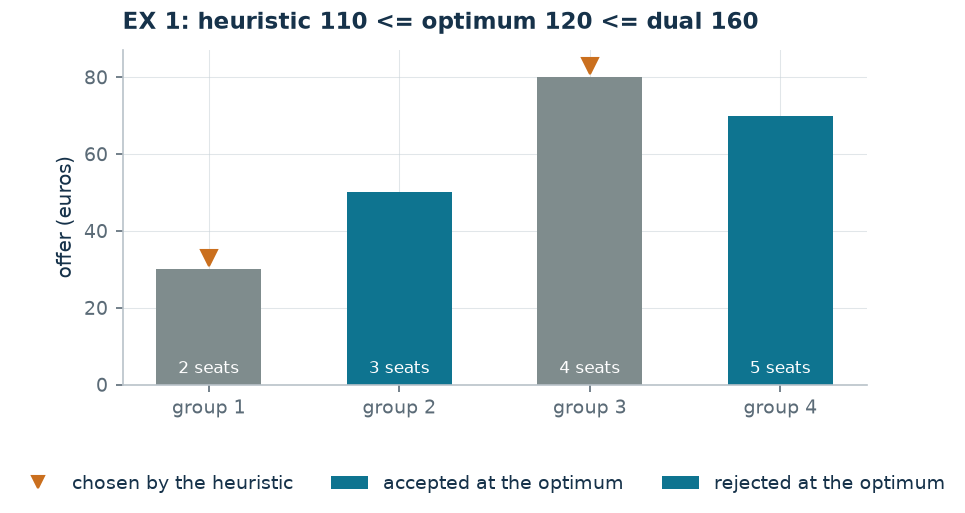
- group 1 (offer \(30\)): accepted — \(6\) seats used, \(2\) groups.
The solution built is \(\bar x = (1, 0, 1, 0)\), of value
LP relaxation and dual: the dual bound
The LP relaxation replaces the binary domain with non-negativity alone. The dual attaches a non-negative variable to each of the three constraints: \(\alpha\) to the seats, \(\beta\) to the number of groups, \(\gamma\) to the implication. The four columns of the primal give four dual constraints:
A dual solution by hand. Only the seats are priced and the other two multipliers are set to zero, \(\bar\beta = 0\) and \(\bar\gamma = 0\). The four dual constraints become
and the smallest \(\alpha\) satisfying all of them is
of value \(\mathit{UB} = 8 \cdot 20 = 160\). The reading is "a seat is worth as much as the group that pays best for it".
Optimum and comparison
The optimum accepts groups \(2\) and \(4\), filling exactly the eight seats: \(\tilde x = (0, 1, 0, 1)\) and \(z(\mathit{MILP}) = 50 + 70 = 120\).
| value | what it is | |
|---|---|---|
| \(\mathit{LB}\) | 110 | heuristic solution |
| \(\mathit{UB}\) | 160 | dual bound by hand |
| \(z(\mathit{LP})\) | 160 | relaxation without the bounds |
| \(z(\mathit{LP}^+)\) | 140 | relaxation with the bounds |
| \(z(\mathit{MILP})\) | 120 | optimum of the MILP |
The heuristic gap is \(|110 - 120|/120 = 8.3\%\). The one certified by the two bounds is known before solving, and for that very reason it cannot have \(z(\mathit{MILP})\) as its denominator: in absolute terms \(\mathit{UB} - \mathit{LB} = 50\), as a percentage \(|160 - 110|/160 = 31.3\%\) in the solver's convention. The dual solution built by hand is optimal for the relaxation without the bounds: adding \(x_j \le 1\) brings the relaxation down to \(140\), closer to the optimum.
Which constraint really bites
Removing one constraint at a time: without the limit on the number of groups the optimum stays \(120\) (groups 2 and 4), without the implication it rises to \(130\) (groups 2 and 3). It is the implication that costs \(10\) euros, not the limit on the number of groups — which in this instance the optimum already satisfies.
Code
The full script is
python/ex01_van.py;
the notebook is
notebooks/ex01_van.ipynb.
Show the complete script — python/ex01_van.py (160 lines)
"""EX 1 -- An eight-seat van: which group of tourists to accept (family 10).

A knapsack with two extra constraints: at most two groups accepted, and the
implication "if I accept group 2 I must also accept group 4". It is the chance to
see, on a tiny case, the three techniques of chapter 3 that are needed here:
capacity (3.1), counting (3.4) and logical precedence (3.9).
"""
import gurobipy as gp
import pandas as pd
from gurobipy import GRB

from mip import (ammissibile, due_rilassamenti, frazione, nuovo_modello, registra_bound,
                 risolvi, stampa_lp, valuta)
from stile import ARANCIO, GRIGIO, TEAL, intestazione, plt, salva_dati, salva_figura
from esteso import salva_modello

R = range

# ---------- 1. MODEL AND INSTANCE ----------
intestazione("EX 1. An eight-seat van: which groups to accept")
a0 = [2, 3, 4, 5]          # people in each group
p0 = [30, 50, 80, 70]      # offer in euros
K0 = 8                     # seats of the van
G0 = 2                     # at most two groups
IMP = (1, 3)               # accepting group 2 (index 1) forces group 4 (index 3)
n0 = len(a0)
salva_dati(pd.DataFrame({"group": R(1, n0 + 1), "people": a0, "offer": p0}), "ex01_dati")


def modello(a, p, K, G, imp):
    n = len(a)
    m = nuovo_modello("van")
    x = m.addVars(n, vtype=GRB.BINARY, name="x")
    m.setObjective(gp.quicksum(p[j] * x[j] for j in R(n)), GRB.MAXIMIZE)
    m.addConstr(gp.quicksum(a[j] * x[j] for j in R(n)) <= K, name="seats")
    m.addConstr(gp.quicksum(x[j] for j in R(n)) <= G, name="groups")
    m.addConstr(x[imp[0]] - x[imp[1]] <= 0, name="implication")
    return m, x


def duale(a, p, K, G, imp):
    """min K alpha + G beta  s.t.  a_j alpha + beta (+gamma if j=2, -gamma if j=4) >= p_j."""
    n = len(a)
    d = nuovo_modello("dual_van")
    alpha = d.addVar(name="alpha")     # seats
    beta = d.addVar(name="beta")       # number of groups
    gamma = d.addVar(name="gamma")     # implication
    d.setObjective(K * alpha + G * beta, GRB.MINIMIZE)
    for j in R(n):
        segno = 1 if j == imp[0] else (-1 if j == imp[1] else 0)
        d.addConstr(a[j] * alpha + beta + segno * gamma >= p[j], name=f"rc[{j}]")
    return d


m0, x0 = modello(a0, p0, K0, G0, IMP)
salva_modello(m0, "ex01_primale")
print("  The model of the instance:")
stampa_lp(m0)

# ---------- 2. CONSTRUCTIVE HEURISTIC (LOWER BOUND) ----------
# constructive heuristic on the decreasing offer: a group is accepted only if all the constraints stay
# satisfied, the implication included (group 2 enters only with group 4 already in)
def euristica(a, p, K, G, imp):
    n = len(a)
    x = [0] * n
    passi = []
    for j in sorted(R(n), key=lambda j: (-p[j], j)):
        x[j] = 1
        posti = sum(a[k] * x[k] for k in R(n))
        gruppi = sum(x)
        ok_imp = x[imp[0]] <= x[imp[1]]
        motivi = []
        if posti > K:
            motivi.append(f"{posti} seats would be needed out of {K}")
        if gruppi > G:
            motivi.append(f"there would be {gruppi} groups out of {G}")
        if not ok_imp:
            motivi.append(f"group {imp[0] + 1} forces accepting group {imp[1] + 1}")
        if motivi:
            x[j] = 0
            passi.append(f"group {j + 1} (offer {p[j]}): rejected, " + "; ".join(motivi))
        else:
            passi.append(f"group {j + 1} (offer {p[j]}): accepted "
                         f"({posti} seats taken, {gruppi} groups)")
    return x, passi


x_eur, passi = euristica(a0, p0, K0, G0, IMP)
for k, riga in enumerate(passi, 1):
    print(f"  Step {k}. {riga}")
lb0 = sum(p0[j] * x_eur[j] for j in R(n0))
sol_eur = {f"x[{j}]": x_eur[j] for j in R(n0)}
assert ammissibile(m0, sol_eur), sol_eur
print(f"  Heuristic solution: groups {[j + 1 for j in R(n0) if x_eur[j]]}   "
      f"lb = {frazione(lb0)}")

# ---------- 3. LP RELAXATION AND DUAL (UPPER BOUND) ----------
d0 = duale(a0, p0, K0, G0, IMP)
salva_modello(d0, "ex01_duale")
# recipe: only the seats are priced (beta = gamma = 0), at the highest price per seat
alpha_min = max(p0[j] / a0[j] for j in R(n0))
mano = {"alpha": alpha_min, "beta": 0.0, "gamma": 0.0}
ub0, viol = valuta(d0, mano)
assert viol <= 1e-9, viol
print("  Hand-built dual: beta = gamma = 0 and alpha = max_j p_j / a_j (a seat is worth what")
print("  the group paying best pays for it), so every constraint a_j alpha >= p_j holds:")
for j in R(n0):
    print(f"    group {j + 1}: {p0[j]} / {a0[j]} = {frazione(p0[j] / a0[j])}")
print(f"  alpha = {frazione(alpha_min)}  ->  ub = {K0} * alpha = {frazione(ub0)}")
zlp0, zlp0r, _ = due_rilassamenti(m0, d0)

# ---------- 4. OPTIMUM OF THE MILP AND BOUND TABLE ----------
z0 = risolvi(m0)
acc = [j + 1 for j in R(n0) if x0[j].X > 0.5]
print(f"  Optimal solution: groups {acc}, "
      f"{int(sum(a0[j] * x0[j].X for j in R(n0)))} seats taken out of {K0}, revenue "
      f"{frazione(z0)}")
riga = registra_bound("EX 1 van", ub0, lb0, zlp0, zlp0r, z0, senso="max")
salva_dati(pd.DataFrame([riga]), "ex01_bound")
assert lb0 <= z0 <= zlp0r <= zlp0 <= ub0 + 1e-9

# ---------- 5. WHAT EACH CONSTRAINT CONTRIBUTES ----------
intestazione("EX 1. The contribution of each constraint")
prove = []
for nome, togli in [("complete model", []), ("without the limit on groups", ["groups"]),
                    ("without the implication", ["implication"]),
                    ("without both", ["groups", "implication"])]:
    m, x = modello(a0, p0, K0, G0, IMP)
    m.update()
    for c in list(m.getConstrs()):
        if c.ConstrName in togli:
            m.remove(c)
    m.update()
    z = risolvi(m)
    scelti = [j + 1 for j in R(n0) if x[j].X > 0.5]
    print(f"  {nome:32s} z = {frazione(z):>4}   groups {scelti}")
    prove.append({"variant": nome, "z": z, "groups": " ".join(map(str, scelti))})
salva_dati(pd.DataFrame(prove), "ex01_vincoli")
assert prove[0]["z"] <= prove[1]["z"] and prove[0]["z"] <= prove[2]["z"]

# ---------- 6. FIGURE ----------
fig, ax = plt.subplots(figsize=(6.4, 2.9))
idx = list(R(n0))
colori = [TEAL if x0[j].X > 0.5 else GRIGIO for j in idx]
ax.bar(idx, p0, 0.55, color=colori)
for j in idx:
    if x_eur[j]:
        ax.plot(j, p0[j] + 3, marker="v", color=ARANCIO, ms=8)
    ax.annotate(f"{a0[j]} seats", (j, 3), ha="center", fontsize=8, color="white")
ax.plot([], [], marker="v", ls="", color=ARANCIO, label="chosen by the heuristic")
ax.bar([], [], color=TEAL, label="accepted at the optimum")
ax.bar([], [], color=GRIGIO, label="rejected at the optimum")
ax.set_xticks(idx)
ax.set_xticklabels([f"group {j + 1}" for j in idx])
ax.set_ylabel("offer (euros)")
ax.set_title(f"EX 1: heuristic {frazione(lb0)} <= optimum {frazione(z0)} <= dual "
             f"{frazione(ub0)}")
ax.legend(fontsize=8, loc="upper left")
salva_figura(fig, "ex01_ottimo")
print("Done.")