EX 11 — Shoes with a minimum production threshold
Class: MILP · Links: minimum lot, activation · Script: python/ex11_shoes_threshold.py
Difficulty: ★★☆☆☆ · Time: 30–45 min

One of the fifteen numerical models, of the production planning family.
EX 11
A shoe factory produces boots, loafers and walking shoes. The table gives the resources for a pair, the minimum quantity to produce if the type is produced, and the selling price:
| Type | leather (g) | hours | nails | minimum | price |
|---|---|---|---|---|---|
| boots | 850 | 3 | 20 | 100 | 150 |
| loafers | 600 | 2 | 15 | 200 | 120 |
| walking shoes | 700 | 2.5 | 20 | 150 | 130 |
There are \(120\,000\) grams of leather, \(7000\) machine hours and \(40\,000\) nails available. The revenue is to be maximised.
Model
Two families of variables are needed, one per type of shoe:
- \(x_j\) — pairs produced of type \(j\), integer and non-negative;
- \(y_j = 1\) if type \(j\) is produced, \(0\) otherwise.
It is the same setup as EX 6 — minimum lot plus activation — with three resources and no bonus. The big-Ms read off the data are \(M = (141, 200, 171)\), all limited by the leather.
The first three rows are the resources — leather, hours and nails — and each one forbids using more than there is. The next three are the minimum thresholds: if a type is produced, at least \(100\), \(200\) or \(150\) pairs of it are. The three after that are the activations with the big-M read off the data: with \(y_j = 0\) production is pinned to zero. The last two rows declare the productions integer and the choices binary.
When the threshold coincides with the maximum
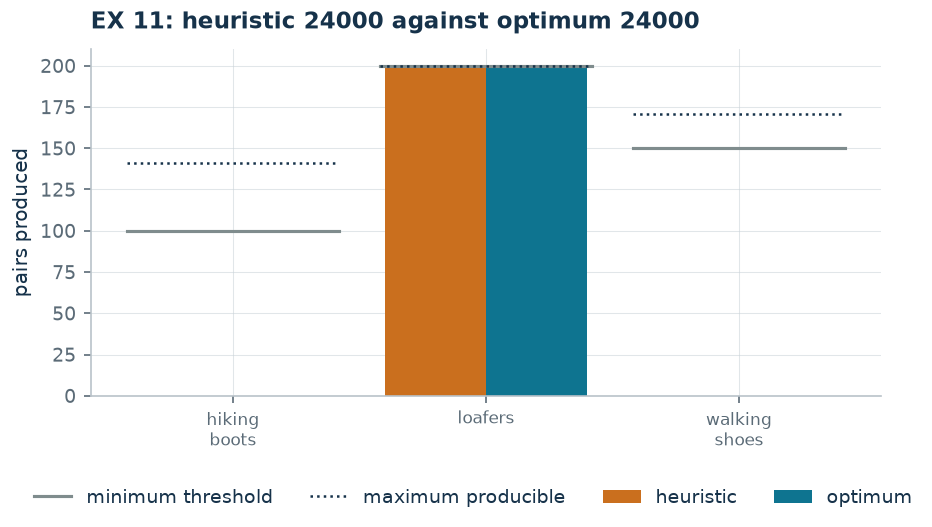
For loafers threshold and maximum coincide (\(200\)): the variable \(x_2\) is in fact a binary multiplied by \(200\). It is not a modelling mistake, it is a consequence of the data — and it is worth noticing, because it makes the minimum lot inactive.
The model of the instance, written out in full:
Constructive heuristic: the primal bound
This is a maximisation. The types are scanned by decreasing price per gram of leather: \(3/17\) for boots, \(1/5\) for loafers, \(13/70\) for walking shoes. Starting from the loafers, \(200\) of them are produced and the leather runs out exactly. No other type reaches its own threshold.
LP relaxation and dual: the dual bound
A dual solution by hand. With \(\ell = \mu = 0\) and a single resource priced:
The best bound is the one from the leather: \(\mathit{UB} = 24\,000\).
Optimum and comparison
| \(\mathit{LB}\) | \(\mathit{UB}\) | \(z(\mathit{LP})\) | \(z(\mathit{LP}^+)\) | \(z(\mathit{MILP})\) |
|---|---|---|---|---|
| 24 000 | 24 000 | 24 000 | 24 000 | 24 000 |
All the numbers coincide: the sandwich closes at once. The reason is that a single resource is tight, the leather, and the type that gets the most out of it per gram exhausts it on its own while staying within its own threshold and its own maximum. It is a didactically useful case precisely because it is easy: it shows that when the dual bound coincides with a feasible solution, the problem is over.
Two variations that change the picture
Doubling the thresholds, the loafers' becomes \(400\) pairs while the leather allows at most \(200\): no type reaches its own threshold any more and production stops altogether, \(z(\mathit{MILP}) = 0\).
Raising the leather to \(200\,000\) grams gives \(333\) loafers for \(39\,960\) euros, and the big-Ms must be recomputed: they become \((235, 333, 285)\). Big-Ms are not constants of the model, but functions of the data of the instance.
Code
The full script is
python/ex11_shoes_threshold.py;
the notebook is
notebooks/ex11_shoes_threshold.ipynb.
Show the complete script — python/ex11_shoes_threshold.py (186 lines)
"""EX 11 -- Shoes with a minimum production threshold (family 9).

Three resources, three types of shoe and a threshold per type: either at least
q_j pairs are produced, or none. It is the semicontinuous variable of technique
3.3, with the big-M chosen naturally as the largest producible amount of that type
alone.
"""
import gurobipy as gp
import pandas as pd
from gurobipy import GRB

from mip import (ammissibile, due_rilassamenti, frazione, nuovo_modello, registra_bound,
                 risolvi, valuta)
from stile import ARANCIO, BLU, GRIGIO, TEAL, intestazione, plt, salva_dati, salva_figura
from esteso import salva_modello

R = range

# ---------- 1. MODEL AND INSTANCE ----------
intestazione("EX 11. Shoes: three resources and a minimum production threshold")
NOMI = ["hiking boots", "loafers", "walking shoes"]
RISORSE = ["leather (g)", "machine hours", "nails"]
a11 = [[850, 600, 700],       # leather per pair
       [3, 2, 2.5],           # machine hours per pair
       [20, 15, 20]]          # nails per pair
b11 = [120000, 7000, 40000]
p11 = [150, 120, 130]         # selling price per pair
q11 = [100, 200, 150]         # minimum threshold
ns, nr = len(p11), len(b11)
M11 = [min(int(b11[i] // a11[i][j]) for i in R(nr)) for j in R(ns)]
salva_dati(pd.DataFrame({"type": NOMI, "leather": a11[0], "hours": a11[1], "nails": a11[2],
                         "price": p11, "threshold": q11, "maximum": M11}), "ex11_dati")
print("  Largest producible amount of a single type (the natural big-M):")
for j in R(ns):
    quale = min(R(nr), key=lambda i: b11[i] / a11[i][j])
    print(f"    {NOMI[j]:16s} {M11[j]} pairs, limited by {RISORSE[quale]}")
print("  For the loafers threshold and maximum coincide (200): either exactly 200 are made,")
print("  or none. The variable is in fact a binary multiplied by 200.")


def modello(a, b, p, q, M):
    ns, nr = len(p), len(b)
    m = nuovo_modello("shoes_threshold")
    x = m.addVars(ns, vtype=GRB.INTEGER, name="x")
    y = m.addVars(ns, vtype=GRB.BINARY, name="y")
    m.setObjective(gp.quicksum(p[j] * x[j] for j in R(ns)), GRB.MAXIMIZE)
    m.addConstrs((gp.quicksum(a[i][j] * x[j] for j in R(ns)) <= b[i] for i in R(nr)),
                 name="resource")
    m.addConstrs((x[j] - q[j] * y[j] >= 0 for j in R(ns)), name="threshold")
    m.addConstrs((x[j] - M[j] * y[j] <= 0 for j in R(ns)), name="activate")
    return m, x, y


def duale(a, b, p, q, M):
    """min sum_i b_i pi_i  with pi >= 0, lam <= 0 (threshold, written >=) and mu >= 0.

    Columns:  x_j: sum_i a_ij pi_i + lam_j + mu_j >= p_j
              y_j: -q_j lam_j - M_j mu_j >= 0
    """
    ns, nr = len(p), len(b)
    d = nuovo_modello("dual_shoes_threshold")
    pi = d.addVars(nr, name="pi")
    lam = d.addVars(ns, lb=-GRB.INFINITY, ub=0.0, name="lam")
    mu = d.addVars(ns, name="mu")
    d.setObjective(gp.quicksum(b[i] * pi[i] for i in R(nr)), GRB.MINIMIZE)
    d.addConstrs((gp.quicksum(a[i][j] * pi[i] for i in R(nr)) + lam[j] + mu[j] >= p[j]
                  for j in R(ns)), name="rcx")
    d.addConstrs((-q[j] * lam[j] - M[j] * mu[j] >= 0 for j in R(ns)), name="rcy")
    return d


m11, x11, y11 = modello(a11, b11, p11, q11, M11)
salva_modello(m11, "ex11_primale")

# ---------- 2. CONSTRUCTIVE HEURISTIC (LOWER BOUND) ----------
# constructive heuristic on the price per gram of leather (the tightest resource), respecting the
# threshold: a type enters only if at least q_j pairs can be made
def euristica(a, b, p, q):
    ns, nr = len(p), len(b)
    res = [float(v) for v in b]
    x = [0] * ns
    passi = ["price per gram of leather: "
             + ", ".join(f"{NOMI[j]} {frazione(p[j] / a[0][j])}" for j in R(ns))]
    for j in sorted(R(ns), key=lambda j: (-p[j] / a[0][j], j)):
        if any(a[i][j] * q[j] > res[i] + 1e-9 for i in R(nr)):
            passi.append(f"{NOMI[j]}: the threshold {q[j]} cannot be reached, skipped")
            continue
        n = min(int(res[i] // a[i][j]) for i in R(nr))
        x[j] = n
        for i in R(nr):
            res[i] -= a[i][j] * n
        passi.append(f"{NOMI[j]}: {n} pairs (threshold {q[j]}); resources left "
                     + ", ".join(f"{RISORSE[i]} {frazione(res[i])}" for i in R(nr)))
    return x, passi


x_e, passi = euristica(a11, b11, p11, q11)
for k, riga in enumerate(passi, 1):
    print(f"  Step {k}. {riga}")
lb11 = sum(p11[j] * x_e[j] for j in R(ns))
sol_eur = ({f"x[{j}]": x_e[j] for j in R(ns)}
           | {f"y[{j}]": 1 if x_e[j] else 0 for j in R(ns)})
assert ammissibile(m11, sol_eur), sol_eur
print("  Heuristic solution: " + ", ".join(f"{x_e[j]} {NOMI[j]}" for j in R(ns) if x_e[j])
      + f"   lb = {frazione(lb11)}")

# ---------- 3. LP RELAXATION AND DUAL (UPPER BOUND) ----------
d11 = duale(a11, b11, p11, q11, M11)
salva_modello(d11, "ex11_duale")
migliore, mano, scelta = float("inf"), None, None
for i in R(nr):
    prezzo = max(p11[j] / a11[i][j] for j in R(ns))
    prova = {f"pi[{i}]": prezzo}
    val, viol = valuta(d11, prova)
    if viol <= 1e-9 and val < migliore:
        migliore, mano, scelta = val, prova, i
ub11, viol = valuta(d11, mano)
assert viol <= 1e-9, viol
print("  Hand-built dual: lam = mu = 0 (the threshold is not priced) and a single resource")
print("  priced, at the highest unit price among the types of shoe:")
for i in R(nr):
    prezzo = max(p11[j] / a11[i][j] for j in R(ns))
    print(f"    {RISORSE[i]:16s} price {frazione(prezzo):>8}  ->  bound "
          f"{frazione(b11[i] * prezzo)}")
print(f"  The better bound comes from: {RISORSE[scelta]}.  ub = {frazione(ub11)}")
zlp11, zlp11r, _ = due_rilassamenti(m11, d11)

# ---------- 4. OPTIMUM OF THE MILP ----------
z11 = risolvi(m11)
print("  Optimal solution: " + ", ".join(f"{int(x11[j].X)} {NOMI[j]}" for j in R(ns)
                                         if x11[j].X > 0.5))
for i in R(nr):
    usato = sum(a11[i][j] * x11[j].X for j in R(ns))
    print(f"    {RISORSE[i]}: {frazione(usato)} out of {b11[i]} "
          f"({'saturated' if abs(usato - b11[i]) < 1e-6 else 'with slack'})")
riga = registra_bound("EX 11 shoes with threshold", ub11, lb11, zlp11, zlp11r, z11,
                      senso="max")
salva_dati(pd.DataFrame([riga]), "ex11_bound")
assert lb11 <= z11 <= zlp11 <= ub11 + 1e-9

# ---------- 5. WHAT THE THRESHOLD COSTS ----------
intestazione("EX 11. The price of the threshold and the price of integrality")
m, x, y = modello(a11, b11, p11, [0] * ns, M11)
z_senza = risolvi(m)
print(f"  ub = lb = z(LP) = z(LP+) = z(MILP) = {frazione(z11)}: on this instance the sandwich")
print("  closes immediately. The reason is that a single resource is tight, the leather, and")
print("  the type that gets the most out of it per gram (the loafers, at 1/5 of a euro per")
print("  gram) uses it up on its own, staying within its own threshold and its own maximum.")
print(f"  Without thresholds the optimum stays {frazione(z_senza)}: here the threshold costs")
print("  nothing.")
varianti = {"without thresholds": z_senza}
m, x, y = modello(a11, b11, p11, [2 * v for v in q11], M11)
z_a = risolvi(m)
varianti["11a. thresholds doubled"] = z_a
print(f"  11a. With the thresholds doubled: z = {frazione(z_a)}. The threshold of the loafers")
print(f"       becomes 400 pairs, but the leather allows at most {M11[1]}: no type reaches")
print("       its own threshold any more and production stops altogether.")
b_alt = [200000, b11[1], b11[2]]
M_alt = [min(int(b_alt[i] // a11[i][j]) for i in R(nr)) for j in R(ns)]
m, x, y = modello(a11, b_alt, p11, q11, M_alt)
z_b = risolvi(m)
varianti["11b. leather at 200000 g"] = z_b
print(f"  11b. With 200000 g of leather: z = {frazione(z_b)}, that is "
      + ", ".join(f"{int(x[j].X)} {NOMI[j]}" for j in R(ns) if x[j].X > 0.5))
print(f"       The maximum producible grows with the resource: the big-Ms must be recomputed "
      f"({M_alt}).")
salva_dati(pd.DataFrame({"variant": list(varianti), "z": list(varianti.values())}),
           "ex11_varianti")

# ---------- 6. FIGURE ----------
fig, ax = plt.subplots(figsize=(6.8, 3.0))
idx = list(R(ns))
ax.bar([j - 0.2 for j in idx], [x_e[j] for j in idx], 0.4, color=ARANCIO, label="heuristic")
ax.bar([j + 0.2 for j in idx], [x11[j].X for j in idx], 0.4, color=TEAL, label="optimum")
for j in idx:
    ax.plot([j - 0.42, j + 0.42], [q11[j], q11[j]], color=GRIGIO, lw=1.5)
    ax.plot([j - 0.42, j + 0.42], [M11[j], M11[j]], color=BLU, lw=1.2, ls=":")
ax.plot([], [], color=GRIGIO, lw=1.5, label="minimum threshold")
ax.plot([], [], color=BLU, lw=1.2, ls=":", label="maximum producible")
ax.set_xticks(idx)
ax.set_xticklabels([n.replace(" ", "\n") for n in NOMI], fontsize=8)
ax.set_ylabel("pairs produced")
ax.set_title(f"EX 11: heuristic {frazione(lb11)} against optimum {frazione(z11)}")
ax.legend(fontsize=8)
salva_figura(fig, "ex11_produzione")
print("Done.")