EX 13 — The emergency room shifts
Class: ILP · Links: set covering, integer counts · Script: python/ex13_shifts.py
Difficulty: ★★★☆☆ · Time: 30–45 min

One of the fifteen numerical models, of the location and covering family.
EX 13
In an emergency room the number of full-time staff needed is given for every day of the week:
| Day | Mon | Tue | Wed | Thu | Fri | Sat | Sun |
|---|---|---|---|---|---|---|---|
| staff | 10 | 8 | 12 | 9 | 9 | 7 | 8 |
A full-time member of staff can be replaced by two half-time ones. The shift pattern is fixed: four consecutive full days, then one half-time day, then two days off. The weekly cost of a member of staff depends on the days worked: \(100\) euros for each weekday, \(110\) for Saturday and \(130\) for Sunday; these costs are halved on half-time days. The weekly plan of minimum cost is wanted.
Model
There are \(n = 7\) shift patterns, one per starting day, and \(m = 7\) days to cover, with requirement \(b_i\). With \(x_j\) the number of staff following pattern \(j\) (integer variables), \(c_j\) the weekly cost of pattern \(j\) and \(a_{ij}\) the share of day \(i\) covered by pattern \(j\) (\(1\) on the four full days, \(1/2\) on the half-time day, \(0\) on the two rest days):
A set covering with coefficients \(1\) and \(1/2\) and integer, non-binary variables. The costs are computed from the data:
| Pattern | full days | half-time | cost |
|---|---|---|---|
| 1 (starts Mon) | Mon, Tue, Wed, Thu | Fri | 450 |
| 2 (starts Tue) | Tue, Wed, Thu, Fri | Sat | 455 |
| 3 (starts Wed) | Wed, Thu, Fri, Sat | Sun | 475 |
| 4 (starts Thu) | Thu, Fri, Sat, Sun | Mon | 490 |
| 5 (starts Fri) | Fri, Sat, Sun, Mon | Tue | 490 |
| 6 (starts Sat) | Sat, Sun, Mon, Tue | Wed | 490 |
| 7 (starts Sun) | Sun, Mon, Tue, Wed | Thu | 480 |
For instance pattern 3 costs \(100 + 100 + 100 + 110\) for the four full days (Wed, Thu, Fri, Sat) plus \(130/2 = 65\) for the half-time Sunday, \(475\) in all.
The model of the instance, written out in full:
Constructive heuristic: the primal bound
This is a minimisation, so a feasible solution gives an upper bound. Covering heuristic: while some requirement is uncovered, one copy of the pattern with the lowest ratio
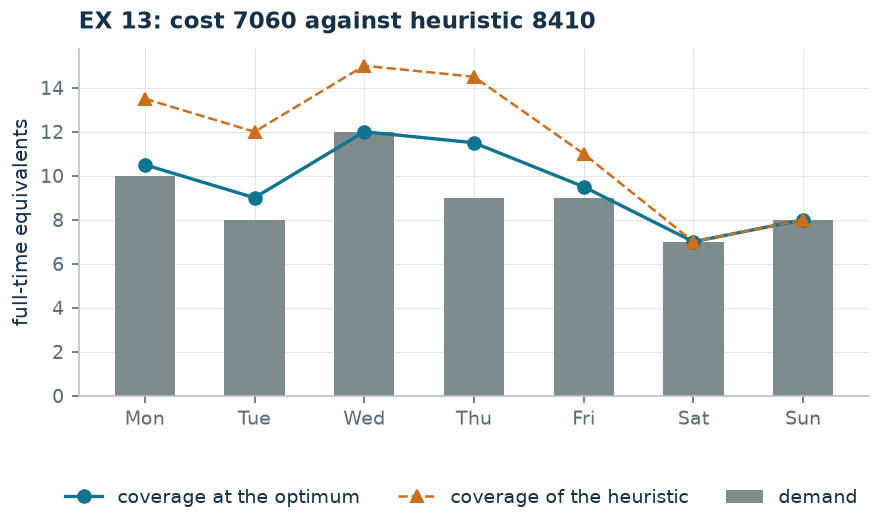
is added. The ratio is recomputed at every step, because the residual requirement changes. On the instance the heuristic adds \(18\) shifts: eight of pattern 1 (at \(100\) euros per unit of requirement covered), then four of 3, two of 5, one of 4 and three of 7, with ratios getting worse, up to \(480\) for the last unit.
LP relaxation and dual: the dual bound
With \(\pi_i \ge 0\) the price attached to covering day \(i\), the dual has one row per shift pattern: the days the pattern covers, counted in full when the service is full and by half on the half-service day, cannot be worth more than the pattern costs.
The best-ratio recipe: the same price \(t\) is put on every day. Each pattern covers \(4 + 1/2 = 9/2\) person-days, so the dual constraint becomes \(\tfrac{9}{2}\, t \le c_j\) for every pattern, and the largest feasible value is
attained by pattern 1. The total requirement is \(10+8+12+9+9+7+8 = 63\), so
The variable \(\pi_i\) is the price attached to covering day \(i\). The objective sums the requirements of the seven days at those prices. There is one constraint per shift pattern: the days the pattern covers, counted in full when the service is full and by half on the half-service day, cannot be worth more than the pattern costs. The \(\frac{1}{2}\) coefficients are the same half day that appears in the primal.
Optimum and comparison
| \(\mathit{UB}\) | \(\mathit{LB}\) | \(z(\mathit{LP})\) | \(z(\mathit{LP}^+)\) | \(z(\mathit{MILP})\) |
|---|---|---|---|---|
| 8 410 | 6 300 | \(115970/17\) | \(115970/17\) | 7 060 |
The optimal plan hires \(5\) staff on pattern 1, \(4\) on 3, \(1\) on 4, \(2\) on 5 and \(3\) on 7, for a cost of \(7060\). The cover is tight on Wednesday, Saturday and Sunday, and abundant on the other days. The heuristic gap is \(19.1\%\); the difference \(z(\mathit{MILP}) - z(\mathit{LP}) \approx 238\) is the price of integrality, that is of the fact that people are hired one at a time.
Is the half-time day worth it?
Compare the contract of the statement with an alternative one: four full days and three days off, with no half-time day. The minimum price per day covered is the same in the two cases, \(100\) euros. And yet the optimum of the second contract is \(6710\), against the \(7060\) of the first: the half-time day is worth less.
The reason is that the half day falls on a prescribed day and often lands where the cover is already there; the flexibility lost costs more than the extra cover is worth. It is an example where the conclusion "more cover at the same unit price is always better" is false, and only the model shows it.
Code
The full script is
python/ex13_shifts.py;
the notebook is
notebooks/ex13_shifts.ipynb.
Show the complete script — python/ex13_shifts.py (178 lines)
"""EX 13 -- Shifts in an emergency department (family 12).

Cyclic covering: seven shift patterns, one per starting day, each with four full
days, one half-service day and two rest days. It is a set covering with
coefficients 1 and 1/2 and integer, non-binary variables.

The dual is written once and solved by hand with the best-ratio recipe: all the
days at the same price, the highest one that no pattern can beat.
"""
import gurobipy as gp
import pandas as pd
from gurobipy import GRB

from mip import (ammissibile, due_rilassamenti, frazione, nuovo_modello, registra_bound,
                 risolvi, stampa_lp, valuta)
from stile import ARANCIO, BLU, GRIGIO, TEAL, intestazione, plt, salva_dati, salva_figura
from esteso import salva_modello

R = range

# ---------- 1. DATA, COSTS AND COVERING MATRIX ----------
intestazione("EX 13. Emergency department shifts: covering the demand at minimum cost")
GIORNI = ["Mon", "Tue", "Wed", "Thu", "Fri", "Sat", "Sun"]
b13 = [10, 8, 12, 9, 9, 7, 8]          # full-time equivalents required
costo_giorno = [100, 100, 100, 100, 100, 110, 130]
ng = 7

# pattern starting on day j: full on days j..j+3, half service on j+4
a13 = [[0.0] * ng for _ in R(ng)]      # a13[i][j] = share of day i covered by pattern j
for j in R(ng):
    for k in R(4):
        a13[(j + k) % ng][j] = 1.0
    a13[(j + 4) % ng][j] = 0.5
c13 = [sum(costo_giorno[(j + k) % ng] for k in R(4)) + costo_giorno[(j + 4) % ng] / 2
       for j in R(ng)]
print("  Weekly cost of each shift pattern:")
for j in R(ng):
    pieni = ", ".join(GIORNI[(j + k) % ng] for k in R(4))
    print(f"    pattern {j + 1} (starts {GIORNI[j]}): full {pieni}; half service "
          f"{GIORNI[(j + 4) % ng]}  ->  {frazione(c13[j])} euros")
salva_dati(pd.DataFrame({"pattern": R(1, ng + 1), "start": GIORNI, "cost": c13}),
           "ex13_schemi")
salva_dati(pd.DataFrame({"day": GIORNI, "demand": b13}), "ex13_fabbisogno")


def modello(a, b, c):
    n = len(c)
    m = nuovo_modello("shifts")
    x = m.addVars(n, vtype=GRB.INTEGER, name="x")
    m.setObjective(gp.quicksum(c[j] * x[j] for j in R(n)), GRB.MINIMIZE)
    m.addConstrs((gp.quicksum(a[i][j] * x[j] for j in R(n)) >= b[i] for i in R(len(b))),
                 name="day")
    return m, x


def duale(a, b, c):
    """max sum_i b_i pi_i  s.t.  sum_i a_ij pi_i <= c_j,  pi >= 0."""
    n = len(c)
    d = nuovo_modello("dual_shifts")
    pi = d.addVars(len(b), name="pi")
    d.setObjective(gp.quicksum(b[i] * pi[i] for i in R(len(b))), GRB.MAXIMIZE)
    d.addConstrs((gp.quicksum(a[i][j] * pi[i] for i in R(len(b))) <= c[j] for j in R(n)),
                 name="rc")
    return d


m13, x13 = modello(a13, b13, c13)
salva_modello(m13, "ex13_primale")
print("  The model of the instance:")
stampa_lp(m13)

# ---------- 2. COVERING HEURISTIC (UPPER BOUND) ----------
# constructive heuristic: while some demand is uncovered, one more copy of the pattern with the lowest
# cost per unit of demand actually covered is added
def euristica(a, b, c):
    n, ng = len(c), len(b)
    x = [0] * n
    residuo = list(map(float, b))
    passi = []
    while max(residuo) > 1e-9:
        def utile(j):
            return sum(min(a[i][j], residuo[i]) for i in R(ng))
        cand = [j for j in R(n) if utile(j) > 1e-9]
        j = min(cand, key=lambda j: (c[j] / utile(j), j))
        x[j] += 1
        coperto = utile(j)
        for i in R(ng):
            residuo[i] = max(0.0, residuo[i] - a[i][j])
        passi.append(f"pattern {j + 1}: covers {frazione(coperto)} of demand at "
                     f"{frazione(c[j])} euros ({frazione(c[j] / coperto)} per unit); "
                     f"residual " + " ".join(frazione(r) for r in residuo))
    return x, passi


x_eur, passi = euristica(a13, b13, c13)
print(f"  The constructive heuristic adds {len(passi)} shifts; here are the first three, one in the middle "
      "and the last one:")
for k in (1, 2, 3, len(passi) // 2, len(passi)):
    print(f"    Step {k}. {passi[k - 1]}")
ub13 = sum(c13[j] * x_eur[j] for j in R(ng))
sol_eur = {f"x[{j}]": x_eur[j] for j in R(ng)}
assert ammissibile(m13, sol_eur), sol_eur
print("  Heuristic solution: " + ", ".join(f"{x_eur[j]} of pattern {j + 1}" for j in R(ng)
                                           if x_eur[j])
      + f"   ub = {frazione(ub13)}")

# ---------- 3. LP RELAXATION AND DUAL (LOWER BOUND) ----------
d13 = duale(a13, b13, c13)
salva_modello(d13, "ex13_duale")
# best-ratio recipe: the same price t on all the days. Every pattern covers
# 4 + 1/2 = 9/2 person-days, so the dual constraint is (9/2) t <= c_j: the largest
# feasible t is min_j c_j / (9/2).
copertura = sum(a13[i][0] for i in R(ng))
t = min(c13[j] / copertura for j in R(ng))
mano = {f"pi[{i}]": t for i in R(ng)}
lb13, viol = valuta(d13, mano)
assert viol <= 1e-9, viol
print(f"  Hand-built dual: every pattern covers {frazione(copertura)} person-days, so the")
print(f"  dual constraint is {frazione(copertura)} * t <= c_j for every pattern. The largest")
print(f"  feasible value is t = min_j c_j / ({frazione(copertura)}):")
for j in R(ng):
    print(f"    pattern {j + 1}: {frazione(c13[j])} / ({frazione(copertura)}) = "
          f"{frazione(c13[j] / copertura)}")
print(f"  that is t = {frazione(t)}, and lb = t * sum_i b_i = {frazione(t)} * {sum(b13)} = "
      f"{frazione(lb13)}")
zlp13, zlp13r, _ = due_rilassamenti(m13, d13)

# ---------- 4. OPTIMUM OF THE MILP ----------
z13 = risolvi(m13)
print("  Optimal solution: " + ", ".join(f"{int(x13[j].X)} of pattern {j + 1}"
                                         for j in R(ng) if x13[j].X > 0.5))
copertura_ott = [sum(a13[i][j] * x13[j].X for j in R(ng)) for i in R(ng)]
print("  Coverage per day: " + ", ".join(
    f"{GIORNI[i]} {frazione(copertura_ott[i])} out of {b13[i]}" for i in R(ng)))
riga = registra_bound("EX 13 shifts", ub13, lb13, zlp13, zlp13r, z13)
salva_dati(pd.DataFrame([riga]), "ex13_bound")
assert lb13 <= zlp13 <= z13 <= ub13 + 1e-9

# ---------- 5. TWO READINGS OF THE RESULT ----------
intestazione("EX 13. Two readings of the result")
print(f"  z(LP) = {frazione(zlp13)} and z(MILP) = {frazione(z13)}: the difference "
      f"{frazione(z13 - zlp13)} is the price of integrality, that is of the fact that people")
print("  are hired one at a time.")
# without the half-service day: four full days and three rest days
a_senza = [[0.0] * ng for _ in R(ng)]
for j in R(ng):
    for k in R(4):
        a_senza[(j + k) % ng][j] = 1.0
c_senza = [sum(costo_giorno[(j + k) % ng] for k in R(4)) for j in R(ng)]
m_s, x_s = modello(a_senza, b13, c_senza)
z_senza = risolvi(m_s)
rapporto_con = min(c13[j] / copertura for j in R(ng))
rapporto_senza = min(c_senza[j] / 4 for j in R(ng))
print("  Without the half-service day (four full days and three rest days) the optimal cost")
print(f"  becomes {frazione(z_senza)}, against {frazione(z13)}. The minimum price per day")
print(f"  covered is the same in the two contracts ({frazione(rapporto_con)} with the half")
print(f"  service, {frazione(rapporto_senza)} without), but the half day falls on a fixed day")
print("  and often ends up where the coverage is already there: the flexibility lost costs")
print("  more than the extra coverage is worth.")
assert z_senza < z13
salva_dati(pd.DataFrame([{"variant": "pattern with half service", "z": z13},
                         {"variant": "pattern without half service", "z": z_senza}]),
           "ex13_varianti")

# ---------- 6. FIGURE ----------
fig, ax = plt.subplots(figsize=(6.8, 3.0))
idx = list(R(ng))
ax.bar(idx, b13, 0.55, color=GRIGIO, label="demand")
ax.plot(idx, copertura_ott, marker="o", color=TEAL, lw=1.6, label="coverage at the optimum")
ax.plot(idx, [sum(a13[i][j] * x_eur[j] for j in R(ng)) for i in idx], marker="^",
        color=ARANCIO, lw=1.2, ls="--", label="coverage of the heuristic")
ax.set_xticks(idx)
ax.set_xticklabels(GIORNI)
ax.set_ylabel("full-time equivalents")
ax.set_title(f"EX 13: cost {frazione(z13)} against heuristic {frazione(ub13)}")
ax.legend(fontsize=8)
salva_figura(fig, "ex13_copertura")
print("Done.")