EX 3 — Relay
Class: BIP · Links: none (a single family of variables) · Script: python/ex03_relay.py
Difficulty: ★☆☆☆☆ · Time: 20–30 min

One of the fifteen numerical models, of the assignment and scheduling family.
EX 3
A coach must form a relay team by choosing three swimmers out of four. The race has three 50-metre legs: backstroke, breaststroke and butterfly. The recorded times (seconds) are:
| Stroke | Carlo | Paolo | Fabio | Marco |
|---|---|---|---|---|
| Backstroke | 37 | 32 | 33 | 37 |
| Breaststroke | 43 | 33 | 42 | 34 |
| Butterfly | 33 | 28 | 38 | 30 |
The total relay time is minimised.
Model
With \(x_{sn} = 1\) if stroke \(s\) is swum by \(n\) (\(12\) binaries): \(\sum_n x_{sn} = 1\) for every stroke (3 constraints), \(\sum_s x_{sn} \le 1\) for every swimmer (4 constraints), objective \(\min \sum_{s,n} t_{sn} x_{sn}\). One swimmer stays out: it is an assignment with more resources than tasks.
The model of the instance, written out in full:
Constructive heuristic: the primal bound
Constructive heuristic on the strokes in the given order: backstroke to Paolo (\(32\)), breaststroke to Marco (\(34\), the fastest of the three left), butterfly to Carlo (\(33\)). Total \(\mathit{UB} = 99\) seconds.
LP relaxation and dual: the dual bound
With \(\alpha_s\) free for each stroke constraint and \(\beta_n\) free for each swimmer constraint:
One row per stroke--swimmer pair: the price of stroke \(s\) plus that of swimmer \(n\) cannot exceed the time \(t_{sn}\) that pair would take. The objective sums the prices of the three strokes and the four swimmers.
The recipe. The same structure as EX 2 with \(p = 1\): \(\bar\beta = 0\) and \(\bar\alpha_s = \min_n t_{sn} = (32, 33, 28)\), so \(\mathit{LB} = 93\). Meaning: "every stroke costs at least the time of its best specialist".
The bound is weak exactly when two strokes share the same best specialist — here Paolo is the fastest in both backstroke and butterfly, and indeed \(93\) is not attainable.
| \(UB\) (constructive heuristic) | \(LB\) (dual by hand) | \(z(\mathit{LP})\) | \(z(\mathit{MILP})\) | heuristic gap |
|---|---|---|---|---|
| 99 | 93 | 95 | 95 | \(4.2\%\) |
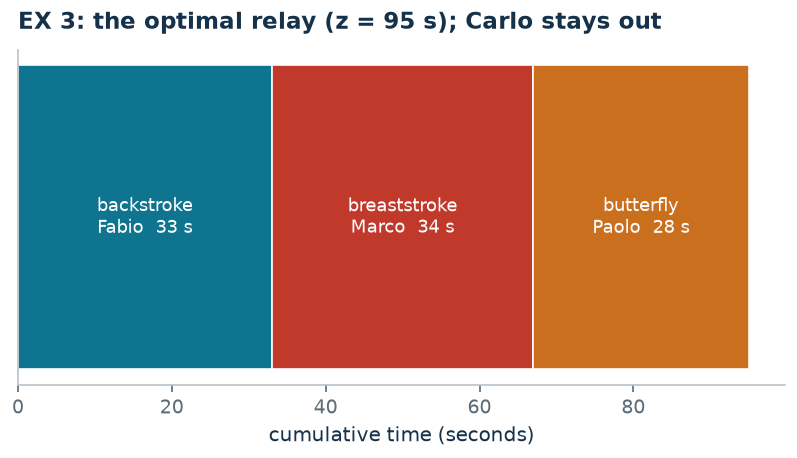
The optimum is \(95\) seconds: backstroke to Fabio (\(33\)), breaststroke to Marco (\(34\)), butterfly to Paolo (\(28\)); Carlo stays out.
Why the relaxation is exact here
The matrix of the model is that of the assignment problem: totally unimodular. All the vertices of the relaxation are integer, so \(z(\mathit{LP}) = z(\mathit{MILP})\) and integrality costs nothing — the same phenomenon as alldiff. This stops being true as soon as a capacity constraint with coefficients other than \(0\) and \(1\) is added.
Code
The complete script is
python/ex03_relay.py;
the notebook is
notebooks/ex03_relay.ipynb.
Show the complete script — python/ex03_relay.py (112 lines)
"""EX 3 -- Relay: three strokes, four swimmers, one stays out (family 7).

An assignment with more "machines" than "jobs": every stroke to exactly one
swimmer, every swimmer at most one stroke. The capacity is unit, so the matrix
is that of the assignment problem: totally unimodular, and the relaxation is
exact.
"""
import gurobipy as gp
import pandas as pd
from gurobipy import GRB

from mip import (ammissibile, due_rilassamenti, frazione, nuovo_modello, registra_bound,
                 risolvi, valuta)
from stile import intestazione, plt, salva_dati, salva_figura
from esteso import salva_modello

R = range

# ---------- 1. MODEL AND INSTANCE ----------
intestazione("EX 3. Relay: three strokes to be assigned to four swimmers")
NUOTATORI = ["Carlo", "Paolo", "Fabio", "Marco"]
STILI = ["backstroke", "breaststroke", "butterfly"]
t = [[37, 32, 33, 37],
     [43, 33, 42, 34],
     [33, 28, 38, 30]]
ns, nn = 3, 4
salva_dati(pd.DataFrame([{"stroke": STILI[s], "swimmer": NUOTATORI[n], "t": t[s][n]}
                         for s in R(ns) for n in R(nn)]), "ex03_tempi")


def modello(t):
    ns, nn = len(t), len(t[0])
    m = nuovo_modello("relay")
    x = m.addVars(ns, nn, vtype=GRB.BINARY, name="x")
    m.setObjective(gp.quicksum(t[s][n] * x[s, n] for s in R(ns) for n in R(nn)), GRB.MINIMIZE)
    m.addConstrs((x.sum(s, "*") == 1 for s in R(ns)), name="stroke")
    m.addConstrs((x.sum("*", n) <= 1 for n in R(nn)), name="swimmer")
    return m, x


def duale(t):
    """max sum_s alpha_s + sum_n beta_n;  alpha_s + beta_n <= t_sn;  alpha free, beta <= 0."""
    ns, nn = len(t), len(t[0])
    d = nuovo_modello("dual_relay")
    alpha = d.addVars(ns, lb=-GRB.INFINITY, name="alpha")
    beta = d.addVars(nn, lb=-GRB.INFINITY, ub=0.0, name="beta")
    d.setObjective(alpha.sum() + beta.sum(), GRB.MAXIMIZE)
    d.addConstrs((alpha[s] + beta[n] <= t[s][n] for s in R(ns) for n in R(nn)), name="rc")
    return d


m, x = modello(t)
salva_modello(m, "ex03_primale")

# ---------- 2. CONSTRUCTIVE HEURISTIC (UPPER BOUND) ----------
liberi = set(R(nn))
scelta = {}
for s in R(ns):
    n = min(liberi, key=lambda n: (t[s][n], n))
    scelta[s] = n
    liberi.discard(n)
    print(f"  {STILI[s].capitalize()}: available swimmers "
          + ", ".join(f"{NUOTATORI[k]} ({t[s][k]} s)" for k in sorted(liberi | {n}))
          + f"; the fastest is {NUOTATORI[n]}")
ub = sum(t[s][scelta[s]] for s in R(ns))
sol_eur = {f"x[{s},{scelta[s]}]": 1 for s in R(ns)}
assert ammissibile(m, sol_eur)
print("  Heuristic solution: " + ", ".join(f"{STILI[s]} -> {NUOTATORI[scelta[s]]}" for s in R(ns))
      + f"   ub = {frazione(ub)} s")

# ---------- 3. LP RELAXATION AND DUAL (LOWER BOUND) ----------
d = duale(t)
salva_modello(d, "ex03_duale")
mano = {f"alpha[{s}]": min(t[s]) for s in R(ns)}       # beta = 0
lb, viol = valuta(d, mano)
assert viol <= 1e-9, viol
print("  Dual by hand (beta = 0): alpha_s = min_n t_sn = "
      + ", ".join(frazione(mano[f"alpha[{s}]"]) for s in R(ns)) + f"  ->  lb = {frazione(lb)} s")
print("  Meaning: 'every stroke costs at least the time of its best specialist';")
print("  the bound is weak when two strokes share the same best specialist.")
zlp, zlpr, pi = due_rilassamenti(m, d)

# ---------- 4. MILP OPTIMUM AND BOUND TABLE ----------
z = risolvi(m)
ott = {s: n for s in R(ns) for n in R(nn) if x[s, n].X > 0.5}
fuori = [NUOTATORI[n] for n in R(nn) if n not in ott.values()]
print("  Optimal solution: " + ", ".join(f"{STILI[s]} -> {NUOTATORI[ott[s]]} ({t[s][ott[s]]} s)"
                                         for s in R(ns))
      + f"   total {frazione(z)} s; {', '.join(fuori)} stays out")
riga = registra_bound("EX 3 relay", ub, lb, zlp, zlpr, z)
salva_dati(pd.DataFrame([riga]), "ex03_bound")
assert lb <= zlp <= z <= ub + 1e-9
assert abs(zlp - z) < 1e-9, "the assignment matrix is TU: the relaxation is exact"
print("  z(LP) = z(MILP): the matrix of the model is that of the assignment problem,")
print("  totally unimodular, so the relaxation has integer vertices and integrality is free.")

# ---------- 5. FIGURE ----------
fig, ax = plt.subplots(figsize=(6.6, 2.9))
colori = ["#0E7490", "#C0392B", "#CA6F1E"]
inizio = 0
for s in R(ns):
    ax.barh(0, t[s][ott[s]], left=inizio, color=colori[s], edgecolor="white")
    ax.annotate(f"{STILI[s]}\n{NUOTATORI[ott[s]]}  {t[s][ott[s]]} s",
                (inizio + t[s][ott[s]] / 2, 0), ha="center", va="center",
                fontsize=8.5, color="white")
    inizio += t[s][ott[s]]
ax.set_yticks([])
ax.set_xlabel("cumulative time (seconds)")
ax.set_title(f"EX 3: the optimal relay (z = {frazione(z)} s); {fuori[0]} stays out")
ax.grid(False)
salva_figura(fig, "ex03_ottimo")
print("Done.")