EX 2 — Bus lines
Class: BIP · Links: none (a single family of variables) · Script: python/ex02_buslines.py
Difficulty: ★☆☆☆☆ · Time: 20–30 min

One of the fifteen numerical models, of the assignment and scheduling family.
EX 2
A city council is evaluating the offers of three bus companies for four bus lines. Each company has stated the cost at which it would operate each line:
| Company | Line 1 | Line 2 | Line 3 | Line 4 |
|---|---|---|---|---|
| 1 | 10 | 4 | 9 | 7 |
| 2 | 1 | 2 | 3 | 10 |
| 3 | 8 | 9 | 10 | 1 |
Every line must be assigned to exactly one company and every company may operate at most two lines. The total cost is minimised.
Model
With \(x_{ij} = 1\) if company \(i\) operates line \(j\) (\(3 \cdot 4 = 12\) binary variables):
With \(n = 3\) companies, \(m = 4\) lines and \(p = 2\): four set partitioning constraints (one per line) and three capacity constraints (one per company). It is problem 7.1 with the capacity counted in number of jobs instead of time.
The model of the instance, written out in full:
Constructive heuristic: the primal bound
Constructive heuristic on the lines, in order: every line to the cheapest company among those not yet full.
- Line 1: costs \(10\), \(1\), \(8\) → company 2.
- Line 2: costs \(4\), \(2\), \(9\) → company 2, now full.
- Line 3: companies 1 and 3 remain, costs \(9\) and \(10\) → company 1.
- Line 4: companies 1 and 3 remain, costs \(7\) and \(1\) → company 3.
Value \(1 + 2 + 9 + 1 = 13\), so \(\mathit{UB} = 13\).
LP relaxation and dual: the dual bound
Relaxing \(x_{ij} \in \{0,1\}\) to \(x_{ij} \ge 0\), with \(\alpha_j\) free for every line constraint and \(\pi_i \le 0\) for every capacity constraint:
With the "zero out and saturate" recipe, \(\bar\pi = 0\) and \(\bar\alpha_j = \min_i c_{ij} = (1, 2, 3, 1)\): feasible by construction, \(\mathit{LB} = 7\). Meaning: "every line costs at least the lowest offer it received".
| \(UB\) (constructive heuristic) | \(LB\) (dual by hand) | \(z(\mathit{LP})\) | \(z(\mathit{MILP})\) | heuristic gap |
|---|---|---|---|---|
| 13 | 7 | 9 | 9 | \(44.4\%\) |
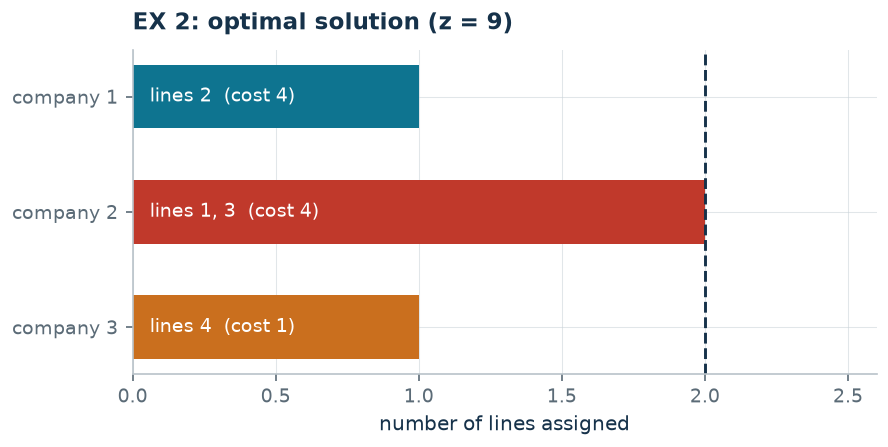
Exact relaxation, but not an exact dual recipe
\(z(\mathit{LP}) = z(\mathit{MILP}) = 9\), yet the hand-built bound stops at \(7\) and the heuristic is off by \(44\%\). That the relaxation is exact says nothing about how good a particular dual solution is: they are two different things.
Code
The complete script is
python/ex02_buslines.py;
the notebook is
notebooks/ex02_buslines.ipynb.
Show the complete script — python/ex02_buslines.py (108 lines)
"""EX 2 -- Bus lines: assignment with a capacity of two (family 7).

Four lines, three companies, every line to one company, every company at most
two lines. It is the generalised assignment of problem 7.1 with the capacity
counted in number of jobs instead of time. Model, heuristic, dual of the pure
relaxation with a hand-built solution, optimum and bound table.
"""
import gurobipy as gp
import pandas as pd
from gurobipy import GRB

from mip import (ammissibile, due_rilassamenti, frazione, nuovo_modello, registra_bound,
                 risolvi, stampa_soluzione, valuta)
from stile import intestazione, plt, salva_dati, salva_figura
from esteso import salva_modello

R = range

# ---------- 1. MODEL AND INSTANCE ----------
intestazione("EX 2. Bus lines: four lines, three companies, at most two lines each")
c = [[10, 4, 9, 7],      # cost of company 1 on the four lines
     [1, 2, 3, 10],
     [8, 9, 10, 1]]
nc, nl, p = 3, 4, 2      # companies, lines, lines at most per company
salva_dati(pd.DataFrame([{"company": i + 1, "line": j + 1, "c": c[i][j]}
                         for i in R(nc) for j in R(nl)]), "ex02_costi")


def modello(c, p):
    nc, nl = len(c), len(c[0])
    m = nuovo_modello("bus_lines")
    x = m.addVars(nc, nl, vtype=GRB.BINARY, name="x")
    m.setObjective(gp.quicksum(c[i][j] * x[i, j] for i in R(nc) for j in R(nl)), GRB.MINIMIZE)
    m.addConstrs((x.sum("*", j) == 1 for j in R(nl)), name="line")
    m.addConstrs((x.sum(i, "*") <= p for i in R(nc)), name="capacity")
    return m, x


def duale(c, p):
    """max sum_j alpha_j + p sum_i beta_i;  alpha_j + beta_i <= c_ij;  alpha free, beta <= 0."""
    nc, nl = len(c), len(c[0])
    d = nuovo_modello("dual_bus_lines")
    alpha = d.addVars(nl, lb=-GRB.INFINITY, name="alpha")
    beta = d.addVars(nc, lb=-GRB.INFINITY, ub=0.0, name="beta")
    d.setObjective(alpha.sum() + p * beta.sum(), GRB.MAXIMIZE)
    d.addConstrs((alpha[j] + beta[i] <= c[i][j] for i in R(nc) for j in R(nl)), name="rc")
    return d


m, x = modello(c, p)
salva_modello(m, "ex02_primale")

# ---------- 2. CONSTRUCTIVE HEURISTIC (UPPER BOUND) ----------
# constructive heuristic on the lines: every line to the cheapest company among those not yet full
residuo = [p] * nc
scelta = {}
for j in R(nl):
    i = min((i for i in R(nc) if residuo[i] > 0), key=lambda i: (c[i][j], i))
    scelta[j] = i
    residuo[i] -= 1
    print(f"  Line {j + 1}: companies with free slots "
          + ", ".join(f"{k + 1} (cost {c[k][j]})" for k in R(nc) if residuo[k] > 0 or k == i)
          + f"; the cheapest is {i + 1}, so x[{i + 1}][{j + 1}] = 1")
ub = sum(c[scelta[j]][j] for j in R(nl))
sol_eur = {f"x[{scelta[j]},{j}]": 1 for j in R(nl)}
assert ammissibile(m, sol_eur)
print("  Heuristic solution: " + ", ".join(f"line {j + 1} -> company {scelta[j] + 1}"
                                           for j in R(nl))
      + f"   ub = {frazione(ub)}")

# ---------- 3. LP RELAXATION AND DUAL (LOWER BOUND) ----------
d = duale(c, p)
salva_modello(d, "ex02_duale")
mano = {f"alpha[{j}]": min(c[i][j] for i in R(nc)) for j in R(nl)}   # beta = 0
lb, viol = valuta(d, mano)
assert viol <= 1e-9, viol
print("  Dual by hand (beta = 0): alpha_j = min_i c_ij = "
      + ", ".join(frazione(mano[f"alpha[{j}]"]) for j in R(nl)) + f"  ->  lb = {frazione(lb)}")
zlp, zlpr, pi = due_rilassamenti(m, d)

# ---------- 4. MILP OPTIMUM AND BOUND TABLE ----------
z = risolvi(m)
ott = [(i, j) for i in R(nc) for j in R(nl) if x[i, j].X > 0.5]
print("  Optimal solution: " + ", ".join(f"line {j + 1} -> company {i + 1}"
                                         for i, j in sorted(ott, key=lambda t: t[1])))
riga = registra_bound("EX 2 bus lines", ub, lb, zlp, zlpr, z)
salva_dati(pd.DataFrame([riga]), "ex02_bound")
assert lb <= zlp <= z <= ub + 1e-9

# ---------- 5. FIGURE ----------
fig, ax = plt.subplots(figsize=(6.4, 2.8))
for i in R(nc):
    linee = [j for (ii, j) in ott if ii == i]
    ax.barh(i, len(linee), color=["#0E7490", "#C0392B", "#CA6F1E"][i], height=0.55)
    if linee:
        ax.annotate("lines " + ", ".join(str(j + 1) for j in linee) +
                    f"  (cost {sum(c[i][j] for j in linee)})",
                    (0.06, i), va="center", fontsize=9, color="white")
ax.axvline(p, color="#16324A", ls="--", lw=1.4)
ax.annotate(f"at most {p}", (p, -0.55), ha="center", fontsize=9, color="#16324A")
ax.set_yticks(R(nc))
ax.set_yticklabels([f"company {i + 1}" for i in R(nc)])
ax.set_xlabel("number of lines assigned")
ax.set_xlim(0, p + 0.6)
ax.set_title(f"EX 2: optimal solution (z = {frazione(z)})")
ax.invert_yaxis()
salva_figura(fig, "ex02_ottimo")
print("Done.")