EX 12 — Balancing between two workers
Class: MILP · Links: min-max, absolute value · Script: python/ex12_balancing.py
Difficulty: ★★★☆☆ · Time: 30–45 min

One of the fifteen numerical models, of the assignment and scheduling family, with a pointer to the partitioning and balancing family.
EX 12
Four indivisible jobs of duration \(2\), \(3\), \(6\) and \(7\) must be assigned to two workers so that their workloads are as balanced as possible.
«Balanced» must be translated, and the translation declared
"Balanced workloads" is not an objective: it is a word. The two linear translations are those of technique 6.6: minimise the maximum of the loads, or minimise their difference. Since the total \(q = 18\) is constant, the identity
holds, so the two models have the same optimal solutions — but different optimal values: \(9\) for the first, \(0\) for the second. Reporting "\(9\)" as the "difference between the loads" is a mistake, and so is reporting "\(0\)" as the "maximum load".
Model (min-max)
With \(x_j = 1\) if job \(j\) goes to worker 1 and \(z \ge 0\) the maximum load:
The model of the instance, written out in full:
Constructive heuristic: the primal bound
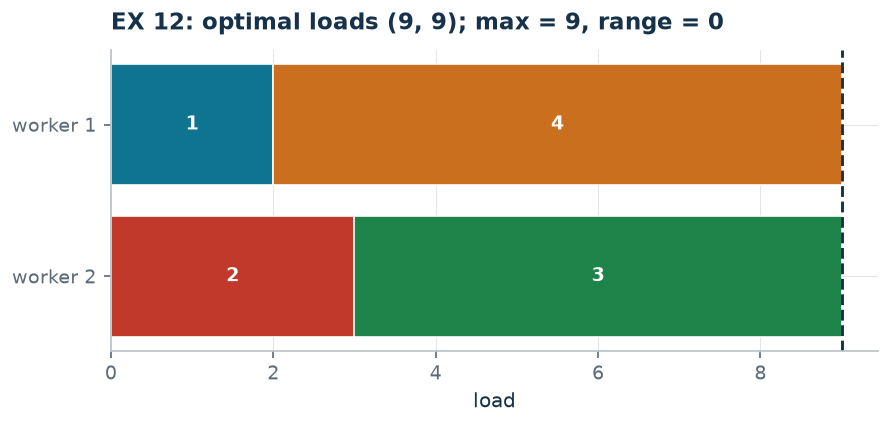
LPT: the jobs in decreasing order of duration, each to the least loaded worker. Job 4 (\(7\)) to worker 1; job 3 (\(6\)) to worker 2; job 2 (\(3\)) to worker 2, which reaches \(9\); job 1 (\(2\)) to worker 1, which reaches \(9\). Loads \((9, 9)\), so \(\mathit{UB} = 9\).
LP relaxation and dual: the dual bound
Relaxing to \(x_j \ge 0\) and using the conversion table — a minimisation primal with \(\le\) constraints, hence dual variables \(\pi_1, \pi_2 \le 0\):
Since \(d_j > 0\), the first constraints say \(\pi_1 \le \pi_2\). Setting \(\pi_1 = \pi_2 = t\), the constraint from \(z\) gives \(-2t \le 1\), that is \(t \ge -1/2\); the objective \(-q t\) is largest at \(t = -1/2\) and equals \(\mathit{LB} = q/2 = 9\). Meaning: "the two loads add up to \(q\), so the larger one is at least \(q/2\)".
The same thing with non-negative dual variables
Many treatments prefer dual variables \(\ge 0\). It suffices to set \(\alpha = -\pi_1\) and \(\beta = -\pi_2\): the dual becomes \(\max q\beta\) with \(\alpha \le \beta\) and \(\alpha + \beta \le 1\), and \(\alpha = \beta = 1/2\) gives \(9\) again. It is the same solution written with the other sign; what one cannot do is declare variables \(\ge 0\) and then use one of them negative.
| \(UB\) (LPT) | \(LB\) (dual by hand) | \(z(\mathit{LP})\) | \(z(\mathit{MILP})\) | heuristic gap |
|---|---|---|---|---|
| 9 | 9 | 9 | 9 | \(0.0\%\) |
All the numbers coincide: the two hand-built bounds meet and optimality is proved without solving the MILP. This happens because \(q\) is even and the jobs can be split exactly in half; with \(q\) odd the bound would become \(\lceil q/2 \rceil\) and one more argument would be needed.
Code
The complete script — which also solves the "minimum range" version and checks
the identity between the two objectives — is
python/ex12_balancing.py;
the notebook is
notebooks/ex12_balancing.ipynb.
Show the complete script — python/ex12_balancing.py (153 lines)
"""EX 12 -- Balancing between two workers (family 7, pointer to family 11).

Four indivisible jobs of duration 2, 3, 6, 7 and two workers: the workloads must
be as balanced as possible.

Two warnings that are easy to conflate:
1. "balanced workloads" can be written as a min-max or as the minimisation of
   the difference: the optimal solutions are the same (the total is constant) but
   the *values* of the objective are not. Both are reported here.
2. the dual must be written with the signs of the conversion table: in a
   minimisation with <= constraints the dual variables are <= 0. The
   presentation with >= 0 variables is the same thing with flipped signs, and it
   is shown too.
"""
import gurobipy as gp
import pandas as pd
from gurobipy import GRB

from mip import (ammissibile, due_rilassamenti, frazione, nuovo_modello, registra_bound,
                 risolvi, valuta)
from stile import intestazione, plt, salva_dati, salva_figura
from esteso import salva_modello

R = range

# ---------- 1. MODEL AND INSTANCE ----------
intestazione("EX 12. Balancing: four indivisible jobs on two workers")
d = [2, 3, 6, 7]
n, D = len(d), sum(d)
print(f"  Durations {d}; total {D}; with perfectly equal loads each would do {frazione(D / 2)}")
salva_dati(pd.DataFrame({"job": R(1, n + 1), "duration": d}), "ex12_lavori")


def modello_minmax(d):
    """min z  with  sum_j d_j x_j <= z  and  D - sum_j d_j x_j <= z."""
    n, D = len(d), sum(d)
    m = nuovo_modello("balancing_minmax")
    x = m.addVars(n, vtype=GRB.BINARY, name="x")
    z = m.addVar(name="z")
    m.setObjective(z, GRB.MINIMIZE)
    m.addConstr(gp.quicksum(d[j] * x[j] for j in R(n)) - z <= 0, name="load1")
    m.addConstr(-gp.quicksum(d[j] * x[j] for j in R(n)) - z <= -D, name="load2")
    return m, x, z


def modello_differenza(d):
    """min s  with  s >= W1 - W2  and  s >= W2 - W1: the same choice, another number."""
    n, D = len(d), sum(d)
    m = nuovo_modello("balancing_range")
    x = m.addVars(n, vtype=GRB.BINARY, name="x")
    s = m.addVar(name="s")
    m.setObjective(s, GRB.MINIMIZE)
    carico1 = gp.quicksum(d[j] * x[j] for j in R(n))
    m.addConstr(s >= 2 * carico1 - D, name="abs_plus")
    m.addConstr(s >= D - 2 * carico1, name="abs_minus")
    return m, x, s


def duale_minmax(d):
    """Dual of the relaxation without the bounds, with the course convention (pi <= 0):
       max 0*pi1 - D*pi2   s.t.  d_j (pi1 - pi2) <= 0 for every j;  -pi1 - pi2 <= 1;  pi <= 0."""
    n, D = len(d), sum(d)
    dl = nuovo_modello("dual_balancing")
    pi1 = dl.addVar(lb=-GRB.INFINITY, ub=0.0, name="pi[0]")
    pi2 = dl.addVar(lb=-GRB.INFINITY, ub=0.0, name="pi[1]")
    dl.setObjective(-D * pi2, GRB.MAXIMIZE)
    dl.addConstrs((d[j] * (pi1 - pi2) <= 0 for j in R(n)), name="rc_x")
    dl.addConstr(-pi1 - pi2 <= 1, name="rc_z")
    return dl, pi1, pi2


m, x, z = modello_minmax(d)
salva_modello(m, "ex12_primale")

# ---------- 2. CONSTRUCTIVE HEURISTIC (UPPER BOUND) ----------
carico = [0, 0]
assegn = {}
for j in sorted(R(n), key=lambda j: -d[j]):
    k = 0 if carico[0] <= carico[1] else 1
    assegn[j] = k
    print(f"  Job {j + 1} (duration {d[j]}): loads {carico}; the smaller is worker "
          f"{k + 1}, which goes to {carico[k] + d[j]}")
    carico[k] += d[j]
ub = max(carico)
sol_eur = {f"x[{j}]": 1 for j in R(n) if assegn[j] == 0} | {"z": ub}
assert ammissibile(m, sol_eur)
print(f"  Heuristic solution: worker 1 = {[j + 1 for j in R(n) if assegn[j] == 0]}, "
      f"worker 2 = {[j + 1 for j in R(n) if assegn[j] == 1]}, loads {carico}")
print(f"  ub = max of the loads = {frazione(ub)}")

# ---------- 3. LP RELAXATION AND DUAL (LOWER BOUND) ----------
dl, pi1, pi2 = duale_minmax(d)
salva_modello(dl, "ex12_duale")
mano = {"pi[0]": -0.5, "pi[1]": -0.5}
lb, viol = valuta(dl, mano)
assert viol <= 1e-9, viol
print("  Dual by hand: the constraints d_j (pi1 - pi2) <= 0 impose pi1 <= pi2; setting")
print("  pi1 = pi2 = t, the constraint -pi1 - pi2 <= 1 gives t >= -1/2, and the objective")
print(f"  -D t is largest at t = -1/2:  lb = -{D} * (-1/2) = {frazione(lb)}")
print("  Equivalent presentation with flipped signs (alpha = -pi1, beta = -pi2, >= 0):")
print("  max D beta with alpha <= beta and alpha + beta <= 1; alpha = beta = 1/2 gives 9 again.")
print("  Meaning: 'the two loads add up to D, so the larger one is at least D/2'.")
zlp, zlpr, pi = due_rilassamenti(m, dl)

# ---------- 4. MILP OPTIMUM AND BOUND TABLE ----------
zv = risolvi(m)
op1 = [j + 1 for j in R(n) if x[j].X > 0.5]
op2 = [j + 1 for j in R(n) if x[j].X <= 0.5]
c1 = sum(d[j - 1] for j in op1)
print(f"  Optimal solution (min-max): worker 1 = {op1} (load {c1}), worker 2 = {op2} "
      f"(load {D - c1});  z(MILP) = {frazione(zv)}")
riga = registra_bound("EX 12 balancing", ub, lb, zlp, zlpr, zv)
salva_dati(pd.DataFrame([riga]), "ex12_bound")
assert lb <= zlp <= zv <= ub + 1e-9

# ---------- 5. THE SAME PROBLEM WITH THE "RANGE" OBJECTIVE ----------
intestazione("EX 12 (continued). The same problem written as the minimum difference")
md, xd, sd = modello_differenza(d)
zd = risolvi(md)
op1d = [j + 1 for j in R(n) if xd[j].X > 0.5]
c1d = sum(d[j - 1] for j in op1d)
print(f"  Optimal solution (range): worker 1 = {op1d} (load {c1d}), loads "
      f"({c1d}, {D - c1d});  z = {frazione(zd)}")
print(f"  The split is the same; the two objectives are worth {frazione(zv)} and "
      f"{frazione(zd)}.")
print(f"  The link is exact: max = D/2 + range/2, that is {frazione(D / 2)} + "
      f"{frazione(zd / 2)} = {frazione(zv)}.")
assert abs(zv - (D / 2 + zd / 2)) < 1e-9
print("  So the two models have the same optimal solutions, but their values are not")
print("  comparable: calling the min-max value a 'difference' is a mistake.")
salva_dati(pd.DataFrame([{"objective": "min-max", "z": zv},
                         {"objective": "minimum range", "z": zd}]), "ex12_obiettivi")

# ---------- 6. FIGURE ----------
fig, ax = plt.subplots(figsize=(6.6, 2.6))
colori = ["#0E7490", "#C0392B", "#1E8449", "#CA6F1E"]
for k, lavori in enumerate([op1, op2]):
    inizio = 0
    for j in lavori:
        ax.barh(k, d[j - 1], left=inizio, color=colori[(j - 1) % 4], edgecolor="white")
        ax.annotate(f"{j}", (inizio + d[j - 1] / 2, k), ha="center", va="center",
                    color="white", fontsize=9, fontweight="bold")
        inizio += d[j - 1]
ax.axvline(D / 2, color="#16324A", ls="--", lw=1.4)
ax.annotate(f"D/2 = {frazione(D / 2)}", (D / 2, -0.62), ha="center", fontsize=9, color="#16324A")
ax.set_yticks([0, 1])
ax.set_yticklabels(["worker 1", "worker 2"])
ax.set_xlabel("load")
ax.set_title(f"EX 12: optimal loads ({c1}, {D - c1}); max = {frazione(zv)}, "
             f"range = {frazione(zd)}")
ax.invert_yaxis()
salva_figura(fig, "ex12_ottimo")
print("Done.")