EX 7 — Custom aircraft with a fixed cost
Class: MILP · Links: fixed cost, activation · Script: python/ex07_aircraft.py
Difficulty: ★★☆☆☆ · Time: 30–45 min

One of the fifteen numerical models, of the production planning family.
EX 7
A company builds custom aircraft; before producing for a client a fixed setup cost must be paid. Three clients have ordered \(3\), \(2\) and \(5\) aircraft respectively. The production capacity is \(1000\) hours. The company decides which orders to accept and how many units to produce (possibly fewer than requested).
| client 1 | client 2 | client 3 | |
|---|---|---|---|
| setup (millions) | 3 | 2 | 0 |
| unit profit (millions) | 2 | 3 | 1 |
| hours per aircraft | 200 | 400 | 200 |
The total profit net of the setup costs is to be maximised.
Model
The data are \(n = 3\) clients, with unit profit \(p_j\), setup cost \(f_j\), hours per aircraft \(h_j\) and maximum order \(M_j\), plus the production capacity \(H = 1000\) hours. With \(x_j\) aircraft produced for client \(j\) (integer) and \(y_j\) the indicator of an accepted order:
A single constraint per client does two things at once: it limits the quantity to the number of aircraft ordered and it makes the setup be paid. Client 3 has zero setup, so \(y_3\) does not appear in the objective and equals \(1\) in every optimal solution with \(x_3 > 0\).
The model of the instance, written out in full:
Constructive heuristic: the primal bound
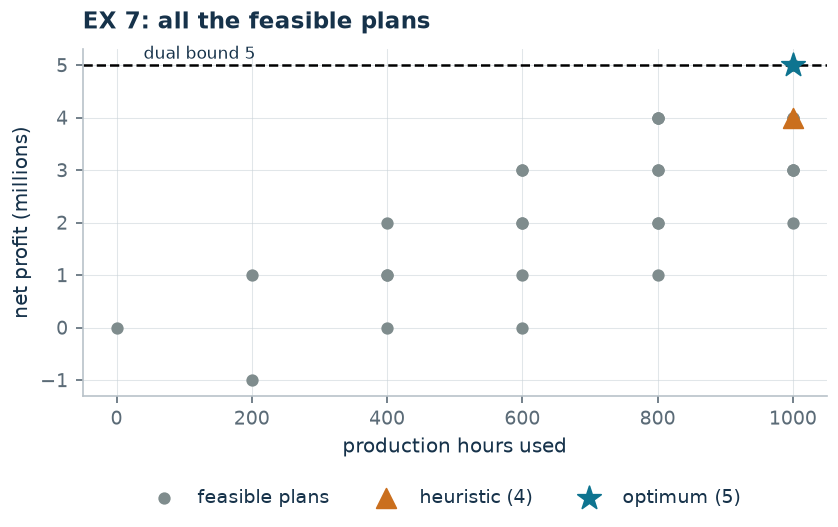
This is a maximisation. The clients are scanned by decreasing net profit per hour, computed on the whole order: \(3/600\), \(4/800\) and \(5/1000\), that is \(1/200\) for all three. At equal ratios the natural order is followed: client 1 is accepted with \(3\) aircraft (\(600\) hours, net profit \(3\)), then client 2 with a single aircraft (\(400\) hours, net profit \(3 - 2 = 1\)), and the hours run out.
LP relaxation and dual: the dual bound
With \(\alpha \ge 0\) on the capacity and \(\beta_j \ge 0\) on the links, the dual is
With \(\alpha \ge 0\) on the production capacity and \(\beta_j \ge 0\) on each link between quantity and commission, the dual has one row per \(x_j\) — one aircraft for customer \(j\) uses its hours and takes one unit of the order, and the total must cover the unit profit — and one per \(y_j\), which asks the saving on the order not to exceed the setup cost.
The recipe: \(\bar\beta_j = f_j / M_j\), that is the setup spread over the aircraft ordered (\(1\), \(1\) and \(0\)), whence \(\alpha \ge (p_j - \bar\beta_j)/h_j\) for every \(j\), that is \(\alpha \ge 1/200\) in all three cases. With \(\bar\alpha = 1/200\),
The variable \(\alpha\) is the price of one production hour, \(\beta_j\) that of the maximum order of customer \(j\). The objective values the \(1000\) available hours at that price. The first three constraints are the columns of the \(x_j\): one aircraft for customer \(j\) uses its hours and takes one unit of the order, and the total must cover the unit profit. The last three are the columns of the \(y_j\): switching commission \(j\) on frees \(M_j\) units of order, and the saving cannot exceed the setup cost.
Optimum and comparison
| \(\mathit{LB}\) | \(\mathit{UB}\) | \(z(\mathit{LP})\) | \(z(\mathit{LP}^+)\) | \(z(\mathit{MILP})\) |
|---|---|---|---|---|
| 4 | 5 | 5 | 5 | 5 |
The optimum is \(5\) and is attained by three different plans: five aircraft to client 3; two to client 2 and one to the third; three to client 1 and two to the third. All three use exactly the \(1000\) hours.
When the certificate closes the problem by itself
Here the dual bound is exact: \(\mathit{UB} = z(\mathit{MILP}) = 5\). The certificate built by hand proves optimality without the solver having to do anything. Without setup costs the optimum would rise to \(9\); with \(1400\) hours available, to \(7\).
Code
The full script is
python/ex07_aircraft.py;
the notebook is
notebooks/ex07_aircraft.ipynb.
Show the complete script — python/ex07_aircraft.py (182 lines)
"""EX 7 -- Custom aircraft with a fixed set-up cost (family 9).

Three orders, each with a fixed set-up cost and a cap on the units. It is the
fixed cost of technique 3.2 in pure form: the link x <= M y limits the quantity
and charges the set-up at the same time. The dual of the relaxation is built by
hand in two lines and coincides with the optimum of the MILP.
"""
import gurobipy as gp
import pandas as pd
from gurobipy import GRB

from mip import (ammissibile, due_rilassamenti, frazione, nuovo_modello, registra_bound,
                 risolvi, stampa_lp, valuta)
from stile import ARANCIO, GRIGIO, TEAL, intestazione, plt, salva_dati, salva_figura
from esteso import salva_modello

R = range


def aerei(n):
    return f"{int(n)} aircraft"


# ---------- 1. MODEL AND INSTANCE ----------
intestazione("EX 7. Custom aircraft: which orders to accept")
p6 = [2, 3, 1]        # unit profit (millions)
f6 = [3, 2, 0]        # fixed set-up cost (millions)
h6 = [200, 400, 200]  # production hours per aircraft
M6 = [3, 2, 5]        # aircraft ordered by the client
H6 = 1000             # hours available
nc = len(p6)
salva_dati(pd.DataFrame({"client": R(1, nc + 1), "profit": p6, "setup": f6,
                         "hours": h6, "ordered": M6}), "ex07_dati")
print("  Net profit if a client is accepted and all their aircraft are produced:")
for j in R(nc):
    print(f"    client {j + 1}: {p6[j]} * {M6[j]} - {f6[j]} = {p6[j] * M6[j] - f6[j]} "
          f"millions, with {h6[j] * M6[j]} hours")


def modello(p, f, h, M, H):
    nc = len(p)
    m = nuovo_modello("aircraft")
    x = m.addVars(nc, vtype=GRB.INTEGER, name="x")
    y = m.addVars(nc, vtype=GRB.BINARY, name="y")
    m.setObjective(gp.quicksum(p[j] * x[j] - f[j] * y[j] for j in R(nc)), GRB.MAXIMIZE)
    m.addConstr(gp.quicksum(h[j] * x[j] for j in R(nc)) <= H, name="hours")
    m.addConstrs((x[j] - M[j] * y[j] <= 0 for j in R(nc)), name="activate")
    return m, x, y


def duale(p, f, h, M, H):
    """min H alpha  with alpha >= 0 and beta >= 0 (links x_j <= M_j y_j).

    Columns:  x_j: h_j alpha + beta_j >= p_j
              y_j: -M_j beta_j >= -f_j, that is beta_j <= f_j / M_j
    """
    nc = len(p)
    d = nuovo_modello("dual_aircraft")
    alpha = d.addVar(name="alpha")
    beta = d.addVars(nc, name="beta")
    d.setObjective(H * alpha, GRB.MINIMIZE)
    d.addConstrs((h[j] * alpha + beta[j] >= p[j] for j in R(nc)), name="rcx")
    d.addConstrs((-M[j] * beta[j] >= -f[j] for j in R(nc)), name="rcy")
    return d


m6, x6, y6 = modello(p6, f6, h6, M6, H6)
salva_modello(m6, "ex07_primale")
print("  The model of the instance:")
stampa_lp(m6)

# ---------- 2. CONSTRUCTIVE HEURISTIC (LOWER BOUND) ----------
# constructive heuristic on the net profit per hour if the whole order is accepted
def euristica(p, f, h, M, H):
    nc = len(p)
    res = H
    x = [0] * nc
    valore = [(p[j] * M[j] - f[j]) / (h[j] * M[j]) for j in R(nc)]
    passi = ["net profit per hour, on the whole order: "
             + ", ".join(f"client {j + 1} {frazione(valore[j])}" for j in R(nc))]
    for j in sorted(R(nc), key=lambda j: (-valore[j], j)):
        n = min(M[j], res // h[j])
        if n == 0 or p[j] * n - f[j] <= 0:
            passi.append(f"client {j + 1}: with {res} hours left one could build "
                         f"{aerei(n)}, profit {p[j] * n - f[j]} <= 0, rejected")
            continue
        x[j] = n
        res -= h[j] * n
        passi.append(f"client {j + 1}: {aerei(n)}, net profit {p[j] * n - f[j]}; "
                     f"hours left {res}")
    return x, passi


x_e, passi = euristica(p6, f6, h6, M6, H6)
for k, riga in enumerate(passi, 1):
    print(f"  Step {k}. {riga}")
lb6 = sum(p6[j] * x_e[j] - f6[j] * (1 if x_e[j] else 0) for j in R(nc))
sol_eur = ({f"x[{j}]": x_e[j] for j in R(nc)}
           | {f"y[{j}]": 1 if x_e[j] else 0 for j in R(nc)})
assert ammissibile(m6, sol_eur), sol_eur
print(f"  Heuristic solution: " + ", ".join(f"{aerei(x_e[j])} to client {j + 1}"
                                            for j in R(nc) if x_e[j])
      + f"   lb = {frazione(lb6)}")

# ---------- 3. LP RELAXATION AND DUAL (UPPER BOUND) ----------
d6 = duale(p6, f6, h6, M6, H6)
salva_modello(d6, "ex07_duale")
# recipe: beta_j = f_j / M_j (the largest value allowed by the column of y_j, that is
# the set-up spread over the aircraft ordered) and alpha the smallest value that makes
# all the columns of x feasible
beta_v = [f6[j] / M6[j] for j in R(nc)]
alpha_v = max((p6[j] - beta_v[j]) / h6[j] for j in R(nc))
mano = {"alpha": alpha_v} | {f"beta[{j}]": beta_v[j] for j in R(nc)}
ub6, viol = valuta(d6, mano)
assert viol <= 1e-9, viol
print("  Hand-built dual: beta_j = f_j / M_j (the set-up spread over the ordered aircraft):")
for j in R(nc):
    print(f"    client {j + 1}: {f6[j]} / {M6[j]} = {frazione(beta_v[j])}, hence "
          f"alpha >= ({p6[j]} - {frazione(beta_v[j])}) / {h6[j]} = "
          f"{frazione((p6[j] - beta_v[j]) / h6[j])}")
print(f"  alpha = {frazione(alpha_v)} (an hour of production is worth {frazione(alpha_v)} "
      f"millions)")
print(f"  ub = {H6} * alpha = {frazione(ub6)}")
zlp6, zlp6r, _ = due_rilassamenti(m6, d6)

# ---------- 4. OPTIMUM OF THE MILP ----------
z6 = risolvi(m6)
print("  Optimal solution: " + ", ".join(
    f"{aerei(x6[j].X)} to client {j + 1}" for j in R(nc) if x6[j].X > 0.5)
    + f"; hours used {int(sum(h6[j] * x6[j].X for j in R(nc)))} out of {H6}")
riga = registra_bound("EX 7 aircraft", ub6, lb6, zlp6, zlp6r, z6, senso="max")
salva_dati(pd.DataFrame([riga]), "ex07_bound")
assert lb6 <= z6 <= zlp6 <= ub6 + 1e-9

# ---------- 5. ALL THE FEASIBLE PLANS, ONE BY ONE ----------
intestazione("EX 7. The feasible plans, one by one")
righe = []
for a in R(M6[0] + 1):
    for b in R(M6[1] + 1):
        for c in R(M6[2] + 1):
            ore = h6[0] * a + h6[1] * b + h6[2] * c
            if ore > H6:
                continue
            val = (p6[0] * a + p6[1] * b + p6[2] * c
                   - sum(f6[j] for j, n in enumerate((a, b, c)) if n))
            righe.append({"client_1": a, "client_2": b, "client_3": c, "hours": ore,
                          "profit": val})
df = pd.DataFrame(righe).sort_values("profit", ascending=False)
print(df.head(6).to_string(index=False))
print(f"  Feasible plans in total: {len(df)}; the best one is worth {df.profit.max()}, and")
print(f"  coincides with the optimum found by the solver ({frazione(z6)}).")
salva_dati(df, "ex07_piani")
assert abs(df.profit.max() - z6) <= 1e-9

# ---------- 6. VARIANTS ----------
varianti = {}
m, x, y = modello(p6, [0] * nc, h6, M6, H6)
varianti["6a. without set-up costs"] = risolvi(m)
print(f"  6a. Without set-up costs: z = "
      f"{frazione(varianti['6a. without set-up costs'])}")
m, x, y = modello(p6, f6, h6, M6, 1400)
varianti["6b. 1400 hours available"] = risolvi(m)
print(f"  6b. With 1400 hours available: z = "
      f"{frazione(varianti['6b. 1400 hours available'])}")
salva_dati(pd.DataFrame({"variant": list(varianti), "z": list(varianti.values())}),
           "ex07_varianti")

# ---------- 7. FIGURE ----------
fig, ax = plt.subplots(figsize=(6.4, 3.0))
ax.scatter(df.hours, df.profit, s=26, color=GRIGIO, label="feasible plans")
ax.scatter([sum(h6[j] * x_e[j] for j in R(nc))], [lb6], s=90, marker="^", color=ARANCIO,
           label=f"heuristic ({frazione(lb6)})", zorder=3)
ax.scatter([sum(h6[j] * x6[j].X for j in R(nc))], [z6], s=140, marker="*", color=TEAL,
           label=f"optimum ({frazione(z6)})", zorder=3)
ax.axhline(ub6, color="black", ls="--", lw=1.2)
ax.annotate(f"dual bound {frazione(ub6)}", (40, ub6 + 0.12), fontsize=8)
ax.set_xlabel("production hours used")
ax.set_ylabel("net profit (millions)")
ax.set_title("EX 7: all the feasible plans")
ax.legend(fontsize=8, loc="lower left")
salva_figura(fig, "ex07_piani")
print("Done.")