6.1 Activation: aggregated and disaggregated form
Technique: binary with binary · Script: python/cap03_links.py · All the techniques
The link in words
A resource (a machine, a site, a plant) must be activated before being used. The binaries \(x_{ij}\) say "object \(i\) uses resource \(j\)", the binaries \(y_j\) say "resource \(j\) is activated". We want: if anyone uses \(j\), then \(j\) is activated.
The constraints
When the resource has a capacity \(k_j\) (at most \(k_j\) objects), the aggregated form is written with that coefficient, \(\sum_i x_{ij} \le k_j y_j\), and then it imposes the capacity as well: two conditions in one constraint.
The proof
On binary points the two forms are equivalent.
- Disaggregated \(\Rightarrow\) aggregated: summing \(x_{ij} \le y_j\) over \(i\) gives \(\sum_i x_{ij} \le n y_j\).
- Aggregated \(\Rightarrow\) disaggregated, on binary points: if \(y_j = 0\), the aggregated constraint gives \(\sum_i x_{ij} \le 0\) and hence \(x_{ij} = 0 \le y_j\) for every \(i\); if \(y_j = 1\), then \(x_{ij} \le 1 = y_j\) because the \(x\) are binary.
The second direction uses binarity: outside the binary points it does not hold, and that is exactly what makes the two forms differ in the relaxation.
The converse is not imposed
"If \(j\) is activated then somebody uses it", that is \(y_j = 1 \Rightarrow \sum_i x_{ij} \ge 1\), does not follow from the constraints: \(y_j = 1\) with all \(x_{ij} = 0\) is feasible in both forms. It follows from optimality when activating costs something: if the activation cost \(f_j\) is strictly positive, given an optimal solution with \(y_j = 1\) and no \(x_{ij} = 1\), setting \(y_j = 0\) leaves all constraints satisfied and reduces the cost by \(f_j > 0\) — a contradiction. Hence "in every optimum". If instead \(f_j = 0\) is allowed, the correct conclusion is the weaker "there exists an optimum with \(y_j = 0\)".
The strength of the relaxation
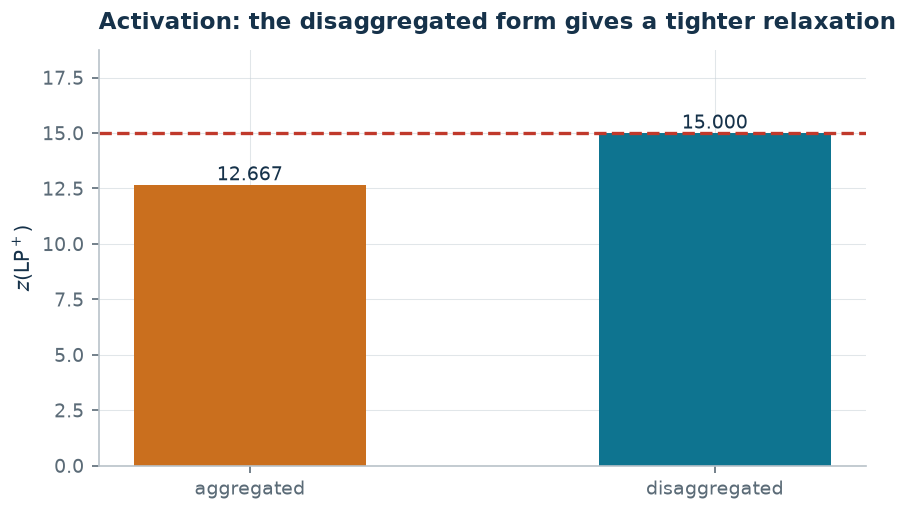
Instance: \(n = 3\) customers, \(m = 2\) sites, activation costs \(f = (8, 6)\), service costs
| Formulation | link constraints | \(z(\mathit{LP}^+)\) |
|---|---|---|
| aggregated | \(m = 2\) | \(38/3 \approx 12.67\) |
| disaggregated | \(n\,m = 6\) | \(15\) |
The integer optimum is \(z(\mathit{MILP}) = 15\): the disaggregated form already reaches it in the relaxation, the aggregated one stops at \(38/3\). More rows, tighter relaxation: the typical trade-off of this technique.
In gurobipy
m.addConstrs((x[i, j] <= y[j] for i in range(n) for j in range(mm)), name="link")   # disaggregated
m.addConstrs((x.sum("*", j) <= n * y[j] for j in range(mm)), name="link")           # aggregated