5. Logic and binary variables
Class: BIP · Links: clauses and implications · Script: python/cap02_logic.py

A binary variable is a "yes/no" answer. This chapter translates logical conditions between those answers into linear constraints and — above all — shows how to prove that the translation is exact.
Propositions, expressions, satisfiability
A boolean function returns TRUE or FALSE and is represented by
\(x \in \{0,1\}\): \(x = 1\) if and only if the proposition is true. A boolean
expression is built from binary variables, the three operators AND
(\(\land\)), OR (\(\lor\)), NOT (\(\lnot\)) and parentheses. The satisfiability
problem asks whether an assignment exists that makes the expression true.
Satisfiable and not
NOT\(x_a\)OR\(\big((x_b\)OR\(x_c)\)AND\((x_d\)OR\(x_e)\big)\) is satisfied by \(x_a = 0\).- \((x_a\)
OR\(x_b)\)AND\((x_c\)OR\(x_d)\)ANDNOT\(x_e\) is satisfied by \(x_a = x_c = 1\), \(x_b = x_d = x_e = 0\). - \((x_a \lor x_b) \land (\lnot x_a \lor x_b) \land (x_a \lor \lnot x_b) \land (\lnot x_a \lor \lnot x_b)\) is unsatisfiable: each of the four assignments of \((x_a, x_b)\) falsifies one clause.
Literals, clauses, conjunctive normal form
A literal is a variable or its negation; a clause is a disjunction of literals; an expression is in conjunctive normal form (CNF) if it is a conjunction of clauses.
The equivalences needed, for every \(x_a, x_b, x_c \in \{0,1\}\):
Each is proved by cases: with two variables there are \(4\) assignments, with three there are \(8\). The script runs the check on all seven.
Collecting: distributive (C) read backwards
\((x_a \land x_b) \lor (x_a \land x_c) \iff x_a \land (x_b \lor x_c)\). It is useful when putting into CNF a disjunction of several conjunctions sharing literals. For instance "at least two of \(a, b, c\)", that is \((x_a \land x_b) \lor (x_a \land x_c) \lor (x_b \land x_c)\), becomes
From CNF to linear constraints
The translation, in three rules
- every clause becomes an inequality constraint \(\ge 1\);
- every
ORinside the clause becomes a \(+\); - every negative literal
NOT\(x\) becomes \(1 - x\).
A clause with positive literals \(P\) and negative literals \(N\) becomes
The left-hand side counts how many literals of the clause are true: asking it to be \(\ge 1\) is asking the clause to be true.
The form in which the constraint is written
With two or more negative literals the equivalent form obtained by multiplying by \(-1\) reads better: \(1 - x_1 + 1 - x_6 + x_7 \ge 1\) is written \(x_1 + x_6 - x_7 \le 1\). It is the same constraint. What never changes is the number of constraints: one per clause, counted after removing tautologies and absorbed clauses.
Logical implications
\(x_a \Rightarrow x_b\) is equivalent to NOT \(x_a\) OR \(x_b\), already in CNF,
that is to \(x_b - x_a \ge 0\). The contrapositive
\(\lnot x_b \Rightarrow \lnot x_a\) is not a second constraint: by double negation
its expression is the same one.
| Implication | Expression in CNF | Constraints | # |
|---|---|---|---|
| \(x_a \land x_b \Rightarrow x_c\) | \(\lnot x_a \lor \lnot x_b \lor x_c\) | \(x_a + x_b - x_c \le 1\) | 1 |
| \(x_a \lor x_b \Rightarrow x_c\) | \((\lnot x_a \lor x_c) \land (\lnot x_b \lor x_c)\) | \(x_c - x_a \ge 0\), \(x_c - x_b \ge 0\) | 2 |
| \(x_a \Rightarrow x_b \land x_c\) | \((\lnot x_a \lor x_b) \land (\lnot x_a \lor x_c)\) | \(x_b - x_a \ge 0\), \(x_c - x_a \ge 0\) | 2 |
| \(x_a \Rightarrow x_b \lor x_c\) | \(\lnot x_a \lor x_b \lor x_c\) | \(x_b + x_c - x_a \ge 0\) | 1 |
A disjunction in the antecedent and a conjunction in the consequent cost two constraints; the opposite costs one.
Splitting an implication: when it is allowed
The split with a conjunctive antecedent is not valid
\((x_a \land x_b) \Rightarrow x_c\) is not equivalent to \((x_a \Rightarrow x_c) \land (x_b \Rightarrow x_c)\). With \(x_a = 1\), \(x_b = 0\), \(x_c = 0\) the original implication is true (false antecedent) but \(x_a \Rightarrow x_c\) is false: the conjunction of the two splits is strictly stronger and cuts off solutions the problem allows.
Counting: at most one, at least one, exactly one
| Condition | Constraint | Note |
|---|---|---|
| at least one | \(\sum_{i \in I} x_i \ge 1\) | it is the clause: set covering |
| at most one | \(\sum_{i \in I} x_i \le 1\) | set packing; equivalent to $\binom{ |
| exactly one | \(\sum_{i \in I} x_i = 1\) | set partitioning |
| at least \(p\) | \(\sum_{i \in I} x_i \ge p\) | in CNF it would take $\binom{ |
| at most \(p\) | \(\sum_{i \in I} x_i \le p\) | in CNF it would take $\binom{ |
One cardinality constraint beats many clauses
"At most one out of three" is written as three clauses (\(x_1+x_2 \le 1\), \(x_1+x_3 \le 1\), \(x_2+x_3 \le 1\)) or as \(x_1+x_2+x_3 \le 1\). Same binary solutions, different relaxations: \(x = (1/2,1/2,1/2)\) satisfies the three clauses and violates the aggregated constraint. When counting is possible, count.
Checking the translation, not trusting it
A translation is correct when, for every binary assignment, the expression
is true if and only if all constraints are satisfied. With few variables this is
an enumeration of \(2^n\) cases: it is the proof, by cases, of the result. The
module
python/booleane.py
performs it, and every translation below is checked this way.
Five solved exercises
In all of them, \(x_p = 1\) if project \(p\) is chosen.
2.1 — Direct implications (ten projects)
(1) if 2 is chosen then 3 is chosen; (2) if 2 is chosen then 4 is not chosen; (3) if 1 and 6 are chosen then 7 is chosen; (4) if 1 or 6 is chosen then 8 is chosen; (5) if 2 and 3 are chosen then 9 is not chosen; (6) if 2 or 3 is chosen then 10 is not chosen.
2.2 — Negated antecedents and consequents (ten projects)
(1) \(\lnot x_3 \Rightarrow x_2\); (2) \(\lnot x_4 \Rightarrow \lnot x_2\); (3) \(x_7 \Rightarrow x_1 \land x_6\); (4) \(x_8 \Rightarrow x_1 \lor x_6\); (5) \(\lnot x_9 \Rightarrow x_2 \land x_3\); (6) \(\lnot x_{10} \Rightarrow x_2 \lor x_3\).
2.3 — Compound antecedents and consequents (eight projects)
(1) \(x_7 \lor x_3 \Rightarrow x_1 \land x_2\); (2) \(x_1 \land x_6 \land x_7 \Rightarrow x_8\); (3) \(x_5 \land x_2 \land \lnot x_4 \Rightarrow \lnot x_3\); (4) \((x_1 \lor x_4) \land x_6 \Rightarrow x_2 \land (x_5 \lor x_7)\); (5) \((x_2 \lor x_5) \land \lnot x_8 \Rightarrow x_3 \lor \lnot x_6\); (6) \((x_1 \lor x_4) \land (x_2 \lor x_5) \land \lnot x_8 \Rightarrow x_3 \land (\lnot x_6 \lor x_7)\).
2.4 — "At least two of" (nine projects)
(1) \(x_4 \Rightarrow\) at least two of 1, 2, 3; (2) at least two of 6, 7, 8 \(\Rightarrow x_5\); (3) \(\lnot x_4 \Rightarrow\) at least two of 1, 2, 3, 9; (4) \(x_8 \Rightarrow (x_1 \land x_6) \lor (x_1 \land x_7) \lor (x_2 \land x_6)\); (5) at least two of 1, 3, 5 \(\Rightarrow \lnot x_9\); (6) \((x_1 \land x_2) \lor (x_3 \land x_4) \Rightarrow x_5\).
«At least two» can also be written by counting
As the consequent of the implication governed by \(x_4\), the condition is also \(x_1 + x_2 + x_3 \ge 2 x_4\): one constraint instead of three, with the same \(16\) binary solutions but stronger in the relaxation. On \(\max x_1+x_2+x_3+3x_4\) with \(x_1+x_2+x_3+2x_4 \le 3\) and \(z(\mathit{MILP}) = 3\), the three clauses give \(z(\mathit{LP}^+) = 27/7 \approx 3.86\) and the counted constraint \(15/4 = 3.75\).
2.5 — Splits (ten projects)
(1) \(x_1 \lor x_2 \Rightarrow x_3\); (2) \(x_4 \Rightarrow x_5 \land x_6\); (3) \(x_1 \lor x_2 \Rightarrow x_3 \land x_4\); (4) \(x_1 \land x_2 \Rightarrow x_3\); (5) \(x_5 \lor x_6 \Rightarrow \lnot x_7\); (6) \(\lnot x_8 \lor \lnot x_9 \Rightarrow x_{10}\).
Logical constraints inside an optimisation model
With the ten projects of exercise 2.1, revenues and costs
| project \(p\) | 1 | 2 | 3 | 4 | 5 | 6 | 7 | 8 | 9 | 10 |
|---|---|---|---|---|---|---|---|---|---|---|
| revenue \(r_p\) | 9 | 7 | 4 | 8 | 3 | 6 | 2 | 5 | 7 | 6 |
| cost \(c_p\) | 4 | 3 | 2 | 4 | 2 | 3 | 1 | 3 | 4 | 3 |
and budget \(b = 14\):
The six implications, brought into conjunctive normal form, give eight clauses, and every clause is an inequality: on the data above the model is written out in full like this, one column per variable.
Without the logical constraints the optimum is \(30\). With them it drops to \(z(\mathit{MILP}) = 28\), with projects \(1, 2, 3, 5, 8\) of total cost \(14\): the budget is tight. The relaxation \(z(\mathit{LP}^+)\) is \(29\).
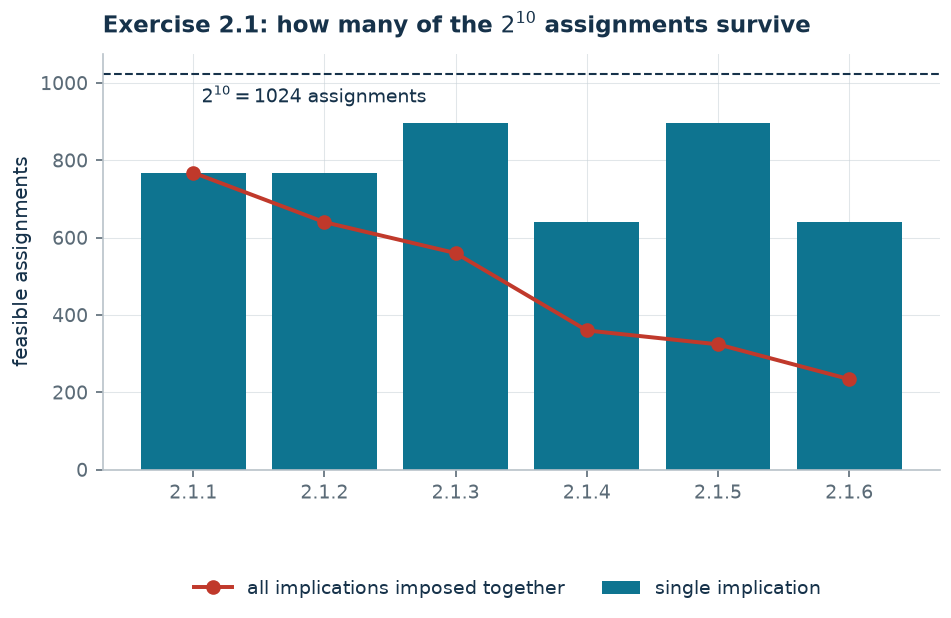
How much six implications cut
The \(2^{10} = 1024\) assignments drop to \(234\) once all six implications are imposed: less than a quarter. None of them, on its own, cuts more than half the space.
from booleane import cnf, vincolo, IMP, AND, OR, NOT, V

x = {p: V(f"x{p}") for p in range(1, 11)}
implications = [IMP(x[2], x[3]), IMP(x[2], NOT(x[4])),
                IMP(AND(x[1], x[6]), x[7]), IMP(OR(x[1], x[6]), x[8]),
                IMP(AND(x[2], x[3]), NOT(x[9])), IMP(OR(x[2], x[3]), NOT(x[10]))]

m = gp.Model("project_selection");  m.Params.OutputFlag = 0
xv = m.addVars(range(1, 11), vtype=GRB.BINARY, name="x")
m.setObjective(gp.quicksum(r[p] * xv[p] for p in range(1, 11)), GRB.MAXIMIZE)
m.addConstr(gp.quicksum(b[p] * xv[p] for p in range(1, 11)) <= budget, name="budget")
for i, formula in enumerate(implications, 1):          # one clause, one constraint
    for j, clause in enumerate(cnf(formula), 1):
        coef, sense, rhs = vincolo(clause)
        lhs = gp.quicksum(k * xv[int(n[1:])] for n, k in coef.items())
        m.addConstr(lhs <= rhs if sense == "<=" else lhs >= rhs, name=f"logic{i}_{j}")
m.optimize()
What this chapter has put in your hands
A logical condition between yes/no decisions is always written the same way: one binary per elementary fact, the condition brought into conjunctive normal form — a conjunction of ORs — and every clause becomes a linear inequality. The AND costs nothing, because constraints are already in AND with each other; the OR becomes a sum \(\ge 1\); the NOT becomes \(1 - x\); the implication \(x \Rightarrow y\) becomes \(x \le y\); the "if and only if" asks for both inequalities.
Three shapes recur often enough to have a name: the set covering (\(\sum_{j \in S} x_j \ge 1\), at least one), the set packing (\(\le 1\), at most one) and the set partitioning (\(= 1\), exactly one). Recognising them in a statement is half of the modelling work.
Code
The complete script is
python/cap02_logic.py,
which uses the module
python/booleane.py.
The notebook is
notebooks/cap02_logic.ipynb.
Show the complete script — python/cap02_logic.py (220 lines)
"""Chapter 5 -- Logic and binary variables: from CNF to linear constraints.

Turns the implications of the chapter's five exercises into conjunctive normal
form and then into linear constraints, and *proves by enumeration* that the
translation is exact: for every binary assignment, the formula is true if and
only if the linear system is satisfied. It ends with a project-selection model
that uses those constraints.
"""
import gurobipy as gp
import pandas as pd
from gurobipy import GRB

from booleane import (AND, IMP, NOT, OR, V, cnf, equivalenti, scrivi, testo_cnf,
                      valuta, variabili, verifica, vincolo)
from esteso import salva_modello
from mip import ammissibile, frazione, nuovo_modello, rilassamento, risolvi, stampa_soluzione
from stile import BLU, CICLO, ROSSO, TEAL, VERDE, intestazione, plt, salva_dati, salva_figura

R = range
x = {p: V(f"x{p}") for p in R(1, 11)}

# ---------- 1. THE PROPERTIES OF BOOLEAN ALGEBRA ----------
intestazione("1. De Morgan, distributivity, absorption: checked by enumeration")
a, b, c = V("xa"), V("xb"), V("xc")
PROPRIETA = [
    ("distributivity (C)", AND(a, OR(b, c)), OR(AND(a, b), AND(a, c))),
    ("distributivity (D)", OR(a, AND(b, c)), AND(OR(a, b), OR(a, c))),
    ("De Morgan (A)", NOT(OR(a, b)), AND(NOT(a), NOT(b))),
    ("De Morgan (B)", NOT(AND(a, b)), OR(NOT(a), NOT(b))),
    ("absorption (E)", OR(a, AND(a, b)), a),
    ("absorption (F)", AND(a, OR(a, b)), a),
    ("double negation", NOT(NOT(a)), a),
]
for nome, sinistra, destra in PROPRIETA:
    assert equivalenti(sinistra, destra), nome
    print(f"  {nome:22s} checked on all {2 ** len(variabili(sinistra) | variabili(destra))} assignments")

# ---------- 2. THE VALID SPLITS AND THE INVALID ONE ----------
intestazione("2. Splitting an implication: when it is allowed and when it is not")
scissioni = [
    ("disjunctive antecedent", IMP(OR(a, b), c), AND(IMP(a, c), IMP(b, c)), True),
    ("conjunctive consequent", IMP(a, AND(b, c)), AND(IMP(a, b), IMP(a, c)), True),
    ("conjunctive antecedent", IMP(AND(a, b), c), AND(IMP(a, c), IMP(b, c)), False),
]
for nome, sinistra, destra, attesa in scissioni:
    ok = equivalenti(sinistra, destra)
    assert ok == attesa, nome
    print(f"  {nome:24s} split {'valid' if ok else 'NOT valid'}")
contro = {"xa": 1, "xb": 0, "xc": 0}
assert valuta(IMP(AND(a, b), c), contro) and not valuta(AND(IMP(a, c), IMP(b, c)), contro)
print("  counterexample to the third: xa = 1, xb = 0, xc = 0 makes the original")
print("  implication true (false antecedent) but the conjunction of the splits false.")

# ---------- 3. THE FIVE EXERCISES: CNF AND LINEAR CONSTRAINTS ----------
intestazione("3. Exercises 2.1-2.5: conjunctive normal form and linear constraints")
ESERCIZI = {
    "2.1": [("if 2 is chosen, then 3 is chosen", IMP(x[2], x[3])),
            ("if 2 is chosen, then 4 is not chosen", IMP(x[2], NOT(x[4]))),
            ("if 1 and 6 are chosen, then 7 is chosen", IMP(AND(x[1], x[6]), x[7])),
            ("if 1 or 6 is chosen, then 8 is chosen", IMP(OR(x[1], x[6]), x[8])),
            ("if 2 and 3 are chosen, then 9 is not chosen", IMP(AND(x[2], x[3]), NOT(x[9]))),
            ("if 2 or 3 is chosen, then 10 is not chosen", IMP(OR(x[2], x[3]), NOT(x[10])))],
    "2.2": [("if 3 is not chosen, then 2 is chosen", IMP(NOT(x[3]), x[2])),
            ("if 4 is not chosen, then 2 is not chosen", IMP(NOT(x[4]), NOT(x[2]))),
            ("if 7 is chosen, then 1 and 6 are chosen", IMP(x[7], AND(x[1], x[6]))),
            ("if 8 is chosen, then 1 or 6 is chosen", IMP(x[8], OR(x[1], x[6]))),
            ("if 9 is not chosen, then 2 and 3 are chosen", IMP(NOT(x[9]), AND(x[2], x[3]))),
            ("if 10 is not chosen, then 2 or 3 is chosen", IMP(NOT(x[10]), OR(x[2], x[3])))],
    "2.3": [("if 7 or 3 is chosen, then 1 and 2 are chosen", IMP(OR(x[7], x[3]), AND(x[1], x[2]))),
            ("if 1, 6 and 7 are chosen, then 8 is chosen", IMP(AND(x[1], x[6], x[7]), x[8])),
            ("if 5 and 2 are chosen and 4 is not, then 3 is not chosen",
             IMP(AND(x[5], x[2], NOT(x[4])), NOT(x[3]))),
            ("if 6 and (1 or 4) are chosen, then 2 and (5 or 7) are chosen",
             IMP(AND(OR(x[1], x[4]), x[6]), AND(x[2], OR(x[5], x[7])))),
            ("if (2 or 5) is chosen and 8 is not, then 3 is chosen or 6 is not",
             IMP(AND(OR(x[2], x[5]), NOT(x[8])), OR(x[3], NOT(x[6])))),
            ("if (1 or 4) and (2 or 5) and not 8, then 3 and (not 6 or 7)",
             IMP(AND(OR(x[1], x[4]), OR(x[2], x[5]), NOT(x[8])),
                 AND(x[3], OR(NOT(x[6]), x[7]))))],
    "2.4": [("if 4 is chosen, at least two of 1, 2, 3",
             IMP(x[4], OR(AND(x[1], x[2]), AND(x[1], x[3]), AND(x[2], x[3])))),
            ("if at least two of 6, 7, 8, then 5",
             IMP(OR(AND(x[6], x[7]), AND(x[6], x[8]), AND(x[7], x[8])), x[5])),
            ("if 4 is not chosen, at least two of 1, 2, 3, 9",
             IMP(NOT(x[4]), OR(AND(x[1], x[2]), AND(x[1], x[3]), AND(x[1], x[9]),
                               AND(x[2], x[3]), AND(x[2], x[9]), AND(x[3], x[9])))),
            ("if 8 is chosen, then (1 and 6) or (1 and 7) or (2 and 6)",
             IMP(x[8], OR(AND(x[1], x[6]), AND(x[1], x[7]), AND(x[2], x[6])))),
            ("if at least two of 1, 3, 5, then 9 is not chosen",
             IMP(OR(AND(x[1], x[3]), AND(x[1], x[5]), AND(x[3], x[5])), NOT(x[9]))),
            ("if (1 and 2) or (3 and 4), then 5",
             IMP(OR(AND(x[1], x[2]), AND(x[3], x[4])), x[5]))],
    "2.5": [("if 1 or 2 is chosen, then 3 is chosen", IMP(OR(x[1], x[2]), x[3])),
            ("if 4 is chosen, then 5 and 6 are chosen", IMP(x[4], AND(x[5], x[6]))),
            ("if 1 or 2 is chosen, then 3 and 4 are chosen",
             IMP(OR(x[1], x[2]), AND(x[3], x[4]))),
            ("if 1 and 2 are chosen, then 3 is chosen", IMP(AND(x[1], x[2]), x[3])),
            ("if 5 or 6 is chosen, then 7 is not chosen", IMP(OR(x[5], x[6]), NOT(x[7]))),
            ("if 8 is not chosen or 9 is not chosen, then 10 is chosen",
             IMP(OR(NOT(x[8]), NOT(x[9])), x[10]))],
}
righe = []
for es, voci in ESERCIZI.items():
    print(f"\nExercise {es}")
    for i, (testo, formula) in enumerate(voci, 1):
        clausole = cnf(formula)
        vincoli = [vincolo(c) for c in clausole]
        totali, vere = verifica(formula, vincoli)
        print(f"  {es}.{i}  {testo}")
        print(f"        CNF ({len(clausole)} clauses) -> "
              + " ;  ".join(scrivi(v, mat=False) for v in vincoli))
        print(f"        equivalence checked on {totali} assignments "
              f"({vere} make the formula true)")
        righe.append({"exercise": es, "item": i, "description": testo,
                      "clauses": len(clausole),
                      "constraints": " ; ".join(scrivi(v, mat=False) for v in vincoli),
                      "assignments": totali, "true": vere})
salva_dati(pd.DataFrame(righe), "cap02_implicazioni")

# ---------- 4. CLAUSES OR COUNTING: TWO FORMULATIONS OF THE SAME SET ----------
intestazione("4. 'At least two of 1, 2, 3 if 4 is chosen': clauses versus counting")


def confronta(clausole=True):
    """max x1+x2+x3+3 x4 with the implication x4 => at least two of 1,2,3."""
    m = nuovo_modello("at_least_two")
    v = m.addVars(R(1, 5), vtype=GRB.BINARY, name="x")
    m.setObjective(v[1] + v[2] + v[3] + 3 * v[4], GRB.MAXIMIZE)
    m.addConstr(v[1] + v[2] + v[3] + 2 * v[4] <= 3, name="budget")
    if clausole:                       # three clauses: x_i + x_j >= x4 for every pair
        for i, j in [(1, 2), (1, 3), (2, 3)]:
            m.addConstr(v[i] + v[j] - v[4] >= 0, name=f"pair{i}{j}")
    else:                              # counted form: x1 + x2 + x3 >= 2 x4
        m.addConstr(v[1] + v[2] + v[3] - 2 * v[4] >= 0, name="counting")
    return m, v


for nome, cl in [("three clauses", True), ("one counted constraint", False)]:
    m, v = confronta(cl)
    z = risolvi(m)
    zr, sol, _ = rilassamento(m, rafforzato=True)
    print(f"  {nome:24s} z(MILP) = {frazione(z)}   z(LP+) = {frazione(zr)}   "
          + "  ".join(f"x{p}={frazione(sol[f'x[{p}]'])}" for p in R(1, 5)))
from itertools import product as _p
for valori in _p((0, 1), repeat=4):
    a4 = dict(zip(R(1, 5), valori))
    cl3 = all(a4[i] + a4[j] - a4[4] >= 0 for i, j in [(1, 2), (1, 3), (2, 3)])
    cnt = a4[1] + a4[2] + a4[3] - 2 * a4[4] >= 0
    assert cl3 == cnt, a4
print("  The two formulations have the same 16 binary solutions (checked by")
print("  enumeration) but different relaxations: the counted constraint is stronger.")

# ---------- 5. A SELECTION MODEL WITH THE LOGICAL CONSTRAINTS ----------
intestazione("5. Project selection subject to the implications of exercise 2.1")
r = {1: 9, 2: 7, 3: 4, 4: 8, 5: 3, 6: 6, 7: 2, 8: 5, 9: 7, 10: 6}   # revenues
b = {1: 4, 2: 3, 3: 2, 4: 4, 5: 2, 6: 3, 7: 1, 8: 3, 9: 4, 10: 3}   # costs
budget = 14
salva_dati(pd.DataFrame({"project": list(r), "revenue": list(r.values()),
                         "cost": list(b.values())}), "cap02_progetti")


def modello_selezione(con_logica=True):
    m = nuovo_modello("project_selection")
    xv = m.addVars(R(1, 11), vtype=GRB.BINARY, name="x")
    m.setObjective(gp.quicksum(r[p] * xv[p] for p in R(1, 11)), GRB.MAXIMIZE)
    m.addConstr(gp.quicksum(b[p] * xv[p] for p in R(1, 11)) <= budget, name="budget")
    if con_logica:
        for i, (_, formula) in enumerate(ESERCIZI["2.1"], 1):
            for j, cl in enumerate(cnf(formula), 1):
                coef, verso, rhs = vincolo(cl)
                lhs = gp.quicksum(k * xv[int(n[1:])] for n, k in coef.items())
                m.addConstr(lhs <= rhs if verso == "<=" else lhs >= rhs, name=f"logic{i}_{j}")
    return m, xv


m_libero, _ = modello_selezione(con_logica=False)
z_libero = risolvi(m_libero)
m_log, x_log = modello_selezione(con_logica=True)
salva_modello(m_log, "cap02_progetti")
z_log = risolvi(m_log)
zlp_log, _, _ = rilassamento(m_log, rafforzato=True)
scelti = sorted(p for p in R(1, 11) if x_log[p].X > 0.5)
print(f"Without the logical constraints:  z = {frazione(z_libero)}")
print(f"With the logical constraints:     z = {frazione(z_log)}   projects chosen: {scelti}")
print(f"                                  cost {sum(b[p] for p in scelti)} out of a budget of {budget}")
print(f"LP+ relaxation of the model with the logical constraints: {frazione(zlp_log)}")
for _, formula in ESERCIZI["2.1"]:
    assert valuta(formula, {f"x{p}": int(p in scelti) for p in R(1, 11)})
print("All six implications are satisfied by the optimal solution.")
salva_dati(pd.DataFrame([{"model": "without logical constraints", "z": z_libero, "z_lp": None},
                         {"model": "with logical constraints", "z": z_log, "z_lp": zlp_log}]),
           "cap02_selezione")

# ---------- 6. FIGURE: HOW MANY ASSIGNMENTS SURVIVE EACH IMPLICATION ----------
sopravvivono = []
etichette = []
for i, (testo, formula) in enumerate(ESERCIZI["2.1"], 1):
    totali, vere = verifica(formula, nomi=[f"x{p}" for p in R(1, 11)])
    sopravvivono.append(vere)
    etichette.append(f"2.1.{i}")
tutte = [dict(zip([f"x{p}" for p in R(1, 11)], v)) for v in _p((0, 1), repeat=10)]
cumulate = []
vive = tutte
for testo, formula in ESERCIZI["2.1"]:
    vive = [ass for ass in vive if valuta(formula, ass)]
    cumulate.append(len(vive))
print(f"Assignments of the 10 binaries: {len(tutte)}; after the six implications: {cumulate[-1]}")
fig, ax = plt.subplots(figsize=(7.2, 3.6))
ax.bar(etichette, sopravvivono, color=TEAL, label="single implication")
ax.plot(etichette, cumulate, "o-", color=ROSSO, label="all implications imposed together")
ax.axhline(len(tutte), color=BLU, lw=1, ls="--")
ax.annotate(f"$2^{{10}} = {len(tutte)}$ assignments", (0, len(tutte)),
            textcoords="offset points", xytext=(4, -14), fontsize=9, color=BLU)
ax.set_ylabel("feasible assignments")
ax.set_title("Exercise 2.1: how many of the $2^{10}$ assignments survive")
ax.legend(loc="lower left", fontsize=9)
salva_figura(fig, "cap02_implicazioni")
salva_dati(pd.DataFrame({"implication": etichette, "single": sopravvivono,
                         "cumulative": cumulate}), "cap02_ammissibili")
print("Done.")