Diet with a count of the foods and a minimum lot
Class: MILP · Links: minimum lot (semicontinuous), counting the types · Script: python/fam10_3_diet.py
Difficulty: ★★★☆☆ · Time: 30–45 min

Problem 10.3
A nutritionist has to compose a monthly diet choosing among \(s \in \mathbb{Z}_{\ge 1}\) foods and controlling \(r \in \mathbb{Z}_{\ge 1}\) nutrients. For every food \(i \in \{1, 2, \dots, s\}\), the value \(w_i \in \mathbb{Q}_{>0}\) is the cost of one kilo; for every food \(i\) and every nutrient \(j \in \{1, 2, \dots, r\}\), the value \(g_{ij} \in \mathbb{Q}_{\ge 0}\) is the amount of nutrient \(j\) contained in one kilo of food \(i\). For every nutrient \(j\), the monthly intake must lie between \(a_j \in \mathbb{Q}_{>0}\) and \(b_j \in \mathbb{Q}_{>0}\). If a food enters the diet, at least \(c_i \in \mathbb{Q}_{>0}\) kilos and at most \(d_i \in \mathbb{Q}_{>0}\) must be consumed. The diet must include at least \(t \in \mathbb{Z}_{\ge 1}\) different foods. The cheapest diet is wanted.
The problem in words. We decide which foods to use and in what amounts. The objective: minimum cost. The constraints: every nutrient within its window; every chosen food in an amount between the minimum lot and the cap; at least \(t\) different foods.
Model
Variables. \(x_i \ge 0\) kilos of food \(i\) consumed in the month; \(y_i \in \{0,1\}\) equals \(1\) if food \(i\) enters the diet.
Description. The objective is the total cost. The minimum requirement constraints, one per nutrient, impose the lower threshold; the cap constraints, again one per nutrient, the upper one. The minimum lot and activation constraints, one per food each, make \(x_i\) semicontinuous: either zero, or between \(c_i\) and \(d_i\). The variety constraint, a single one, requires at least \(t\) foods actually bought.
Why the minimum lot is needed for the count
The variety constraint counts the indicators \(y_i\), not the quantities. If only the activation constraint were there, the indicator could be \(1\) with \(x_i = 0\): foods would be "switched on" without a gram being consumed, and the variety constraint would be satisfied by empty indicators. It is the one-way link of the if and only if technique, and here it produces a model that does not describe the problem.
The minimum lot closes the circle: with \(y_i = 1\) one has \(x_i \ge c_i > 0\), so every switched-on indicator corresponds to a food actually consumed. On the instance, setting \(c_i = 0\) drops the optimum from \(48/5\) to \(46/5\) and the solution "switches on" four foods, two of them with zero quantity: the count no longer says anything.
The model in gurobipy
m = gp.Model("diet")
x = m.addVars(s, name="x")
y = m.addVars(s, vtype=GRB.BINARY, name="y")
m.setObjective(gp.quicksum(w[i] * x[i] for i in range(s)), GRB.MINIMIZE)
m.addConstrs((gp.quicksum(g[i][j] * x[i] for i in range(s)) >= a[j] for j in range(r)),
             name="minimum")
m.addConstrs((gp.quicksum(g[i][j] * x[i] for i in range(s)) <= b[j] for j in range(r)),
             name="maximum")
m.addConstrs((x[i] - c[i] * y[i] >= 0 for i in range(s)), name="minimum_lot")
m.addConstrs((x[i] - d[i] * y[i] <= 0 for i in range(s)), name="activate")
m.addConstr(gp.quicksum(y[i] for i in range(s)) >= t, name="variety")
The instance
\(s = 4\) foods, \(r = 2\) nutrients, \(c_i = 1\), \(d_i = 8\), \(t = 3\).
| milk | rice | bread | potatoes | |
|---|---|---|---|---|
| \(w_i\) (euro/kg) | 2 | 3 | 1 | 4 |
| iron (g/kg) | 10 | 20 | 5 | 25 |
| calcium (g/kg) | 5 | 10 | 15 | 5 |
| iron | calcium | |
|---|---|---|
| \(a_j\) | 60 | 40 |
| \(b_j\) | 200 | 150 |
The model written on the data of the instance:
Constructive heuristic: the primal bound
The \(t\) cheapest foods are switched on at their minimum lot, then the residual requirement of each nutrient is covered by adding the already-switched-on food with the lowest cost per gram.
On the instance the three cheapest foods are bread (\(1\)), milk (\(2\)) and rice (\(3\)): they are switched on at the minimum lot, that is \(1\) kg each. With these amounts one has \(35\) grams of iron (60 are needed) and \(30\) of calcium (40 are needed).
- Iron: \(25\) grams are missing. Among the switched-on foods the lowest cost per gram of iron is rice, \(3/20 = 0.15\); \(1.25\) kg more are needed, and rice reaches \(2.25\) kg.
- Calcium: after the addition one has \(42.5\) grams, already above the minimum of \(40\): nothing else is needed.
The final diet is milk \(1\) kg, rice \(2.25\) kg, bread \(1\) kg, for a cost of \(z(\mathit{MILP}) \le \mathit{UB} = 39/4 = 9.75\).
LP relaxation and dual: the dual bound
Associate \(\alpha_j \ge 0\) with the minima, \(\beta_j \ge 0\) with the maxima, \(\lambda_i \ge 0\) with the minimum lots, \(\mu_i \ge 0\) with the caps and \(\tau \ge 0\) with variety.
The same dual, written on the data of the instance:
Description. \(\alpha_j\) is the price of one unit of nutrient \(j\) when it serves to reach the minimum requirement, \(\beta_j\) what is paid not to exceed the cap, \(\lambda_i\) and \(\mu_i\) the prices of the two semicontinuity constraints of food \(i\), and \(\tau\) the price of variety. The objective collects the requirements priced at \(\alpha\), pays the caps priced at \(\beta\) and collects the threshold \(t\) priced at \(\tau\). The first group of constraints are the columns of the \(x_i\): the nutritional content of one kilo of food \(i\), priced at \(\alpha_j - \beta_j\) and corrected by the two semicontinuity constraints, cannot exceed the price \(w_i\) of that food. The second are the columns of the \(y_i\): switching on food \(i\) grants \(c_i\) units of minimum lot at price \(\lambda_i\), forces at most \(d_i\) at price \(\mu_i\), and must cover the price \(\tau\) of variety.
Recipe. Set \(\beta = \mu = \tau = 0\): caps and variety are not priced, and the constraints on the \(y_i\) become \(-c_i\, \lambda_i \le 0\), satisfied with \(\lambda = 0\). What remains is \(\sum_j g_{ij}\, \alpha_j \le w_i\) for every food: price one nutrient only, at the lowest cost per gram among the foods,
and keep the nutrient that gives the larger bound. On the instance iron gives \(60 \cdot 3/20 = 9\) and calcium \(40 \cdot 1/15 = 8/3\): iron wins, and \(z(\mathit{MILP}) \ge \mathit{LB} = 9\).
Optimal solution
The optimal diet is rice \(1.4\) kg, bread \(1.4\) kg, potatoes \(1\) kg: three different foods, as required, with \(60\) grams of iron (exactly the minimum) and \(40\) of calcium (again exactly the minimum).
| \(LB\) (dual) | \(z(\mathit{LP})\) | \(z(\mathit{LP}^+)\) | \(z(\mathit{MILP})\) | \(UB\) (heuristic) | heuristic gap |
|---|---|---|---|---|---|
| 9 | \(46/5\) | \(48/5\) | \(48/5\) | \(39/4\) | \(1.6\%\) |
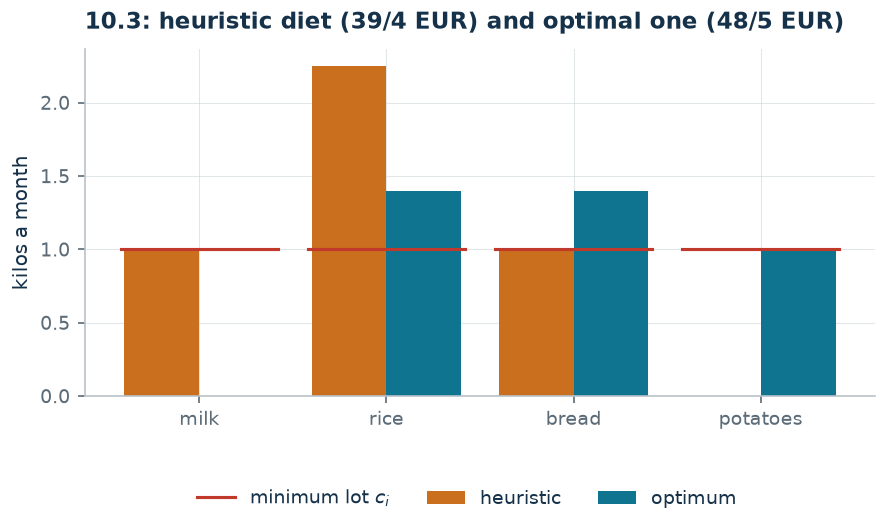
It is the tightest sandwich in the chapter. Here the relaxation with the bounds coincides with the integer optimum, while the one without them sits below: adding \(y_i \le 1\) matters, because the caps \(d_i = 8\) are far wider than the quantities at play and without that limit the relaxation would use fractional indicators greater than one.
Additional considerations
- The maximum constraints are not active at the optimum (\(60 \le 200\) and \(40 \le 150\)): on this instance they could be dropped without changing anything. They stay in the model because the problem requires them, and because on other instances they would bite.
- The classical form of the diet problem (Stigler, 1945) has neither minimum lots nor counts: it is a pure LP. It is exactly the two integer additions that make it a MILP, and that is why the problem belongs to this chapter.
- The variety constraint could also be written as a covering one: at least one food from each food group, that is \(\sum_{i \in G_k} y_i \ge 1\) for every group \(k\). It is a nutritionally more informative formulation, and no harder.
Additional modelling questions
10.3.1 — A higher minimum lot
The minimum lot rises from \(1\) to \(2\) kilos for every chosen food. How does the model change? What is the new optimum?
A worked variant: more variety
At least four different foods are wanted instead of three.
Only the datum \(t\) changes, from \(3\) to \(4\). On the instance the optimum rises to \(31/3 \approx 10.23\): one is forced to buy at least one kilo of the most expensive food (the potatoes) or to rearrange the quantities. The cost of variety is therefore \(31/3 - 48/5 = 11/15 \approx 0.73\) euros a month. With \(t = s\) the constraint becomes "all the foods", and the model stiffens until it coincides with the case in which all the indicators are one.
The variant changes a datum, \(t = 4\), not the structure. The count of the foods, however, is not priced: \(\tau\) enters the objective with its right-hand side, but the column of the \(y_i\) imposes \(\tau \le c_i \lambda_i - d_i \mu_i\), and with the recipe of the base problem — \(\lambda = \mu = 0\) and a single positive \(\alpha\), on iron — it stays \(\tau = 0\). The dual bound does not move, the optimum does: the heuristic switches on the fourth food at its minimum lot, completes with bread and reaches \(31/3\), which is the optimum.
| value | what it is | |
|---|---|---|
| \(\mathit{UB}\) | \(\frac{31}{3}\) | heuristic solution |
| \(\mathit{LB}\) | \(9\) | dual certificate built by hand |
| \(z(\mathit{LP})\) | \(\frac{28}{3}\) | relaxation without the bounds |
| \(z(\mathit{LP}^+)\) | \(\frac{31}{3}\) | relaxation with the bounds |
| \(z(\mathit{MILP})\) | \(\frac{31}{3}\) | optimum of the MILP |
Code
Complete script —
python/fam10_3_diet.py
(reproducible with python3 python/fam10_3_diet.py from the python/ folder).
Notebook —
notebooks/fam10_3_diet.ipynb
— which opens in Colab from the badge at the top of the page.
Show the complete script — python/fam10_3_diet.py (241 lines)
"""Problem 10.3 -- Diet with a count of the foods and a minimum lot.

A classic diet (continuous quantities, two-sided nutritional constraints) with
three integer techniques on top: activation (3.2), minimum lot (3.3) and counting
of the types (3.11). Without the minimum lot the count "at least t different
foods" would be empty: indicators would switch on with zero quantity.
"""
import gurobipy as gp
import pandas as pd
from gurobipy import GRB

from mip import (ammissibile, dualita_forte, due_rilassamenti, frazione,
                 nuovo_modello, registra_bound, rilassamenti, rilassamento, risolvi,
                 valuta)
from stile import ARANCIO, BLU, ROSSO, TEAL, VERDE, intestazione, plt, salva_dati, salva_figura
from esteso import salva_modello

R = range

# ---------- 1. MODEL AND INSTANCE ----------
intestazione("10.3 Diet: minimum cost with at least t different foods and a minimum lot")
CIBI = ["milk", "rice", "bread", "potatoes"]
NUTRIENTI = ["iron", "calcium"]
w2 = [2, 3, 1, 4]                      # cost per kilo
g2 = [[10, 5], [20, 10], [5, 15], [25, 5]]   # grams of nutrient j per kilo of food i
a2 = [60, 40]                          # monthly minimum of each nutrient
b2 = [200, 150]                        # monthly maximum
c2 = [1, 1, 1, 1]                      # minimum quantity if the food is chosen
d2 = [8, 8, 8, 8]                      # maximum quantity
t2 = 3                                 # at least three different foods
s2, r2 = len(w2), len(a2)
salva_dati(pd.DataFrame({"food": CIBI, "cost": w2,
                         "iron": [g[0] for g in g2], "calcium": [g[1] for g in g2],
                         "min": c2, "max": d2}), "fam10_3_dati")


def modello_2(w, g, a, b, c, d, t):
    s, r = len(w), len(a)
    m = nuovo_modello("diet")
    x = m.addVars(s, name="x")                        # kilos of each food
    y = m.addVars(s, vtype=GRB.BINARY, name="y")      # food present in the diet
    m.setObjective(gp.quicksum(w[i] * x[i] for i in R(s)), GRB.MINIMIZE)
    m.addConstrs((gp.quicksum(g[i][j] * x[i] for i in R(s)) >= a[j] for j in R(r)),
                 name="minimum")
    m.addConstrs((gp.quicksum(g[i][j] * x[i] for i in R(s)) <= b[j] for j in R(r)),
                 name="maximum")
    m.addConstrs((x[i] - c[i] * y[i] >= 0 for i in R(s)), name="minimum_lot")
    m.addConstrs((x[i] - d[i] * y[i] <= 0 for i in R(s)), name="activate")
    m.addConstr(gp.quicksum(y[i] for i in R(s)) >= t, name="variety")
    return m, x, y


def duale_2(w, g, a, b, c, d, t):
    """max sum_j a_j alpha_j - sum_j b_j beta_j + t tau
       s.t.  sum_j g_ij (alpha_j - beta_j) + lam_i - mu_i <= w_i        (column x_i)
             -c_i lam_i + d_i mu_i + tau <= 0                            (column y_i)
             alpha, beta, lam, mu, tau >= 0."""
    s, r = len(w), len(a)
    dl = nuovo_modello("dual_diet")
    alpha = dl.addVars(r, name="alpha")
    beta = dl.addVars(r, name="beta")
    lam = dl.addVars(s, name="lam")
    mu = dl.addVars(s, name="mu")
    tau = dl.addVar(name="tau")
    dl.setObjective(gp.quicksum(a[j] * alpha[j] for j in R(r))
                    - gp.quicksum(b[j] * beta[j] for j in R(r)) + t * tau, GRB.MAXIMIZE)
    dl.addConstrs((gp.quicksum(g[i][j] * (alpha[j] - beta[j]) for j in R(r))
                   + lam[i] - mu[i] <= w[i] for i in R(s)), name="rc_x")
    dl.addConstrs((-c[i] * lam[i] + d[i] * mu[i] + tau <= 0 for i in R(s)), name="rc_y")
    return dl


m2, x2, y2 = modello_2(w2, g2, a2, b2, c2, d2, t2)
salva_modello(m2, "fam10_3_primale")

# ---------- 2. THE LP RELAXATION ----------
zlp2, zlp2r, _ = rilassamenti(m2)

# ---------- 3. THE DUAL OF THE RELAXATION (LOWER BOUND) ----------
dl2 = duale_2(w2, g2, a2, b2, c2, d2, t2)
salva_modello(dl2, "fam10_3_duale")
# recipe: beta = mu = tau = 0 (maxima, caps and variety are not priced);
# a single nutrient is priced, at the lowest cost per gram among the foods
mano, migliore, scelto = {}, -1.0, None
for j in R(r2):
    prova = {f"alpha[{jj}]": (min(w2[i] / g2[i][jj] for i in R(s2) if g2[i][jj] > 0)
                              if jj == j else 0.0) for jj in R(r2)}
    val, viol = valuta(dl2, prova)
    if viol <= 1e-9 and val > migliore:
        migliore, scelto, mano = val, j, prova
lb2, viol = valuta(dl2, mano)
assert viol <= 1e-9, viol
print("  Hand-built dual: beta = mu = tau = 0 (maxima, caps and variety are not priced) and")
print("  a single positive alpha_j, equal to the lowest cost per gram among the foods:")
for j in R(r2):
    prezzo = min(w2[i] / g2[i][j] for i in R(s2) if g2[i][j] > 0)
    print(f"    {NUTRIENTI[j]}: price {frazione(prezzo)} EUR/g  ->  a_j * price = "
          f"{frazione(a2[j] * prezzo)}")
print(f"  The best one is {NUTRIENTI[scelto]}:  lb = {frazione(lb2)}")
dualita_forte(dl2, zlp2)

# ---------- 4. CONSTRUCTIVE HEURISTIC (UPPER BOUND) ----------
# constructive heuristic: start from the minimum lot of the t cheapest foods, then cover the residual
# requirement with the food that has the lowest cost per gram
def euristica(w, g, a, b, c, d, t):
    s, r = len(w), len(a)
    x = [0.0] * s
    scelti = sorted(R(s), key=lambda i: (w[i], i))[:t]
    for i in scelti:
        x[i] = c[i]
    passi = [f"the {t} cheapest foods are switched on at their minimum lot: "
             + ", ".join(f"{CIBI[i]} ({c[i]} kg)" for i in scelti)]
    for j in R(r):
        while sum(g[i][j] * x[i] for i in R(s)) < a[j] - 1e-9:
            # the food, already switched on, with the lowest cost per gram of nutrient j
            cand = [i for i in scelti if g[i][j] > 0 and x[i] < d[i] - 1e-9]
            if not cand:
                return None, passi + [f"no active food can cover the {NUTRIENTI[j]}"]
            i = min(cand, key=lambda i: w[i] / g[i][j])
            manca = a[j] - sum(g[k][j] * x[k] for k in R(s))
            aggiunta = min(manca / g[i][j], d[i] - x[i])
            x[i] += aggiunta
            passi.append(f"{NUTRIENTI[j]}: {manca:.4g} g are missing; {aggiunta:.4g} kg of "
                         f"{CIBI[i]} are added (cost per gram {w[i] / g[i][j]:.4g})")
    return x, passi


x_eur, passi = euristica(w2, g2, a2, b2, c2, d2, t2)
for k, riga in enumerate(passi, 1):
    print(f"  Step {k}. {riga}")
ub2 = sum(w2[i] * x_eur[i] for i in R(s2))
sol_eur = {f"x[{i}]": x_eur[i] for i in R(s2)} | {f"y[{i}]": 1 if x_eur[i] > 1e-9 else 0
                                                 for i in R(s2)}
assert ammissibile(m2, sol_eur), sol_eur
print("  Heuristic solution: " + ", ".join(f"{CIBI[i]} {x_eur[i]:.4g} kg" for i in R(s2)
                                           if x_eur[i] > 1e-9)
      + f"   ub = {frazione(ub2)}")

# ---------- 5. WITHOUT THE MINIMUM LOT THE COUNT IS EMPTY ----------
intestazione("10.3 Why the count needs the minimum lot")
m, x, y = modello_2(w2, g2, a2, b2, [0] * s2, d2, t2)   # c_i = 0: no minimum lot
z_senza = risolvi(m)
accesi = [CIBI[i] for i in R(s2) if y[i].X > 0.5]
vuoti = [CIBI[i] for i in R(s2) if y[i].X > 0.5 and x[i].X < 1e-9]
print(f"  With c_i = 0 the optimum drops to {frazione(z_senza)} and the 'active' foods are "
      f"{accesi},")
print(f"  but of these the following have zero quantity: {vuoti}. The variety constraint is")
print("  satisfied by empty indicators: without a minimum lot the count says nothing.")
assert vuoti, "with c = 0 empty indicators must appear"

# ---------- 6. OPTIMUM OF THE MILP ----------
z2 = risolvi(m2)
print("  Optimal solution: " + ", ".join(f"{CIBI[i]} {x2[i].X:.4g} kg" for i in R(s2)
                                         if x2[i].X > 1e-9)
      + f"   ({int(sum(y2[i].X for i in R(s2)))} different foods, {t2} required)")
for j in R(r2):
    print(f"    {NUTRIENTI[j]}: {sum(g2[i][j] * x2[i].X for i in R(s2)):.4g} g "
          f"(between {a2[j]} and {b2[j]})")
riga = registra_bound("2 diet", ub2, lb2, zlp2, zlp2r, z2)
salva_dati(pd.DataFrame([riga]), "fam10_3_bound")
assert lb2 <= zlp2 <= z2 <= ub2 + 1e-9

# ---------- 7. ADDITIONAL MODELLING QUESTIONS ----------
varianti = {}


def variante(nome, m):
    z = risolvi(m)
    print(f"  {nome:70s} z = {frazione(z)}")
    return z


# 2a: the minimum lot rises to 2 kg for every chosen food
m, x, y = modello_2(w2, g2, a2, b2, [2] * s2, d2, t2)
varianti["3a"] = variante("3a. The minimum lot rises to 2 kg per food (c_i = 2)", m)
# 2b: at least four different foods are wanted
m, x, y = modello_2(w2, g2, a2, b2, c2, d2, 4)
varianti["3b"] = variante("3b. At least four different foods are wanted (t = 4)", m)
salva_dati(pd.DataFrame({"variant": list(varianti), "z": list(varianti.values())}),
           "fam10_3_varianti")

# ---------- 8. THE SANDWICH ON THE VARIANT 2b ----------
intestazione("10.3b The sandwich on the variant: at least four different foods")
T2B = 4

# The variant changes a datum, not the structure: model, dual and heuristic are
# the same with t = 4. What changes is the value of the certificate --- and above
# all the heuristic, which must switch on one more food at its minimum lot.
m2b, x2b, y2b = modello_2(w2, g2, a2, b2, c2, d2, T2B)
salva_modello(m2b, "fam10_3b_primale")
dl2b = duale_2(w2, g2, a2, b2, c2, d2, T2B)
salva_modello(dl2b, "fam10_3b_duale")

# -- feasible heuristic: the same rule, with one more food --
x_2b, passi_2b = euristica(w2, g2, a2, b2, c2, d2, T2B)
assert x_2b is not None, "the heuristic must stay feasible with four foods"
for i, s in enumerate(passi_2b, 1):
    print(f"  Step {i}. {s}")
ub2b = sum(w2[i] * x_2b[i] for i in R(s2))
sol_2b = ({f"x[{i}]": x_2b[i] for i in R(s2)}
          | {f"y[{i}]": (1 if x_2b[i] > 1e-9 else 0) for i in R(s2)})
assert ammissibile(m2b, sol_2b), "the heuristic solution of the variant must be feasible"
print(f"  ub = {frazione(ub2b)}")

# -- dual certificate: the same recipe, on t = 4 --
mano_2b, migliore_2b, scelto_2b = {}, -1.0, None
for j in R(r2):
    prova = {f"alpha[{jj}]": (min(w2[i] / g2[i][jj] for i in R(s2) if g2[i][jj] > 0)
                              if jj == j else 0.0) for jj in R(r2)}
    val, viol = valuta(dl2b, prova)
    if viol <= 1e-9 and val > migliore_2b:
        migliore_2b, scelto_2b, mano_2b = val, j, prova
lb2b, viol_2b = valuta(dl2b, mano_2b)
assert viol_2b <= 1e-9, viol_2b
print("Dual solution by hand: the same recipe as the base problem --- beta = mu = tau = 0 and")
print(f"  a single positive alpha, on {NUTRIENTI[scelto_2b]}. Variety is not priced: tau")
print("  enters the objective with its right-hand side t, but the column of the y_i imposes")
print("  tau <= c_i lam_i - d_i mu_i, and with lam = mu = 0 it stays tau = 0. Asking for one")
print("  more food does not move the hand-built dual bound, but it does move the optimum.")
print(f"  ->  lb = {frazione(lb2b)}")
zlp2b, zlp2br, _ = due_rilassamenti(m2b, dl2b)
z2b = risolvi(m2b)
riga_2b = registra_bound("3b at least four foods", ub2b, lb2b, zlp2b, zlp2br, z2b)
salva_dati(pd.DataFrame([riga_2b]), "fam10_3b_bound")
assert lb2b <= zlp2b <= z2b <= ub2b + 1e-9

# ---------- 9. FIGURE ----------
fig, ax = plt.subplots(figsize=(6.8, 3.0))
idx = list(R(s2))
ax.bar([i - 0.2 for i in idx], [x_eur[i] for i in idx], 0.4, color=ARANCIO, label="heuristic")
ax.bar([i + 0.2 for i in idx], [x2[i].X for i in idx], 0.4, color=TEAL, label="optimum")
for i in idx:
    ax.plot([i - 0.42, i + 0.42], [c2[i], c2[i]], color=ROSSO, lw=1.5)
ax.plot([], [], color=ROSSO, lw=1.5, label="minimum lot $c_i$")
ax.set_xticks(idx)
ax.set_xticklabels(CIBI)
ax.set_ylabel("kilos a month")
ax.set_title(f"10.3: heuristic diet ({frazione(ub2)} EUR) and optimal one ({frazione(z2)} EUR)")
ax.legend(fontsize=8)
salva_figura(fig, "cap10_dieta_ottimo")
print("Done.")