Shipments in boxes
Class: MILP · Links: capacity with rounding up · Script: python/fam10_5_shipments.py
Difficulty: ★★★★☆ · Time: 45–60 min

Problem 10.5
A company has to organise the shipments from its \(n \in \mathbb{Z}_{\ge 1}\) plants to its \(m \in \mathbb{Z}_{\ge 1}\) customers. The company makes \(k \in \mathbb{Z}_{\ge 1}\) types of product. Products are shipped in boxes: every box travels directly from one plant to one customer and has a maximum capacity \(w \in \mathbb{Z}_{\ge 1}\), expressed as the maximum number of product units it can carry. For every product \(p\) and every customer \(c\), the value \(d_{pc} \in \mathbb{Z}_{\ge 0}\) is the number of units ordered. For every product \(p\) and every plant \(s\), the value \(a_{ps} \in \mathbb{Z}_{\ge 0}\) is the number of units available. The company wants a shipping plan that minimises the total number of boxes used.
The problem in words. We decide how many units of each product to ship from each plant to each customer, and how many boxes are needed on each leg. The objective: minimum number of boxes. The constraints: every order met exactly, no plant beyond its stock, and enough boxes on every leg for the units loaded.
Model
For brevity \(P = \{1, 2, \dots, k\}\) is the set of products, \(S = \{1, 2, \dots, n\}\) the set of plants and \(C = \{1, 2, \dots, m\}\) the set of customers.
Variables. \(x_{psc} \in \mathbb{Z}_{\ge 0}\) units of product \(p\) shipped from \(s\) to \(c\); \(y_{sc} \in \mathbb{Z}_{\ge 0}\) boxes shipped from \(s\) to \(c\).
Description. The objective counts the boxes used on all the legs. The demand constraints, one per product–customer pair, say that every order is met exactly. The availability constraints, one per product–plant pair, do not allow shipping more than the plant has. The capacity constraints, one per leg, say that the boxes shipped from \(s\) to \(c\) are enough to hold the units loaded.
The link is a rounding up
The capacity constraint reads
and since \(y_{sc}\) is integer and non-negative this is equivalent to
The ceiling never appears in the model: integrality produces it. The same constraint also imposes the implication
that is: if even a single unit leaves a plant towards a customer, then at least one box must travel on that leg. The contrapositive is more readable: if \(y_{sc} = 0\) then \(\sum_p x_{psc} = 0\). The converse — if nothing is shipped then no box — is not imposed by the constraint but follows from optimality, because every box costs \(1\).
The model in gurobipy
m = gp.Model("shipments")
x = m.addVars(nk, nn, nm, vtype=GRB.INTEGER, name="x")
y = m.addVars(nn, nm, vtype=GRB.INTEGER, name="y")
m.setObjective(y.sum(), GRB.MINIMIZE)
m.addConstrs((x.sum(p, "*", c) == d[p][c] for p in range(nk) for c in range(nm)),
             name="demand")
m.addConstrs((x.sum(p, s, "*") <= a[p][s] for p in range(nk) for s in range(nn)),
             name="availability")
m.addConstrs((w * y[s, c] - x.sum("*", s, c) >= 0 for s in range(nn) for c in range(nm)),
             name="capacity")
The instance
\(n = 2\) plants, \(m = 2\) customers, \(k = 2\) products, \(w = 10\).
| \(d_{pc}\) | \(c=1\) | \(c=2\) |
|---|---|---|
| \(p=1\) | 5 | 0 |
| \(p=2\) | 2 | 4 |
| \(a_{ps}\) | \(s=1\) | \(s=2\) |
|---|---|---|
| \(p=1\) | 8 | 6 |
| \(p=2\) | 5 | 7 |
The units to ship are \(5 + 0 + 2 + 4 = 11\) in all.
The model written on the data of the instance:
Constructive heuristic: the primal bound
Customer by customer: one tries to serve them from a single plant, the one that has everything needed; if none suffices, the order is split among several plants. At the end \(\lceil \cdot / w \rceil\) boxes are counted per leg.
On the instance customer 1 asks for \(5\) units of product 1 and \(2\) of product 2: plant 1 has \(8\) and \(5\), so it suffices alone. Customer 2 asks for \(4\) units of product 2: after the first shipment plant 1 has \(3\) left, plant 2 has \(7\), so the shipment leaves from there. There are two legs, with \(7\) and \(4\) units: one box each.
LP relaxation and dual: the dual bound
Associate \(\alpha_{pc}\) free with demand, \(\beta_{ps} \le 0\) with availability and \(\gamma_{sc} \ge 0\) with capacity.
The same dual, written on the data of the instance:
Description. \(\alpha_{pc}\) is the value of one unit of product \(p\) delivered to customer \(c\), \(\beta_{ps}\) the (non-positive) price of availability, and \(\gamma_{sc}\) the price of one unit of space on the leg from \(s\) to \(c\). The objective prices orders and availabilities at those values. The first group of constraints are the columns of the \(x_{psc}\): shipping one unit is worth \(\alpha_{pc} + \beta_{ps}\) and takes up one unit of space at price \(\gamma_{sc}\); the balance cannot be positive, because those variables do not appear in the objective. The second are the columns of the \(y_{sc}\): one box offers \(w\) units of space, and their value cannot exceed \(1\).
Recipe. The box constraint bounds \(\gamma_{sc} \le 1/w\): take the maximum, \(\bar\gamma_{sc} = 1/w\). With \(\bar\beta = 0\) what remains is \(\alpha_{pc} \le 1/w\): take \(\bar\alpha_{pc} = 1/w\). The value is
Every unit ordered takes up \(1/w\) of a box: it is the "volumetric" bound, and it coincides with \(z(\mathit{LP})\).
A stronger integer bound
The volumetric bound ignores that a box is not split between two customers. Every customer \(c\) with at least one unit ordered receives at least \(\lceil \sum_p d_{pc} / w \rceil\) boxes, and these boxes are different from those of the other customers.
| Customer | units ordered | minimum boxes |
|---|---|---|
| 1 | 7 | 1 |
| 2 | 4 | 1 |
| total | 11 | 2 |
almost twice the volumetric bound \(11/10\).
Optimal solution
Plant 2 serves both customers: customer 1 with one box holding \(5\) units of product 1 and \(2\) of product 2, customer 2 with one box holding \(4\) units of product 2.
| \(LB\) (combinatorial) | \(z(\mathit{LP})\) | \(z(\mathit{LP}^+)\) | \(z(\mathit{MILP})\) | \(UB\) (heuristic) | heuristic gap |
|---|---|---|---|---|---|
| 2 | \(11/10\) | \(11/10\) | 2 | 2 | \(0\%\) |
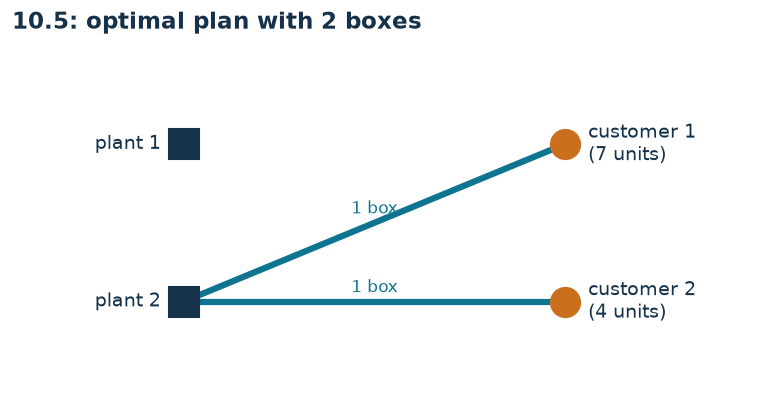
The heuristic gap is zero, and the integer bound certifies optimality. The difference \(2 - 11/10 = 9/10\) is entirely due to integrality: \(45\%\) of the optimal value.
Additional considerations
- The model is a multicommodity flow with costs only on the containers. If the costs were on the flow (per unit transported) and there were no boxes, the problem would be a pure transportation one, solvable in polynomial time and with an integral relaxation.
- The variables \(x_{psc}\) could be continuous without changing the optimum, because the data are integer and the transportation matrix is totally unimodular for fixed \(y\). They stay integer because the problem speaks of product units.
- The capacity constraint uses the same capacity \(w\) on every leg. With boxes of different sizes one would need several families \(y^{(t)}_{sc}\), one per type, as in problem 10.4.
Additional modelling questions
10.5.1 — Products kept apart
Different products cannot travel in the same box. How does the model change? What is the new optimum?
A worked variant: smaller boxes
The boxes hold \(4\) units instead of \(10\).
Only the datum \(w\) changes. On the instance the optimum rises from \(2\) to \(3\): customer 1, who orders \(7\) units, now requires at least \(\lceil 7/4 \rceil = 2\) boxes, and customer 2 at least \(\lceil 4/4 \rceil = 1\). The integer bound built above becomes \(2 + 1 = 3\) and is exact again.
The capacity of the box changes, \(4\) instead of \(10\), not the structure: the recipe stays \(\beta = 0\) and \(\gamma = \alpha = 1/w\), the dual constraints stay satisfied by construction and the bound of the relaxation is still ``units ordered divided by the capacity of the box'', that is \(11/4\) instead of \(11/10\) — inversely proportional to the capacity, so smaller boxes raise it. As in the base problem, though, the per-customer count is stronger: every customer receives at least \(\lceil (\text{its units}) / 4 \rceil\) boxes and boxes are not shared between customers, so \(\lb = 2 + 1 = 3\). The heuristic uses \(3\): the sandwich closes, and the optimum goes from \(2\) to \(3\).
| value | what it is | |
|---|---|---|
| \(\mathit{UB}\) | \(3\) | heuristic solution |
| \(\mathit{LB}\) | \(3\) | count of the boxes per customer |
| \(z(\mathit{LP})\) | \(\frac{11}{4}\) | relaxation without the bounds |
| \(z(\mathit{LP}^+)\) | \(\frac{11}{4}\) | relaxation with the bounds |
| \(z(\mathit{MILP})\) | \(3\) | optimum of the MILP |
Code
Complete script —
python/fam10_5_shipments.py
(reproducible with python3 python/fam10_5_shipments.py from the python/
folder). Notebook —
notebooks/fam10_5_shipments.ipynb
— which opens in Colab from the badge at the top of the page.
Show the complete script — python/fam10_5_shipments.py (267 lines)
"""Problem 10.5 -- Shipments in boxes: multi-product flow and counting of containers.

The quantities shipped are a multi-product flow between plants and customers; on
top of them there are the boxes, an integer count tied to the flow by the capacity
(technique 3.4: y >= ceil(sum / w)). The linear relaxation only sees the ratio
between units and capacity, and completely misses the fact that a box cannot be
split between two customers.
"""
import gurobipy as gp
import pandas as pd
from gurobipy import GRB

from mip import (ammissibile, dualita_forte, due_rilassamenti, frazione,
                 nuovo_modello, registra_bound, rilassamenti, risolvi, valuta)
from stile import ARANCIO, BLU, GRIGIO, TEAL, intestazione, plt, salva_dati, salva_figura
from esteso import salva_modello

R = range


def scatole(n):
    """"1 box" or "3 boxes"."""
    return f"{int(n)} box" if int(n) == 1 else f"{int(n)} boxes"


# ---------- 1. MODEL AND INSTANCE ----------
intestazione("10.5 Shipments in boxes: minimising the number of boxes")
d2 = [[5, 0],       # units of product p ordered by customer c
      [2, 4]]
a2 = [[8, 6],       # units of product p available at plant s
      [5, 7]]
w2 = 10             # capacity of a box, in units of product
nk, nm, nn = len(d2), len(d2[0]), len(a2[0])   # products, customers, plants
D2 = sum(d2[p][c] for p in R(nk) for c in R(nm))
salva_dati(pd.DataFrame([{"product": p + 1, "customer": c + 1, "demand": d2[p][c]}
                         for p in R(nk) for c in R(nm)]), "fam10_5_domanda")
salva_dati(pd.DataFrame([{"product": p + 1, "plant": s + 1, "availability": a2[p][s]}
                         for p in R(nk) for s in R(nn)]), "fam10_5_disponibilita")
print(f"  Units to ship in total: {D2}; capacity of a box: {w2}.")


def modello_2(d, a, w):
    nk, nm, nn = len(d), len(d[0]), len(a[0])
    m = nuovo_modello("shipments")
    x = m.addVars(nk, nn, nm, vtype=GRB.INTEGER, name="x")   # units of p from s to c
    y = m.addVars(nn, nm, vtype=GRB.INTEGER, name="y")       # boxes from s to c
    m.setObjective(y.sum(), GRB.MINIMIZE)
    m.addConstrs((x.sum(p, "*", c) == d[p][c] for p in R(nk) for c in R(nm)), name="demand")
    m.addConstrs((x.sum(p, s, "*") <= a[p][s] for p in R(nk) for s in R(nn)),
                 name="availability")
    m.addConstrs((w * y[s, c] - x.sum("*", s, c) >= 0 for s in R(nn) for c in R(nm)),
                 name="capacity")
    return m, x, y


def duale_2(d, a, w):
    """max sum_pc d_pc alpha_pc + sum_ps a_ps beta_ps

    alpha free (demand with =), beta <= 0 (availability with <=), gamma >= 0 (link with
    the boxes). Columns:
      x_psc:  alpha_pc + beta_ps - gamma_sc <= 0
      y_sc:   w gamma_sc <= 1
    """
    nk, nm, nn = len(d), len(d[0]), len(a[0])
    dl = nuovo_modello("dual_shipments")
    alpha = dl.addVars(nk, nm, lb=-GRB.INFINITY, name="alpha")
    beta = dl.addVars(nk, nn, lb=-GRB.INFINITY, ub=0.0, name="beta")
    gamma = dl.addVars(nn, nm, name="gamma")
    dl.setObjective(gp.quicksum(d[p][c] * alpha[p, c] for p in R(nk) for c in R(nm))
                    + gp.quicksum(a[p][s] * beta[p, s] for p in R(nk) for s in R(nn)),
                    GRB.MAXIMIZE)
    dl.addConstrs((alpha[p, c] + beta[p, s] - gamma[s, c] <= 0
                   for p in R(nk) for s in R(nn) for c in R(nm)), name="rcx")
    dl.addConstrs((w * gamma[s, c] <= 1 for s in R(nn) for c in R(nm)), name="rcy")
    return dl


m2, x2, y2 = modello_2(d2, a2, w2)
salva_modello(m2, "fam10_5_primale")

# ---------- 2. THE LP RELAXATION ----------
zlp2, zlp2r, _ = rilassamenti(m2)

# ---------- 3. THE DUAL OF THE RELAXATION (LOWER BOUND) ----------
dl2 = duale_2(d2, a2, w2)
salva_modello(dl2, "fam10_5_duale")
# recipe: beta = 0, gamma_sc = 1/w (the largest value allowed by w gamma <= 1) and
# alpha_pc = 1/w: every unit ordered takes 1/w of a box
mano = ({f"gamma[{s},{c}]": 1 / w2 for s in R(nn) for c in R(nm)}
        | {f"alpha[{p},{c}]": 1 / w2 for p in R(nk) for c in R(nm)})
lb_lp, viol = valuta(dl2, mano)
assert viol <= 1e-9, viol
print(f"  Hand-built dual: beta = 0, gamma_sc = alpha_pc = 1/{w2}. The dual constraints")
print(f"  become 1/{w2} + 0 - 1/{w2} = 0 <= 0 and {w2} * 1/{w2} = 1 <= 1: all verified.")
print(f"  lb = (units ordered) / {w2} = {D2} / {w2} = {frazione(lb_lp)}")
dualita_forte(dl2, zlp2)

# ---------- 4. CONSTRUCTIVE HEURISTIC (UPPER BOUND) ----------
# customer by customer: we try to serve them from a single plant, the one that has
# everything they need; if no plant is enough, the order is split.
def euristica(d, a, w):
    nk, nm, nn = len(d), len(d[0]), len(a[0])
    res = [[a[p][s] for s in R(nn)] for p in R(nk)]
    x = {(p, s, c): 0 for p in R(nk) for s in R(nn) for c in R(nm)}
    passi = []
    for c in R(nm):
        completi = [s for s in R(nn) if all(res[p][s] >= d[p][c] for p in R(nk))]
        if completi:
            s = completi[0]
            for p in R(nk):
                x[p, s, c] = d[p][c]
                res[p][s] -= d[p][c]
            passi.append(f"customer {c + 1}: plant {s + 1} has the whole order, we ship "
                         f"from there")
        else:
            for p in R(nk):
                manca = d[p][c]
                for s in R(nn):
                    preso = min(manca, res[p][s])
                    x[p, s, c] += preso
                    res[p][s] -= preso
                    manca -= preso
                assert manca == 0, "order cannot be satisfied"
            passi.append(f"customer {c + 1}: no plant is enough on its own, the order is "
                         f"split")
    y = {(s, c): -(-sum(x[p, s, c] for p in R(nk)) // w) for s in R(nn) for c in R(nm)}
    for s in R(nn):
        for c in R(nm):
            if y[s, c]:
                passi.append(f"plant {s + 1} -> customer {c + 1}: "
                             f"{sum(x[p, s, c] for p in R(nk))} units -> {scatole(y[s, c])}")
    return x, y, passi


x_eur, y_eur, passi = euristica(d2, a2, w2)
for k, riga in enumerate(passi, 1):
    print(f"  Step {k}. {riga}")
ub2 = sum(y_eur.values())
sol_eur = ({f"x[{p},{s},{c}]": x_eur[p, s, c] for p in R(nk) for s in R(nn) for c in R(nm)}
           | {f"y[{s},{c}]": y_eur[s, c] for s in R(nn) for c in R(nm)})
assert ammissibile(m2, sol_eur), sol_eur
print(f"  Boxes used by the heuristic: {ub2}  ->  ub = {frazione(ub2)}")

# ---------- 5. A STRONGER INTEGER BOUND ----------
intestazione("10.5 Counting the boxes customer by customer")
clienti_attivi = [c for c in R(nm) if any(d2[p][c] > 0 for p in R(nk))]
print("  Every customer with at least one unit ordered receives at least one box, and boxes")
print(f"  are not shared between customers. The customers with orders are "
      f"{len(clienti_attivi)}:")
print(f"  lb = {len(clienti_attivi)}, against {frazione(lb_lp)} from the linear relaxation.")
print(f"  More precisely every customer c receives at least ceil(sum_p d_pc / {w2}) boxes:")
per_cliente = [-(-sum(d2[p][c] for p in R(nk)) // w2) for c in R(nm)]
for c in R(nm):
    print(f"    customer {c + 1}: {sum(d2[p][c] for p in R(nk))} units -> at least "
          f"{scatole(per_cliente[c])}")
lb2 = float(sum(per_cliente))
print(f"  Summing up: lb = {frazione(lb2)}.")
salva_dati(pd.DataFrame([{"argument": "dual of the LP relaxation", "bound": lb_lp},
                         {"argument": "boxes per customer", "bound": lb2}]),
           "fam10_5_argomento")

# ---------- 6. OPTIMUM OF THE MILP ----------
z2 = risolvi(m2)
for s in R(nn):
    for c in R(nm):
        if y2[s, c].X > 0.5:
            carico = ", ".join(f"{int(x2[p, s, c].X)} of product {p + 1}" for p in R(nk)
                               if x2[p, s, c].X > 0.5)
            print(f"  Plant {s + 1} -> customer {c + 1}: {scatole(y2[s, c].X)} with {carico}")
riga = registra_bound("2 shipments", ub2, lb2, zlp2, zlp2r, z2)
salva_dati(pd.DataFrame([riga]), "fam10_5_bound")
assert lb2 <= z2 <= ub2 + 1e-9

# ---------- 7. ADDITIONAL MODELLING QUESTIONS ----------
varianti = {}


def variante(nome, m):
    z = risolvi(m)
    print(f"  {nome:70s} z = {frazione(z)}")
    return z


# 2a: smaller boxes
m, x, y = modello_2(d2, a2, 4)
varianti["2a"] = variante("2a. The boxes hold 4 units instead of 10", m)
# 2b: different products cannot travel in the same box
m = nuovo_modello("shipments_separate")
x = m.addVars(nk, nn, nm, vtype=GRB.INTEGER, name="x")
y = m.addVars(nk, nn, nm, vtype=GRB.INTEGER, name="y")
m.setObjective(y.sum(), GRB.MINIMIZE)
m.addConstrs((x.sum(p, "*", c) == d2[p][c] for p in R(nk) for c in R(nm)), name="demand")
m.addConstrs((x.sum(p, s, "*") <= a2[p][s] for p in R(nk) for s in R(nn)), name="availability")
m.addConstrs((w2 * y[p, s, c] - x[p, s, c] >= 0 for p in R(nk) for s in R(nn) for c in R(nm)),
             name="capacity")
varianti["2b"] = variante("2b. Different products cannot travel in the same box", m)
salva_dati(pd.DataFrame({"variant": list(varianti), "z": list(varianti.values())}),
           "fam10_5_varianti")

# ---------- 8. THE SANDWICH ON THE VARIANT 2a ----------
intestazione("10.5a The sandwich on the variant: boxes of 4 units instead of 10")
W2A = 4

# The capacity of the box changes, not the structure: model, dual, heuristic and
# recipe are the same with w = 4. The certificate rescales by itself, and that
# is the point: the bound is 'units ordered divided by the capacity of the box'.
m2a, x2a, y2a = modello_2(d2, a2, W2A)
salva_modello(m2a, "fam10_5a_primale")
dl2a = duale_2(d2, a2, W2A)
salva_modello(dl2a, "fam10_5a_duale")

# -- feasible heuristic: the same rule, with the smaller box --
x_2a, y_2a, passi_2a = euristica(d2, a2, W2A)
ub2a = sum(y_2a.values())
sol_2a = ({f"x[{p},{s},{c}]": x_2a[p, s, c] for p in R(nk) for s in R(nn) for c in R(nm)}
          | {f"y[{s},{c}]": y_2a[s, c] for s in R(nn) for c in R(nm)})
assert ammissibile(m2a, sol_2a), "the heuristic solution of the variant must be feasible"
print(f"  Boxes used by the heuristic: ub = {frazione(ub2a)}")

# -- dual certificate: the same recipe, with the new 1/w --
mano_2a = ({f"gamma[{s},{c}]": 1 / W2A for s in R(nn) for c in R(nm)}
           | {f"alpha[{p},{c}]": 1 / W2A for p in R(nk) for c in R(nm)})
lb2a, viol_2a = valuta(dl2a, mano_2a)
assert viol_2a <= 1e-9, viol_2a
print(f"Dual solution by hand: beta = 0, gamma_sc = alpha_pc = 1/{W2A}, as in the base")
print("  problem. The dual constraints stay satisfied by construction, and the bound is")
print(f"  still 'units ordered divided by capacity': {D2} / {W2A} = {frazione(lb2a)}.")
print(f"  With boxes of {w2} it was {frazione(D2 / w2)}: the bound is inversely"
      f" proportional to the capacity, so smaller boxes raise it.")
zlp2a, zlp2ar, _ = due_rilassamenti(m2a, dl2a)

# -- integer bound: the same per-customer count as the base problem, with the new w --
per_cliente_2a = [-(-sum(d2[p][c] for p in R(nk)) // W2A) for c in R(nm)]
comb_2a = float(sum(per_cliente_2a))
print(f"  Every customer c, though, receives at least ceil(sum_p d_pc / {W2A}) boxes, and boxes")
print("  are not shared between customers: " + ", ".join(
    f"customer {c + 1} at least {scatole(per_cliente_2a[c])}" for c in R(nm)) + ".")
print(f"  Adding up: lb = {frazione(comb_2a)}, better than the bound of the relaxation.")
lb2a_usato = max(lb2a, comb_2a)
z2a_val = risolvi(m2a)
riga_2a = registra_bound("2a boxes of 4", ub2a, lb2a_usato, zlp2a, zlp2ar, z2a_val,
                         certificato="count of the boxes per customer")
salva_dati(pd.DataFrame([riga_2a]), "fam10_5a_bound")
assert lb2a_usato <= z2a_val <= ub2a + 1e-9

# ---------- 9. FIGURE ----------
fig, ax = plt.subplots(figsize=(6.4, 3.0))
for s in R(nn):
    for c in R(nm):
        n = int(y2[s, c].X)
        if n:
            ax.plot([0, 1], [nn - 1 - s, nm - 1 - c], color=TEAL, lw=1 + 2 * n)
            ax.annotate(scatole(n), (0.5, (nn - 1 - s + nm - 1 - c) / 2 + 0.06),
                        ha="center", fontsize=8, color=TEAL)
for s in R(nn):
    ax.plot(0, nn - 1 - s, marker="s", color=BLU, ms=14)
    ax.annotate(f"plant {s + 1}", (-0.06, nn - 1 - s), ha="right", va="center", fontsize=9)
for c in R(nm):
    ax.plot(1, nm - 1 - c, marker="o", color=ARANCIO, ms=14)
    ax.annotate(f"customer {c + 1}\n({sum(d2[p][c] for p in R(nk))} units)",
                (1.06, nm - 1 - c), ha="left", va="center", fontsize=9)
ax.set_xlim(-0.45, 1.5)
ax.set_ylim(-0.6, max(nn, nm) - 0.4)
ax.axis("off")
ax.set_title(f"10.5: optimal plan with {frazione(z2)} boxes")
salva_figura(fig, "cap10_spedizioni_ottimo")
print("Done.")