Songs across CDs
Class: MILP · Links: maximum and minimum variables · Script: python/fam10_8_cds.py
Difficulty: ★★★☆☆ · Time: 45–60 min

Problem 10.8
A record company publishes a collection of \(n \in \mathbb{Z}_{\ge 1}\) songs. For every song \(i \in \{1, 2, \dots, n\}\), the value \(d_i \in \mathbb{Q}_{\ge 1}\) is its duration in minutes. The collection must be distributed over \(m \in \mathbb{Z}_{\ge 1}\) compact discs; every song must be assigned to exactly one CD, and every CD \(j \in \{1, 2, \dots, m\}\) must contain at least \(w_j \in \mathbb{Z}_{\ge 1}\) songs. The record company wants to minimise the difference between the total duration of the longest CD and that of the shortest.
The problem in words. We decide which CD every song ends up on. The objective: CDs as homogeneous in duration as possible. The constraints: every song on one CD only, and no CD too thin.
Model
Variables. \(x_{ij} \in \{0,1\}\) equals \(1\) if song \(i\) goes on CD \(j\); \(y \ge 0\) is the duration of the longest CD and \(z \ge 0\) that of the shortest.
Description. The objective is the difference between the longest and the shortest duration. The assignment constraints, one per song, say that every song ends up on exactly one CD. The minimum number constraints, one per CD, impose at least \(w_j\) songs. The maximum constraints, one per CD, push \(y\) above every duration; the minimum ones, again one per CD, push \(z\) below every duration: at the optimum the first becomes the maximum of the durations and the second the minimum.
Two auxiliary variables, two opposite directions
The maximum constraints say \(y \ge \sum_i d_i x_{ij}\) for every CD: \(y\) is at least the maximum. The minimum ones say \(z \le \sum_i d_i x_{ij}\): \(z\) is at most the minimum. Neither imposes equality; the objective does, pushing \(y\) down and \(z\) up. It is the maximum variable technique applied twice, in the two opposite directions.
The model in gurobipy
m = gp.Model("cds")
x = m.addVars(n, mm, vtype=GRB.BINARY, name="x")
y = m.addVar(name="y")
z = m.addVar(name="z")
m.setObjective(y - z, GRB.MINIMIZE)
m.addConstrs((x.sum(i, "*") == 1 for i in range(n)), name="song")
m.addConstrs((x.sum("*", j) >= w[j] for j in range(mm)), name="minimum_songs")
m.addConstrs((-gp.quicksum(d[i] * x[i, j] for i in range(n)) + y >= 0
              for j in range(mm)), name="maximum")
m.addConstrs((gp.quicksum(d[i] * x[i, j] for i in range(n)) - z >= 0
              for j in range(mm)), name="minimum")
The instance
\(n = 6\) songs, \(m = 2\) CDs, \(w_j = 1\).
| song | 1 | 2 | 3 | 4 | 5 | 6 |
|---|---|---|---|---|---|---|
| \(d_i\) (minutes) | 5 | 6 | 7 | 3 | 4 | 10 |
The total duration is \(35\) minutes.
The model written on the data of the instance:
Constructive heuristic: the primal bound
The songs are scanned and each is put on the currently shortest CD. The same rule, with two different orders, gives two results.
- (a) Natural order. \(5 \to\) CD1, \(6 \to\) CD2, \(7 \to\) CD1, \(3 \to\) CD2, \(4 \to\) CD2, \(10 \to\) CD1. Final durations \(22\) and \(13\): difference \(9\).
- (b) Decreasing-duration order (LPT). \(10 \to\) CD1, \(7 \to\) CD2, \(6 \to\) CD2, \(5 \to\) CD1, \(4 \to\) CD2, \(3 \to\) CD1. Final durations \(18\) and \(17\): difference \(1\).
The better one is kept: \(z(\mathit{MILP}) \le \mathit{UB} = 1\).
LP relaxation and dual: zero again
Associate \(\alpha_i\) free with the assignment, \(\beta_j \ge 0\) with the minimum number, \(\gamma_j \ge 0\) with the maximum and \(\delta_j \ge 0\) with the minimum.
The same dual, written on the data of the instance:
Description. \(\alpha_i\) is the value of song \(i\), \(\beta_j\) the price of the minimum number of songs on CD \(j\), while \(\gamma_j\) and \(\delta_j\) are the weights with which CD \(j\) enters the maximum and the minimum duration. The objective prices the songs and the thresholds \(w_j\). The two equality constraints are the columns of \(y\) and \(z\): each of the two variables appears in one constraint per CD and in the primal objective with coefficient \(\pm 1\), so the respective weights sum to one. The last group are the columns of the \(x_{ij}\): putting song \(i\) on CD \(j\) satisfies its assignment constraint, contributes to the minimum number of songs and moves both durations by \(d_i\); the balance cannot be positive.
Recipe. With \(\bar\gamma_j = \bar\delta_j = 1/m\) and \(\alpha = \beta = 0\) the two equality constraints are satisfied and the others become \(-d_i/m + d_i/m = 0 \le 0\). The value is \(\mathit{LB} = 0\).
Here too the relaxation is mute
That the relaxation is worth zero is clearer from the primal side: setting \(x_{ij} = 1/m\) for every song and every CD, every CD "lasts" \(35/2 = 17.5\) minutes and the difference is nil. It is feasible for the relaxation and meaningless for the problem, because a song does not split. The LP relaxation of balancing models is almost always like this: it balances everything and is worth zero.
A parity argument that closes the problem
The durations are integers and there are two CDs: their durations \(q_1\) and \(q_2\) are integers summing to \(q = 35\), which is odd. Two integers summing to an odd number cannot be equal, and their difference \(|q_1 - q_2|\) has the same parity as \(q\), that is, it is odd. An odd, non-negative difference is at least \(1\):
The LPT heuristic reaches exactly \(1\): the two bounds coincide, and the heuristic solution is optimal. This is known before calling the solver, and it is the sharpest case in the course where a two-line combinatorial argument does the job the LP relaxation cannot do.
Optimal solution
| songs | duration | |
|---|---|---|
| CD 1 | 1, 2, 3 | 18 |
| CD 2 | 4, 5, 6 | 17 |
| \(LB\) (parity) | \(z(\mathit{LP})\) | \(z(\mathit{LP}^+)\) | \(z(\mathit{MILP})\) | \(UB\) (heuristic) | heuristic gap |
|---|---|---|---|---|---|
| 1 | 0 | 0 | 1 | 1 | \(0\%\) |
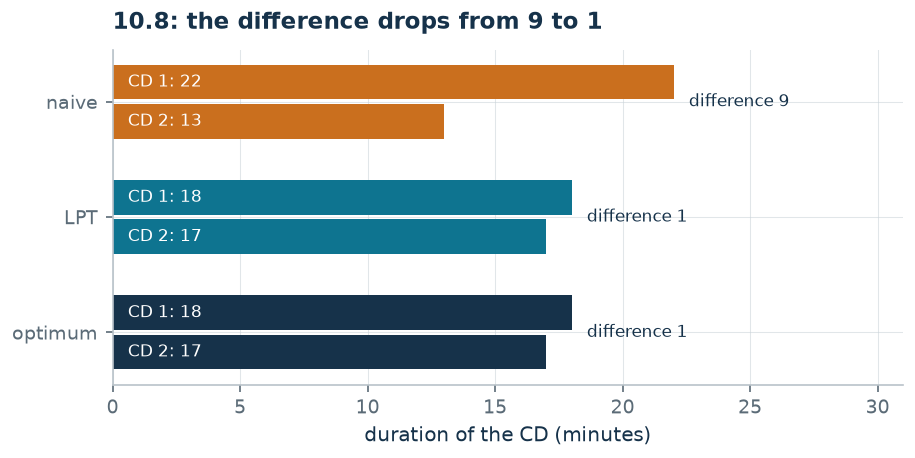
The solution found by the solver is not the LPT one (which put songs \(6, 1, 4\) on one CD and \(3, 2, 5\) on the other), but it has the same value: the problem has several optima.
Additional considerations
- The parity argument holds as it stands for \(m = 2\). With \(m = 3\) it must be redone: \(35\) is not divisible by \(3\), so the three durations cannot all be equal, but the minimum spread is no longer immediate. On the instance with three CDs the optimum is \(2\) (durations \(13, 11, 11\)).
- The constraint \(\sum_i x_{ij} \ge w_j\) with \(w_j = 1\) never bites at the optimum: a solution leaving a CD empty would have \(z = 0\) and hence a difference equal to the total duration. It is needed in the model, though, because without it the relaxation would have degenerate solutions.
- Minimising \(y - z\) is not equivalent to minimising \(y\) (the makespan): the latter is the classical formulation of scheduling on parallel machines, and it has different optima. It is the same difference as between "balancing" and "finishing early".
Additional modelling questions
10.8.1 — A smaller medium
CD 1 is a reduced medium and cannot exceed \(15\) minutes. How does the model change? What is the new optimum?
A worked variant: three CDs
The collection is distributed over three CDs instead of two.
Only the datum \(m\) changes, from \(2\) to \(3\) (and the list \(w\)). On the instance the optimum rises to \(2\): with three CDs the total duration \(35\) does not split into equal parts, and the parity argument must be redone. The \(10\)-minute song is the structural constraint: if it sits alone on a CD, that CD lasts \(10\) and the other two share \(25\), with a maximum of at least \(13\); if it goes with the \(3\)-minute song, one gets \(13, 11, 11\) and the difference is \(2\).
With three CDs instead of two the structure does not change: the columns of \(y\) and \(z\) ask the \(\gamma\) and the \(\delta\) to sum to one, and spreading them evenly, \(\gamma_j = \delta_j = 1/3\), is the choice that favours no CD. The dual is worth \(0\), like the relaxation, for the usual reason: a fractional solution splits every track into three equal parts and levels the durations. The useful bound comes from integrality, as in the base problem: the durations are integers summing to \(35\), which is not a multiple of \(3\), so they cannot all be equal and the difference is at least \(1\). The LPT heuristic leaves \(2\), which is the optimum: the certified gap stays open by one unit.
| value | what it is | |
|---|---|---|
| \(\mathit{UB}\) | \(2\) | heuristic solution |
| \(\mathit{LB}\) | \(1\) | parity of the durations on three CDs |
| \(z(\mathit{LP})\) | \(0\) | relaxation without the bounds |
| \(z(\mathit{LP}^+)\) | \(0\) | relaxation with the bounds |
| \(z(\mathit{MILP})\) | \(2\) | optimum of the MILP |
Code
Complete script —
python/fam10_8_cds.py
(reproducible with python3 python/fam10_8_cds.py from the python/ folder).
Notebook —
notebooks/fam10_8_cds.ipynb
— which opens in Colab from the badge at the top of the page.
Show the complete script — python/fam10_8_cds.py (234 lines)
"""Problem 10.8 -- Songs on several CDs: minimising the difference between the
longest and the shortest.

Two auxiliary variables: y for the maximum (technique 3.5) and z for the minimum,
with objective y - z. As in 11.2 the linear relaxation is worth zero, and the
useful lower bound comes from a parity argument that settles optimality by itself.
"""
import gurobipy as gp
import pandas as pd
from gurobipy import GRB

from mip import (ammissibile, dualita_forte, due_rilassamenti, frazione,
                 nuovo_modello, registra_bound, rilassamenti, risolvi, valuta)
from stile import ARANCIO, BLU, TEAL, intestazione, plt, salva_dati, salva_figura
from esteso import salva_modello

R = range

# ---------- 1. MODEL AND INSTANCE ----------
intestazione("10.8 Songs on CDs: levelling the longest and the shortest CD")
d3 = [5, 6, 7, 3, 4, 10]     # duration of the songs, in minutes
w3 = [1, 1]                  # minimum number of songs per CD
n3, m3 = len(d3), len(w3)
D3 = sum(d3)
salva_dati(pd.DataFrame({"song": R(1, n3 + 1), "duration": d3}), "fam10_8_dati")
print(f"  Total duration of the collection: {D3} minutes on {m3} CDs.")


def modello_3(d, w):
    n, m = len(d), len(w)
    mod = nuovo_modello("cds")
    x = mod.addVars(n, m, vtype=GRB.BINARY, name="x")
    y = mod.addVar(name="y")     # duration of the longest CD
    z = mod.addVar(name="z")     # duration of the shortest CD
    mod.setObjective(y - z, GRB.MINIMIZE)
    mod.addConstrs((x.sum(i, "*") == 1 for i in R(n)), name="song")
    mod.addConstrs((x.sum("*", j) >= w[j] for j in R(m)), name="minimum")
    mod.addConstrs((y - gp.quicksum(d[i] * x[i, j] for i in R(n)) >= 0 for j in R(m)),
                   name="maximum")
    mod.addConstrs((gp.quicksum(d[i] * x[i, j] for i in R(n)) - z >= 0 for j in R(m)),
                   name="minimum_duration")
    return mod, x, y, z


def duale_3(d, w):
    """max sum_i alpha_i + sum_j w_j beta_j

    alpha_i free (equality constraint), beta_j >= 0 (>= w_j), gamma_j >= 0 (column of
    y: sum_j gamma_j = 1) and delta_j >= 0 (column of z: sum_j delta_j = 1). Column of
    x_ij: alpha_i + beta_j - d_i gamma_j + d_i delta_j <= 0.
    """
    n, m = len(d), len(w)
    dl = nuovo_modello("dual_cds")
    alpha = dl.addVars(n, lb=-GRB.INFINITY, name="alpha")
    beta = dl.addVars(m, name="beta")
    gamma = dl.addVars(m, name="gamma")
    delta = dl.addVars(m, name="delta")
    dl.setObjective(alpha.sum() + gp.quicksum(w[j] * beta[j] for j in R(m)), GRB.MAXIMIZE)
    dl.addConstr(gamma.sum() == 1, name="rcy")
    dl.addConstr(delta.sum() == 1, name="rcz")
    dl.addConstrs((alpha[i] + beta[j] - d[i] * gamma[j] + d[i] * delta[j] <= 0
                   for i in R(n) for j in R(m)), name="rcx")
    return dl


m3mod, x3, y3, z3v = modello_3(d3, w3)
salva_modello(m3mod, "fam10_8_primale")

# ---------- 2. THE LP RELAXATION ----------
zlp3, zlp3r, _ = rilassamenti(m3mod)

# ---------- 3. THE DUAL OF THE RELAXATION (LOWER BOUND) ----------
dl3 = duale_3(d3, w3)
salva_modello(dl3, "fam10_8_duale")
mano = {f"gamma[{j}]": 1 / m3 for j in R(m3)} | {f"delta[{j}]": 1 / m3 for j in R(m3)}
lb_lp, viol = valuta(dl3, mano)
assert viol <= 1e-9, viol
print(f"  Hand-built dual: gamma_j = delta_j = 1/{m3}, alpha = beta = 0 -> value "
      f"{frazione(lb_lp)}.")
dualita_forte(dl3, zlp3)

meta = ({f"x[{i},{j}]": 1 / m3 for i in R(n3) for j in R(m3)}
        | {"y": D3 / m3, "z": D3 / m3})
val_meta, viol_meta = valuta(m3mod, meta)
assert viol_meta <= 1e-9 and abs(val_meta) <= 1e-9
print(f"  And indeed z(LP) = {frazione(zlp3)}: putting 1/{m3} of every song on every CD, all")
print(f"  the CDs last {frazione(D3 / m3)} minutes and the difference is zero. A song, though,")
print("  cannot be split.")
assert abs(zlp3) <= 1e-9

# ---------- 4. CONSTRUCTIVE HEURISTIC (UPPER BOUND) ----------
def riempi(d, m, ordine, etichetta):
    """The songs are scanned in the given order and each one goes on the shortest CD."""
    carichi = [0] * m
    dove = {}
    passi = []
    for i in ordine:
        j = min(R(m), key=lambda j: (carichi[j], j))
        dove[i] = j
        carichi[j] += d[i]
        passi.append(f"song {i + 1} ({d[i]} min) on CD {j + 1}; durations {carichi}")
    diff = max(carichi) - min(carichi)
    print(f"  {etichetta}")
    for k, riga in enumerate(passi, 1):
        print(f"    Step {k}. {riga}")
    print(f"    final durations {carichi}, difference {diff}")
    return dove, carichi, diff


ordine_lpt = sorted(R(n3), key=lambda i: (-d3[i], i))
dove, carichi, ub3 = riempi(d3, m3, ordine_lpt,
                            "LPT heuristic: songs in decreasing order of duration.")
dove_nat, carichi_nat, diff_nat = riempi(d3, m3, list(R(n3)),
                                         "Naive heuristic: songs in the given order.")
sol_eur = ({f"x[{i},{dove[i]}]": 1 for i in R(n3)}
           | {"y": max(carichi), "z": min(carichi)})
assert ammissibile(m3mod, sol_eur), sol_eur
print(f"  The decreasing order gives {frazione(ub3)}, the natural order {frazione(diff_nat)}:")
print("  the same insertion rule changes a lot depending on the order of the songs.")
print(f"  The better of the two is kept:  ub = {frazione(ub3)}")
assert diff_nat >= ub3

# ---------- 5. THE PARITY BOUND ----------
intestazione("10.8 A parity argument that settles the problem")
print(f"  The durations are integers and there are {m3} CDs: the two durations add up to")
print(f"  {D3}, which is {'odd' if D3 % 2 else 'even'}. Two integers adding up to an odd")
print("  number cannot be equal, and their difference is itself odd: so it is at least 1.")
lb3 = 1 if D3 % 2 else 0
assert m3 == 2, "the parity argument holds as written for two CDs only"
print(f"  lb = {frazione(lb3)}, and the LPT heuristic reaches {frazione(ub3)}: the two bounds")
print("  coincide and the heuristic solution is already optimal, with no need for the solver.")
salva_dati(pd.DataFrame([{"argument": "parity of the total duration", "bound": lb3},
                         {"argument": "dual of the LP relaxation", "bound": lb_lp}]),
           "fam10_8_argomento")

# ---------- 6. OPTIMUM OF THE MILP ----------
z3 = risolvi(m3mod)
carichi_ott = [sum(d3[i] * x3[i, j].X for i in R(n3)) for j in R(m3)]
for j in R(m3):
    brani = [i + 1 for i in R(n3) if x3[i, j].X > 0.5]
    print(f"  CD {j + 1}: songs {brani}, duration {frazione(carichi_ott[j])} minutes")
riga = registra_bound("3 cds", ub3, lb3, zlp3, zlp3r, z3)
salva_dati(pd.DataFrame([riga]), "fam10_8_bound")
assert lb3 <= z3 <= ub3 + 1e-9 and abs(z3 - lb3) <= 1e-9

# ---------- 7. ADDITIONAL MODELLING QUESTIONS ----------
varianti = {}


def variante(nome, m):
    z = risolvi(m)
    print(f"  {nome:70s} z = {frazione(z)}")
    return z


# 3a: CD 1 is a smaller medium and cannot exceed 15 minutes
m, x, y, z = modello_3(d3, w3)
m.addConstr(gp.quicksum(d3[i] * x[i, 0] for i in R(n3)) <= 15, name="capacity_cd1")
varianti["3a"] = variante("3a. CD 1 cannot exceed 15 minutes", m)
print(f"       CD 2 must then hold at least {D3} - 15 = {D3 - 15} minutes and the difference")
print(f"       cannot go below {D3 - 2 * 15}: the bound is read off the data.")
# 3b: three CDs instead of two
m, x, y, z = modello_3(d3, [1, 1, 1])
varianti["3b"] = variante("3b. The collection is spread over three CDs", m)
print(f"       with three CDs the total duration {D3} is no longer divisible into equal")
print("       parts: the parity argument has to be redone and no longer proves optimality.")
salva_dati(pd.DataFrame({"variant": list(varianti), "z": list(varianti.values())}),
           "fam10_8_varianti")

# ---------- 8. THE SANDWICH ON THE VARIANT 3b ----------
intestazione("10.8b The sandwich on the variant: the collection on three CDs")
M3B = 3
w3b = [1] * M3B

# The number of CDs changes, not the structure: model, dual, heuristic and recipe
# are the same with m = 3.
m3b, x3b, y3b, z3b = modello_3(d3, w3b)
salva_modello(m3b, "fam10_8b_primale")
dl3b = duale_3(d3, w3b)
salva_modello(dl3b, "fam10_8b_duale")

# -- feasible heuristic: LPT on the three CDs --
ordine_3b = sorted(R(n3), key=lambda i: (-d3[i], i))
dove_3b, carichi_3b, ub3b = riempi(d3, M3B, ordine_3b,
                                   "LPT heuristic on the three CDs: tracks in decreasing order.")
sol_3b = ({f"x[{i},{dove_3b[i]}]": 1 for i in R(n3)}
          | {"y": max(carichi_3b), "z": min(carichi_3b)})
assert ammissibile(m3b, sol_3b), "the heuristic solution of the variant must be feasible"
print(f"  ub = {frazione(ub3b)}")

# -- dual certificate: the same recipe, on three CDs --
mano_3b = ({f"gamma[{j}]": 1 / M3B for j in R(M3B)}
           | {f"delta[{j}]": 1 / M3B for j in R(M3B)})
lb3b, viol_3b = valuta(dl3b, mano_3b)
assert viol_3b <= 1e-9, viol_3b
print(f"Dual solution by hand: gamma_j = delta_j = 1/{M3B}, as in the base problem: the two")
print("  columns of y and z ask the gammas and the deltas to sum to one, and spreading them")
print("  evenly is the choice that favours no CD. alpha = beta = 0.")
print(f"  ->  lb = {frazione(lb3b)}")
zlp3b, zlp3br, _ = due_rilassamenti(m3b, dl3b)

# -- combinatorial bound: the parity argument of the base problem, generalised --
resto_3b = D3 % M3B
comb_3b = float(1 if resto_3b else 0)
verso_3b = "is not" if resto_3b else "is"
print(f"  The parity argument generalises: the durations are integers summing to {D3}, and")
print(f"  {D3} {verso_3b} a multiple of {M3B}, so they cannot all be equal and the difference")
print(f"  between the longest and the shortest is at least {frazione(comb_3b)}.")
lb3b_usato = max(lb3b, comb_3b)
z3b_val = risolvi(m3b)
riga_3b = registra_bound("3b collection on three CDs", ub3b, lb3b_usato, zlp3b, zlp3br, z3b_val,
                         certificato="parity of the durations on three CDs")
salva_dati(pd.DataFrame([riga_3b]), "fam10_8b_bound")
assert lb3b_usato <= z3b_val <= ub3b + 1e-9

# ---------- 9. FIGURE ----------
fig, ax = plt.subplots(figsize=(6.8, 2.9))
for k, (nome, car, colore) in enumerate([("naive heuristic", carichi_nat, ARANCIO),
                                         ("LPT heuristic", carichi, TEAL),
                                         ("optimum", carichi_ott, BLU)]):
    for j in R(m3):
        ax.barh(k + (j - 0.5) * 0.34, car[j], 0.3, color=colore)
        ax.annotate(f"CD {j + 1}: {frazione(car[j])}", (0.6, k + (j - 0.5) * 0.34),
                    va="center", fontsize=8, color="white")
    ax.annotate(f"difference {frazione(max(car) - min(car))}", (max(car) + 0.6, k),
                va="center", fontsize=8)
ax.set_yticks(R(3))
ax.set_yticklabels(["naive", "LPT", "optimum"])
ax.set_xlim(0, max(carichi_nat) + 9)
ax.set_xlabel("duration of the CD (minutes)")
ax.set_title(f"10.8: the difference drops from {frazione(diff_nat)} to {frazione(z3)}")
ax.invert_yaxis()
salva_figura(fig, "cap10_cd_ottimo")
print("Done.")