Children across summer camps
Class: ILP · Links: integer counts, composition constraints · Script: python/fam10_6_camps.py
Difficulty: ★★★☆☆ · Time: 30–45 min

Problem 10.6
A company runs \(r \in \mathbb{Z}_{\ge 1}\) summer camps to host children during the holidays. For every camp \(j \in \{1, 2, \dots, r\}\), the value \(d_j \in \mathbb{Z}_{\ge 1}\) is the maximum number of children it can host. The company has received applications from children of \(s \in \mathbb{Z}_{\ge 1}\) different nationalities: for every nationality \(i \in \{1, 2, \dots, s\}\) there are \(f_i \in \mathbb{Z}_{\ge 0}\) girls and \(g_i \in \mathbb{Z}_{\ge 0}\) boys. In every camp the number of girls must be greater than or equal to the number of boys, and the number of children of nationality \(c \in \{1, 2, \dots, s\}\) must be greater than or equal to that of every other nationality. The company wants to maximise the total number of children accepted.
The problem in words. We decide how many children of each nationality and each sex to send to each camp. The objective: maximum number of children accepted. The constraints: neither the availabilities nor the capacities are exceeded; and in every camp the two composition rules hold.
Model
Variables. They are not binary but counts: \(2\,r\,s\) non-negative integer variables. \(x_{ij}\) are the girls of nationality \(i\) in camp \(j\), \(y_{ij}\) the boys.
Description. The objective counts the children accepted. The two groups of availability constraints, one per nationality each, do not allow accepting more girls or boys than have applied (\(2s\) constraints). The capacity constraints, one per camp, are the available places. The balance constraints, one per camp, impose "girls \(\ge\) boys". The majority constraints, one per nationality-camp pair, impose that nationality \(c\) is no fewer than each of the others (\((s-1)\,r\) constraints).
The majority constraint with more than two nationalities
The majority constraint translates the statement literally: nationality \(c\) is no fewer than each of the others, one inequality per pair, \((s-1)\,r\) in all. There is however a second, shorter writing that is easy to mistake for this one:
that is \(r\) inequalities instead of \((s-1)\,r\). It says something else, and it is stronger: that nationality \(c\) is no fewer than all the others together, that is, that it takes at least half the places of every camp. The two readings coincide for \(s = 2\) --- with a single "other" nationality the sum has one term --- and diverge for \(s > 2\), where the aggregated form cuts off solutions the statement allows. The choice is made by reading the text, not for convenience of writing: fewer constraints does not mean a better model if they are not the constraints of the problem.
On this instance \(s = 2\), so the two forms give the same numbers; and it is precisely because \(s = 2\) that the combinatorial argument below can read the majority as "half the places".
The model in gurobipy
m = gp.Model("camps")
x = m.addVars(s, r, vtype=GRB.INTEGER, name="x")
y = m.addVars(s, r, vtype=GRB.INTEGER, name="y")
m.setObjective(gp.quicksum(x[i, j] + y[i, j] for i in range(s) for j in range(r)),
               GRB.MAXIMIZE)
m.addConstrs((x.sum(i, "*") <= f[i] for i in range(s)), name="girls")
m.addConstrs((y.sum(i, "*") <= g[i] for i in range(s)), name="boys")
m.addConstrs((gp.quicksum(x[i, j] + y[i, j] for i in range(s)) <= d[j]
              for j in range(r)), name="capacity")
m.addConstrs((gp.quicksum(x[i, j] - y[i, j] for i in range(s)) >= 0
              for j in range(r)), name="balance")
m.addConstrs((x[c, j] + y[c, j] - x[i, j] - y[i, j] >= 0
              for i in range(s) if i != c for j in range(r)), name="majority")
The instance
\(s = 2\) nationalities, \(r = 2\) camps, \(c = 1\).
| \(i=1\) | \(i=2\) | |
|---|---|---|
| \(f_i\) (girls) | 8 | 10 |
| \(g_i\) (boys) | 4 | 12 |
| \(j=1\) | \(j=2\) | |
|---|---|---|
| \(d_j\) | 15 | 8 |
In all there are \(34\) children available and \(23\) places.
The model written on the data of the instance:
Constructive heuristic: the primal bound
The problem is a maximisation. One camp is filled at a time, taking first the majority nationality (girls and then boys) and then the others, stopping as soon as one of the three constraints would break.
- Camp 1 (capacity 15): all \(8\) girls and all \(4\) boys of nationality 1 are taken, then \(3\) girls of nationality 2. The camp is full: \(12\) of nationality 1 against \(3\) of nationality 2 (majority respected), \(11\) girls against \(4\) boys (balance respected).
- Camp 2 (capacity 8): nationality 1 is exhausted, so any child of nationality 2 would violate the majority. The camp stays empty.
LP relaxation and dual: the dual bound
Associate \(\alpha_i, \beta_i, \gamma_j \ge 0\) with the three groups of \(\le\) constraints, \(\delta_j \ge 0\) with the balance and \(\varepsilon_{ij} \ge 0\) with the majority, one per pair (nationality \(i \ne c\), camp \(j\)).
The same dual, written on the data of the instance:
Description. \(\alpha_i\) and \(\beta_i\) are the prices of a place for the girls and for the boys of nationality \(i\); \(\gamma_j\) is the price of a place in camp \(j\), \(\delta_j\) that of the balance constraint and \(\varepsilon_{ij}\) that of the comparison between nationality \(i\) and the majority one in camp \(j\). The objective prices the availabilities and the capacities.
The dual constraints are the columns of the primal, and they split into two blocks because nationality \(c\) appears in the comparisons differently from the others. The first is the column of the \(x_{cj}\): accepting one girl of the majority nationality uses one place of her nationality and one of the camp, raises the balance by one unit and loosens every comparison of that camp, one per other nationality --- hence the sum with the minus sign. The third is the column of the \(x_{ij}\) with \(i \ne c\): that girl tightens one comparison only, her own. The second and the fourth say the same for the boys, with the sign of the balance reversed.
Recipe. The simplest one prices capacity only: \(\alpha = \beta = \delta = \varepsilon = 0\) and \(\gamma_j = 1\) for every camp. All dual constraints become \(\gamma_j \ge 1\) and are satisfied, and
Every child accepted takes one place, so no more children can be accepted than there are places. And it is also optimal: on the relaxation without the bounds \(z(\mathit{LP}) = 23\).
Two more combinatorial arguments
The bound \(23\) is not the only one that can be read off the data. With \(s = 2\) the majority constraint says that in every camp nationality \(c\) takes at least half the places; since there are \(f_c + g_c = 12\) children of that nationality in all, at most \(2 \cdot 12 = 24\) can be accepted. Likewise the balance constraint says that in every camp the girls are at least half, and there are \(18\) girls: at most \(2 \cdot 18 = 36\) can be accepted.
| Argument | upper bound |
|---|---|
| capacity of the camps | 23 |
| majority nationality | 24 |
| girls available | 36 |
On this instance capacity wins, but that is no rule: question 10.6.1 enlarges camp 1 and hands command to the majority nationality.
Optimal solution
| camp 1 · girls | camp 1 · boys | camp 2 · girls | camp 2 · boys | |
|---|---|---|---|---|
| nationality 1 | 8 | 0 | 0 | 4 |
| nationality 2 | 1 | 6 | 4 | 0 |
| total | 15 of 15 | 8 of 8 |
Both camps are full.
| \(LB\) (heuristic) | \(z(\mathit{MILP})\) | \(z(\mathit{LP})\) | \(UB\) (dual) | heuristic gap |
|---|---|---|---|---|
| 15 | 23 | 23 | 23 | \(34.8\%\) |
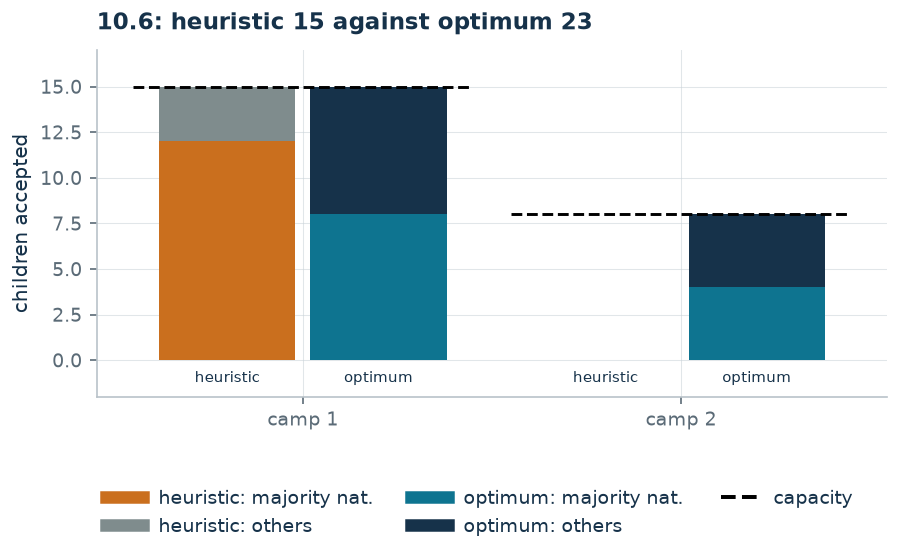
The dual bound closes the problem: all the gap was on the solution side, not on the certificate side. The heuristic's mistake is clear: it exhausts the majority nationality in the first camp, and in the second nobody is left who can act as the majority.
Additional considerations
- The variables are integer but not binary: it is the first family in the course where the counts take large values, and the relaxation stays tight anyway because all the constraints are sums.
- The balance constraint and the majority one are independent: one can have camps with many girls and few of nationality \(c\), and vice versa. On the instance it is the second that bites.
- If a nationality had zero children available, the majority constraint would automatically exclude it from every camp in which anybody else appears: a limit case worth checking on the data.
Additional modelling questions
10.6.1 — An indivisible nationality
For organisational reasons the children of nationality 1 must all stay in the same camp. How does the model change? What is the new optimum?
A worked variant: a bigger camp
Camp 1 is enlarged and reaches \(20\) places.
Only the datum \(d_1\) changes. The total capacity rises to \(28\), but the optimum stops at \(24\): the second combinatorial argument is now in charge, the one about the majority nationality, \(2 \cdot (f_1 + g_1) = 2 \cdot 12 = 24\). It is a good example of the fact that the "right" bound changes with the instance: the dual recipe \(\gamma_j = 1\) would give \(28\), which is worse.
Camp 1 goes from \(15\) to \(20\) places: a datum changes, not the structure. The recipe is the one of the base problem — \(\gamma_j = 1\) and all the other dual variables at zero, because every child accepted takes a place — and it returns \(\sum_j d_j\), which is now \(28\) instead of \(23\). The certificate does not change shape: the datum it adds up does. The heuristic fills the camps in order and reaches \(20\), the optimum is \(24\).
| value | what it is | |
|---|---|---|
| \(\mathit{UB}\) | \(28\) | dual certificate built by hand |
| \(\mathit{LB}\) | \(20\) | heuristic solution |
| \(z(\mathit{LP})\) | \(24\) | relaxation without the bounds |
| \(z(\mathit{LP}^+)\) | \(24\) | relaxation with the bounds |
| \(z(\mathit{MILP})\) | \(24\) | optimum of the MILP |
Code
Complete script —
python/fam10_6_camps.py
(reproducible with python3 python/fam10_6_camps.py from the python/
folder). Notebook —
notebooks/fam10_6_camps.ipynb
— which opens in Colab from the badge at the top of the page.
Show the complete script — python/fam10_6_camps.py (263 lines)
"""Problem 10.6 -- Summer camps: children of several nationalities in several camps.

Counting variables (not binary), a capacity per camp and two composition
constraints: in every camp the girls must not be fewer than the boys, and
nationality c must not be fewer than any other. The second is written once only
because there are two nationalities; with s > 2 one needs s - 1 inequalities.
"""
import gurobipy as gp
import pandas as pd
from gurobipy import GRB

from mip import (ammissibile, dualita_forte, due_rilassamenti, frazione,
                 nuovo_modello, registra_bound, rilassamenti, risolvi, valuta)
from stile import ARANCIO, BLU, GRIGIO, TEAL, intestazione, plt, salva_dati, salva_figura
from esteso import salva_modello

R = range

# ---------- 1. MODEL AND INSTANCE ----------
intestazione("10.6 Summer camps: accepting the largest number of children")
f1 = [8, 10]        # girls available per nationality
g1 = [4, 12]        # boys available per nationality
d1 = [15, 8]        # capacity of the camps
c1 = 0              # nationality that must be the majority (index 0 = nationality 1)
s1, r1 = len(f1), len(d1)
salva_dati(pd.DataFrame({"nationality": R(1, s1 + 1), "girls": f1, "boys": g1}),
           "fam10_6_dati")
salva_dati(pd.DataFrame({"camp": R(1, r1 + 1), "capacity": d1}), "fam10_6_capacita")


def modello_1(f, g, d, c):
    s, r = len(f), len(d)
    m = nuovo_modello("camps")
    x = m.addVars(s, r, vtype=GRB.INTEGER, name="x")    # girls of nationality i in camp j
    y = m.addVars(s, r, vtype=GRB.INTEGER, name="y")    # boys of nationality i in camp j
    m.setObjective(gp.quicksum(x[i, j] + y[i, j] for i in R(s) for j in R(r)), GRB.MAXIMIZE)
    m.addConstrs((x.sum(i, "*") <= f[i] for i in R(s)), name="girls")
    m.addConstrs((y.sum(i, "*") <= g[i] for i in R(s)), name="boys")
    m.addConstrs((gp.quicksum(x[i, j] + y[i, j] for i in R(s)) <= d[j] for j in R(r)),
                 name="capacity")
    m.addConstrs((gp.quicksum(x[i, j] - y[i, j] for i in R(s)) >= 0 for j in R(r)),
                 name="balance")
    # the statement asks that nationality c be no fewer than *each* other one:
    # one inequality per pair (i, j), not a single aggregated sum
    m.addConstrs((x[c, j] + y[c, j] - x[i, j] - y[i, j] >= 0
                  for i in R(s) if i != c for j in R(r)),
                 name="majority")
    return m, x, y


def duale_1(f, g, d, c):
    """min sum_i f_i alpha_i + sum_i g_i beta_i + sum_j d_j gamma_j

    with alpha, beta, gamma >= 0 for the three <= constraints, delta_j >= 0 for the
    balance and eps_{ij} >= 0, one per pair (nationality i != c, camp j), for the
    majority. In the dual constraint of a variable of nationality c all the
    eps_{kj} appear with a minus sign; in that of a nationality i != c only
    eps_{ij} appears, with a plus sign.
    """
    s, r = len(f), len(d)
    dl = nuovo_modello("dual_camps")
    alpha = dl.addVars(s, name="alpha")
    beta = dl.addVars(s, name="beta")
    gamma = dl.addVars(r, name="gamma")
    delta = dl.addVars(r, name="delta")
    eps = dl.addVars([(i, j) for i in R(s) if i != c for j in R(r)], name="eps")
    dl.setObjective(gp.quicksum(f[i] * alpha[i] for i in R(s))
                    + gp.quicksum(g[i] * beta[i] for i in R(s))
                    + gp.quicksum(d[j] * gamma[j] for j in R(r)), GRB.MINIMIZE)
    for i in R(s):
        for j in R(r):
            magg = (-gp.quicksum(eps[k, j] for k in R(s) if k != c) if i == c
                    else eps[i, j])
            dl.addConstr(alpha[i] + gamma[j] - delta[j] + magg >= 1,
                         name=f"rcx[{i},{j}]")
            dl.addConstr(beta[i] + gamma[j] + delta[j] + magg >= 1,
                         name=f"rcy[{i},{j}]")
    return dl


m1, x1, y1 = modello_1(f1, g1, d1, c1)
salva_modello(m1, "fam10_6_primale")

# ---------- 2. THE LP RELAXATION ----------
zlp1, zlp1r, _ = rilassamenti(m1)

# ---------- 3. THE DUAL OF THE RELAXATION (LOWER BOUND) ----------
dl1 = duale_1(f1, g1, d1, c1)
salva_modello(dl1, "fam10_6_duale")
# recipe: alpha = beta = delta = eps = 0 and gamma_j = 1, that is only the capacity is
# priced: every accepted child takes one place, so no more than sum_j d_j can be accepted
mano = {f"gamma[{j}]": 1.0 for j in R(r1)}
ub1, viol = valuta(dl1, mano)
assert viol <= 1e-9, viol
print("  Hand-built dual: alpha = beta = delta = eps = 0 and gamma_j = 1 (every child takes")
print("  one place). All the dual constraints become gamma_j >= 1 and are satisfied:")
print(f"  ub = sum_j d_j = {' + '.join(map(str, d1))} = {frazione(ub1)}")
dualita_forte(dl1, zlp1)

# ---------- 4. CONSTRUCTIVE HEURISTIC (UPPER BOUND) ----------
# constructive heuristic camp by camp: the current camp is filled taking first the majority
# nationality (girls and boys) and then the others, never violating capacity,
# balance and majority.
def euristica(f, g, d, c):
    s, r = len(f), len(d)
    x = {(i, j): 0 for i in R(s) for j in R(r)}
    y = {(i, j): 0 for i in R(s) for j in R(r)}
    rf, rg = list(f), list(g)
    passi = []
    ordine = [c] + [i for i in R(s) if i != c]
    for j in R(r):
        for i in ordine:
            for quale, res, var in (("girls", rf, x), ("boys", rg, y)):
                while res[i] > 0:
                    var[i, j] += 1
                    tot = sum(x[k, j] + y[k, j] for k in R(s))
                    par = sum(x[k, j] - y[k, j] for k in R(s))
                    magg = (x[c, j] + y[c, j]
                            - sum(x[k, j] + y[k, j] for k in R(s) if k != c))
                    if tot > d[j] or par < 0 or magg < 0:
                        var[i, j] -= 1
                        break
                    res[i] -= 1
        occupati = sum(x[k, j] + y[k, j] for k in R(s))
        passi.append(f"camp {j + 1} (capacity {d[j]}): "
                     + ", ".join(f"nat. {i + 1} -> {x[i, j]} girls and {y[i, j]} boys"
                                 for i in R(s))
                     + f"; {occupati} places used")
    return x, y, passi


x_eur, y_eur, passi = euristica(f1, g1, d1, c1)
for k, riga in enumerate(passi, 1):
    print(f"  Step {k}. {riga}")
lb1 = sum(x_eur[i, j] + y_eur[i, j] for i in R(s1) for j in R(r1))
sol_eur = ({f"x[{i},{j}]": x_eur[i, j] for i in R(s1) for j in R(r1)}
           | {f"y[{i},{j}]": y_eur[i, j] for i in R(s1) for j in R(r1)})
assert ammissibile(m1, sol_eur), sol_eur
print(f"  Children accepted by the heuristic: lb = {frazione(lb1)}")
print("  The heuristic uses up the majority nationality in the first camp: in the second one")
print("  nobody is left who can form the majority, and the camp stays empty.")

# ---------- 5. THE REAL LIMIT IS THE MAJORITY NATIONALITY ----------
intestazione("10.6 Two combinatorial arguments on the bounds")
tot_c = f1[c1] + g1[c1]
print(f"  In every camp nationality {c1 + 1} is not fewer than all the others together, so in")
print(f"  every camp it takes at least half of the places. It has {tot_c} children in total:")
print(f"  at most 2 * {tot_c} = {2 * tot_c} children can be accepted. This is a second upper")
print(f"  bound, worse than the capacity one ({frazione(ub1)}) on this instance but not in")
print("  general.")
print(f"  Likewise the girls are {sum(f1)}: with girls >= boys in every camp, the accepted")
print(f"  children are at most 2 * {sum(f1)} = {2 * sum(f1)}.")
salva_dati(pd.DataFrame([{"argument": "capacity of the camps", "bound": ub1},
                         {"argument": "majority nationality", "bound": 2 * tot_c},
                         {"argument": "girls available", "bound": 2 * sum(f1)}]),
           "fam10_6_argomenti")

# ---------- 6. OPTIMUM OF THE MILP ----------
z1 = risolvi(m1)
print("  Optimal solution:")
for j in R(r1):
    tot = sum(x1[i, j].X + y1[i, j].X for i in R(s1))
    print(f"    camp {j + 1}: " + ", ".join(
        f"nat. {i + 1} -> {int(x1[i, j].X)} girls and {int(y1[i, j].X)} boys" for i in R(s1))
        + f"; {int(tot)} places out of {d1[j]}")
riga = registra_bound("1 camps", ub1, lb1, zlp1, zlp1r, z1, senso="max")
salva_dati(pd.DataFrame([riga]), "fam10_6_bound")
assert lb1 <= z1 <= zlp1 <= ub1 + 1e-9
print(f"  The dual bound {frazione(ub1)} coincides with the optimum: the capacity is")
print("  saturated and the certificate closes the gap. The whole gap was on the heuristic side.")

# ---------- 7. ADDITIONAL MODELLING QUESTIONS ----------
varianti = {}


def variante(nome, m):
    z = risolvi(m)
    print(f"  {nome:70s} z = {frazione(z)}")
    return z


# 1a: camp 1 grows; the limit moves from the capacity to nationality 1
m, x, y = modello_1(f1, g1, [20, d1[1]], c1)
varianti["1a"] = variante("1a. Camp 1 grows to 20 places (d1 = 20)", m)
print(f"       the total capacity is now 28 but the optimum stops at 2 * {f1[c1] + g1[c1]} = "
      f"{2 * (f1[c1] + g1[c1])}: the majority nationality is in charge.")
# 1b: the majority nationality cannot be split between several camps
m, x, y = modello_1(f1, g1, d1, c1)
M1 = f1[c1] + g1[c1]
w = m.addVars(r1, vtype=GRB.BINARY, name="w")
m.addConstrs((x[c1, j] + y[c1, j] - M1 * w[j] <= 0 for j in R(r1)), name="single_camp")
m.addConstr(w.sum() <= 1, name="at_most_one_camp")
varianti["1b"] = variante("1b. Nationality 1 cannot be split between several camps", m)
print("       this is exactly what the heuristic does: the second camp stays empty and we")
print(f"       are back to the value {frazione(lb1)}.")
salva_dati(pd.DataFrame({"variant": list(varianti), "z": list(varianti.values())}),
           "fam10_6_varianti")

# ---------- 8. THE SANDWICH ON THE VARIANT 1a ----------
intestazione("10.6a The sandwich on the variant: camp 1 goes up to 20 places")
d1a = [20] + list(d1[1:])

# A capacity changes, not the structure: same model, same dual, same recipe.
# The bound 'every child takes a place' follows the places available.
m1a, x1a, y1a = modello_1(f1, g1, d1a, c1)
salva_modello(m1a, "fam10_6a_primale")
dl1a = duale_1(f1, g1, d1a, c1)
salva_modello(dl1a, "fam10_6a_duale")

# -- feasible heuristic: the same rule, with the new places --
x_1a, y_1a, passi_1a = euristica(f1, g1, d1a, c1)
for k, s in enumerate(passi_1a, 1):
    print(f"  Step {k}. {s}")
lb1a = sum(x_1a[i, j] + y_1a[i, j] for i in R(s1) for j in R(r1))
sol_1a = ({f"x[{i},{j}]": x_1a[i, j] for i in R(s1) for j in R(r1)}
          | {f"y[{i},{j}]": y_1a[i, j] for i in R(s1) for j in R(r1)})
assert ammissibile(m1a, sol_1a), "the heuristic solution of the variant must be feasible"
print(f"  lb = {frazione(lb1a)}")

# -- dual certificate: the same recipe, on the new places --
mano_1a = {f"gamma[{j}]": 1.0 for j in R(r1)}
ub1a, viol_1a = valuta(dl1a, mano_1a)
assert viol_1a <= 1e-9, viol_1a
print("Dual solution by hand: alpha = beta = delta = eps = 0 and gamma_j = 1, as in the")
print("  base problem: every child accepted takes a place, so no more than sum_j d_j can")
print(f"  be accepted = {' + '.join(map(str, d1a))} = {frazione(ub1a)}.")
print("  The certificate does not change shape: the datum it adds up does.")
zlp1a, zlp1ar, _ = due_rilassamenti(m1a, dl1a)
z1a_val = risolvi(m1a)
riga_1a = registra_bound("1a camp 1 at 20 places", ub1a, lb1a, zlp1a, zlp1ar, z1a_val, senso="max")
salva_dati(pd.DataFrame([riga_1a]), "fam10_6a_bound")
assert lb1a <= z1a_val <= zlp1a + 1e-9 <= ub1a + 1e-9

# ---------- 9. FIGURE ----------
fig, ax = plt.subplots(figsize=(6.8, 3.0))
etichette = [f"camp {j + 1}" for j in R(r1)]
for k, (nome, sol) in enumerate([("heuristic", (x_eur, y_eur)),
                                 ("optimum", ({(i, j): x1[i, j].X for i in R(s1) for j in R(r1)},
                                              {(i, j): y1[i, j].X for i in R(s1)
                                               for j in R(r1)}))]):
    xs, ys = sol
    off = -0.2 + 0.4 * k
    for j in R(r1):
        naz1 = xs[c1, j] + ys[c1, j]
        altre = sum(xs[i, j] + ys[i, j] for i in R(s1) if i != c1)
        ax.bar(j + off, naz1, 0.36, color=TEAL if k else ARANCIO)
        ax.bar(j + off, altre, 0.36, bottom=naz1, color=BLU if k else GRIGIO)
        ax.annotate(nome, (j + off, -1.2), ha="center", fontsize=7)
for j in R(r1):
    ax.plot([j - 0.45, j + 0.45], [d1[j], d1[j]], color="black", lw=1.4, ls="--")
ax.plot([], [], color=ARANCIO, lw=6, label="heuristic: majority nat.")
ax.plot([], [], color=GRIGIO, lw=6, label="heuristic: others")
ax.plot([], [], color=TEAL, lw=6, label="optimum: majority nat.")
ax.plot([], [], color=BLU, lw=6, label="optimum: others")
ax.plot([], [], color="black", ls="--", label="capacity")
ax.set_xticks(R(r1))
ax.set_xticklabels(etichette)
ax.set_ylim(-2, max(d1) + 2)
ax.set_ylabel("children accepted")
ax.set_title(f"10.6: heuristic {frazione(lb1)} against optimum {frazione(z1)}")
ax.legend(fontsize=7, ncol=2)
salva_figura(fig, "cap10_campi_ottimo")
print("Done.")