Branches across two companies
Class: BIP · Links: absolute value, min-max · Script: python/fam10_7_antitrust.py
Difficulty: ★★★☆☆ · Time: 45–60 min

Problem 10.7
A company has \(s \in \mathbb{Z}_{\ge 1}\) branches and sells \(r \in \mathbb{Z}_{\ge 1}\) products. For every branch \(i \in \{1, 2, \dots, s\}\) and every product \(j \in \{1, 2, \dots, r\}\), the value \(v_{ij} \in \mathbb{Q}_{\ge 0}\) is the turnover in millions of euros that branch generates with that product. Because of a new antitrust rule the company must split into two smaller companies; every branch is indivisible and must be assigned to exactly one of them. The company wants to partition the branches so as to minimise the largest difference, over all products, between the turnovers of the two new companies.
The problem in words. We decide which of the two companies each branch goes to. The objective: make the two companies as similar as possible, measuring similarity on the product where they do worst. The constraint: every branch to one company only.
Model
Variables. One family of \(s\) binaries suffices: \(x_i \in \{0,1\}\) equals \(1\) if branch \(i\) goes to company \(A\) and \(0\) if it goes to \(B\); plus one free variable \(z\) for the min-max.
One could also declare \(z \ge 0\): the two constraints keep it above an absolute value, hence non-negative, and the solution would not change. It is left free because that is the choice one sees in the dual --- the column of a free variable gives an equality constraint, and that is where the condition \(\sum_j (\lambda_j + \mu_j) = 1\) comes from --- and because this way non-negativity stays a consequence of the model, not an assumption added by hand.
With \(T_j = \sum_{i=1}^{s} v_{ij}\) the total turnover on product \(j\), the turnover of \(A\) is \(\sum_i v_{ij}\, x_i\) and that of \(B\) is \(T_j - \sum_i v_{ij}\, x_i\): their difference is \(2 \sum_i v_{ij}\, x_i - T_j\).
Description. The objective is the worst imbalance. The two groups of constraints, one per product each, say that \(z\) is no smaller than the imbalance of product \(j\) nor than its opposite: together they impose \(z \ge \bigl|2\sum_i v_{ij}\, x_i - T_j\bigr|\), and the minimisation turns them into an equality on the worst product.
One family or two?
The classical statement introduces two families, \(x_i\) and \(y_i\), with the constraint \(x_i + y_i = 1\). The two writings are equivalent, because \(y_i = 1 - x_i\): substituting gives exactly the model above, with \(s\) fewer variables and \(s\) fewer constraints. The aggregated form is preferable as long as the companies are two; with three or more companies the disaggregated form \(\sum_k x_{ik} = 1\) is the only possible one, and it is the one that extends.
The model in gurobipy
m = gp.Model("antitrust")
x = m.addVars(s, vtype=GRB.BINARY, name="x")
z = m.addVar(lb=-GRB.INFINITY, name="z")
m.setObjective(z, GRB.MINIMIZE)
for j in range(r):
    tot = sum(v[i][j] for i in range(s))
    m.addConstr(z - 2 * gp.quicksum(v[i][j] * x[i] for i in range(s)) + tot >= 0)
    m.addConstr(z + 2 * gp.quicksum(v[i][j] * x[i] for i in range(s)) - tot >= 0)
The instance
\(s = 4\) branches, \(r = 3\) products.
| \(v_{ij}\) | \(j=1\) | \(j=2\) | \(j=3\) | branch total |
|---|---|---|---|---|
| \(i=1\) | 3 | 3 | 2 | 8 |
| \(i=2\) | 6 | 8 | 5 | 19 |
| \(i=3\) | 3 | 4 | 4 | 11 |
| \(i=4\) | 2 | 7 | 9 | 18 |
| \(T_j\) | 14 | 22 | 20 |
The model written on the data of the instance:
Constructive heuristic: the primal bound
The branches are assigned in order of decreasing total turnover, each to the company that currently has the lower total. It is the analogue of LPT for scheduling.
On the instance the totals are \(8, 19, 11, 18\), so the order is \(2, 4, 3, 1\): branch 2 to \(A\) (\(A = 19\)), branch 4 to \(B\) (\(B = 18\)), branch 3 to \(B\) (\(B = 29\)), branch 1 to \(A\) (\(A = 27\)). One gets \(A = \{1, 2\}\), \(B = \{3, 4\}\), with differences \(4\), \(0\) and \(6\) on the three products:
LP relaxation and dual: the bound is zero
Associate \(\lambda_j \ge 0\) with the "from above" constraints and \(\mu_j \ge 0\) with the "from below" ones. The column of \(z\), a free variable, gives an equality constraint.
The same dual, written on the data of the instance:
Description. \(\lambda_j\) and \(\mu_j\) are the prices of the two constraints that bound the imbalance of product \(j\), one from above and one from below. The objective prices the total \(T_j\) of each product at those values. The first constraint is the column of \(z\): the variable appears in every constraint with coefficient \(1\) and in the primal objective with cost \(1\), so the prices of the \(2r\) constraints must sum to exactly one — the dual distributes a single unit of weight among the products. The second group are the columns of the \(x_i\): moving branch \(i\) from one company to the other changes the imbalance of product \(j\) by \(2 v_{ij}\), and the weighted sum of these moves cannot be positive.
Recipe. \(\bar\lambda_1 = \bar\mu_1 = 1/2\) and everything else zero: the first constraint is satisfied, \(\mu_j - \lambda_j = 0\) for every \(j\) and hence so are the others. The value is \(\mathit{LB} = 0\).
Here the dual cannot do better
No feasible dual solution is worth more than zero. Indeed, setting \(\theta_j = \mu_j - \lambda_j\), the objective is \(\sum_j T_j\, \theta_j\) and the constraints on the \(x_i\) impose \(\sum_j v_{ij}\, \theta_j \le 0\) for every branch; summing over all branches gives \(\sum_j T_j\, \theta_j \le 0\). The dual is therefore worth at most \(0\), and by strong duality \(z(\mathit{LP}) = 0\).
The primal certificate is even simpler: the fractional solution \(x_i = 1/2\) for every branch with \(z = 0\) is feasible for the relaxation and balances every product exactly. Half a branch to each company: legitimate for the LP, meaningless for the problem.
A combinatorial bound, product by product
If the relaxation says nothing, one has to look elsewhere. For every product \(j\) one can compute, looking at that product alone, the minimum achievable imbalance:
It is the classical partition problem on a single column, and with small \(s\) it is solved by enumeration (\(2^s\) subsets). Every feasible partition of the whole problem is in particular a partition for product \(j\), so \(z(\mathit{MILP}) \ge \max_j g_j\).
| Product | total \(T_j\) | \(g_j\) |
|---|---|---|
| 1 | 14 | 2 |
| 2 | 22 | 0 |
| 3 | 20 | 2 |
On product 1 the values are \(3, 6, 3, 2\): the sum \(7\) is not reachable by any subset, and the best is \(6\) against \(8\), that is \(g_1 = 2\). Hence \(z(\mathit{MILP}) \ge \mathit{LB} = 2\), a bound the LP relaxation cannot see, because it comes from integrality and not from the constraints.
Optimal solution
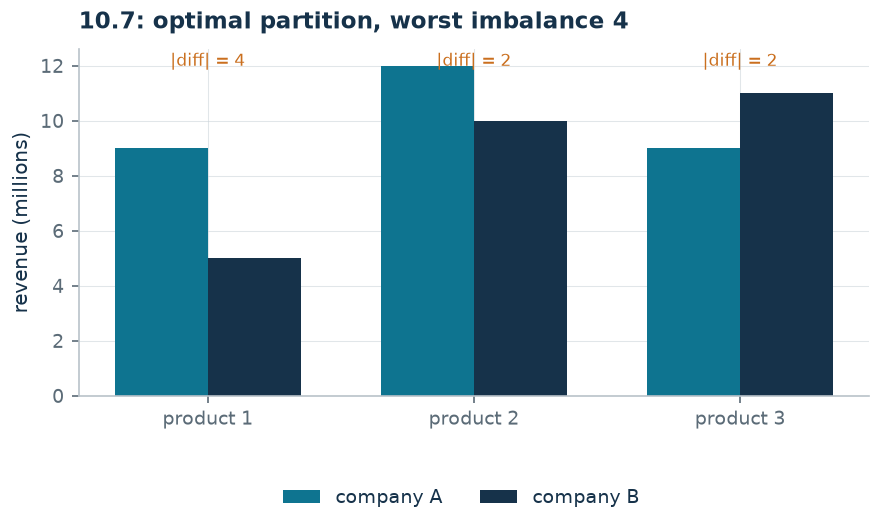
The optimal partition is \(A = \{2, 3\}\) and \(B = \{1, 4\}\), with differences \(4\), \(2\) and \(2\) on the three products.
| \(LB\) (combinatorial) | \(z(\mathit{LP})\) | \(z(\mathit{LP}^+)\) | \(z(\mathit{MILP})\) | \(UB\) (heuristic) | heuristic gap |
|---|---|---|---|---|---|
| 2 | 0 | 0 | 4 | 6 | \(50.0\%\) |
\(\mathit{LB}\) is not the value of the dual (\(0\)) but the combinatorial bound: that is why the column is called "certified bound".
Additional considerations
- The problem with a single product is number partitioning, one of Karp's twenty-one NP-complete problems. With several products it is its vector version, and it stays NP-hard.
- The combinatorial bound can be strengthened: instead of the maximum of the \(g_j\) one can look, for every pair of products, for the minimum of the maximum of the two imbalances. The cost grows but the bound improves, and it is the same idea as surrogate relaxation.
- The min-max objective is not the only possible one: minimising the sum of the differences is another legitimate choice and gives a model with \(r\) auxiliary variables instead of one.
Additional modelling questions
10.7.1 — Min-sum instead of min-max
One wants to minimise the sum of the differences over all products instead of the worst difference. How does the model change? Is the optimal partition the same?
A worked variant: two inseparable branches
Branches \(1\) and \(2\) share their premises and must stay in the same company.
One adds the single linear constraint
that is "both to \(A\) or both to \(B\)". On the instance the optimum worsens from \(4\) to \(6\): the only feasible partitions with \(1\) and \(2\) together are \(\{1,2\}\), \(\{1,2,3\}\) and \(\{1,2,4\}\) (with their complements), and the best one is exactly the one found by the heuristic.
The equality \(x_1 - x_2 = 0\) adds to the dual a free \(\sigma\), which appears with a plus sign in the column of branch \(1\) and with a minus in that of branch \(2\). Its right-hand side is zero, so the objective does not change: the relaxation is worth \(0\) as in the base problem, and for the same reason. The useful bound is combinatorial again: keeping branches \(1\) and \(2\) together, the best possible imbalance on the three products is \(4\), \(0\) and \(2\), and every feasible partition must respect all of them, so \(\zmilp \ge 4\). With the branches free it was \(2\): tying two branches raises the bound.
| value | what it is | |
|---|---|---|
| \(\mathit{UB}\) | \(6\) | heuristic solution |
| \(\mathit{LB}\) | \(4\) | smallest imbalance with branches 1 and 2 tied |
| \(z(\mathit{LP})\) | \(0\) | relaxation without the bounds |
| \(z(\mathit{LP}^+)\) | \(0\) | relaxation with the bounds |
| \(z(\mathit{MILP})\) | \(6\) | optimum of the MILP |
Code
Complete script —
python/fam10_7_antitrust.py
(reproducible with python3 python/fam10_7_antitrust.py from the python/
folder). Notebook —
notebooks/fam10_7_antitrust.ipynb
— which opens in Colab from the badge at the top of the page.
Show the complete script — python/fam10_7_antitrust.py (310 lines)
"""Problem 10.7 -- Antitrust split: two companies as similar as possible.

The branches must be divided into two groups minimising, over the worst product,
the revenue difference between the two groups. It is technique 3.6 (min-max)
applied to an absolute value (3.7): two inequalities per product around the same
variable z.

The point of the problem is that the linear relaxation is worth zero: half a
branch to each company balances every product. The useful lower bound does not
come from the dual but from a combinatorial argument, product by product.
"""
import itertools

import gurobipy as gp
import pandas as pd
from gurobipy import GRB

from mip import (ammissibile, dualita_forte, due_rilassamenti, frazione,
                 nuovo_modello, registra_bound, rilassamenti, risolvi, valuta)
from stile import ARANCIO, BLU, TEAL, intestazione, plt, salva_dati, salva_figura
from esteso import salva_modello

R = range

# ---------- 1. MODEL AND INSTANCE ----------
intestazione("10.7 Antitrust: splitting the branches minimising the worst imbalance")
v2 = [[3, 3, 2],      # revenue of branch i on product j (millions)
      [6, 8, 5],
      [3, 4, 4],
      [2, 7, 9]]
s2, r2 = len(v2), len(v2[0])
salva_dati(pd.DataFrame(v2, columns=[f"product_{j + 1}" for j in R(r2)],
                        index=[f"branch_{i + 1}" for i in R(s2)]).reset_index(),
           "fam10_7_dati")


def modello_2(v):
    """A single family of binaries: x_i = 1 if branch i goes to company A.

    The source uses two families x_i and y_i with x_i + y_i = 1. They are
    equivalent: y_i = 1 - x_i. Here we keep the aggregated form, which is more
    compact; the disaggregated one follows by substitution, and it is the one
    needed when the companies become more than two.
    """
    s, r = len(v), len(v[0])
    m = nuovo_modello("antitrust")
    x = m.addVars(s, vtype=GRB.BINARY, name="x")
    z = m.addVar(lb=-GRB.INFINITY, name="z")
    m.setObjective(z, GRB.MINIMIZE)
    for j in R(r):
        tot = sum(v[i][j] for i in R(s))
        # difference between A and B on product j: 2 * sum_i v_ij x_i - tot
        m.addConstr(z - 2 * gp.quicksum(v[i][j] * x[i] for i in R(s)) + tot >= 0,
                    name=f"above[{j}]")
        m.addConstr(z + 2 * gp.quicksum(v[i][j] * x[i] for i in R(s)) - tot >= 0,
                    name=f"below[{j}]")
    return m, x, z


def duale_2(v):
    """max sum_j T_j (mu_j - lam_j)  with  sum_j (lam_j + mu_j) = 1  (column of z, free)
       and  2 sum_j v_ij (mu_j - lam_j) <= 0 for every branch i (column of x_i >= 0)."""
    s, r = len(v), len(v[0])
    dl = nuovo_modello("dual_antitrust")
    lam = dl.addVars(r, name="lam")     # "above" constraints
    mu = dl.addVars(r, name="mu")       # "below" constraints
    tot = [sum(v[i][j] for i in R(s)) for j in R(r)]
    dl.setObjective(gp.quicksum(tot[j] * (mu[j] - lam[j]) for j in R(r)), GRB.MAXIMIZE)
    dl.addConstr(gp.quicksum(lam[j] + mu[j] for j in R(r)) == 1, name="rcz")
    dl.addConstrs((2 * gp.quicksum(v[i][j] * (mu[j] - lam[j]) for j in R(r)) <= 0
                   for i in R(s)), name="rcx")
    return dl


m2, x2, z2v = modello_2(v2)
salva_modello(m2, "fam10_7_primale")
tot2 = [sum(v2[i][j] for i in R(s2)) for j in R(r2)]
print("  Total revenue per product: "
      + ", ".join(f"product {j + 1} = {tot2[j]}" for j in R(r2)))

# ---------- 2. THE LP RELAXATION ----------
zlp2, zlp2r, _ = rilassamenti(m2)

# ---------- 3. THE DUAL OF THE RELAXATION (LOWER BOUND) ----------
dl2 = duale_2(v2)
salva_modello(dl2, "fam10_7_duale")
mano = {"lam[0]": 0.5, "mu[0]": 0.5}      # lam_1 = mu_1 = 1/2, everything else zero
lb_lp, viol = valuta(dl2, mano)
assert viol <= 1e-9, viol
print(f"  Hand-built dual: lam_1 = mu_1 = 1/2 and everything else zero -> value "
      f"{frazione(lb_lp)}.")
print("  Every feasible dual solution here is worth at most zero: the objective contains the")
print("  difference mu_j - lam_j, and the constraints on the columns x_i force it to be")
print("  non-positive on every branch.")
dualita_forte(dl2, zlp2)

meta = {f"x[{i}]": 0.5 for i in R(s2)} | {"z": 0.0}
val_meta, viol_meta = valuta(m2, meta)
assert viol_meta <= 1e-9 and abs(val_meta) <= 1e-9
print(f"  And indeed z(LP) = {frazione(zlp2)}: it is enough to put half of every branch in")
print("  each company (x_i = 1/2, z = 0) and every product is balanced exactly. It is")
print("  feasible for the relaxation and useless for the real problem: branches are indivisible.")
assert abs(zlp2) <= 1e-9

# ---------- 4. CONSTRUCTIVE HEURISTIC (UPPER BOUND) ----------
# constructive heuristic: the branches in decreasing order of total revenue, each one to the company
# that currently has the smaller total
def euristica(v):
    s, r = len(v), len(v[0])
    tot_i = [sum(v[i]) for i in R(s)]
    gruppo = {}
    somme = [0, 0]
    passi = [f"total revenue of the branches: "
             + ", ".join(f"{i + 1} -> {tot_i[i]}" for i in R(s))]
    for i in sorted(R(s), key=lambda i: (-tot_i[i], i)):
        k = 0 if somme[0] <= somme[1] else 1
        gruppo[i] = k
        somme[k] += tot_i[i]
        passi.append(f"branch {i + 1} ({tot_i[i]}) to company "
                     f"{'AB'[k]}; now A = {somme[0]}, B = {somme[1]}")
    diff = [abs(sum(v[i][j] for i in R(s) if gruppo[i] == 0)
                - sum(v[i][j] for i in R(s) if gruppo[i] == 1)) for j in R(r)]
    passi.append("differences per product: "
                 + ", ".join(f"product {j + 1} -> {diff[j]}" for j in R(r)))
    return gruppo, max(diff), passi


gruppo, ub2, passi = euristica(v2)
for k, riga in enumerate(passi, 1):
    print(f"  Step {k}. {riga}")
sol_eur = {f"x[{i}]": 1 - gruppo[i] for i in R(s2)} | {"z": ub2}
assert ammissibile(m2, sol_eur), sol_eur
print("  Company A = " + str([i + 1 for i in R(s2) if gruppo[i] == 0])
      + ", company B = " + str([i + 1 for i in R(s2) if gruppo[i] == 1])
      + f"   ub = {frazione(ub2)}")

# ---------- 5. A COMBINATORIAL BOUND, PRODUCT BY PRODUCT ----------
intestazione("10.7 The lower bound comes from a combinatorial argument")
# for every product, the smallest imbalance obtainable looking at that product alone
def minimo_squilibrio(colonna, tot):
    s = len(colonna)
    return min(abs(2 * sum(colonna[i] for i in sotto) - tot)
               for k in R(s + 1) for sotto in itertools.combinations(R(s), k))


gj = [minimo_squilibrio([v2[i][j] for i in R(s2)], tot2[j]) for j in R(r2)]
for j in R(r2):
    print(f"  Product {j + 1}: total {tot2[j]}, best imbalance achievable looking at this")
    print(f"    product alone = {gj[j]}")
lb2 = max(gj)
print(f"  Every partition must respect all the products at once, so z >= max_j g_j = "
      f"{frazione(lb2)}.")
print("  It is a valid bound that the linear relaxation cannot see: it comes from")
print("  integrality, not from the constraints.")
salva_dati(pd.DataFrame({"product": R(1, r2 + 1), "total": tot2, "g_j": gj}),
           "fam10_7_argomento")

# ---------- 6. OPTIMUM OF THE MILP ----------
z2 = risolvi(m2)
A = [i + 1 for i in R(s2) if x2[i].X > 0.5]
B = [i + 1 for i in R(s2) if x2[i].X <= 0.5]
diff_ott = [abs(sum(v2[i - 1][j] for i in A) - sum(v2[i - 1][j] for i in B)) for j in R(r2)]
print(f"  Optimal solution: company A = {A}, company B = {B}")
print("  differences per product: "
      + ", ".join(f"product {j + 1} -> {diff_ott[j]}" for j in R(r2))
      + f"   z = {frazione(z2)}")
riga = registra_bound("2 antitrust", ub2, lb2, zlp2, zlp2r, z2)
salva_dati(pd.DataFrame([riga]), "fam10_7_bound")
assert lb2 <= z2 <= ub2 + 1e-9
print(f"  Sandwich: {frazione(lb2)} <= z(MILP) = {frazione(z2)} <= {frazione(ub2)}. Careful:")
print(f"  here lb is not the value of the dual ({frazione(lb_lp)}) but the combinatorial bound.")

# ---------- 7. ADDITIONAL MODELLING QUESTIONS ----------
varianti = {}


def variante(nome, m):
    z = risolvi(m)
    print(f"  {nome:70s} z = {frazione(z)}")
    return z


# 2a: branches 1 and 2 must stay in the same company
m, x, zz = modello_2(v2)
m.addConstr(x[0] - x[1] == 0, name="together")
varianti["2a"] = variante("2a. Branches 1 and 2 must stay together (x1 = x2)", m)
# 2b: minimise the sum of the differences instead of the worst one
m = nuovo_modello("antitrust_sum")
x = m.addVars(s2, vtype=GRB.BINARY, name="x")
zj = m.addVars(r2, name="z")
m.setObjective(zj.sum(), GRB.MINIMIZE)
for j in R(r2):
    m.addConstr(zj[j] - 2 * gp.quicksum(v2[i][j] * x[i] for i in R(s2)) + tot2[j] >= 0,
                name=f"above[{j}]")
    m.addConstr(zj[j] + 2 * gp.quicksum(v2[i][j] * x[i] for i in R(s2)) - tot2[j] >= 0,
                name=f"below[{j}]")
varianti["2b"] = variante("2b. Minimise the sum of the differences (min-sum, not min-max)", m)
A_somma = sorted(min(([i + 1 for i in R(s2) if x[i].X > 0.5],
                      [i + 1 for i in R(s2) if x[i].X <= 0.5])))
A_max = sorted(min((A, B)))
print(f"       min-sum partition: {A_somma} against the rest; min-max partition: {A_max}.")
print("       The two objectives are not comparable in value: the function changes, not")
print("       the feasible set.")
assert A_somma == A_max, (A_somma, A_max)
salva_dati(pd.DataFrame({"variant": list(varianti), "z": list(varianti.values())}),
           "fam10_7_varianti")

# ---------- 8. THE SANDWICH ON THE VARIANT 2a ----------
intestazione("10.7a The sandwich on the variant: branches 1 and 2 stay together")


def modello_2a(v):
    mm, xx, zz = modello_2(v)
    mm.addConstr(xx[0] - xx[1] == 0, name="insieme")
    return mm, xx, zz


def duale_2a(v):
    """To the dual of 10.7 one adds a free sigma for the equality x_1 - x_2 = 0: it
    appears in the column of branch 1 with a plus sign and in that of branch 2
    with a minus sign. The right-hand side is zero: the objective does not change."""
    ss, rr = len(v), len(v[0])
    dl = nuovo_modello("duale_antitrust_2a")
    lam = dl.addVars(rr, name="lam")
    mu = dl.addVars(rr, name="mu")
    sg = dl.addVar(lb=-GRB.INFINITY, name="sigma")
    tot = [sum(v[i][j] for i in R(ss)) for j in R(rr)]
    dl.setObjective(gp.quicksum(tot[j] * (mu[j] - lam[j]) for j in R(rr)), GRB.MAXIMIZE)
    dl.addConstr(gp.quicksum(lam[j] + mu[j] for j in R(rr)) == 1, name="rcz")
    for i in R(ss):
        extra = sg if i == 0 else (-sg if i == 1 else 0)
        dl.addConstr(2 * gp.quicksum(v[i][j] * (mu[j] - lam[j]) for j in R(rr)) + extra <= 0,
                     name=f"rcx[{i}]")
    return dl


m2a, x2a, z2a = modello_2a(v2)
salva_modello(m2a, "fam10_7a_primale")

# -- feasible heuristic: the branches are few, every partition is tried --
print("Constructive heuristic: the branches are few, so the partitions keeping 1 and 2")
print("together are enumerated and the one with the lowest maximum imbalance is kept. With")
print("a constraint tying two branches, the greedy rule of the base problem no longer does:")
print("it would put the two branches in different groups.")
migliore_2a = None
for k in R(s2 + 1):
    for sotto in itertools.combinations(R(s2), k):
        if (0 in sotto) != (1 in sotto):
            continue
        squilibrio = max(abs(2 * sum(v2[i][j] for i in sotto) - tot2[j]) for j in R(r2))
        if migliore_2a is None or squilibrio < migliore_2a[0]:
            migliore_2a = (squilibrio, sotto)
ub2a, gruppo_A = migliore_2a
print(f"  best partition: company A = branches {[i + 1 for i in gruppo_A]}, "
      f"B = {[i + 1 for i in R(s2) if i not in gruppo_A]}")
sol_2a = {f"x[{i}]": (1 if i in gruppo_A else 0) for i in R(s2)} | {"z": ub2a}
assert ammissibile(m2a, sol_2a), "the heuristic solution of the variant must be feasible"
print(f"  ub = {frazione(ub2a)}")

# -- dual certificate: the relaxation stays silent, the bound comes from integrality --
dl2a = duale_2a(v2)
salva_modello(dl2a, "fam10_7a_duale")
mano_2a = {"lam[0]": 0.5, "mu[0]": 0.5, "sigma": 0.0}
lb_lp_2a, viol_2a = valuta(dl2a, mano_2a)
assert viol_2a <= 1e-9, viol_2a
print("Dual solution by hand: lam_1 = mu_1 = 1/2, sigma = 0 and everything else zero. As in")
print("  the base problem the value is zero, and for the same reason: the objective contains")
print("  the difference mu_j - lam_j, which the column constraints force to be")
print("  non-positive. The new sigma does not change it, because its right-hand side is zero.")
print(f"  ->  relaxation: {frazione(lb_lp_2a)}")
zlp2a, zlp2ar, _ = due_rilassamenti(m2a, dl2a)
# the real bound comes from the same combinatorial argument as the base problem,
# restricted to the partitions that keep branches 1 and 2 together
def minimo_squilibrio_legato(colonna, tot):
    ss = len(colonna)
    return min(abs(2 * sum(colonna[i] for i in sotto) - tot)
               for k in R(ss + 1) for sotto in itertools.combinations(R(ss), k)
               if (0 in sotto) == (1 in sotto))


gj_2a = [minimo_squilibrio_legato([v2[i][j] for i in R(s2)], tot2[j]) for j in R(r2)]
lb2a = max(gj_2a)
for j in R(r2):
    print(f"  product {j + 1}: with 1 and 2 tied the best possible imbalance is {gj_2a[j]}")
print(f"  Every feasible partition must respect them all: z >= max_j g_j = {frazione(lb2a)}")
print("  (with the branches free it was " + frazione(lb2) + ": tying two branches raises the bound)")
z2a_val = risolvi(m2a)
riga_2a = registra_bound("2a branches 1 and 2 together", ub2a, lb2a, zlp2a, zlp2ar, z2a_val,
                         certificato="smallest imbalance with branches 1 and 2 tied")
salva_dati(pd.DataFrame([riga_2a]), "fam10_7a_bound")
assert lb2a <= z2a_val <= ub2a + 1e-9

# ---------- 9. FIGURE ----------
fig, ax = plt.subplots(figsize=(6.8, 3.0))
larg = 0.35
idx = list(R(r2))
ax.bar([j - larg / 2 for j in idx], [sum(v2[i - 1][j] for i in A) for j in idx], larg,
       color=TEAL, label="company A")
ax.bar([j + larg / 2 for j in idx], [sum(v2[i - 1][j] for i in B) for j in idx], larg,
       color=BLU, label="company B")
for j in idx:
    ax.annotate(f"|diff| = {diff_ott[j]}", (j, max(tot2) / 2 + 1), ha="center", fontsize=8,
                color=ARANCIO)
ax.set_xticks(idx)
ax.set_xticklabels([f"product {j + 1}" for j in idx])
ax.set_ylabel("revenue (millions)")
ax.set_title(f"10.7: optimal partition, worst imbalance {frazione(z2)}")
ax.legend(fontsize=8)
salva_figura(fig, "cap10_antitrust_ottimo")
print("Done.")