Prizes obtainable in two ways
Class: BIP · Links: mutual exclusion (set packing), a sum as an indicator · Script: python/fam10_1_prizes.py
Difficulty: ★★☆☆☆ · Time: 30–45 min

Problem 10.1
A loyalty programme offers \(s \in \mathbb{Z}_{\ge 1}\) prizes and a customer has \(p \in \mathbb{Q}_{>0}\) points. Every prize \(i \in \{1, 2, \dots, s\}\) can be obtained in two alternative ways: with points only, spending \(a_i \in \mathbb{Q}_{>0}\) of them; or spending only \(b_i \in \mathbb{Q}_{>0}\) points (with \(b_i < a_i\)) and adding a money contribution of \(c_i \in \mathbb{Q}_{\ge 0}\) euros. Every prize can be obtained at most once, and in only one of the two ways. Each prize carries a preference value \(d_i \in \mathbb{Q}_{>0}\), and the customer wants to reach a total preference of at least \(\ell \in \mathbb{Q}_{>0}\). The customer wants to minimise the money spent.
The problem in words. We decide which prizes to take and, for each of them, in which of the two ways. The objective: minimum money contribution. The constraints: the points are not enough for everything; the total preference must reach the threshold; and the same prize is not taken twice.
Model
Variables. Two families of binaries are needed, one per option: \(x_i \in \{0,1\}\) equals \(1\) if prize \(i\) is taken with points only; \(y_i \in \{0,1\}\) equals \(1\) if it is taken with points and a contribution. In all \(2s\) binary variables.
Description. The objective counts money only: the points-only option does not appear, because it costs no euros. The mutual exclusion constraints, one per prize (\(s\) linear constraints), forbid taking the same prize twice. The point budget constraint, a single one, says that the points spent do not exceed those available. The preference constraint, a single one, imposes the threshold.
What mutual exclusion says and what it does not
The constraint \(x_i + y_i \le 1\) allows three configurations: \((0,0)\), \((1,0)\) and \((0,1)\). It forbids only \((1,1)\). In particular:
- it does not say "prize \(i\) must be taken": the configuration \((0,0)\) is legitimate and means that prize is given up;
- it does not say "if I do not take it with points then I take it with a contribution": the converse \(x_i = 0 \Rightarrow y_i = 1\) is false, and the counterexample is exactly \((0,0)\);
- if one wanted every prize to be taken, the constraint would have to be an equality, \(x_i + y_i = 1\): that is a set partitioning instead of a set packing, and the problem changes.
| \(x_i\) | \(y_i\) | allowed? | meaning |
|---|---|---|---|
| 0 | 0 | yes | prize \(i\) is given up |
| 1 | 0 | yes | taken with points only |
| 0 | 1 | yes | taken with points and a contribution |
| 1 | 1 | no | taken twice |
The quantity \(x_i + y_i\) is therefore the indicator "prize \(i\) has been taken, one way or the other", and it is exactly this sum that appears in the preference constraint.
The model in gurobipy
m = gp.Model("prizes")
x = m.addVars(s, vtype=GRB.BINARY, name="x")
y = m.addVars(s, vtype=GRB.BINARY, name="y")
m.setObjective(gp.quicksum(c[i] * y[i] for i in range(s)), GRB.MINIMIZE)
m.addConstrs((x[i] + y[i] <= 1 for i in range(s)), name="one_option")
m.addConstr(gp.quicksum(a[i] * x[i] + b[i] * y[i] for i in range(s)) <= p, name="points")
m.addConstr(gp.quicksum(d[i] * (x[i] + y[i]) for i in range(s)) >= ell, name="preference")
The instance
\(s = 5\) prizes, \(p = 20\) points, \(\ell = 16\).
| \(i=1\) | \(i=2\) | \(i=3\) | \(i=4\) | \(i=5\) | |
|---|---|---|---|---|---|
| \(a_i\) | 8 | 6 | 10 | 5 | 7 |
| \(b_i\) | 4 | 3 | 6 | 2 | 4 |
| \(c_i\) | 10 | 8 | 15 | 5 | 9 |
| \(d_i\) | 5 | 4 | 7 | 3 | 6 |
The model written on the data of the instance:
Constructive heuristic: the primal bound
The prizes are scanned by decreasing preference. Each is taken with points only if they suffice, otherwise with the contribution if the reduced points suffice, otherwise it is skipped; one stops as soon as the required preference is reached.
On the instance the order by preference is \(3, 5, 1, 2, 4\).
- prize 3 (preference 7): points only suffice (\(10 \le 20\)), taken; \(10\) points left, preference \(7\);
- prize 5 (preference 6): points only suffice (\(7 \le 10\)), taken; \(3\) points left, preference \(13\);
- prize 1 (preference 5): the points suffice neither for option a (\(8 > 3\)) nor for option b (\(4 > 3\)): skipped;
- prize 2 (preference 4): the points do not suffice for a (\(6 > 3\)) but do for b (\(3 \le 3\)): taken with a contribution of \(8\) euros; the preference reaches \(17 \ge 16\) and one stops.
The total contribution is \(z(\mathit{MILP}) \le \mathit{UB} = 8\).
LP relaxation and dual: the dual bound
Associate \(\sigma_i \ge 0\) with the mutual-exclusion constraints, \(\pi \ge 0\) with the point budget and \(\rho \ge 0\) with the preference threshold. The primal is a minimisation, so \(\le\) constraints give duals of negative sign.
The same dual, written on the data of the instance:
Description. \(\pi\) is the price of one point, \(\rho\) the value of one unit of preference and \(\sigma_i\) the price of the mutual exclusion of prize \(i\). The objective collects the threshold \(\ell\) priced at \(\rho\) and pays the point budget \(p\) priced at \(\pi\) together with the multipliers \(\sigma_i\). The first group of constraints are the columns of the \(x_i\): taking prize \(i\) with points only yields \(d_i\, \rho\) of preference, consumes \(a_i\, \pi\) of points and \(\sigma_i\) of mutual exclusion, and the balance cannot exceed the money cost of that option, which is zero. The second group says the same for the second option, which consumes only \(b_i\) points: there the balance may reach \(c_i\).
Recipe. Here the free parameters are two, not one: the price \(\pi\) of a point and the price \(\rho\) of one unit of preference. Once they are fixed, the mutual-exclusion multipliers follow by taking the smallest feasible value,
and only the constraints on the second option remain to be checked. The function
is concave and piecewise linear: it can be explored on a grid. On the instance the maximum is at \(\bar\pi = 2\), \(\bar\rho = 3\), \(\bar\sigma = (0,\ 0,\ 1,\ 0,\ 4)\), with value
This solution is optimal for the relaxation without the bounds: indeed \(z(\mathit{LP}) = z(\mathit{LP}^+) = 3\).
An honest bound can be very far away
Here \(\mathit{LB} = 3\), \(\mathit{UB} = 8\) and \(z(\mathit{MILP}) = 5\). It
pays to look at the distances before the percentages:
\(\mathit{UB} - \mathit{LB} = 5\) is what is known without solving, and
\(z(\mathit{MILP}) - \mathit{LB} = 2\) is how far the dual bound really is.
As percentages, the certified gap in the solver's convention is
\((\mathit{UB} - \mathit{LB}) / \mathit{UB} = 5/8 = 62.5\%\) --- what Gurobi
would call MIPGap if it stopped here --- while the heuristic gap in the
table below is
\((\mathit{UB} - z(\mathit{MILP})) / z(\mathit{MILP}) = 3/5 = 60\%\): two
close numbers measuring different things, and it is the denominator that
says so. Nothing is wrong: the LP relaxation may take
"half a prize" at half preference, and that freedom is worth a lot. It is
the most extreme case in the course, and it serves as a reminder that a
valid bound is not automatically a useful bound.
Optimal solution
| \(i=1\) | \(i=2\) | \(i=3\) | \(i=4\) | \(i=5\) | |
|---|---|---|---|---|---|
| points only \(x_i\) | 0 | 0 | 1 | 0 | 1 |
| with contribution \(y_i\) | 0 | 0 | 0 | 1 | 0 |
Prizes \(3\) and \(5\) are taken with points only (\(10 + 7 = 17\)) and prize \(4\) with the contribution (\(2\) points and \(5\) euros): \(19\) of the \(20\) points are used, the preference is \(7 + 6 + 3 = 16\), exactly the threshold.
| \(UB\) | \(LB\) (dual) | \(z(\mathit{LP})\) | \(z(\mathit{LP}^+)\) | \(z(\mathit{MILP})\) | heuristic gap |
|---|---|---|---|---|---|
| 8 | 3 | 3 | 3 | 5 | \(60.0\%\) |
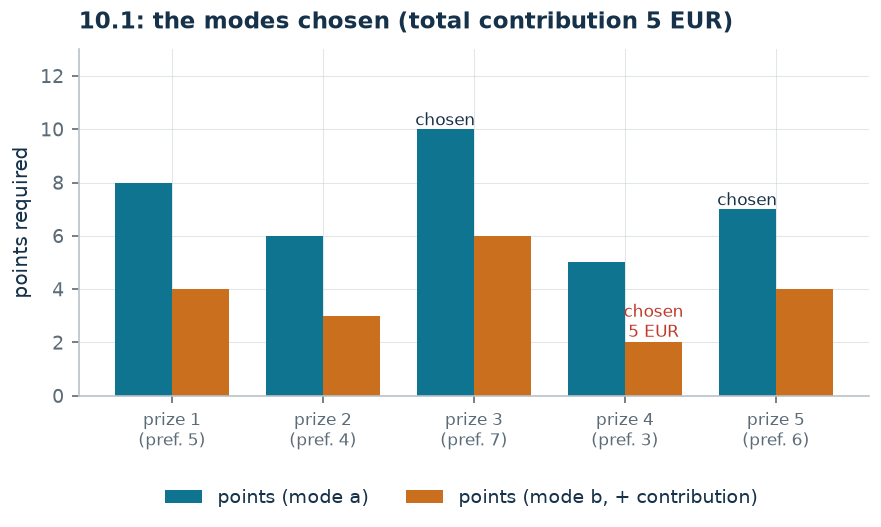
The heuristic goes wrong because it looks only at preference: it takes prize \(5\) with points only (correct) but then finds itself with \(3\) points and has to buy prize \(2\) for \(8\) euros, whereas the optimum keeps the points for prize \(4\), which costs only \(5\) euros of contribution.
Additional considerations
- The valid inequalities \(x_i \le 1\) and \(y_i \le 1\) are implied by the mutual-exclusion constraints: indeed \(z(\mathit{LP}) = z(\mathit{LP}^+)\).
- If for some prize \(c_i = 0\), the second option would dominate the first (fewer points, same cost) and the variable \(x_i\) could be removed. It is a check on the data worth doing.
- The model extends to \(k\) options without effort: \(k\) families of binaries and the constraint \(\sum_{m=1}^{k} x_i^{(m)} \le 1\). The structure stays a set packing by rows.
Additional modelling questions
10.1.1 — Alternative prizes
Prizes \(3\) and \(5\) come from the same supplier and are alternatives: at most one of them may be taken, in either option. How does the model change? What is the new optimum?
A worked variant: at least four prizes
Besides the preference threshold, the customer wants at least four different prizes.
One adds the single linear constraint
again written on the indicators \(x_i + y_i\). On the instance the optimum rises to \(13\): with only \(20\) points, four prizes force a repeated use of the mode that is cheap in points, that is the one that costs money. Note that the preference constraint and the counting constraint are not equivalent, however similar they look: the first one weights the prizes by \(d_i\), the second one counts them.
The constraint \(\sum_i (x_i + y_i) \ge 4\) adds to the dual a \(\kappa \ge 0\) with right-hand side \(4\): it enters the objective and appears in both columns of every prize, because a prize counts however it was taken. The recipe of the base problem extends by searching \(\kappa\) too on the grid of quarters, and gives \(\pi = \varrho = 3/2\), \(\kappa = 9/2\), that is \(\lb = 6\). The heuristic enumerates the \(3^5 = 243\) possible states — each prize not taken, on points or with a contribution — and finds \(13\), which is the optimum: with five objects enumeration is the most honest rule.
| value | what it is | |
|---|---|---|
| \(\mathit{UB}\) | \(13\) | heuristic solution |
| \(\mathit{LB}\) | \(6\) | dual certificate built by hand |
| \(z(\mathit{LP})\) | \(\frac{25}{2}\) | relaxation without the bounds |
| \(z(\mathit{LP}^+)\) | \(\frac{25}{2}\) | relaxation with the bounds |
| \(z(\mathit{MILP})\) | \(13\) | optimum of the MILP |
Code
Complete script —
python/fam10_1_prizes.py
(reproducible with python3 python/fam10_1_prizes.py from the python/
folder). Notebook —
notebooks/fam10_1_prizes.ipynb
— which opens in Colab from the badge at the top of the page.
Show the complete script — python/fam10_1_prizes.py (281 lines)
"""Problem 10.1 -- Prizes obtainable in two ways.

Every prize is obtained either with points only, or with fewer points plus a
contribution in euros: two binary variables per prize and a mutual-exclusion
constraint. The link is the one of chapter 2: x_i + y_i <= 1 is a set packing, and
the converses must be refuted explicitly with x_i = y_i = 0.
"""
import gurobipy as gp
import pandas as pd
from gurobipy import GRB
from itertools import product

from mip import (ammissibile, dualita_forte, due_rilassamenti, frazione,
                 nuovo_modello, registra_bound, rilassamenti, risolvi, valuta)
from stile import ARANCIO, BLU, ROSSO, TEAL, intestazione, plt, salva_dati, salva_figura
from esteso import salva_modello

R = range

# ---------- 1. MODEL AND INSTANCE ----------
intestazione("10.1 Prizes: points only, or fewer points plus a contribution in euros")
a1 = [8, 6, 10, 5, 7]        # points if the points-only mode is used
b1 = [4, 3, 6, 2, 4]         # points if the contribution is added
c1 = [10, 8, 15, 5, 9]       # contribution in euros
d1 = [5, 4, 7, 3, 6]         # preference value
p1, ell1 = 20, 16            # points available and minimum preference required
s1 = len(a1)
salva_dati(pd.DataFrame({"prize": R(1, s1 + 1), "a": a1, "b": b1, "c": c1, "d": d1}),
           "fam10_1_dati")
print(f"  {s1} prizes, {p1} points available, minimum preference required {ell1}")


def modello_1(a, b, c, d, p, ell):
    s = len(a)
    m = nuovo_modello("prizes")
    x = m.addVars(s, vtype=GRB.BINARY, name="x")     # prize with points only
    y = m.addVars(s, vtype=GRB.BINARY, name="y")     # prize with points + contribution
    m.setObjective(gp.quicksum(c[i] * y[i] for i in R(s)), GRB.MINIMIZE)
    m.addConstrs((x[i] + y[i] <= 1 for i in R(s)), name="one_mode")
    m.addConstr(gp.quicksum(a[i] * x[i] + b[i] * y[i] for i in R(s)) <= p, name="points")
    m.addConstr(gp.quicksum(d[i] * (x[i] + y[i]) for i in R(s)) >= ell, name="preference")
    return m, x, y


def duale_1(a, b, c, d, p, ell):
    """max -sum_i sigma_i - p pi + ell rho;  -sigma_i - a_i pi + d_i rho <= 0;
    -sigma_i - b_i pi + d_i rho <= c_i;  sigma, pi >= 0, rho >= 0.
    (sigma are the duals of x_i + y_i <= 1, pi that of the points, rho that of the
    preference; in a minimisation the <= constraints give duals <= 0: here we write
    -sigma with sigma >= 0.)"""
    s = len(a)
    dl = nuovo_modello("dual_prizes")
    sigma = dl.addVars(s, name="sigma")
    pi = dl.addVar(name="pi")
    rho = dl.addVar(name="rho")
    dl.setObjective(-gp.quicksum(sigma[i] for i in R(s)) - p * pi + ell * rho, GRB.MAXIMIZE)
    dl.addConstrs((-sigma[i] - a[i] * pi + d[i] * rho <= 0 for i in R(s)), name="rc_x")
    dl.addConstrs((-sigma[i] - b[i] * pi + d[i] * rho <= c[i] for i in R(s)), name="rc_y")
    return dl


m1, x1, y1 = modello_1(a1, b1, c1, d1, p1, ell1)
salva_modello(m1, "fam10_1_primale")

# ---------- 2. THE LP RELAXATION ----------
zlp1, zlp1r, _ = rilassamenti(m1)

# ---------- 3. THE DUAL OF THE RELAXATION (LOWER BOUND) ----------
dl1 = duale_1(a1, b1, c1, d1, p1, ell1)
salva_modello(dl1, "fam10_1_duale")
# recipe: one chooses the price pi of a point and the price rho of one unit of
# preference; the duals of the mutual exclusion follow from these by setting
# sigma_i = max(0, d_i rho - a_i pi), the smallest value that makes the constraint on
# mode a feasible. What is left to check are the constraints on mode b. The pair
# (pi, rho) is chosen on a grid: the objective is concave and piecewise linear.
def duale_da(pi_v, rho_v):
    sig = [max(0.0, d1[i] * rho_v - a1[i] * pi_v) for i in R(s1)]
    ok = all(-sig[i] - b1[i] * pi_v + d1[i] * rho_v <= c1[i] + 1e-9 for i in R(s1))
    val = -sum(sig) - p1 * pi_v + ell1 * rho_v
    return (val if ok else float("-inf")), sig


griglia = [k / 100 for k in R(0, 301)]
coppie = [(pi_v, rho_v) for pi_v in griglia for rho_v in griglia]
pi_star, rho_star = max(coppie, key=lambda c: duale_da(*c)[0])
_, sigma_star = duale_da(pi_star, rho_star)
mano = {"pi": pi_star, "rho": rho_star} | {f"sigma[{i}]": sigma_star[i] for i in R(s1)}
lb1, viol = valuta(dl1, mano)
assert viol <= 1e-9, (viol, mano)
print("  Hand-built dual: one chooses the price pi of a point and the price rho of one unit")
print("  of preference; the duals of the mutual exclusion follow by setting")
print("  sigma_i = max(0, d_i rho - a_i pi), the smallest value that makes the constraint on")
print("  mode a feasible. What is left to check are the constraints on mode b.")
print(f"    pi = {frazione(pi_star)} euros per point, rho = {frazione(rho_star)} euros per")
print(f"    unit of preference, sigma = " + ", ".join(frazione(v) for v in sigma_star))
print(f"  ->  lb = -sum(sigma) - p pi + l rho = {frazione(lb1)}")
dualita_forte(dl1, zlp1)

# ---------- 4. CONSTRUCTIVE HEURISTIC (UPPER BOUND) ----------
# constructive heuristic: the prizes are scanned by decreasing preference; each one is taken with points
# only if they suffice, otherwise with the contribution if the reduced points suffice,
# and we stop as soon as the required preference is reached
punti, pref = p1, 0
scelta = {}
for i in sorted(R(s1), key=lambda i: (-d1[i], i)):
    if pref >= ell1:
        break
    if punti >= a1[i]:
        scelta[i], punti, pref = "points", punti - a1[i], pref + d1[i]
        print(f"  Prize {i + 1} (preference {d1[i]}): the points alone are enough ({a1[i]} <= "
              f"{punti + a1[i]}): it is taken; preference {pref}, points left {punti}")
    elif punti >= b1[i]:
        scelta[i], punti, pref = "contribution", punti - b1[i], pref + d1[i]
        print(f"  Prize {i + 1} (preference {d1[i]}): the points are not enough for mode a "
              f"({a1[i]} > {punti + b1[i]}), mode b is used: {b1[i]} points and {c1[i]} euros; "
              f"preference {pref}, points left {punti}")
    else:
        print(f"  Prize {i + 1} (preference {d1[i]}): the {punti} points left are not enough "
              f"for either mode: it is skipped")
assert pref >= ell1, "the constructive heuristic does not reach the required preference"
ub1 = sum(c1[i] for i, mod in scelta.items() if mod == "contribution")
sol_eur = {f"x[{i}]": 1 for i, mod in scelta.items() if mod == "points"} \
    | {f"y[{i}]": 1 for i, mod in scelta.items() if mod == "contribution"}
assert ammissibile(m1, sol_eur)
print(f"  Heuristic solution: preference {pref} >= {ell1}, total contribution "
      f"ub = {frazione(ub1)}")

# ---------- 5. OPTIMUM OF THE MILP ----------
z1 = risolvi(m1)
soli_punti = [i + 1 for i in R(s1) if x1[i].X > 0.5]
con_contributo = [i + 1 for i in R(s1) if y1[i].X > 0.5]
print(f"  Optimal solution: with points only {soli_punti}, with a contribution "
      f"{con_contributo}; total contribution {frazione(z1)}")
print(f"  Points used: "
      f"{sum(a1[i - 1] for i in soli_punti) + sum(b1[i - 1] for i in con_contributo)}"
      f" out of {p1}; preference "
      f"{sum(d1[i - 1] for i in soli_punti + con_contributo)} >= {ell1}")
riga = registra_bound("1 prizes", ub1, lb1, zlp1, zlp1r, z1)
salva_dati(pd.DataFrame([riga]), "fam10_1_bound")
assert lb1 <= zlp1 <= z1 <= ub1 + 1e-9

# ---------- 6. ADDITIONAL MODELLING QUESTIONS ----------
varianti = {}


def variante(nome, m):
    z = risolvi(m)
    print(f"  {nome:70s} z = {frazione(z)}")
    return z


# 1a: prizes 3 and 5 are alternatives (at most one of the two, in either mode)
m, x, y = modello_1(a1, b1, c1, d1, p1, ell1)
m.addConstr(x[2] + y[2] + x[4] + y[4] <= 1, name="alternatives")
varianti["1a"] = variante("1a. Prizes 3 and 5 are alternatives (x3+y3+x5+y5 <= 1)", m)
# 1b: at least four prizes are wanted, on top of the preference threshold
m, x, y = modello_1(a1, b1, c1, d1, p1, ell1)
m.addConstr(gp.quicksum(x[i] + y[i] for i in R(s1)) >= 4, name="at_least_four")
varianti["1b"] = variante("1b. At least four prizes are wanted (sum_i (x_i+y_i) >= 4)", m)
salva_dati(pd.DataFrame({"variant": list(varianti), "z": list(varianti.values())}),
           "fam10_1_varianti")

# ---------- 7. THE SANDWICH ON THE VARIANT 1b ----------
intestazione("10.1b The sandwich on the variant: at least four prizes")
MIN_PREMI = 4


def modello_1b(a, b, c, d, p, ell, minimo=MIN_PREMI):
    mm, xx, yy = modello_1(a, b, c, d, p, ell)
    mm.addConstr(gp.quicksum(xx[i] + yy[i] for i in R(len(a))) >= minimo, name="almeno_quattro")
    return mm, xx, yy


def duale_1b(a, b, c, d, p, ell, minimo=MIN_PREMI):
    """To the dual of 10.1 one adds kappa >= 0 for the constraint
    sum_i (x_i + y_i) >= minimo: the right-hand side is `minimo`, so kappa enters
    the objective, and it appears in both columns of every prize."""
    ss = len(a)
    dl = nuovo_modello("duale_premi_1b")
    sigma = dl.addVars(ss, name="sigma")
    pi = dl.addVar(name="pi")
    rho = dl.addVar(name="rho")
    kap = dl.addVar(name="kappa")
    dl.setObjective(-gp.quicksum(sigma[i] for i in R(ss)) - p * pi + ell * rho + minimo * kap,
                    GRB.MAXIMIZE)
    dl.addConstrs((-sigma[i] - a[i] * pi + d[i] * rho + kap <= 0 for i in R(ss)), name="rc_x")
    dl.addConstrs((-sigma[i] - b[i] * pi + d[i] * rho + kap <= c[i] for i in R(ss)), name="rc_y")
    return dl


m1b, x1b, y1b = modello_1b(a1, b1, c1, d1, p1, ell1)
salva_modello(m1b, "fam10_1b_primale")

# -- feasible heuristic: the base one, then prizes are added up to four --
print("Constructive heuristic: there are five prizes and each has three states (not taken,")
print("on points, with a contribution), so the combinations are 3^5 = 243: all are tried and")
print("the cheapest feasible one is kept. With few objects it is the most honest rule ---")
print("and one sees at once what the new constraint costs.")
migliore_eur = None
for stati in product(("no", "punti", "contributo"), repeat=s1):
    presi = [i for i in R(s1) if stati[i] != "no"]
    if len(presi) < MIN_PREMI:
        continue
    punti_usati = sum(a1[i] if stati[i] == "punti" else b1[i] for i in presi)
    if punti_usati > p1:
        continue
    if sum(d1[i] for i in presi) < ell1:
        continue
    costo = sum(c1[i] for i in presi if stati[i] == "contributo")
    if migliore_eur is None or costo < migliore_eur[0]:
        migliore_eur = (costo, stati, presi, punti_usati)
assert migliore_eur is not None, "no feasible combination: the variant would be empty"
ub1b, stati_1b, presi_1b, punti_1b = migliore_eur
print(f"  best combination: " + ", ".join(
    f"prize {i + 1} {stati_1b[i]}" for i in presi_1b))
print(f"  points used {punti_1b} out of {p1}, preference {sum(d1[i] for i in presi_1b)} "
      f"(required {ell1})")
sol_1b = ({f"x[{i}]": 1 for i in presi_1b if stati_1b[i] == "punti"}
          | {f"y[{i}]": 1 for i in presi_1b if stati_1b[i] == "contributo"})
assert ammissibile(m1b, sol_1b), "the heuristic solution of the variant must be feasible"
print(f"  ub = {frazione(ub1b)}")

# -- dual certificate: kappa pays for every prize and collects four times --
dl1b = duale_1b(a1, b1, c1, d1, p1, ell1)
salva_modello(dl1b, "fam10_1b_duale")


def valore_duale_1b(pi_v, rho_v, kap_v):
    sig = [max(0.0, d1[i] * rho_v - a1[i] * pi_v + kap_v) for i in R(s1)]
    ok = all(-sig[i] - b1[i] * pi_v + d1[i] * rho_v + kap_v <= c1[i] + 1e-9 for i in R(s1))
    val = -sum(sig) - p1 * pi_v + ell1 * rho_v + MIN_PREMI * kap_v
    return (val if ok else None), sig


migliore_1b = (None, None, None, None)
for pi_v in [k / 4 for k in R(0, 21)]:
    for rho_v in [k / 4 for k in R(0, 21)]:
        for kap_v in [k / 4 for k in R(0, 21)]:
            val, sig = valore_duale_1b(pi_v, rho_v, kap_v)
            if val is not None and (migliore_1b[0] is None or val > migliore_1b[0]):
                migliore_1b = (val, pi_v, rho_v, kap_v)
lb1b, pi_1b, rho_1b, kap_1b = migliore_1b
_, sig_1b = valore_duale_1b(pi_1b, rho_1b, kap_1b)
mano_1b = ({"pi": pi_1b, "rho": rho_1b, "kappa": kap_1b}
           | {f"sigma[{i}]": sig_1b[i] for i in R(s1)})
lb1b_val, viol_1b = valuta(dl1b, mano_1b)
assert viol_1b <= 1e-9, (viol_1b, mano_1b)
print("Dual solution by hand: the recipe of the base problem --- price pi of a point, price")
print("  rho of a unit of preference, sigma_i the smallest value making the column of the")
print("  points mode feasible --- plus kappa, the price of 'one more prize'. The triple is")
print("  searched on the grid of quarters and the best is kept:")
print(f"  pi = {frazione(pi_1b)}, rho = {frazione(rho_1b)}, kappa = {frazione(kap_1b)}")
print(f"  ->  lb = {frazione(lb1b_val)}")
zlp1b, zlp1br, _ = due_rilassamenti(m1b, dl1b)
z1b = risolvi(m1b)
riga_1b = registra_bound("1b at least four prizes", ub1b, lb1b_val, zlp1b, zlp1br, z1b)
salva_dati(pd.DataFrame([riga_1b]), "fam10_1b_bound")
assert lb1b_val <= zlp1b <= z1b <= ub1b + 1e-9

# ---------- 8. FIGURE ----------
fig, ax = plt.subplots(figsize=(6.8, 3.0))
premi = list(R(1, s1 + 1))
larghezza = 0.38
ax.bar([i - larghezza / 2 for i in premi], a1, larghezza, color=TEAL, label="points (mode a)")
ax.bar([i + larghezza / 2 for i in premi], b1, larghezza, color=ARANCIO,
       label="points (mode b, + contribution)")
for i in R(s1):
    if x1[i].X > 0.5:
        ax.annotate("chosen", (i + 1 - larghezza / 2, a1[i]), ha="center", va="bottom",
                    fontsize=8, color=BLU)
    if y1[i].X > 0.5:
        ax.annotate(f"chosen\n{c1[i]} EUR", (i + 1 + larghezza / 2, b1[i]), ha="center",
                    va="bottom", fontsize=8, color=ROSSO)
ax.set_xticks(premi)
ax.set_xticklabels([f"prize {i}\n(pref. {d1[i - 1]})" for i in premi], fontsize=8)
ax.set_ylabel("points required")
ax.set_ylim(0, max(a1) + 3)
ax.set_title(f"10.1: the modes chosen (total contribution {frazione(z1)} EUR)")
ax.legend(fontsize=8)
salva_figura(fig, "cap10_premi_ottimo")
print("Done.")