Christmas trees and boxes of lights
Class: MILP · Links: availability across two levels, counting with an indicator · Script: python/fam10_4_lights.py
Difficulty: ★★★★☆ · Time: 45–60 min

Problem 10.4
The city council wants to decorate \(q \in \mathbb{Z}_{\ge 1}\) trees for the holidays. Every tree can be decorated according to one of \(n \in \mathbb{Z}_{\ge 1}\) possible configurations, each characterised by lights of \(m \in \mathbb{Z}_{\ge 1}\) different colours. For every configuration \(c \in \{1, 2, \dots, n\}\) and every colour \(l \in \{1, 2, \dots, m\}\), the value \(u_{cl} \in \mathbb{Z}_{\ge 0}\) is the number of lights of colour \(l\) required by configuration \(c\), and \(i_c \in \mathbb{Q}_{>0}\) is the installation cost of a tree decorated that way. All the lights must be bought on the market, where they are sold in boxes of \(k \in \mathbb{Z}_{\ge 1}\) types: for every type \(b \in \{1, 2, \dots, k\}\) and every colour \(l\), the value \(v_{bl} \in \mathbb{Z}_{\ge 0}\) is the number of lights of colour \(l\) in a box of type \(b\), and \(p_b \in \mathbb{Q}_{\ge 0}\) is its cost. To guarantee a pleasant visual variety, at least \(f \in \mathbb{Z}_{\ge 1}\) different configurations must be used. The trees are to be decorated at minimum total cost.
The problem in words. We decide how many trees to decorate with each configuration and how many boxes to buy of each type. The objective: minimum total cost (installation plus boxes). The constraints: all the trees must be decorated; the lights bought must cover those needed, colour by colour; at least \(f\) different configurations.
Model
Variables. \(x_c \in \mathbb{Z}_{\ge 0}\) trees decorated with configuration \(c\); \(y_b \in \mathbb{Z}_{\ge 0}\) boxes bought of type \(b\); \(z_c \in \{0,1\}\) equals \(1\) if configuration \(c\) is used.
Description. The objective adds up the cost of the installations and that of the boxes. The trees constraint, a single one, says that exactly \(q\) trees are decorated. The lights constraints, one per colour, say that the lights bought cover those used. The variety constraint, a single one, imposes at least \(f\) different configurations. The configuration used constraints, one per configuration, tie the indicator \(z_c\) to the actual use of the configuration.
The link between the two levels
The lights constraint is an availability: for every colour, the lights bought must be at least those required. There is no big-M, because both sides are sums of real quantities. The count of the boxes comes from here: if the lights of colour \(l\) required are \(u_l\) and a box contains \(v_{bl}\), buying only boxes of type \(b\) would require \(\lceil u_l / v_{bl} \rceil\) boxes. The model never writes the ceiling: integrality produces it.
The 'configuration used' link
The constraint reads \(z_c \le x_c\). If \(z_c = 1\) then \(x_c \ge 1\): the configuration really is used on at least one tree. The converse is not imposed, and it is not needed: a minimisation objective has no interest in raising \(z_c\), and the variety constraint forces it to do so exactly \(f\) times. No big-M is needed here because \(x_c\) and \(z_c\) are directly comparable: \(x_c\) is a count, not a continuous quantity.
A frequent mistake is writing \(x_c \le M\, z_c\) thinking of activation: that would be the link in the other direction, and would impose that an unused configuration has \(x_c = 0\) — true but useless, since it is already guaranteed by \(\sum_c x_c = q\) and \(x_c \ge 0\).
The model in gurobipy
m = gp.Model("lights")
x = m.addVars(nc, vtype=GRB.INTEGER, name="x")
y = m.addVars(nb, vtype=GRB.INTEGER, name="y")
z = m.addVars(nc, vtype=GRB.BINARY, name="z")
m.setObjective(gp.quicksum(i[c] * x[c] for c in range(nc))
               + gp.quicksum(p[b] * y[b] for b in range(nb)), GRB.MINIMIZE)
m.addConstr(x.sum() == q, name="trees")
m.addConstrs((gp.quicksum(v[b][l] * y[b] for b in range(nb))
              - gp.quicksum(u[c][l] * x[c] for c in range(nc)) >= 0
              for l in range(nl)), name="lights")
m.addConstr(z.sum() >= f, name="variety")
m.addConstrs((x[c] - z[c] >= 0 for c in range(nc)), name="used")
The instance
\(q = 20\) trees, \(n = 3\) configurations, \(m = 2\) colours, \(k = 2\) box types, \(f = 2\).
| \(u_{cl}\) | colour 1 | colour 2 | \(i_c\) |
|---|---|---|---|
| \(c=1\) | 4 | 2 | 7 |
| \(c=2\) | 2 | 3 | 6 |
| \(c=3\) | 2 | 2 | 8 |
| \(v_{bl}\) | colour 1 | colour 2 | \(p_b\) |
|---|---|---|---|
| \(b=1\) | 10 | 2 | 100 |
| \(b=2\) | 15 | 4 | 200 |
The price of one light depends on the colour and on the box type: colour 1 at \(10\) in box 1 and at \(40/3\) in box 2; colour 2 at \(50\) in both. Colour 2 is far more expensive, and that is what drives the solution.
The model written on the data of the instance:
Constructive heuristic: the primal bound
Two phases. First the configurations: \(q - f + 1\) trees with the cheapest one to install and one tree for each of the other \(f - 1\), so that variety is satisfied at minimum installation cost. Then the boxes: while some light is missing, buy the box with the lowest price per missing light.
On the instance the cheapest configuration to install is \(2\) (cost \(6\)), the second is \(1\) (cost \(7\)): \(19\) trees are decorated with \(2\) and one with \(1\). Then \(42\) lights of colour 1 and \(59\) of colour 2 are needed, and the heuristic buys \(30\) boxes of type 1. The total cost is \(z(\mathit{MILP}) \le \mathit{UB} = 3121\).
The heuristic picks the configuration that is cheapest to install, \(2\), which is however the greediest in lights of the expensive colour: the boxes pay the bill. It is the typical mistake of a constructive heuristic that looks at one cost item only.
LP relaxation and dual: the dual bound
Associate \(\alpha\) free with the trees constraint (an equality), \(\beta_l \ge 0\) with the colours, \(\gamma \ge 0\) with variety and \(\delta_c \ge 0\) with the link.
The same dual, written on the data of the instance:
Description. \(\alpha\) is the value of one decorated tree, \(\beta_l\) the price of one light of colour \(l\), \(\gamma\) the price of variety and \(\delta_c\) that of the link between configuration \(c\) and its indicator. The objective prices the \(q\) trees at \(\alpha\) and the threshold \(f\) at \(\gamma\). The first group of constraints are the columns of the \(x_c\): using configuration \(c\) on a tree is worth \(\alpha\), consumes \(u_{cl}\) lights of each colour and releases \(\delta_c\), and the balance cannot exceed the installation cost \(i_c\). The second are the columns of the \(y_b\): a box of type \(b\) supplies \(v_{bl}\) lights of each colour, and their value cannot exceed the price \(p_b\). The third are the columns of the \(z_c\): the price of variety cannot exceed that of the link which makes it claimable.
Recipe. Set \(\gamma = 0\) and \(\delta_c = 0\): variety is not priced. The constraints on the boxes bound \(\beta\), those on the configurations bound \(\alpha\). Price one colour only, at the price per light no box can beat,
every tree costs at least the installation of the most convenient configuration, lights included. On the instance the best colour is \(2\), where both box types give the same price per light, \(\bar\beta_2 = 50\):
so \(\bar\alpha = 107\) and \(z(\mathit{MILP}) \ge \mathit{LB} = 20 \cdot 107 = 2140\).
Optimal solution
\(19\) trees are decorated with configuration 1 and one with 3, and \(20\) boxes of type 1 are bought. Of the lights, \(78\) of colour 1 are needed (\(200\) are bought: many are left over) and \(40\) of colour 2 (exactly \(40\) are bought).
| \(LB\) (dual) | \(z(\mathit{LP})\) | \(z(\mathit{LP}^+)\) | \(z(\mathit{MILP})\) | \(UB\) (heuristic) | heuristic gap |
|---|---|---|---|---|---|
| 2140 | 2140 | 2141 | 2141 | 3121 | \(45.8\%\) |
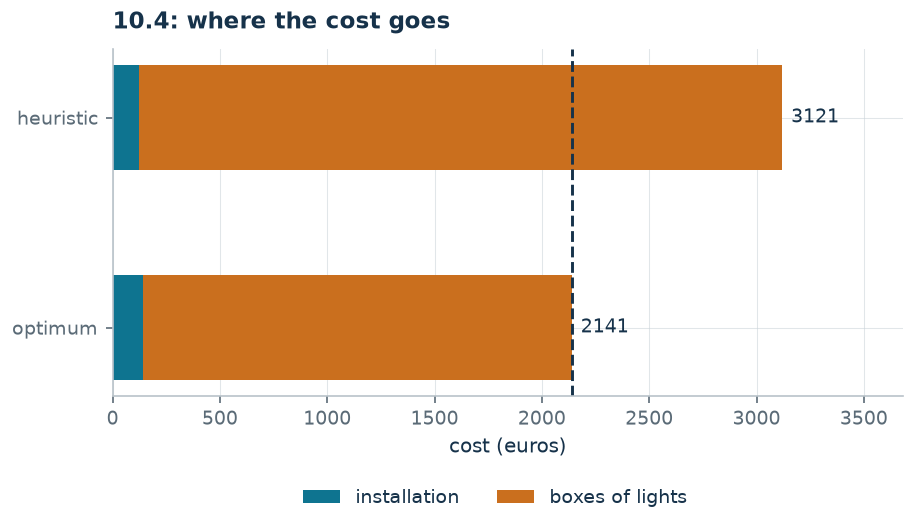
The dual bound is off by one unit out of \(2141\), and the relaxation with the bounds is exact.
Additional considerations
- Colour 1 is left over in abundance: the boxes are bought for colour 2, and colour 1 comes "for free". That is why the dual bound that prices colour 2 only is almost exact.
- The trees constraint is an equality: all the trees must be decorated. If it were \(\le q\) the problem would become trivial (\(x = 0\) and zero cost); if it were \(\ge q\) nothing would change, because decorating more trees costs more.
- The structure "two levels tied by an availability" reappears identically in cutting stock problems: below the pieces to cut, above the bars to buy.
Additional modelling questions
10.4.1 — A minimum lot per configuration
Every configuration used must decorate at least three trees (below that threshold it is not worth equipping the crew). How does the model change? What is the new optimum?
A worked variant: all the configurations
All three configurations are required to appear.
Only the datum \(f\) changes, from \(2\) to \(3\). On the instance the optimum rises from \(2141\) to \(2239\): forcing the use of configuration 2, the greediest for the expensive colour, costs \(98\) euros. Note that the variety constraint, on its own, does not say how many trees must use each configuration: one is enough.
Asking for all three configurations changes the right-hand side of the variety constraint, not the structure. But that constraint is not priced: the recipe of the base problem keeps \(\gamma = \delta = 0\) and puts the whole price on a single colour, so the bound stays \(2140\) while the optimum rises from \(2141\) to \(2239\). The heuristic is the same, and to respect the variety it installs the two missing configurations on one tree each: it costs \(3023\), and the certified gap stays wide. Here the MILP really is needed.
| value | what it is | |
|---|---|---|
| \(\mathit{UB}\) | \(3023\) | heuristic solution |
| \(\mathit{LB}\) | \(2140\) | dual certificate built by hand |
| \(z(\mathit{LP})\) | \(2140\) | relaxation without the bounds |
| \(z(\mathit{LP}^+)\) | \(2190\) | relaxation with the bounds |
| \(z(\mathit{MILP})\) | \(2239\) | optimum of the MILP |
Code
Complete script —
python/fam10_4_lights.py
(reproducible with python3 python/fam10_4_lights.py from the python/
folder). Notebook —
notebooks/fam10_4_lights.ipynb
— which opens in Colab from the badge at the top of the page.
Show the complete script — python/fam10_4_lights.py (265 lines)
"""Problem 10.4 -- Christmas trees: configurations and boxes of lights.

Two integer decisions tied by an availability constraint: how many lights are
needed (from the chosen configurations) and how many are bought (from the boxes).
On top of that, the variety constraint "at least f different configurations",
which needs an indicator per configuration and the link with the count
(technique 3.11).
"""
import gurobipy as gp
import pandas as pd
from gurobipy import GRB

from mip import (ammissibile, dualita_forte, due_rilassamenti, frazione,
                 nuovo_modello, registra_bound, rilassamenti, risolvi, valuta)
from stile import ARANCIO, BLU, GRIGIO, TEAL, intestazione, plt, salva_dati, salva_figura
from esteso import salva_modello

R = range

# ---------- 1. MODEL AND INSTANCE ----------
intestazione("10.4 Christmas trees: configurations, lights and boxes")
q1 = 20                          # trees to decorate
i1 = [7, 6, 8]                   # installation cost of a configuration
u1 = [[4, 2], [2, 3], [2, 2]]    # lights of colour l required by configuration c
p1 = [100, 200]                  # cost of a box
v1 = [[10, 2], [15, 4]]          # lights of colour l contained in a box of type b
f1 = 2                           # different configurations required
nc, nl, nb = len(i1), len(u1[0]), len(p1)
salva_dati(pd.DataFrame({"configuration": R(1, nc + 1), "cost": i1,
                         "colour_1": [u[0] for u in u1], "colour_2": [u[1] for u in u1]}),
           "fam10_4_configurazioni")
salva_dati(pd.DataFrame({"box": R(1, nb + 1), "cost": p1,
                         "colour_1": [v[0] for v in v1], "colour_2": [v[1] for v in v1]}),
           "fam10_4_scatole")


def modello_1(q, i, u, p, v, f):
    nc, nl, nb = len(i), len(u[0]), len(p)
    m = nuovo_modello("lights")
    x = m.addVars(nc, vtype=GRB.INTEGER, name="x")        # trees with configuration c
    y = m.addVars(nb, vtype=GRB.INTEGER, name="y")        # boxes bought of type b
    z = m.addVars(nc, vtype=GRB.BINARY, name="z")         # configuration c used
    m.setObjective(gp.quicksum(i[c] * x[c] for c in R(nc))
                   + gp.quicksum(p[b] * y[b] for b in R(nb)), GRB.MINIMIZE)
    m.addConstr(x.sum() == q, name="trees")
    m.addConstrs((gp.quicksum(v[b][l] * y[b] for b in R(nb))
                  - gp.quicksum(u[c][l] * x[c] for c in R(nc)) >= 0 for l in R(nl)),
                 name="lights")
    m.addConstr(z.sum() >= f, name="variety")
    m.addConstrs((x[c] - z[c] >= 0 for c in R(nc)), name="used")
    return m, x, y, z


def duale_1(q, i, u, p, v, f):
    """max q alpha + f gamma

    alpha free (equality on the trees), beta_l >= 0 (availability of the lights),
    gamma >= 0 (variety), delta_c >= 0 (link x_c >= z_c). Columns:
      x_c:  alpha - sum_l u_cl beta_l + delta_c <= i_c
      y_b:  sum_l v_bl beta_l <= p_b
      z_c:  gamma - delta_c <= 0
    """
    nc, nl, nb = len(i), len(u[0]), len(p)
    dl = nuovo_modello("dual_lights")
    alpha = dl.addVar(lb=-GRB.INFINITY, name="alpha")
    beta = dl.addVars(nl, name="beta")
    gamma = dl.addVar(name="gamma")
    delta = dl.addVars(nc, name="delta")
    dl.setObjective(q * alpha + f * gamma, GRB.MAXIMIZE)
    dl.addConstrs((alpha - gp.quicksum(u[c][l] * beta[l] for l in R(nl)) + delta[c] <= i[c]
                   for c in R(nc)), name="rcx")
    dl.addConstrs((gp.quicksum(v[b][l] * beta[l] for l in R(nl)) <= p[b] for b in R(nb)),
                  name="rcy")
    dl.addConstrs((gamma - delta[c] <= 0 for c in R(nc)), name="rcz")
    return dl


m1, x1, y1, z1 = modello_1(q1, i1, u1, p1, v1, f1)
salva_modello(m1, "fam10_4_primale")
print("  Price of one light, colour by colour, in each type of box:")
for b in R(nb):
    print(f"    box {b + 1}: " + ", ".join(
        f"colour {l + 1} at {frazione(p1[b] / v1[b][l])}" for l in R(nl) if v1[b][l] > 0))

# ---------- 2. THE LP RELAXATION ----------
zlp1, zlp1r, _ = rilassamenti(m1)

# ---------- 3. THE DUAL OF THE RELAXATION (LOWER BOUND) ----------
dl1 = duale_1(q1, i1, u1, p1, v1, f1)
salva_modello(dl1, "fam10_4_duale")
# recipe: gamma = delta = 0; a single colour is priced, at the highest price per light
# that no box can beat; then every tree costs at least alpha = min_c (i_c + its lights)
migliore, mano, scelto = float("-inf"), None, None
for l in R(nl):
    prezzo = min(p1[b] / v1[b][l] for b in R(nb) if v1[b][l] > 0)
    prova = {f"beta[{l}]": prezzo}
    prova["alpha"] = min(i1[c] + u1[c][l] * prezzo for c in R(nc))
    val, viol = valuta(dl1, prova)
    if viol <= 1e-9 and val > migliore:
        migliore, mano, scelto = val, prova, l
lb1, viol = valuta(dl1, mano)
assert viol <= 1e-9, viol
prezzo = mano[f"beta[{scelto}]"]
print(f"  Hand-built dual: gamma = delta = 0 and a single colour priced. On colour "
      f"{scelto + 1}")
print(f"  both types of box give the same price per light, {frazione(prezzo)}: it is the")
print("  largest value of beta compatible with sum_l v_bl beta_l <= p_b.")
print("  Then every tree costs at least alpha = min_c (i_c + u_c" + str(scelto + 1)
      + " * beta) = " + ", ".join(f"{i1[c]} + {u1[c][scelto]} * {frazione(prezzo)} = "
                                  f"{frazione(i1[c] + u1[c][scelto] * prezzo)}"
                                  for c in R(nc)))
print(f"  alpha = {frazione(mano['alpha'])}  ->  lb = {q1} * alpha = {frazione(lb1)}")
dualita_forte(dl1, zlp1)

# ---------- 4. CONSTRUCTIVE HEURISTIC (UPPER BOUND) ----------
# Two phases. First the configurations: q - f + 1 trees with the cheapest one to
# install and one tree for each of the other f - 1, so that variety is met at the
# lowest installation cost. Then the boxes: while some light is missing, buy the box
# with the lowest price per missing light.
def euristica(q, i, u, p, v, f):
    nc, nl, nb = len(i), len(u[0]), len(p)
    ordine = sorted(R(nc), key=lambda c: (i[c], c))
    x = [0] * nc
    for c in ordine[1:f]:
        x[c] = 1
    x[ordine[0]] = q - (f - 1)
    altre = ", ".join(str(c + 1) for c in ordine[1:f])
    passi = [f"configurations: {x[ordine[0]]} trees with number {ordine[0] + 1} "
             f"(installation {i[ordine[0]]} each) and one tree with configuration "
             f"{altre}, the second cheapest to install"]
    serve = [sum(u[c][l] * x[c] for c in R(nc)) for l in R(nl)]
    passi.append("lights needed: " + ", ".join(f"colour {l + 1} -> {serve[l]}"
                                               for l in R(nl)))
    y = [0] * nb
    while True:
        manca = [max(0, serve[l] - sum(v[b][l] * y[b] for b in R(nb))) for l in R(nl)]
        if max(manca) == 0:
            break
        # price per still-missing light: only the useful lights are counted
        b = min(R(nb), key=lambda b: (p[b] / max(1e-9, sum(min(v[b][l], manca[l])
                                                           for l in R(nl))), b))
        y[b] += 1
        passi.append(f"{manca} are missing: a box {b + 1} is bought (cost {p[b]}); "
                     f"boxes {y}")
    return x, y, passi


x_eur, y_eur, passi = euristica(q1, i1, u1, p1, v1, f1)
for k, riga in enumerate(passi[:4], 1):
    print(f"  Step {k}. {riga}")
print(f"  ... ({len(passi) - 4} further purchases of the same kind)")
print(f"  Step {len(passi)}. {passi[-1]}")
ub1 = sum(i1[c] * x_eur[c] for c in R(nc)) + sum(p1[b] * y_eur[b] for b in R(nb))
sol_eur = ({f"x[{c}]": x_eur[c] for c in R(nc)} | {f"y[{b}]": y_eur[b] for b in R(nb)}
           | {f"z[{c}]": 1 if x_eur[c] > 0 else 0 for c in R(nc)})
assert ammissibile(m1, sol_eur), sol_eur
print(f"  Heuristic solution: trees {x_eur}, boxes {y_eur}   ub = {frazione(ub1)}")
print("  The heuristic picks the configuration that is cheapest to install, number 2, which")
print("  is however the greediest for the expensive colour: the boxes pay the bill. It is the")
print("  typical mistake of a constructive heuristic that looks at a single cost item.")

# ---------- 5. OPTIMUM OF THE MILP ----------
z1v = risolvi(m1)
print("  Optimal solution: "
      + ", ".join(f"{int(x1[c].X)} trees with configuration {c + 1}" for c in R(nc)
                  if x1[c].X > 0.5)
      + "; boxes "
      + ", ".join(f"{int(y1[b].X)} of type {b + 1}" for b in R(nb) if y1[b].X > 0.5))
for l in R(nl):
    serve = sum(u1[c][l] * x1[c].X for c in R(nc))
    compra = sum(v1[b][l] * y1[b].X for b in R(nb))
    print(f"    colour {l + 1}: {int(serve)} lights needed, {int(compra)} bought")
riga = registra_bound("1 lights", ub1, lb1, zlp1, zlp1r, z1v)
salva_dati(pd.DataFrame([riga]), "fam10_4_bound")
assert lb1 <= zlp1 <= z1v <= ub1 + 1e-9

# ---------- 6. ADDITIONAL MODELLING QUESTIONS ----------
varianti = {}


def variante(nome, m):
    z = risolvi(m)
    print(f"  {nome:70s} z = {frazione(z)}")
    return z


# 1a: all three configurations are wanted
m, x, y, z = modello_1(q1, i1, u1, p1, v1, 3)
varianti["1a"] = variante("1a. All three configurations must appear (f = 3)", m)
# 1b: every configuration used must decorate at least three trees (minimum lot)
m, x, y, z = modello_1(q1, i1, u1, p1, v1, f1)
m.addConstrs((x[c] - 3 * z[c] >= 0 for c in R(nc)), name="minimum_lot")
varianti["1b"] = variante("1b. Every configuration used decorates at least three trees", m)
salva_dati(pd.DataFrame({"variant": list(varianti), "z": list(varianti.values())}),
           "fam10_4_varianti")

# ---------- 7. THE SANDWICH ON THE VARIANT 1a ----------
intestazione("10.4a The sandwich on the variant: all three configurations")
F1A = 3

# The variant changes a datum --- the required variety goes from f to 3 --- not
# the structure: model, dual, heuristic and recipe are the same, and the
# certificate follows the data by itself.
m1a, x1a, y1a, z1a = modello_1(q1, i1, u1, p1, v1, F1A)
salva_modello(m1a, "fam10_4a_primale")
dl1a = duale_1(q1, i1, u1, p1, v1, F1A)
salva_modello(dl1a, "fam10_4a_duale")

# -- feasible heuristic: the same rule, with the new variety --
x_1a, y_1a, passi_1a = euristica(q1, i1, u1, p1, v1, F1A)
for k, s in enumerate(passi_1a[:4], 1):
    print(f"  Step {k}. {s}")
print(f"  ... ({len(passi_1a) - 5} further purchases of the same kind)")
print(f"  Step {len(passi_1a)}. {passi_1a[-1]}")
ub1a = sum(i1[c] * x_1a[c] for c in R(nc)) + sum(p1[b] * y_1a[b] for b in R(nb))
sol_1a = ({f"x[{c}]": x_1a[c] for c in R(nc)} | {f"y[{b}]": y_1a[b] for b in R(nb)}
          | {f"z[{c}]": (1 if x_1a[c] > 0 else 0) for c in R(nc)})
assert ammissibile(m1a, sol_1a), "the heuristic solution of the variant must be feasible"
print(f"  ub = {frazione(ub1a)}")

# -- dual certificate: the same recipe, on the new datum --
migliore_1a, mano_1a, scelto_1a = float("-inf"), None, None
for l in R(nl):
    prezzo = min(p1[b] / v1[b][l] for b in R(nb) if v1[b][l] > 0)
    prova = {f"beta[{l}]": prezzo}
    prova["alpha"] = min(i1[c] + u1[c][l] * prezzo for c in R(nc))
    val, viol = valuta(dl1a, prova)
    if viol <= 1e-9 and val > migliore_1a:
        migliore_1a, mano_1a, scelto_1a = val, prova, l
lb1a, viol_1a = valuta(dl1a, mano_1a)
assert viol_1a <= 1e-9, viol_1a
print("Dual solution by hand: the same recipe as the base problem --- gamma = delta = 0, a")
print(f"  single colour priced (number {scelto_1a + 1}) at the lowest price per light, and")
print("  alpha = min_c (i_c + price of its lights). The right-hand side of the variety has")
print("  changed, but gamma stays at zero: variety is not priced, so the bound does not move.")
print(f"  ->  lb = {frazione(lb1a)}")
zlp1a, zlp1ar, _ = due_rilassamenti(m1a, dl1a)
z1a_val = risolvi(m1a)
riga_1a = registra_bound("1a all three configurations", ub1a, lb1a, zlp1a, zlp1ar, z1a_val)
salva_dati(pd.DataFrame([riga_1a]), "fam10_4a_bound")
assert lb1a <= zlp1a <= z1a_val <= ub1a + 1e-9

# ---------- 8. FIGURE ----------
fig, ax = plt.subplots(figsize=(6.8, 3.0))
etichette = ["heuristic", "optimum"]
inst = [sum(i1[c] * x_eur[c] for c in R(nc)),
        sum(i1[c] * x1[c].X for c in R(nc))]
scat = [sum(p1[b] * y_eur[b] for b in R(nb)),
        sum(p1[b] * y1[b].X for b in R(nb))]
ax.barh(R(2), inst, 0.5, color=TEAL, label="installation")
ax.barh(R(2), scat, 0.5, left=inst, color=ARANCIO, label="boxes of lights")
for k in R(2):
    ax.annotate(f"{frazione(inst[k] + scat[k])}", (inst[k] + scat[k] + 40, k), va="center",
                fontsize=9)
ax.axvline(lb1, color=BLU, ls="--", lw=1.4)
ax.annotate(f"dual bound {frazione(lb1)}", (lb1, 1.55), ha="center", fontsize=8, color=BLU)
ax.set_yticks(R(2))
ax.set_yticklabels(etichette)
ax.set_xlim(0, max(inst[k] + scat[k] for k in R(2)) * 1.18)
ax.set_xlabel("cost (euros)")
ax.set_title("10.4: where the cost goes")
ax.legend(fontsize=8, loc="lower right")
ax.invert_yaxis()
salva_figura(fig, "cap10_luci_ottimo")
print("Done.")