Books across shelves
Class: MILP · Links: maximum variable (disaggregated form) · Script: python/fam10_9_shelves.py
Difficulty: ★★★★☆ · Time: 45–60 min

Problem 10.9
A library has to arrange \(n \in \mathbb{Z}_{\ge 1}\) books on shelves. Every book \(b \in \{1, 2, \dots, n\}\) has width \(w_b \in \mathbb{Z}_{\ge 1}\) and height \(h_b \in \mathbb{Z}_{\ge 1}\). There are \(m \in \mathbb{Z}_{\ge 1}\) shelves available, each of maximum width \(c \in \mathbb{Q}_{>0}\). Every book must be assigned to exactly one shelf, and the total width of the books on a shelf cannot exceed \(c\). The height of a shelf is that of the tallest book on it. The library wants to minimise the sum of the heights of the shelves.
The problem in words. We decide which shelf every book goes on. The objective: minimum total height (it is the timber that is saved). The constraints: every book on one shelf only, and no shelf wider than \(c\).
Model
Variables. \(x_{bs} \in \{0,1\}\) equals \(1\) if book \(b\) goes on shelf \(s\); \(y_s \ge 0\) is the height of shelf \(s\).
Description. The objective is the total height of the shelves. The assignment constraints, one per book, say that every book sits on exactly one shelf. The width constraints, one per shelf, are the capacity. The height constraints, one per book–shelf pair, push \(y_s\) above that of every book placed on that shelf.
The link between the variables
The height constraints say \(y_s \ge h_b\, x_{bs}\): if book \(b\) is on shelf \(s\) then \(y_s \ge h_b\), otherwise they say nothing (\(y_s \ge 0\)). None of them imposes equality; the minimisation objective does, pushing every \(y_s\) to the smallest allowed value, that is the height of the tallest book present. It is the maximum variable technique in disaggregated form.
The model in gurobipy
m = gp.Model("shelves")
x = m.addVars(n, ms, vtype=GRB.BINARY, name="x")
y = m.addVars(ms, name="y")
m.setObjective(y.sum(), GRB.MINIMIZE)
m.addConstrs((x.sum(b, "*") == 1 for b in range(n)), name="book")
m.addConstrs((gp.quicksum(w[b] * x[b, s] for b in range(n)) <= c
              for s in range(ms)), name="width")
m.addConstrs((-h[b] * x[b, s] + y[s] >= 0 for b in range(n) for s in range(ms)),
             name="height")
The instance
\(n = 4\) books, \(m = 2\) shelves, \(c = 10\).
| \(b=1\) | \(b=2\) | \(b=3\) | \(b=4\) | |
|---|---|---|---|---|
| \(w_b\) | 3 | 5 | 4 | 6 |
| \(h_b\) | 8 | 5 | 7 | 4 |
The total width of the books is \(18\), the total capacity \(2 \cdot 10 = 20\).
The model written on the data of the instance:
Constructive heuristic: two orders, two outcomes
The rule is first-fit: every book on the first shelf it fits on. As in problem 10.8 the order changes everything — but here, in one order, the heuristic fails.
- (a) Decreasing-height order (\(1, 3, 2, 4\)). Book 1 (width 3) on shelf 1; book 3 (width 4) on shelf 1, which reaches \(7\); book 2 (width 5) on shelf 2. Book 4 is left, width \(6\): shelf 1 has \(3\) of residue, shelf 2 has \(5\). The heuristic fails.
- (b) Decreasing-width order (\(4, 2, 3, 1\)). Book 4 on shelf 1; book 2 on shelf 2; book 3 on shelf 1, which reaches \(10\); book 1 on shelf 2, which reaches \(8\). Heights \(\max(4, 7) = 7\) and \(\max(5, 8) = 8\), sum \(15\).
The right order depends on the constraint, not on the objective
The decreasing-height order is the one suggested by the objective, but the constraint that can make an insertion infeasible is the width: that is what one must sort on. It is the same logic as first-fit decreasing for bin packing, where one sorts by size and not by value. A constructive heuristic that may fail is not wrong in itself — one just has to foresee the case and change the order — but it must be said explicitly, because a heuristic "that sometimes returns nothing" provides no bound at all.
LP relaxation and dual: the dual bound
Associate \(\alpha_b\) free with the assignment, \(\beta_s \le 0\) with the width (\(\le\) in a minimisation) and \(\gamma_{bs} \ge 0\) with the height.
The same dual, written on the data of the instance:
Description. \(\alpha_b\) is the value of book \(b\), \(\beta_s\) the (non-positive) price of the width of shelf \(s\), and \(\gamma_{bs}\) the price of the link "the height of shelf \(s\) covers book \(b\)". The objective prices the books and the width available. The first group of constraints are the columns of the \(y_s\): the height of shelf \(s\) costs \(1\) in the primal objective, and the prices of the links that push it up cannot be worth more. The second are the columns of the \(x_{bs}\): putting book \(b\) on shelf \(s\) satisfies its assignment constraint, takes up \(w_b\) of width and forces the height up to \(h_b\); the balance cannot be positive.
Recipe. Set \(\beta = 0\) (width is not priced) and concentrate all the weight \(\gamma\) on the tallest book, number \(1\) with \(h_1 = 8\): \(\bar\gamma_{1s} = 1\) for every \(s\) and \(\bar\gamma_{bs} = 0\) elsewhere. The first group becomes \(1 \le 1\); the second gives \(\alpha_1 \le 8\) and \(\alpha_b \le 0\) for \(b \ne 1\). With \(\bar\alpha_1 = 8\) the value is \(\mathit{LB} = 8\): the shelf hosting the tallest book is at least as tall as it is.
A stronger combinatorial bound
The total width of the books is \(18\) and every shelf holds \(10\): at least \(\lceil 18/10 \rceil = 2\) non-empty shelves are needed. One of them hosts the tallest book and measures at least \(8\); the other contains at least one book, so it measures at least \(\min_{b \ne 1} h_b = 4\). Summing,
better than the dual bound \(8\). Here too the jump comes from integrality: the relaxation can put half a book on each shelf and pay half the height twice, that is, still \(8\) in total.
Optimal solution
| books | width | height | |
|---|---|---|---|
| shelf 1 | 1, 2 | 8 of 10 | 8 |
| shelf 2 | 3, 4 | 10 of 10 | 7 |
| \(LB\) (combinatorial) | \(z(\mathit{LP})\) | \(z(\mathit{LP}^+)\) | \(z(\mathit{MILP})\) | \(UB\) (heuristic) | heuristic gap |
|---|---|---|---|---|---|
| 12 | 8 | 8 | 15 | 15 | \(0\%\) |
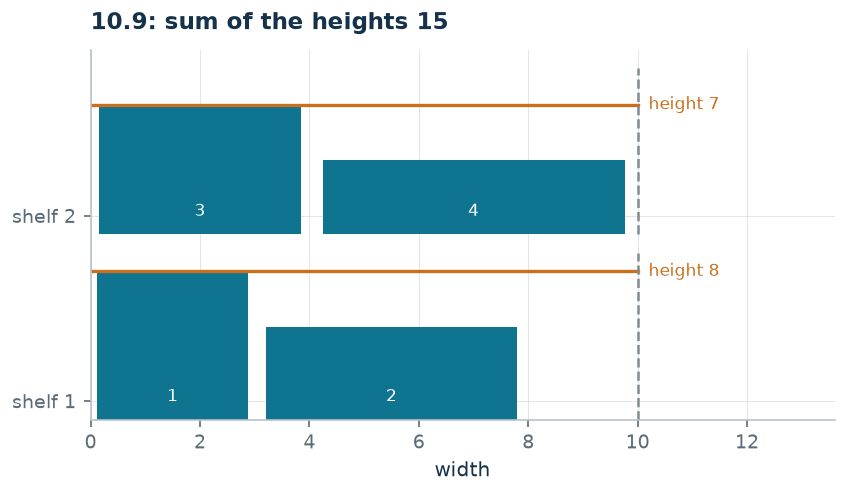
The heuristic gap is zero: first-fit by decreasing width finds the optimum. The certified gap, before solving the MILP, is \((15-12)/15 = 20\%\).
Additional considerations
- The problem is a variant of bin packing in which the cost of a container is not fixed but depends on its contents. It is known as bin packing with item fragmentation or, in the warehouse literature, as shelf space allocation.
- The model has an annoying symmetry: swapping the two shelves gives the same solution with the same value. On larger instances it is worth breaking it, for example by imposing \(y_1 \ge y_2 \ge \dots \ge y_m\).
- The disaggregated form uses \(n\,m\) constraints. The aggregated form with a big-M, \(y_s \ge h_b - M(1 - x_{bs})\), would use just as many and is weaker: here the disaggregated one costs nothing and is preferable.
Additional modelling questions
10.9.1 — A third shelf
The library buys a third shelf, as wide as the others. What is the new optimum?
A worked variant: wider shelves
The shelves are \(12\) wide instead of \(10\).
Only the datum \(c\) changes. The optimum drops from \(15\) to \(12\). With shelves \(12\) wide the arrangement \(\{1, 2, 3\}\) on the first shelf (width \(3 + 5 + 4 = 12\), height \(\max(8,5,7) = 8\)) and \(\{4\}\) on the second (width \(6\), height \(4\)) becomes feasible, for a sum of \(8 + 4 = 12\). Note that the combinatorial bound built above, the height of the tallest book plus \(\min_b h_b\), is still \(8 + 4 = 12\) and here it is exact: the three shorter books all sit on the same shelf as the tallest one, and the fourth stays alone.
The width does not enter the dual certificate: the recipe puts the whole \(\gamma\) weight on the tallest book — number \(1\), \(8\) tall — because whatever shelf holds it must be at least as tall, and the dual bound stays \(8\). The combinatorial argument of the base problem is needed here too: the total width is \(18\) and one shelf holds \(12\), so the non-empty shelves are still at least two, one at least \(8\) tall and the other at least \(4\), that is \(\lb = 12\). What changes is the heuristic: first-fit by decreasing width now fits the four books on two shelves \(5\) and \(8\) tall and drops from \(15\) to \(13\); the optimum from \(15\) to \(12\), and the bound certifies it.
| value | what it is | |
|---|---|---|
| \(\mathit{UB}\) | \(13\) | heuristic solution |
| \(\mathit{LB}\) | \(12\) | shelves used and minimum heights |
| \(z(\mathit{LP})\) | \(8\) | relaxation without the bounds |
| \(z(\mathit{LP}^+)\) | \(8\) | relaxation with the bounds |
| \(z(\mathit{MILP})\) | \(12\) | optimum of the MILP |
Code
Complete script —
python/fam10_9_shelves.py
(reproducible with python3 python/fam10_9_shelves.py from the python/
folder). Notebook —
notebooks/fam10_9_shelves.ipynb
— which opens in Colab from the badge at the top of the page.
Show the complete script — python/fam10_9_shelves.py (240 lines)
"""Problem 10.9 -- Books on shelves: minimising the sum of the heights.

Assignment with a capacity (the width of the shelf) and a maximum variable per
shelf (technique 3.5): the height of a shelf is that of the tallest book on it.
It also shows that the order in which the heuristic looks at the objects can lead
it into a dead end.
"""
import gurobipy as gp
import pandas as pd
from gurobipy import GRB

from mip import (ammissibile, dualita_forte, due_rilassamenti, frazione,
                 nuovo_modello, registra_bound, rilassamenti, risolvi, valuta)
from stile import ARANCIO, BLU, GRIGIO, TEAL, intestazione, plt, salva_dati, salva_figura
from esteso import salva_modello

R = range

# ---------- 1. MODEL AND INSTANCE ----------
intestazione("10.9 Books on shelves: minimising the sum of the heights")
w4 = [3, 5, 4, 6]      # width of the books
h4 = [8, 5, 7, 4]      # height of the books
c4 = 10                # width of every shelf
n4, m4 = len(w4), 2    # books and shelves
salva_dati(pd.DataFrame({"book": R(1, n4 + 1), "width": w4, "height": h4}),
           "fam10_9_dati")
print(f"  Total width of the books: {sum(w4)}; overall capacity: {m4} * {c4} = {m4 * c4}.")


def modello_4(w, h, c, m):
    n = len(w)
    mod = nuovo_modello("shelves")
    x = mod.addVars(n, m, vtype=GRB.BINARY, name="x")
    y = mod.addVars(m, name="y")            # height of the shelf
    mod.setObjective(y.sum(), GRB.MINIMIZE)
    mod.addConstrs((x.sum(b, "*") == 1 for b in R(n)), name="book")
    mod.addConstrs((gp.quicksum(w[b] * x[b, s] for b in R(n)) <= c for s in R(m)),
                   name="width")
    mod.addConstrs((y[s] - h[b] * x[b, s] >= 0 for b in R(n) for s in R(m)), name="height")
    return mod, x, y


def duale_4(w, h, c, m):
    """max sum_b alpha_b + c sum_s beta_s   with  beta_s <= 0  and  gamma >= 0,
       column of x_bs: alpha_b + w_b beta_s - h_b gamma_bs <= 0,
       column of y_s:  sum_b gamma_bs <= 1."""
    n = len(w)
    dl = nuovo_modello("dual_shelves")
    alpha = dl.addVars(n, lb=-GRB.INFINITY, name="alpha")
    beta = dl.addVars(m, lb=-GRB.INFINITY, ub=0.0, name="beta")
    gamma = dl.addVars(n, m, name="gamma")
    dl.setObjective(alpha.sum() + c * beta.sum(), GRB.MAXIMIZE)
    dl.addConstrs((gamma.sum("*", s) <= 1 for s in R(m)), name="rcy")
    dl.addConstrs((alpha[b] + w[b] * beta[s] - h[b] * gamma[b, s] <= 0
                   for b in R(n) for s in R(m)), name="rcx")
    return dl


m4mod, x4, y4 = modello_4(w4, h4, c4, m4)
salva_modello(m4mod, "fam10_9_primale")

# ---------- 2. THE LP RELAXATION ----------
zlp4, zlp4r, _ = rilassamenti(m4mod)

# ---------- 3. THE DUAL OF THE RELAXATION (LOWER BOUND) ----------
dl4 = duale_4(w4, h4, c4, m4)
salva_modello(dl4, "fam10_9_duale")
# recipe: beta = 0, and all the gamma "weight" is concentrated on the tallest book
alto = max(R(n4), key=lambda b: h4[b])
mano = ({f"gamma[{alto},{s}]": 1.0 for s in R(m4)}
        | {f"alpha[{alto}]": float(h4[alto])})
lb_lp, viol = valuta(dl4, mano)
assert viol <= 1e-9, viol
print(f"  Hand-built dual: beta = 0, gamma_bs = 1 only for the tallest book (number")
print(f"  {alto + 1}, height {h4[alto]}) and alpha equal to {h4[alto]} on that book, zero on")
print(f"  the others. The dual constraints become {h4[alto]} <= {h4[alto]} and 0 <= 0  ->  "
      f"lb = {frazione(lb_lp)}.")
print("  It is the obvious remark: the shelf holding the tallest book is at least as tall as")
print(f"  that book, so the sum of the heights is at least {h4[alto]}.")
dualita_forte(dl4, zlp4)

# ---------- 4. CONSTRUCTIVE HEURISTIC (UPPER BOUND) ----------
def first_fit(w, h, c, m, ordine, etichetta):
    """Every book on the first shelf where it fits; if it fits nowhere the heuristic
    fails and returns None."""
    n = len(w)
    dove, residuo, passi = {}, [c] * m, []
    for b in ordine:
        posti = [s for s in R(m) if residuo[s] >= w[b]]
        if not posti:
            passi.append(f"book {b + 1} (width {w[b]}): it fits on no shelf "
                         f"(residuals {residuo}) -> the heuristic fails")
            print(f"  {etichetta}")
            for k, riga in enumerate(passi, 1):
                print(f"    Step {k}. {riga}")
            return None, None, passi
        s = posti[0]
        dove[b] = s
        residuo[s] -= w[b]
        passi.append(f"book {b + 1} (width {w[b]}, height {h[b]}) on shelf {s + 1}; "
                     f"residuals {residuo}")
    altezze = [max((h[b] for b in R(n) if dove[b] == s), default=0) for s in R(m)]
    print(f"  {etichetta}")
    for k, riga in enumerate(passi, 1):
        print(f"    Step {k}. {riga}")
    print(f"    shelf heights {altezze}, sum {sum(altezze)}")
    return dove, altezze, passi


ordine_h = sorted(R(n4), key=lambda b: (-h4[b], b))
dove_h, alt_h, _ = first_fit(w4, h4, c4, m4, ordine_h,
                             "Order by decreasing height (books 1, 3, 2, 4):")
assert dove_h is None, "on this instance the height order must get stuck"
print("  The height order ignores the widths and gets stuck. The right criterion for a")
print("  capacity constraint is the width.")
ordine_w = sorted(R(n4), key=lambda b: (-w4[b], b))
dove_w, alt_w, _ = first_fit(w4, h4, c4, m4, ordine_w,
                             "Order by decreasing width (books 4, 2, 3, 1):")
ub4 = sum(alt_w)
sol_eur = {f"x[{b},{dove_w[b]}]": 1 for b in R(n4)} | {f"y[{s}]": alt_w[s] for s in R(m4)}
assert ammissibile(m4mod, sol_eur), sol_eur
print(f"  ub = {frazione(ub4)}")

# ---------- 5. A STRONGER COMBINATORIAL BOUND ----------
intestazione("10.9 The combinatorial bound: at least two shelves are used")
usati = -(-sum(w4) // c4)     # integer division rounding up
print(f"  The total width is {sum(w4)} and every shelf holds {c4}: at least")
print(f"  ceil({sum(w4)} / {c4}) = {usati} shelves must be non-empty.")
altre = sorted(h4[b] for b in R(n4) if b != alto)
lb4 = h4[alto] + min(altre)
print(f"  One of them holds the tallest book and measures at least {h4[alto]}; the other one")
print(f"  holds at least one book, so it measures at least {min(altre)}, the smallest")
print("  remaining height.")
print(f"  lb = {h4[alto]} + {min(altre)} = {frazione(lb4)}, better than the dual bound "
      f"{frazione(lb_lp)}.")
salva_dati(pd.DataFrame([{"argument": "dual of the LP relaxation", "bound": lb_lp},
                         {"argument": "shelves used and minimum heights", "bound": lb4}]),
           "fam10_9_argomento")

# ---------- 6. OPTIMUM OF THE MILP ----------
z4 = risolvi(m4mod)
for s in R(m4):
    libri = [b + 1 for b in R(n4) if x4[b, s].X > 0.5]
    largh = sum(w4[b] for b in R(n4) if x4[b, s].X > 0.5)
    print(f"  Shelf {s + 1}: books {libri}, width {largh}/{c4}, height {frazione(y4[s].X)}")
riga = registra_bound("4 shelves", ub4, lb4, zlp4, zlp4r, z4)
salva_dati(pd.DataFrame([riga]), "fam10_9_bound")
assert lb4 <= z4 <= ub4 + 1e-9

# ---------- 7. ADDITIONAL MODELLING QUESTIONS ----------
varianti = {}


def variante(nome, m):
    z = risolvi(m)
    print(f"  {nome:70s} z = {frazione(z)}")
    return z


# 4a: one more shelf
m, x, y = modello_4(w4, h4, c4, 3)
varianti["4a"] = variante("4a. The library buys a third shelf (m = 3)", m)
print("       the optimum does not change: an empty shelf has height zero and costs nothing,")
print("       but splitting the books over three shelves means paying three heights, not two.")
# 4b: wider shelves
m, x, y = modello_4(w4, h4, 12, m4)
varianti["4b"] = variante("4b. The shelves are 12 wide instead of 10", m)
salva_dati(pd.DataFrame({"variant": list(varianti), "z": list(varianti.values())}),
           "fam10_9_varianti")

# ---------- 8. THE SANDWICH ON THE VARIANT 4b ----------
intestazione("10.9b The sandwich on the variant: shelves 12 wide instead of 10")
C4B = 12

# The width of the shelves changes, not the structure: same model, same dual,
# same recipe.
m4b, x4b, y4b = modello_4(w4, h4, C4B, m4)
salva_modello(m4b, "fam10_9b_primale")
dl4b = duale_4(w4, h4, C4B, m4)
salva_modello(dl4b, "fam10_9b_duale")

# -- feasible heuristic: first-fit by decreasing width, with the new c --
ordine_4b = sorted(R(n4), key=lambda b: (-w4[b], b))
dove_4b, alt_4b, _ = first_fit(w4, h4, C4B, m4, ordine_4b,
                               f"Order by decreasing width, shelves of {C4B}:")
assert dove_4b is not None, "with wider shelves the first-fit must succeed"
ub4b = sum(alt_4b)
sol_4b = ({f"x[{b},{dove_4b[b]}]": 1 for b in R(n4)}
          | {f"y[{s}]": alt_4b[s] for s in R(m4)})
assert ammissibile(m4b, sol_4b), "the heuristic solution of the variant must be feasible"
print(f"  ub = {frazione(ub4b)}")

# -- dual certificate: the same recipe, all the weight on the tallest book --
alto_4b = max(R(n4), key=lambda b: h4[b])
mano_4b = ({f"gamma[{alto_4b},{s}]": 1.0 for s in R(m4)}
           | {f"alpha[{alto_4b}]": float(h4[alto_4b])})
lb4b, viol_4b = valuta(dl4b, mano_4b)
assert viol_4b <= 1e-9, viol_4b
print(f"Dual solution by hand: beta = 0 and all the gamma weight on the tallest book (number")
print(f"  {alto_4b + 1}, {h4[alto_4b]} tall), as in the base problem: whatever shelf holds it")
print("  must be at least as tall. The width does not enter the certificate, and indeed the")
print(f"  dual bound does not change: lb = {frazione(lb4b)}.")
zlp4b, zlp4br, _ = due_rilassamenti(m4b, dl4b)

# -- combinatorial bound: the same argument as the base problem, on the new width --
usati_4b = -(-sum(w4) // C4B)
altre_4b = sorted(h4[b] for b in R(n4) if b != alto_4b)
comb_4b = h4[alto_4b] + min(altre_4b)
print(f"  The total width is {sum(w4)} and every shelf holds {C4B}: at least")
print(f"  ceil({sum(w4)} / {C4B}) = {usati_4b} non-empty shelves are still needed. One holds")
print(f"  the tallest book and is at least {h4[alto_4b]} tall, the other at least {min(altre_4b)}:")
print(f"  lb = {h4[alto_4b]} + {min(altre_4b)} = {frazione(comb_4b)}, better than the dual bound.")
lb4b_usato = max(lb4b, comb_4b)
z4b_val = risolvi(m4b)
riga_4b = registra_bound("4b shelves 12 wide", ub4b, lb4b_usato, zlp4b, zlp4br, z4b_val,
                         certificato="shelves used and minimum heights")
salva_dati(pd.DataFrame([riga_4b]), "fam10_9b_bound")
assert lb4b_usato <= z4b_val <= ub4b + 1e-9

# ---------- 9. FIGURE ----------
fig, ax = plt.subplots(figsize=(6.4, 3.2))
for s in R(m4):
    sx = 0.0
    for b in R(n4):
        if x4[b, s].X > 0.5:
            ax.bar(sx + w4[b] / 2, h4[b], w4[b] * 0.92, bottom=s * 10, color=TEAL)
            ax.annotate(str(b + 1), (sx + w4[b] / 2, s * 10 + 1), ha="center", fontsize=8,
                        color="white")
            sx += w4[b]
    ax.plot([0, c4], [s * 10 + y4[s].X, s * 10 + y4[s].X], color=ARANCIO, lw=1.6)
    ax.annotate(f"height {frazione(y4[s].X)}", (c4 + 0.2, s * 10 + y4[s].X), fontsize=8,
                va="center", color=ARANCIO)
    ax.plot([c4, c4], [s * 10, s * 10 + 9], color=GRIGIO, ls="--", lw=1.2)
ax.set_xlim(0, c4 + 3.6)
ax.set_yticks([1, 11])
ax.set_yticklabels(["shelf 1", "shelf 2"])
ax.set_xlabel("width")
ax.set_title(f"10.9: sum of the heights {frazione(z4)}")
salva_figura(fig, "cap10_scaffali_ottimo")
print("Done.")