Half-spaces and polyhedra
Part 1 · Linear functions, polyhedra and linear programming problems · Chapter 2 · Lecture notes, volume 1 (PDF) · Exercises: Half-spaces and polyhedra · App: Half-spaces and polyhedra
2.1 Half-spaces and supporting hyperplanes
Definition 2.1: half-space
Given a (row) vector
and a scalar \(b \in \R\), the set
is called an half-space.
-
Given an half-space, the set
\[ \left\{~~ \underbrace{\begin{pmatrix} x_{1} \\ x_{2} \\ \vdots \\ x_{n} \\ \end{pmatrix}}_{{\boldsymbol x}} \in \R^n:~~~ \underbrace{\sum_{j=1}^n a_j \; x_j = b}_{{\boldsymbol a} \: {\boldsymbol x} = b} ~~\right\} \]is called the supporting hyperplane of the half-space.
Example 2.1: half-space and supporting hyper-plane
Let us consider the following half-space in \(\R^2\):
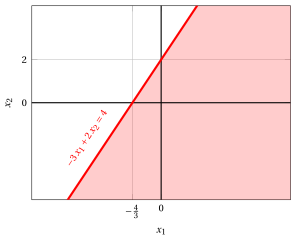
Let us consider the following half-space in \(\R^2\):
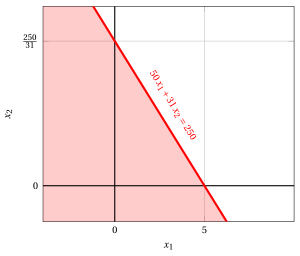
2.2 Polyhedra
Definition 2.2: polyhedron
Given a matrix
and a (column) vector
the set
is called a polyhedron.
Definition 2.3: bounded polyhedron
A polyhedron \(P \subseteq \R^n\) is bounded if there exists \(\underbrace{\begin{pmatrix} \beta_1 \\ \beta_2 \\ \vdots \\ \beta_n \end{pmatrix}}_{={\boldsymbol \beta}} \in \R^n_{\ge 0}\) such that
Here, \(\beta_j\) is an upper bound, while \(-\beta_j\) is a lower bound of \(P\) along dimension \(j \in \{1,2,\dots,n\}\).
Definition 2.4: polytope
A bounded polyhedron is called a polytope.
Example 2.2: polyhedron
Consider the following polyhedron defined as the intersection of four half-spaces:
For example, consider two points, \(\begin{pmatrix} 3 \\[0.3ex] 5 \end{pmatrix}\) and \(\begin{pmatrix} 5 \\[0.3ex] 3 \end{pmatrix}\), in the set \(P\). All points on the blue segment in the figure, given by:
also belong to \(P\). Indeed, for every \(\lambda \in [0,1]\) we have \(x_1 + x_2 = 8\) and \(x_1 - x_2 = 2 - 4\lambda \in [-2,2]\), so that all four inequalities defining \(P\) are satisfied.
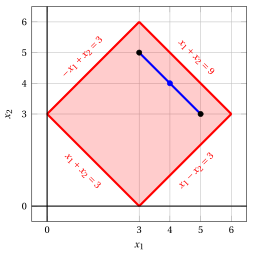
For example, with \(\lambda = \tfrac{1}{2}\), the point of the segment is the one shown in blue
This polyhedron \(P\) is a also polytope, since it is a bounded polyhedron in \(\R^2\). Indeed, by setting \({\boldsymbol \beta} = \begin{pmatrix} 6 \\[0.5ex] 6 \end{pmatrix}\) we have
-
It is worth noticing that if a polyhedron contains the following two half spaces:
\[ \left\{ {\boldsymbol x} \in \R^n:~~ {\boldsymbol a} \; {\boldsymbol x} \le b \right\}~~~~\text{and}~~~~~ \left\{ {\boldsymbol x} \in \R^n:~~ {\boldsymbol a} \; {\boldsymbol x} \ge b \right\} \]it contains, de facto, the following hyperplanes:
\[ \left\{ {\boldsymbol x} \in \R^n:~~ {\boldsymbol a} \; {\boldsymbol x} = b \right\} \]
In general, a polyhedron is given by the intersection of half-spaces and hyperplanes.
Example 2.3: polyhedron
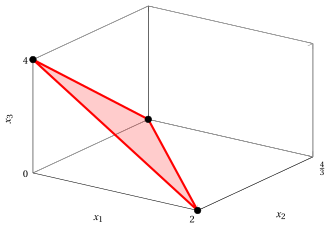
Consider the following polyhedron given by the intersection of three half-spaces and one hyperplane:
Its three-dimensional representation corresponds to the hyperplane shown in the figure.
Exercises on this chapter: Half-spaces and polyhedra
Interactive lab
The ideas of the chapter, hands on: move the sliders and drag the points. Each app also opens full page in the interactive lab: Half-spaces and polyhedra.