Exercises · Half-spaces and polyhedra
Exercises · Chapter 2 · each solution opens with a click · Chapter 2: Half-spaces and polyhedra · Exercises, volume 1 (PDF)
In the exercises of this chapter the intersection point of two supporting hyper-planes in \(\R^2\) is computed by solving a system of two linear equations in two variables, with the following formula:
Given \(a_{11},a_{12},a_{21},a_{22},b_1,b_2 \in \R\), if \((a_{11} \; a_{22} - a_{12} \; a_{21}) \neq 0\), we have:
Exercise 2.1: Polyhedra (P2)
Consider the following half-spaces in \(\R^2\):
Questions
-
Draw a plot of their supporting hyper-planes.
-
Draw the polyhedron given by the intersection of the half-spaces. Is it a polytope?
Solution
-
The supporting hyper-planes associated with the half-spaces and the intersection points with the axis are:
\(-\)4 \(x_1\) \(+\) 10 \(x_2\) \(=\) 35 \(\begin{pmatrix} -\dfrac{35}{4} \\[0.5ex] 0 \end{pmatrix}\), \(\begin{pmatrix} 0 \\[0.5ex] \dfrac{7}{2} \end{pmatrix}\) 3 \(x_1\) \(+\) \(x_2\) \(=\) 12 \(\begin{pmatrix} 4 \\[0.5ex] 0 \end{pmatrix}\), \(\begin{pmatrix} 0 \\[0.5ex] 12 \end{pmatrix}\) \(x_1\) \(=\) \(0\) \(x_2\) \(=\) \(0\) Their plot is shown below.
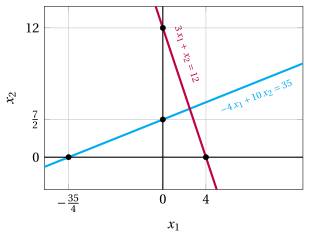
We compute the intersection point:
\[\begin{equation*} \left\{ \begin{array}{ll} -4 \; {x}_1 + 10 \; {x}_2 & = 35\\[2ex] 3 \; {x}_1 + \; {x}_2 & = 12 \end{array} \right. ~~\Longrightarrow~~ \begin{pmatrix} x_1 \\[0.5ex] x_2 \end{pmatrix} = \begin{pmatrix} \frac{35 \cdot 1 - 10 \cdot 12}{(-4) \cdot 1 - 10 \cdot 3} \\[2ex] \frac{(-4) \cdot 12 - 35 \cdot 3}{(-4) \cdot 1 - 10 \cdot 3 } \end{pmatrix} = \begin{pmatrix} \frac{5}{2} \\[0.5ex] \frac{9}{2} \end{pmatrix} \end{equation*}\] -
The polyhedron, given by the intersection of the half-spaces, is:
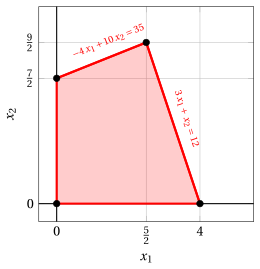
A polyhedron is a polytope if it is bounded (definitions of bounded polyhedron and of polytope in the chapter «Half-spaces and polyhedra»); equivalently, if there exist \({\boldsymbol \alpha},{\boldsymbol \beta} \in \R^n\) such that \(\alpha_j \le x_j \le \beta_j\) for every \({\boldsymbol x} \in P\) and every \(j \in \{1,2,\dots,n\}\).
This polyhedron \(P\) is bounded since for every \(\begin{pmatrix} x_1 \\[0.5ex] x_2 \end{pmatrix} \in P\), we have for instance:
\[\begin{align*} 0 \le & ~~x_1~ \le 4\\[1ex] 0 \le & ~~x_2~ \le \frac{9}{2} \end{align*}\]Accordingly this polyhedron is also a polytope.
Exercise 2.2: Polyhedra (P10)
Consider the following half-spaces in \(\R^2\):
Questions
-
Draw a plot of their supporting hyper-planes.
-
Draw the polyhedron given by the intersection of the half-spaces. Is it a polytope?
-
What happens if we add the constraint \(~ x_1 \ge 5 ~\) to the polyhedron? What if we add the constraint \(~ x_1 \le 5 ~\)?
Solution
-
The supporting hyper-planes associated with the half-spaces and the intersection points with the axis are:
\(-\) \(x_1\) \(+\) 3 \(x_2\) \(=\) 12 \(\begin{pmatrix} -12 \\[0.5ex] 0 \end{pmatrix}\), \(\begin{pmatrix} 0 \\[0.5ex] 4 \end{pmatrix}\) \(x_1\) \(+\) 2 \(x_2\) \(=\) 12 \(\begin{pmatrix} 12 \\[0.5ex] 0 \end{pmatrix}\), \(\begin{pmatrix} 0 \\[0.5ex] 6 \end{pmatrix}\) 3 \(x_1\) \(-\) 2 \(x_2\) \(=\) 8 \(\begin{pmatrix} \dfrac{8}{3} \\[0.5ex] 0 \end{pmatrix}\), \(\begin{pmatrix} 0 \\[0.5ex] -4 \end{pmatrix}\) \(x_1\) \(=\) \(0\) \(x_2\) \(=\) \(0\) Their plot is shown below.
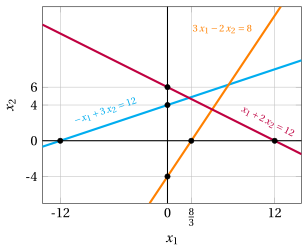
We compute the intersection points:
\[\begin{equation*} \left\{ \begin{array}{ll} -\; {x}_1 + 3 \; {x}_2 & = 12\\[2ex] \; {x}_1 + 2 \; {x}_2 & = 12 \end{array} \right. ~~\Longrightarrow~~ \begin{pmatrix} x_1 \\[0.5ex] x_2 \end{pmatrix} = \begin{pmatrix} \frac{12 \cdot 2 - 3\cdot 12}{(-1) \cdot 2 - 3 \cdot 1} \\[2ex] \frac{(-1) \cdot 12 - 12 \cdot 1}{(-1) \cdot 2 - 3 \cdot 1} \end{pmatrix} = \begin{pmatrix} \frac{12}{5} \\[0.5ex] \frac{24}{5} \end{pmatrix} \end{equation*}\]\[\begin{equation*} \left\{ \begin{array}{ll} \; {x}_1 + 2 \; {x}_2 & = 12\\[2ex] 3 \; {x}_1 - 2 \; {x}_2 & = 8 \end{array} \right. ~~\Longrightarrow~~ \begin{pmatrix} x_1 \\[0.5ex] x_2 \end{pmatrix} = \begin{pmatrix} \frac{12 \cdot (-2)-2 \cdot 8}{1 \cdot (-2) - 2 \cdot 3} \\[2ex] \frac{1 \cdot 8 - 12 \cdot 3}{1 \cdot (-2) - 2 \cdot 3} \end{pmatrix} = \begin{pmatrix} 5 \\[0.5ex] \frac{7}{2} \end{pmatrix} \end{equation*}\] -
The polyhedron, given by the intersection of the half-spaces, is:
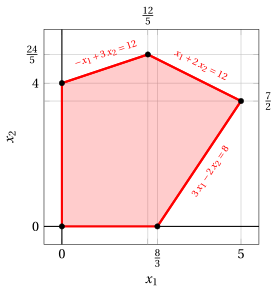
A polyhedron is a polytope if it is bounded (definitions of bounded polyhedron and of polytope in the chapter «Half-spaces and polyhedra»); equivalently, if there exist \({\boldsymbol \alpha},{\boldsymbol \beta} \in \R^n\) such that \(\alpha_j \le x_j \le \beta_j\) for every \({\boldsymbol x} \in P\) and every \(j \in \{1,2,\dots,n\}\).
This polyhedron \(P\) is bounded since for every \(\begin{pmatrix} x_1 \\[0.5ex] x_2 \end{pmatrix} \in P\), we have for instance:
\[\begin{align*} 0 \le & ~~x_1~ \le 5\\[1ex] 0 \le & ~~x_2~ \le \frac{24}{5} \end{align*}\]Accordingly this polyhedron is also a polytope.
-
If we add constraint \(~x_1 \ge 5~\) the polyhedron reduces to the point \(\left (~5,~ \frac{7}{2}~\right)\). If we add constraint \(~x_1 \le 5~\) the polyhedron does not change.
Exercise 2.3: Polyhedra (P21)
Consider the following half-spaces in \(\R^2\):
Questions
-
Draw a plot of their supporting hyper-planes.
-
Draw the polyhedron given by the intersection of the half-spaces. Is it a polytope?
Solution
-
The supporting hyper-planes associated with the half-spaces and the intersection points with the axis are:
\(-\) \(x_1\) \(-\) \(x_2\) \(=\) \(-2\) \(\begin{pmatrix} 2 \\[0.5ex] 0 \end{pmatrix}\), \(\begin{pmatrix} 0 \\[0.5ex] 2 \end{pmatrix}\) 4 \(x_1\) \(-\) 2 \(x_2\) \(=\) 7 \(\begin{pmatrix} \dfrac{7}{4} \\[0.5ex] 0 \end{pmatrix}\), \(\begin{pmatrix} 0 \\[0.5ex] -\dfrac{7}{2} \end{pmatrix}\) \(x_1\) \(+\) 5 \(x_2\) \(=\) 21 \(\begin{pmatrix} 21 \\[0.5ex] 0 \end{pmatrix}\), \(\begin{pmatrix} 0 \\[0.5ex] \dfrac{21}{5} \end{pmatrix}\) \(x_1\) \(=\) \(0\) \(x_2\) \(=\) \(0\) Their plot is shown below.
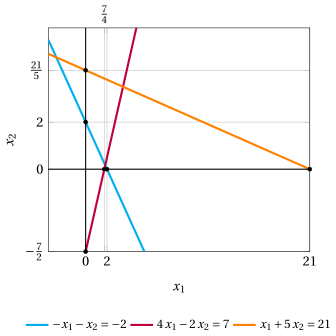
We compute the intersection points:
\[\begin{equation*} \left\{ \begin{array}{ll} {x}_1 + 5 \; {x}_2 & = 21\\[2ex] 4\; {x}_1 - 2 \; {x}_2 & = 7 \end{array} \right. ~~\Longrightarrow~~ \begin{pmatrix} x_1 \\[0.5ex] x_2 \end{pmatrix} = \begin{pmatrix} \frac{21 \cdot (-2) - 5\cdot 7}{ 1 \cdot (-2) - 5 \cdot 4} \\[2ex] \frac{1 \cdot 7 - 21 \cdot 4}{1 \cdot (-2) - 5 \cdot 4} \end{pmatrix} = \begin{pmatrix} \frac{7}{2} \\[0.5ex] \frac{7}{2} \end{pmatrix} \end{equation*}\]\[\begin{equation*} \left\{ \begin{array}{ll} -\; {x}_1 - \; {x}_2 & = -2\\[2ex] 4 \; {x}_1 - 2 \; {x}_2 & = 7 \end{array} \right. ~~\Longrightarrow~~ \begin{pmatrix} x_1 \\[0.5ex] x_2 \end{pmatrix} = \begin{pmatrix} \frac{(-2) \cdot (-2)-(-1) \cdot 7}{(-1) \cdot (-2)-(-1) \cdot 4} \\[2ex] \frac{(-1) \cdot 7 - (-2) \cdot 4}{(-1) \cdot (-2)-(-1) \cdot 4} \end{pmatrix} = \begin{pmatrix} \frac{11}{6} \\[0.5ex] \frac{1}{6} \end{pmatrix} \end{equation*}\] -
The polyhedron, given by the intersection of the half-spaces, is:
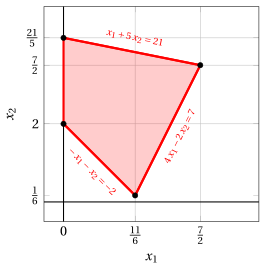
A polyhedron is a polytope if it is bounded (definitions of bounded polyhedron and of polytope in the chapter «Half-spaces and polyhedra»); equivalently, if there exist \({\boldsymbol \alpha},{\boldsymbol \beta} \in \R^n\) such that \(\alpha_j \le x_j \le \beta_j\) for every \({\boldsymbol x} \in P\) and every \(j \in \{1,2,\dots,n\}\).
This polyhedron \(P\) is bounded since for every \(\begin{pmatrix} x_1 \\[0.5ex] x_2 \end{pmatrix} \in P\), we have for instance:
\[\begin{align*} 0 \le & ~~x_1~ \le \frac{7}{2}\\[1ex] 0 \le & ~~x_2~ \le \frac{21}{5} \end{align*}\]Accordingly this polyhedron is also a polytope.
Exercise 2.4: Polyhedra (P41)
Consider the following half-spaces in \(\R^3\):
Questions
-
Draw a plot of their supporting hyper-planes.
-
Draw the polyhedron given by the intersection of the half-spaces. Is it a polytope?
Solution
-
The supporting hyper-planes associated with the half-spaces and the intersection points with the axis are:
\(x_1\) \(+\) \(x_2\) \(+\) \(x_3\) \(=\) 4 \(\begin{pmatrix} 4 \\[0.5ex] 0 \\[0.5ex] 0 \end{pmatrix}\), \(\begin{pmatrix} 0 \\[0.5ex] 4 \\[0.5ex] 0 \end{pmatrix}\), \(\begin{pmatrix} 0 \\[0.5ex] 0 \\[0.5ex] 4 \end{pmatrix}\) \(x_2\) \(=\) 2 \(\begin{pmatrix} 0 \\[0.5ex] 2 \\[0.5ex] 0 \end{pmatrix}\) \(x_3\) \(=\) 3 \(\begin{pmatrix} 0 \\[0.5ex] 0 \\[0.5ex] 3 \end{pmatrix}\) 3 \(x_1\) \(+\) \(x_3\) \(=\) 6 \(\begin{pmatrix} 2 \\[0.5ex] 0 \\[0.5ex] 0 \end{pmatrix}\), \(\begin{pmatrix} 0 \\[0.5ex] 0 \\[0.5ex] 6 \end{pmatrix}\) \(x_1\) \(=\) \(0\) \(x_2\) \(=\) \(0\) \(x_3\) \(=\) \(0\) Their plot is shown below.
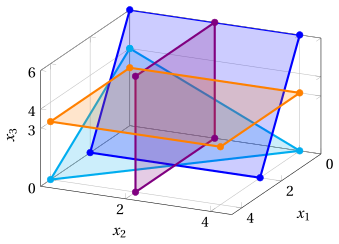
-
The polyhedron given by the intersection of the half-spaces in \(\R^3\) is:
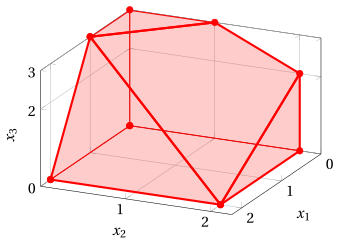
A polyhedron is a polytope if it is bounded (definitions of bounded polyhedron and of polytope in the chapter «Half-spaces and polyhedra»); equivalently, if there exist \({\boldsymbol \alpha},{\boldsymbol \beta} \in \R^n\) such that \(\alpha_j \le x_j \le \beta_j\) for every \({\boldsymbol x} \in P\) and every \(j \in \{1,2,\dots,n\}\).
This polyhedron \(P\) is bounded since for every \(\begin{pmatrix} x_1 \\[0.5ex] x_2 \\[0.5ex] x_3 \end{pmatrix} \in P\), we have for instance:
\[\begin{align*} 0 \le & ~~x_1~ \le 2\\[1ex] 0 \le & ~~x_2~ \le 2\\[1ex] 0 \le & ~~x_3~ \le 3 \end{align*}\]Accordingly this polyhedron is also a polytope.
Exercise 2.5: Polyhedra (P42)
Consider the following half-spaces in \(\R^3\):
Questions
-
Draw a plot of their supporting hyper-planes.
-
Draw the polyhedron given by the intersection of the half-spaces. Is it a polytope?
Solution
-
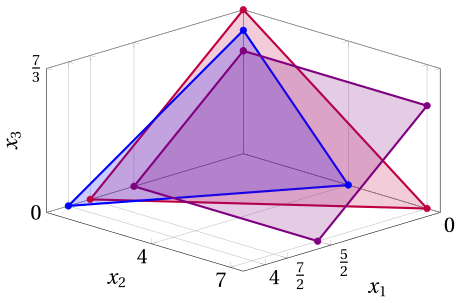
The supporting hyper-planes associated with the half-spaces and the intersection points with the axis are:
\(x_1\) \(+\) \(x_2\) \(+\) 2 \(x_3\) \(=\) 4 \(\begin{pmatrix} 4 \\[0.5ex] 0 \\[0.5ex] 0 \end{pmatrix}\), \(\begin{pmatrix} 0 \\[0.5ex] 4 \\[0.5ex] 0 \end{pmatrix}\), \(\begin{pmatrix} 0 \\[0.5ex] 0 \\[0.5ex] 2 \end{pmatrix}\) 2 \(x_1\) \(+\) 3 \(x_3\) \(=\) 5 \(\begin{pmatrix} \tfrac{5}{2} \\[0.5ex] 0 \\[0.5ex] 0 \end{pmatrix}\), \(\begin{pmatrix} 0 \\[0.5ex] 0 \\[0.5ex] \tfrac{5}{3} \end{pmatrix}\) 2 \(x_1\) \(+\) \(x_2\) \(+\) 3 \(x_3\) \(=\) 7 \(\begin{pmatrix} \tfrac{7}{2} \\[0.5ex] 0 \\[0.5ex] 0 \end{pmatrix}\), \(\begin{pmatrix} 0 \\[0.5ex] 7 \\[0.5ex] 0 \end{pmatrix}\), \(\begin{pmatrix} 0 \\[0.5ex] 0 \\[0.5ex] \tfrac{7}{3} \end{pmatrix}\) \(x_1\) \(=\) \(0\) \(x_2\) \(=\) \(0\) \(x_3\) \(=\) \(0\) Their plot is shown below.
-
The polyhedron given by the intersection of the half-spaces in \(\R^3\) is:
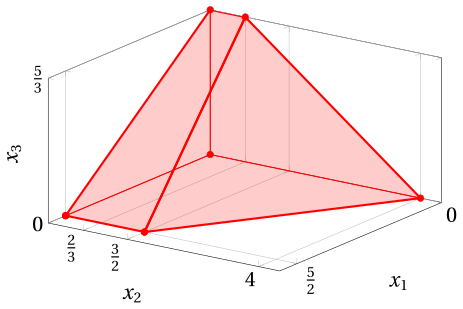
A polyhedron is a polytope if it is bounded (definitions of bounded polyhedron and of polytope in the chapter «Half-spaces and polyhedra»); equivalently, if there exist \({\boldsymbol \alpha},{\boldsymbol \beta} \in \R^n\) such that \(\alpha_j \le x_j \le \beta_j\) for every \({\boldsymbol x} \in P\) and every \(j \in \{1,2,\dots,n\}\).
This polyhedron \(P\) is bounded since for every \(\begin{pmatrix} x_1 \\[0.5ex] x_2 \\[0.5ex] x_3 \end{pmatrix} \in P\), we have for instance:
\[\begin{align*} 0 \le & ~~x_1~ \le 10\\[1ex] 0 \le & ~~x_2~ \le 10\\[1ex] 0 \le & ~~x_3~ \le 10 \end{align*}\]Accordingly this polyhedron is also a polytope.
Exercise 2.6: Polyhedra (P44)
Consider the following half-spaces in \(\R^3\):
Questions
-
Draw a plot of their supporting hyper-planes.
-
Draw the polyhedron given by the intersection of the half-spaces. Is it a polytope?
Solution
-
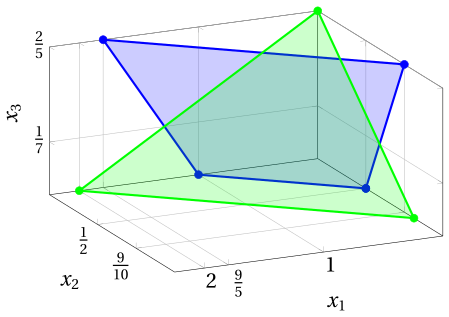
The supporting hyper-planes associated with the half-spaces and the intersection points with the axis are:
\(x_1\) \(+\) 2 \(x_2\) \(-\) 2 \(x_3\) \(=\) 1 \(\begin{pmatrix} 1 \\[0.5ex] 0 \\[0.5ex] 0 \end{pmatrix}\), \(\begin{pmatrix} 0 \\[0.5ex] \tfrac{1}{2} \\[0.5ex] 0 \end{pmatrix}\), \(\begin{pmatrix} 0 \\[0.5ex] 0 \\[0.5ex] -\tfrac{1}{2} \end{pmatrix}\) 2 \(x_1\) \(-\) \(x_2\) \(-\) 3 \(x_3\) \(=\) 4 \(\begin{pmatrix} 2 \\[0.5ex] 0 \\[0.5ex] 0 \end{pmatrix}\), \(\begin{pmatrix} 0 \\[0.5ex] -4 \\[0.5ex] 0 \end{pmatrix}\), \(\begin{pmatrix} 0 \\[0.5ex] 0 \\[0.5ex] -\tfrac{4}{3} \end{pmatrix}\) \(x_1\) \(+\) 2 \(x_2\) \(+\) 5 \(x_3\) \(=\) 2 \(\begin{pmatrix} 2 \\[0.5ex] 0 \\[0.5ex] 0 \end{pmatrix}\), \(\begin{pmatrix} 0 \\[0.5ex] 1 \\[0.5ex] 0 \end{pmatrix}\), \(\begin{pmatrix} 0 \\[0.5ex] 0 \\[0.5ex] \tfrac{2}{5} \end{pmatrix}\) \(x_1\) \(=\) \(0\) \(x_2\) \(=\) \(0\) \(x_3\) \(=\) \(0\) Their plot is shown below.
-
The polyhedron given by the intersection of the half-spaces in \(\R^3\) is:
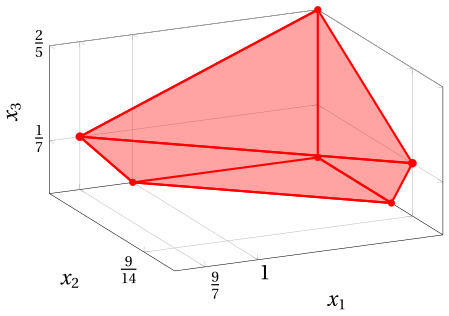
A polyhedron is a polytope if it is bounded (definitions of bounded polyhedron and of polytope in the chapter «Half-spaces and polyhedra»); equivalently, if there exist \({\boldsymbol \alpha},{\boldsymbol \beta} \in \R^n\) such that \(\alpha_j \le x_j \le \beta_j\) for every \({\boldsymbol x} \in P\) and every \(j \in \{1,2,\dots,n\}\).
This polyhedron \(P\) is bounded since for every \(\begin{pmatrix} x_1 \\[0.5ex] x_2 \\[0.5ex] x_3 \end{pmatrix} \in P\), we have for instance:
\[\begin{align*} 0 \le & ~~x_1~ \le 10\\[1ex] 0 \le & ~~x_2~ \le 10\\[1ex] 0 \le & ~~x_3~ \le 10 \end{align*}\]Accordingly this polyhedron is also a polytope.
Exercise 2.7: Polyhedra (P51)
Consider the following half-spaces in \(\R^3\):
Questions
-
Draw a plot of their supporting hyper-planes.
-
Draw the polyhedron given by the intersection of the half-spaces. Is it a polytope?
Solution
-
The supporting hyper-planes associated with the half-spaces and the intersection points with the axis are:
\(x_1\) \(-\) \(x_2\) \(-\) 3 \(x_3\) \(=\) \(-5\) \(\begin{pmatrix} \!-5 \\[0.5ex] 0 \\[0.5ex] 0 \end{pmatrix}\), \(\begin{pmatrix} 0 \\[0.5ex] 5 \\[0.5ex] 0 \end{pmatrix}\), \(\begin{pmatrix} 0 \\[0.5ex] 0 \\[0.5ex] \tfrac{5}{3} \end{pmatrix}\) \(-3\, x_1\) \(-\) 2 \(x_2\) \(+\) 2 \(x_3\) \(=\) \(-2\) \(\begin{pmatrix} \tfrac{2}{3} \\[0.5ex] 0 \\[0.5ex] 0 \end{pmatrix}\), \(\begin{pmatrix} 0 \\[0.5ex] 1 \\[0.5ex] 0 \end{pmatrix}\), \(\begin{pmatrix} 0 \\[0.5ex] 0 \\[0.5ex] -1 \end{pmatrix}\) \(x_1\) \(=\) \(0\) \(x_2\) \(=\) \(0\) \(x_3\) \(=\) \(0\) Their plot is shown below.
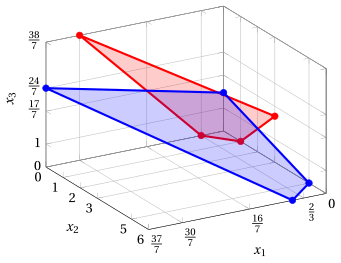
-
The polyhedron given by the intersection of the half-spaces in \(\R^3\) is:
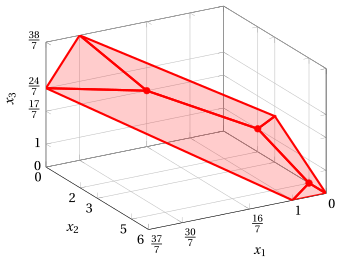
A polyhedron is a polytope if it is bounded (definitions of bounded polyhedron and of polytope in the chapter «Half-spaces and polyhedra»); equivalently, if there exist \({\boldsymbol \alpha},{\boldsymbol \beta} \in \R^n\) such that \(\alpha_j \le x_j \le \beta_j\) for every \({\boldsymbol x} \in P\) and every \(j \in \{1,2,\dots,n\}\).
This polyhedron \(P\) is not bounded, accordingly it is not a polytope.
2.1 Further reading: drawing polyhedra with SageMath
-
The polyhedra of the exercises can be drawn with SageMath, which can be used online at sagecell.sagemath.org/, without installing anything.
-
A polyhedron is given by the list of its half-spaces (the H-representation). SageMath writes every half-space in the form
\[ b + a_1\,x_1 + a_2\,x_2 + \dots + a_n\,x_n \ge 0 \]and describes it by the tuple \((b, a_1, a_2, \dots, a_n)\). A constraint \({\boldsymbol a}'{\boldsymbol x} \le b\) is first written as \(b - {\boldsymbol a}'{\boldsymbol x} \ge 0\), so its tuple is \((b, -a_1, \dots, -a_n)\); a non-negativity constraint \(x_j \ge 0\) has the tuple with \(0\) in the first position and \(1\) in position \(j+1\).
-
The method
Hrepresentation()lists the half-spaces,Vrepresentation()lists the extreme points and the extreme rays, andplot()draws the polyhedron (in \(\R^2\) or in \(\R^3\)).
Example in \(\R^2\) (Exercise with the polyhedron \(P2\)).
SageMath code: a polyhedron in \(\R^2\)
# Define the polyhedron using inequalities (Hyperplane Representation)
p = Polyhedron(ieqs=[
    (35,  4, -10),     # ( 4, -10) x + 35 >= 0
    (12, -3, -1),      # (-3,  -1) x + 12 >= 0
    (0,   1,  0),      # ( 1,   0) x + 0 >= 0
    (0,   0,  1)       # ( 0,   1) x + 0 >= 0
])

# Display the inequalities of the polyhedron
p.Hrepresentation()

# Display the extreme points and extreme rays of the polyhedron
p.Vrepresentation()

# Plot the polyhedron (2D)
p.plot()
Example in \(\R^3\) (Exercise with the polyhedron \(P41\)).
SageMath code: a polyhedron in \(\R^3\)
# Define the polyhedron using inequalities (Hyperplane Representation)
p = Polyhedron(ieqs=[
    (4, -1, -1, -1),   # (-1, -1, -1) x + 4 >= 0
    (2,  0, -1,  0),   # (0, -1, 0) x + 2 >= 0
    (3,  0,  0, -1),   # (0, 0, -1) x + 3 >= 0
    (6, -3,  0, -1),   # (-3, 0, -1) x + 6 >= 0
    (0,  1,  0,  0),   # (1, 0, 0) x + 0 >= 0
    (0,  0,  1,  0),   # (0, 1, 0) x + 0 >= 0
    (0,  0,  0,  1)    # (0, 0, 1) x + 0 >= 0
])

# Display the inequalities of the polyhedron
p.Hrepresentation()

# Display the extreme points and extreme rays of the polyhedron
p.Vrepresentation()

# Plot the polyhedron (3D)
p.plot()
The other polyhedra of this chapter are drawn in the same way, by changing the list of tuples.