Exercises · The geometry of Linear Programming
Exercises · Chapter 15 · each solution opens with a click · Chapter 15: The geometry of Linear Programming · Exercises, volume 4 (PDF)
Exercise 15.1: The geometry of Linear Programming (P2)
Consider the following LP problem in canonical maximization form with \(n=2\) variables and \(m=2\) constraints:
Questions
-
Determine the dimension of the feasible region \(F\) and say whether it is full-dimensional.
-
Determine the facets and the vertices of \(F\).
-
Write its standard maximization form, enumerate all the bases and say which of them are associated with a basic feasible solution. Check the correspondence with the vertices found at the previous question.
Solution
-
The feasible region is
\[ F = \left\{~ \begin{pmatrix} x_1 \\[0.5ex] x_2 \end{pmatrix} \in \R^2 : -4x_1 + 10x_2 \le 35,~~ 3x_1 + x_2 \le 12,~~ x_1 \ge 0,~~ x_2 \ge 0 ~\right\} . \]The point \(\begin{pmatrix} 1 \\ 1 \end{pmatrix}\) satisfies all four constraints strictly, and then a small disc around it is contained in \(F\): we have \(\dim(F) = 2\) and \(F\) is full-dimensional.
-
Since \(\dim(F) = 2\), its facets are the faces of dimension \(1\), that is, its edges, and its vertices are the faces of dimension \(0\). Each of the four constraints defines one facet, and the vertices are
\[ \begin{pmatrix} 0 \\ 0 \end{pmatrix}, \qquad \begin{pmatrix} 4 \\ 0 \end{pmatrix}, \qquad \begin{pmatrix} \frac{5}{2} \\[0.5ex] \frac{9}{2} \end{pmatrix}, \qquad \begin{pmatrix} 0 \\[0.5ex] \frac{7}{2} \end{pmatrix} . \]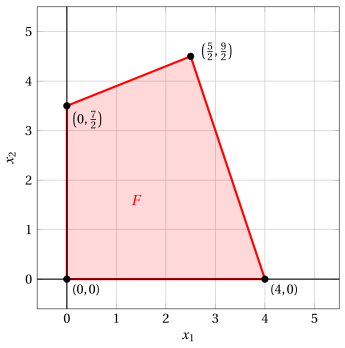
-
By adding \(m=2\) slack variables we obtain the standard maximization form with \(n+m=4\) non-negative variables and \(m=2\) equality linear constraints. A basis is a subset of \(2\) indices out of \(4\), and there are \(\binom{4}{2} = 6\) such subsets, all of them giving an invertible matrix:
\(\pazocal{B}\) \({\boldsymbol x}_{\pazocal{B}}\) feasible vertex \((x_1,x_2)\) \(\{1,2\}\) \(\left(\frac{5}{2},~\frac{9}{2}\right)\) ✓ \(\left(\frac{5}{2},\frac{9}{2}\right)\) \(\{1,3\}\) \((4,~51)\) ✓ \((4,0)\) \(\{1,4\}\) \(\left(-\frac{35}{4},~\frac{153}{4}\right)\) \(\{2,3\}\) \((12,~-85)\) \(\{2,4\}\) \(\left(\frac{7}{2},~\frac{17}{2}\right)\) ✓ \(\left(0,\frac{7}{2}\right)\) \(\{3,4\}\) \((35,~12)\) ✓ \((0,0)\) Exactly \(4\) of the \(6\) bases are feasible, and they correspond to the \(4\) vertices found at the previous question. The correspondence is one-to-one, since no basic feasible solution is degenerate.
Exercise 15.2: The geometry of Linear Programming (G2)
Consider the following LP problem in standard maximization form with \(n=3\) non-negative variables and \(m=1\) equality linear constraint:
Questions
-
Determine the dimension of the feasible region \(F\) and say whether it is full-dimensional.
-
Determine the vertices of \(F\) by enumerating all the bases.
-
Determine the set of the optimal solutions and say whether it is a face of \(F\).
Solution
-
All the points of \(F\) satisfy the equality constraint \(2x_1 + 3x_2 + x_3 = 4\), and then \(\mathrm{aff}(F)\) is contained in that plane:
\[ \dim(F) \; \le \; n - \rank({\boldsymbol A}) = 3 - 1 = 2 . \]The three points \(\begin{pmatrix} 2 \\ 0 \\ 0\end{pmatrix}\), \(\begin{pmatrix} 0 \\ \frac{4}{3} \\ 0\end{pmatrix}\) and \(\begin{pmatrix} 0 \\ 0 \\ 4\end{pmatrix}\) belong to \(F\) and are not aligned, and then \(\dim(F) = 2\). The feasible region is therefore not full-dimensional, as it always happens for the standard maximization form.
-
A basis is a subset of \(m=1\) index out of \(n=3\), and there are \(3\) such subsets, all of them giving an invertible matrix:
\(\pazocal{B}\) \({\boldsymbol x}_{\pazocal{B}}\) feasible vertex \(\{1\}\) \((2)\) ✓ \((2,0,0)\) \(\{2\}\) \(\left(\frac{4}{3}\right)\) ✓ \(\left(0,\frac{4}{3},0\right)\) \(\{3\}\) \((4)\) ✓ \((0,0,4)\) All three bases are feasible, and then \(F\) has exactly three vertices: it is a triangle.
-
The objective values at the three vertices are
\[ 2 \cdot 2 = 4, \qquad 2 \cdot \frac{4}{3} = \frac{8}{3}, \qquad 1 \cdot 4 = 4 , \]and then the optimal value is \(z(\, LP \,) = 4\), attained at two vertices. By the observation on multiple optimal solutions, every point of the segment joining them is optimal:
\[ \left\{~ \lambda \begin{pmatrix} 2 \\ 0 \\ 0\end{pmatrix} + (1-\lambda) \begin{pmatrix} 0 \\ 0 \\ 4\end{pmatrix} ~:~ \lambda \in [0,1] ~\right\} . \]This set is the face of \(F\) defined by the valid inequality \(2x_1 + 2x_2 + x_3 \le 4\), and it has dimension \(1\): it is an edge of the triangle.
Exercise 15.3: The geometry of Linear Programming (G3)
Consider the following LP problem in canonical maximization form with \(n=2\) variables and \(m=4\) constraints:
Questions
-
Determine the feasible region \(F\) and its dimension.
-
Say how many bases of the standard maximization form are associated with the only point of \(F\), and explain why the correspondence between bases and vertices is not one-to-one.
Solution
-
The first two constraints impose \(x_1 + x_2 \le 2\) and \(x_1 + x_2 \ge 2\), that is, \(x_1 + x_2 = 2\). The last two impose \(x_1 \le x_2\) and \(x_1 \ge x_2\), that is, \(x_1 = x_2\). The two equalities give \(x_1 = x_2 = 1\), and then
\[ F = \left\{ \begin{pmatrix} 1 \\ 1 \end{pmatrix} \right\} \qquad \text{and} \qquad \dim(F) = 0 . \]The single point of \(F\) is therefore a vertex (here the vertex is the face \(G = F\) itself, of dimension \(0\)), and it is the optimal solution, with optimal value \(z(\, LP \,) = 1 + 2 = 3\).
-
In standard maximization form the problem has \(n+m=6\) non-negative variables and \(m=4\) equality linear constraints, and a basis is a subset of \(4\) indices out of \(6\). At the point \(\begin{pmatrix} 1 \\ 1 \end{pmatrix}\) all four constraints are binding, and then all four slack variables take the value \(0\). Since \(x_1 = x_2 = 1 > 0\), every basis associated with that point contains the indices \(1\) and \(2\) of the two structural variables, together with two of the four slack variables. Out of the \(\binom{4}{2} = 6\) choices, \(\{1,2,3,4\}\) and \(\{1,2,5,6\}\) give a singular matrix \({\boldsymbol A}_{\pazocal{B}}\) (the columns of \(x_1\) and \(x_2\) restricted to the rows of the other two slack variables are linearly dependent), while the remaining four are bases:
\[ \{1,2,3,5\}, \qquad \{1,2,3,6\}, \qquad \{1,2,4,5\}, \qquad \{1,2,4,6\} , \]that is, four different bases give the same vertex. In each of them two basic variables take the value \(0\): the basic feasible solution is degenerate.
Every basic feasible solution is a vertex, but a degenerate vertex may be associated with several bases, as in this case: the correspondence between bases and vertices is onto, not one-to-one.