EX 3 — Staffetta
Classe: BIP · Legami: nessuno (una sola famiglia di variabili) · Script: python/ex03_staffetta.py
Difficoltà: ★☆☆☆☆ · Tempo: 20–30 min

Uno dei quindici modelli numerici, della famiglia assegnamento e scheduling.
EX 3
Un allenatore deve formare una staffetta scegliendo tre nuotatori fra quattro. La gara ha tre frazioni da 50 metri: dorso, rana e farfalla. I tempi registrati (secondi) sono:
| Stile | Carlo | Paolo | Fabio | Marco |
|---|---|---|---|---|
| Dorso | 37 | 32 | 33 | 37 |
| Rana | 43 | 33 | 42 | 34 |
| Farfalla | 33 | 28 | 38 | 30 |
Si minimizza il tempo totale della staffetta.
Modello
Con \(x_{sn} = 1\) se lo stile \(s\) è nuotato da \(n\) (\(12\) binarie): \(\sum_n x_{sn} = 1\) per ogni stile (3 vincoli), \(\sum_s x_{sn} \le 1\) per ogni nuotatore (4 vincoli), obiettivo \(\min \sum_{s,n} t_{sn} x_{sn}\). Un nuotatore resta fuori: è un assegnamento con più risorse che compiti.
Le prime tre righe dicono che ogni stile è nuotato da esattamente un nuotatore; le quattro successive che ogni nuotatore nuota al più uno stile. Con tre stili e quattro nuotatori uno resta fuori: è un assegnamento con più risorse che compiti, e per questo le righe dei nuotatori sono disuguaglianze mentre quelle degli stili sono uguaglianze.
Euristica costruttiva: il bound primale
Euristica costruttiva sugli stili nell'ordine dato: dorso a Paolo (\(32\)), rana a Marco (\(34\), il più veloce fra i tre rimasti), farfalla a Carlo (\(33\)). Totale \(\mathit{UB} = 99\) secondi.
Rilassamento LP e duale: il bound duale
Con \(\alpha_s\) libera per ogni vincolo di stile e \(\beta_n\) libera per ogni vincolo di nuotatore:
Una riga per ogni coppia stile-nuotatore: il prezzo dello stile \(s\) più quello del nuotatore \(n\) non può superare il tempo \(t_{sn}\) che quella coppia impiegherebbe. L'obiettivo somma i prezzi dei tre stili e dei quattro nuotatori.
La ricetta. Stessa struttura di EX 2 con \(p = 1\): \(\bar\beta = 0\) e \(\bar\alpha_s = \min_n t_{sn} = (32, 33, 28)\), quindi \(\mathit{LB} = 93\). Significato: «ogni stile costa almeno il tempo del suo migliore specialista».
Il bound è debole proprio quando due stili hanno lo stesso specialista migliore — qui Paolo è il più veloce sia nel dorso sia nella farfalla, e infatti \(93\) non è raggiungibile.
| \(UB\) (euristica costruttiva) | \(LB\) (duale a mano) | \(z(\mathit{LP})\) | \(z(\mathit{MILP})\) | gap euristica |
|---|---|---|---|---|
| 99 | 93 | 95 | 95 | \(4{,}2\%\) |
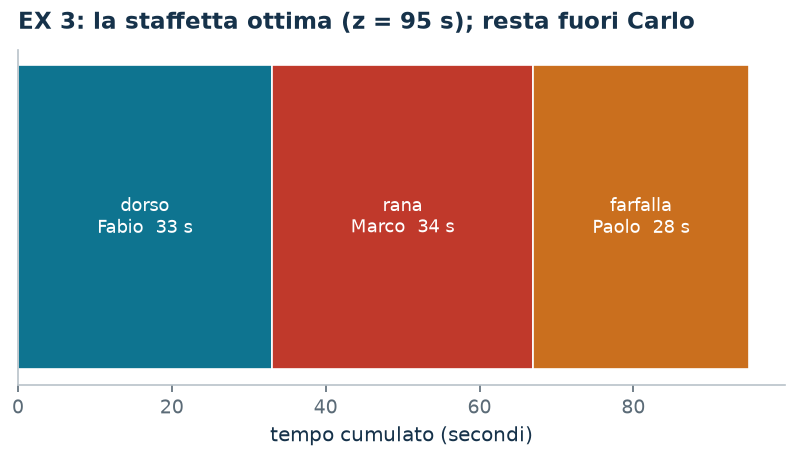
L'ottimo è \(95\) secondi: dorso a Fabio (\(33\)), rana a Marco (\(34\)), farfalla a Paolo (\(28\)); resta fuori Carlo.
Perché qui il rilassamento è esatto
La matrice del modello è quella del problema di assegnamento: totalmente unimodulare. Tutti i vertici del rilassamento sono interi, quindi \(z(\mathit{LP}) = z(\mathit{MILP})\) e l'interezza non costa nulla — lo stesso fenomeno dell'alldiff. Non è così, invece, appena si aggiunge un vincolo di capacità con coefficienti diversi da \(0\) e \(1\).
Codice
Lo script completo è
python/ex03_staffetta.py;
il notebook è
notebooks/ex03_staffetta.ipynb.
Mostra lo script completo — python/ex03_staffetta.py (113 righe)
"""EX 3 -- Staffetta: tre stili, quattro nuotatori, uno resta fuori (famiglia 7).

Un assegnamento con piu' "macchine" che "lavori": ogni stile a esattamente un
nuotatore, ogni nuotatore al piu' uno stile. Il vincolo di capacita' e' unitario,
quindi la matrice e' quella dell'assegnamento: totalmente unimodulare, e il
rilassamento e' esatto.
"""
import gurobipy as gp
import pandas as pd
from gurobipy import GRB

from mip import (ammissibile, due_rilassamenti, frazione, nuovo_modello, registra_bound,
                 risolvi, valuta)
from stile import intestazione, plt, salva_dati, salva_figura
from esteso import salva_modello

R = range

# ---------- 1. MODELLO E ISTANZA ----------
intestazione("EX 3. Staffetta: tre stili da assegnare a quattro nuotatori")
NUOTATORI = ["Carlo", "Paolo", "Fabio", "Marco"]
STILI = ["dorso", "rana", "farfalla"]
t = [[37, 32, 33, 37],   # dorso
     [43, 33, 42, 34],   # rana
     [33, 28, 38, 30]]   # farfalla
ns, nn = 3, 4
salva_dati(pd.DataFrame([{"stile": STILI[s], "nuotatore": NUOTATORI[n], "t": t[s][n]}
                         for s in R(ns) for n in R(nn)]), "ex03_tempi")


def modello(t):
    ns, nn = len(t), len(t[0])
    m = nuovo_modello("staffetta")
    x = m.addVars(ns, nn, vtype=GRB.BINARY, name="x")
    m.setObjective(gp.quicksum(t[s][n] * x[s, n] for s in R(ns) for n in R(nn)), GRB.MINIMIZE)
    m.addConstrs((x.sum(s, "*") == 1 for s in R(ns)), name="stile")
    m.addConstrs((x.sum("*", n) <= 1 for n in R(nn)), name="nuotatore")
    return m, x


def duale(t):
    """max sum_s alpha_s + sum_n beta_n;  alpha_s + beta_n <= t_sn;  alpha libera, beta <= 0."""
    ns, nn = len(t), len(t[0])
    d = nuovo_modello("duale_staffetta")
    alpha = d.addVars(ns, lb=-GRB.INFINITY, name="alpha")
    beta = d.addVars(nn, lb=-GRB.INFINITY, ub=0.0, name="beta")
    d.setObjective(alpha.sum() + beta.sum(), GRB.MAXIMIZE)
    d.addConstrs((alpha[s] + beta[n] <= t[s][n] for s in R(ns) for n in R(nn)), name="rc")
    return d


m, x = modello(t)
salva_modello(m, "ex03_primale")

# ---------- 2. EURISTICA COSTRUTTIVA (UPPER BOUND) ----------
# euristica costruttiva sugli stili nell'ordine dato: il nuotatore piu' veloce fra quelli liberi
liberi = set(R(nn))
scelta = {}
for s in R(ns):
    n = min(liberi, key=lambda n: (t[s][n], n))
    scelta[s] = n
    liberi.discard(n)
    print(f"  {STILI[s].capitalize()}: nuotatori liberi "
          + ", ".join(f"{NUOTATORI[k]} ({t[s][k]} s)" for k in sorted(liberi | {n}))
          + f"; il piu' veloce e' {NUOTATORI[n]}")
ub = sum(t[s][scelta[s]] for s in R(ns))
sol_eur = {f"x[{s},{scelta[s]}]": 1 for s in R(ns)}
assert ammissibile(m, sol_eur)
print(f"  Soluzione euristica: " + ", ".join(f"{STILI[s]} -> {NUOTATORI[scelta[s]]}" for s in R(ns))
      + f"   ub = {frazione(ub)} s")

# ---------- 3. RILASSAMENTO LP E DUALE (LOWER BOUND) ----------
d = duale(t)
salva_modello(d, "ex03_duale")
mano = {f"alpha[{s}]": min(t[s]) for s in R(ns)}       # beta = 0
lb, viol = valuta(d, mano)
assert viol <= 1e-9, viol
print("  Duale a mano (beta = 0): alpha_s = min_n t_sn = "
      + ", ".join(frazione(mano[f"alpha[{s}]"]) for s in R(ns)) + f"  ->  lb = {frazione(lb)} s")
print("  Significato: «ogni stile costa almeno il tempo del suo miglior specialista»;")
print("  il bound e' debole quando due stili hanno lo stesso specialista migliore.")
zlp, zlpr, pi = due_rilassamenti(m, d)

# ---------- 4. OTTIMO DEL MILP E TABELLA DEI BOUND ----------
z = risolvi(m)
ott = {s: n for s in R(ns) for n in R(nn) if x[s, n].X > 0.5}
fuori = [NUOTATORI[n] for n in R(nn) if n not in ott.values()]
print("  Soluzione ottima: " + ", ".join(f"{STILI[s]} -> {NUOTATORI[ott[s]]} ({t[s][ott[s]]} s)"
                                         for s in R(ns))
      + f"   totale {frazione(z)} s; resta fuori {', '.join(fuori)}")
riga = registra_bound("EX 3 staffetta", ub, lb, zlp, zlpr, z)
salva_dati(pd.DataFrame([riga]), "ex03_bound")
assert lb <= zlp <= z <= ub + 1e-9
assert abs(zlp - z) < 1e-9, "la matrice dell'assegnamento e' TU: il rilassamento e' esatto"
print("  z(LP) = z(MILP): la matrice del modello e' quella dell'assegnamento, totalmente")
print("  unimodulare, quindi il rilassamento ha vertici interi e l'interezza e' gratis.")

# ---------- 5. FIGURA ----------
fig, ax = plt.subplots(figsize=(6.6, 2.9))
colori = ["#0E7490", "#C0392B", "#CA6F1E"]
inizio = 0
for s in R(ns):
    ax.barh(0, t[s][ott[s]], left=inizio, color=colori[s], edgecolor="white")
    ax.annotate(f"{STILI[s]}\n{NUOTATORI[ott[s]]}  {t[s][ott[s]]} s",
                (inizio + t[s][ott[s]] / 2, 0), ha="center", va="center",
                fontsize=8.5, color="white")
    inizio += t[s][ott[s]]
ax.set_yticks([])
ax.set_xlabel("tempo cumulato (secondi)")
ax.set_title(f"EX 3: la staffetta ottima (z = {frazione(z)} s); resta fuori {fuori[0]}")
ax.grid(False)
salva_figura(fig, "ex03_ottimo")
print("Fine.")