Convex sets
Part 1 · Preliminaries · Chapter 1 · Lecture notes, volume 1 (PDF) · Slides · Exercises: Convex sets · App: Convex combination · App: Convexity test · App: Balls in the q-norm
1.1 Convex combination
Definition 1.1: convex combination
Given two points
their convex combination with a scalar \(\lambda \in [0,1]\) is the point
-
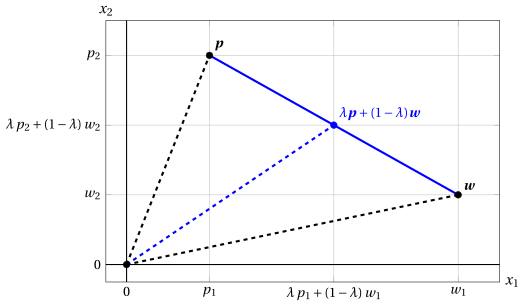
The convex combinations for all values \(\lambda \in [0,1]\) are the points on the segment connecting the two points \({\boldsymbol p}\) and \({\boldsymbol w}\). In \(\R^2\), the blue segment of the following figure:
Example 1.1: convex combination
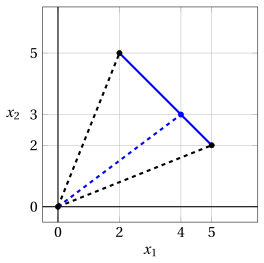
Let us consider the points \(\begin{pmatrix}2 \\[0.3ex] 5\end{pmatrix}\) and \(\begin{pmatrix}5 \\[0.3ex] 2\end{pmatrix}\) in \(\mathbb{R}^2\). Their convex combination with \(\lambda = \tfrac{1}{3}\) is the point:
Definition 1.2: convex combination of \(m\) points
Given \(m\) points
their convex combination with scalars \(\lambda_1, \lambda_2, \ldots, \lambda_m \ge 0\) satisfying
is the point
-
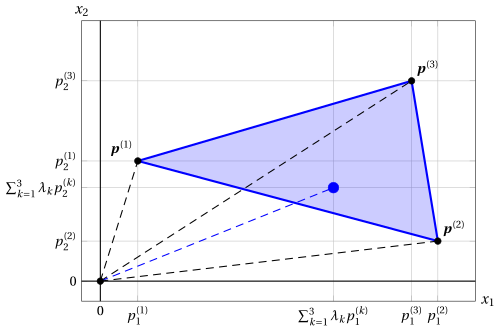
The convex combinations for all valid scalars \(\lambda_1, \lambda_2, \ldots, \lambda_m \ge 0\) are the points in the convex hull of the \(m\) points.
-
In \(\R^2\) with \(m=3\) points, the convex hull is the set of all the points inside (and on the boundary of) the triangle connecting the three points: the blue filled region of the following figure, where the blue point is the convex combination with \(\lambda_1=\frac{1}{3}\), \(\lambda_2=\frac{1}{2}\) and \(\lambda_3=\frac{1}{6}\):
Example 1.2: convex combination of \(3\) points
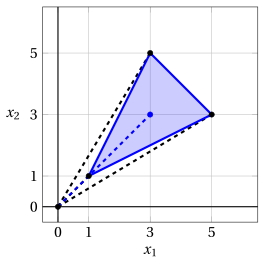
Let us consider the three points \(\begin{pmatrix}1 \\[0.3ex] 1\end{pmatrix}\), \(\begin{pmatrix}5 \\[0.3ex] 3\end{pmatrix}\) and \(\begin{pmatrix}3 \\[0.3ex] 5\end{pmatrix}\) in \(\mathbb{R}^2\). Their convex combination with \(\lambda_1 = \lambda_2 = \lambda_3 = \tfrac{1}{3}\) is the point:
1.2 Convex sets
Definition 1.3: convex set
A set \(A \subseteq \R^n\) is convex if
A subset of the \(n\)-dimensional space is convex if for any of its two points, any convex combination of the two points belongs to the subset. In other words, if all points on the segment that joins any two points of the subset belong to the subset.
- In \(\R^2\) (the 2-dimensional space), an example of a convex set and an example of a non-convex set are given by the following picture, first with curved boundaries:
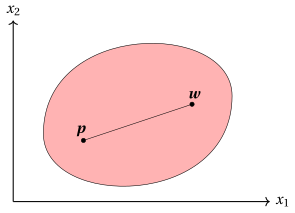
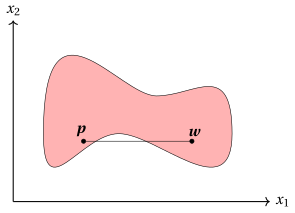
- The same with straight-edged sets: on the left a convex polygon, on the right a non-convex one.
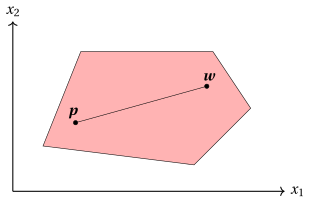
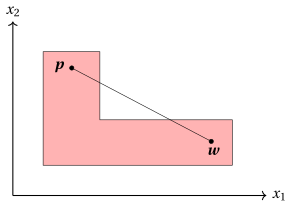
1.3 Examples of convex sets
Observation 1.4
For every vector \(\boldsymbol c \in \mathbb{R}^{n}\) and every scalar \(r \in \mathbb{R}_{>0}\), the set
is convex.
It is the set of points in \(\mathbb{R}^n\) whose sum of absolute deviations from \(\boldsymbol c\) is at most \(r\). In \(\mathbb{R}^2\) this is a diamond (a square rotated by \(45^\circ\)), and in \(\mathbb{R}^3\) it is a regular octahedron.
Proof
For every pair of points \({\boldsymbol p}, {\boldsymbol w}\) in the set and every \(\lambda \in [0,1]\), we have:
Therefore, \(\lambda {\boldsymbol p} + (1-\lambda){\boldsymbol w}\) belongs to the set, and the set is convex. □
Example 1.3: diamond in \(\R^2\)
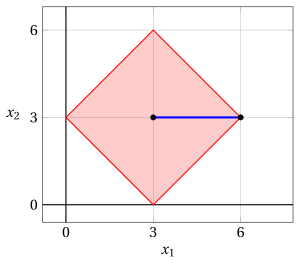
For example, in \(\mathbb{R}^2\), with \(r = 3\) and \({\boldsymbol c} = \begin{pmatrix} 3 \\[0.3ex] 3 \end{pmatrix}\), we have the following convex set:
The points of this set are all those lying inside (and on) the diamond (rotated square) centered at \(\begin{pmatrix} 3 \\[0.3ex] 3 \end{pmatrix}\), with vertices at \(\begin{pmatrix}0\\3\end{pmatrix}\), \(\begin{pmatrix}3\\0\end{pmatrix}\), \(\begin{pmatrix}6\\3\end{pmatrix}\), \(\begin{pmatrix}3\\6\end{pmatrix}\), shown as the red shaded region in the figure below.
Observation 1.5
For every vector \(\boldsymbol c \in \mathbb{R}^{n}\) and every scalar \(r \in \mathbb{R}_{>0}\), the set
is convex.
It is the set of points in \(\mathbb{R}^n\) contained in the closed ball of radius \(r\) centered at \(\boldsymbol c\). In \(\mathbb{R}^2\) this is a disk, and in \(\mathbb{R}^3\) it is a solid ball.
Proof
For every pair of points \({\boldsymbol p}, {\boldsymbol w}\) in the set and every \(\lambda \in [0,1]\), we have:
Therefore, \(\lambda {\boldsymbol p} + (1-\lambda){\boldsymbol w}\) belongs to the set, and the set is convex. □
Example 1.4: closed ball in \(\R^2\)
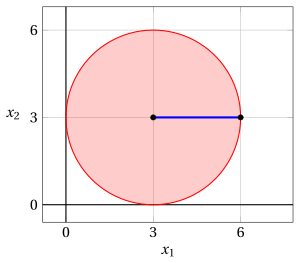
For example, in \(\mathbb{R}^2\), with \(r = 3\) and \({\boldsymbol c} = \begin{pmatrix} 3 \\[0.3ex] 3 \end{pmatrix}\), we have the following convex set:
The points of this set are all those lying inside (and on the boundary of) the disk of radius \(3\) centered at \(\begin{pmatrix} 3 \\[0.3ex] 3 \end{pmatrix}\), shown as the red shaded region in the figure below.
Observation 1.6
For every vector \(\boldsymbol c \in \mathbb{R}^{n}\) and every scalar \(r \in \mathbb{R}_{>0}\), the set
is convex.
It is the set of points in \(\mathbb{R}^n\) whose maximum absolute deviation from \(\boldsymbol c\) is at most \(r\). In \(\mathbb{R}^2\) this is an axis-aligned square of side \(2r\) centered at \(\boldsymbol c\), and in \(\mathbb{R}^3\) it is a cube.
Proof
For every pair of points \({\boldsymbol p}, {\boldsymbol w}\) in the set and every \(\lambda \in [0,1]\), we have:
Therefore, \(\lambda {\boldsymbol p} + (1-\lambda){\boldsymbol w}\) belongs to the set, and the set is convex. □
Example 1.5: square in \(\R^2\)
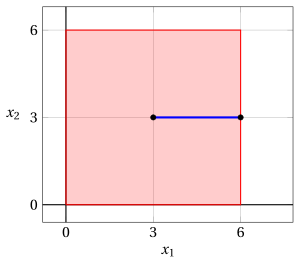
For example, in \(\mathbb{R}^2\), with \(r = 3\) and \({\boldsymbol c} = \begin{pmatrix} 3 \\[0.3ex] 3 \end{pmatrix}\), we have the following convex set:
The points of this set are all those lying inside (and on) the axis-aligned square of side \(6\) centered at \(\begin{pmatrix} 3 \\[0.3ex] 3 \end{pmatrix}\), with vertices at \(\begin{pmatrix}0\\0\end{pmatrix}\), \(\begin{pmatrix}6\\0\end{pmatrix}\), \(\begin{pmatrix}6\\6\end{pmatrix}\), \(\begin{pmatrix}0\\6\end{pmatrix}\), shown as the red shaded region in the figure below.
1.4 Properties of convex sets
Observation 1.7
For every \(m\) convex sets \(A_i \subseteq \mathbb{R}^n\) with \(i \in \{1,2,\dots,m\}\), the set
is convex.
It is the set of points in \(\mathbb{R}^n\) that belong to all the sets \(A_1,A_2,\dots,A_m\) at the same time.
Proof
For every pair of points \({\boldsymbol p}, {\boldsymbol w} \in \bigcap_{i=1}^m A_i\) and every \(\lambda \in [0,1]\), we have:
Therefore, \(\lambda\,{\boldsymbol p}+(1-\lambda)\,{\boldsymbol w} \in \bigcap_{i=1}^m A_i\), and the set is convex. □
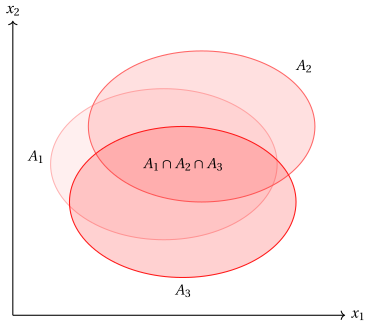
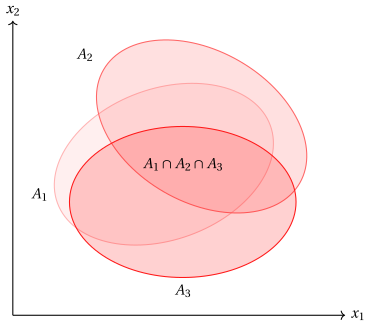
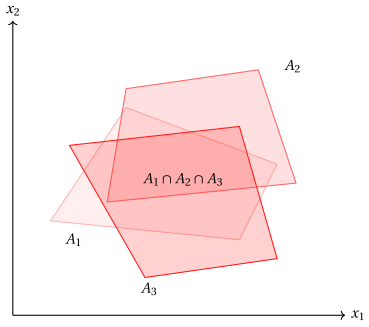
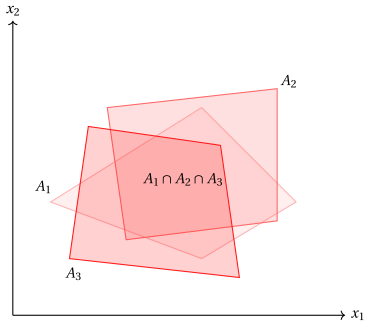
- In \(\R^2\) (the 2-dimensional space), examples of intersection of three convex sets \(A_1,A_2\) and \(A_3\) are given by the following pictures, first with three ellipses:
- The same with three convex quadrilaterals (straight edges, like the polyhedra of linear programming, which are all convex):
Exercises on this chapter: Convex sets
Interactive lab
The ideas of the chapter, hands on: move the sliders and drag the points. All the graphs of the course are in the interactive lab.