Exercises · Functions of several variables
Exercises · Chapter 2 · each solution opens with a click · Chapter 2: Functions of several variables · Exercises, volume 1 (PDF)
Exercise 2.1: Functions of several variables (E1)
Consider the following real-valued function:
Questions
-
Compute the value of the function at the points \(\begin{pmatrix} 1 \\ 1 \end{pmatrix}\) and \(\begin{pmatrix} -1 \\ 2 \end{pmatrix}\).
-
Compute the gradient of the function and evaluate it at the two points.
-
Compute the Hessian of the function and evaluate it at the two points.
Solution
-
Substituting the coordinates of the points:
\[\begin{align*} f\left(\begin{pmatrix} 1 \\ 1 \end{pmatrix}\right) &= 1^3 + 2 \cdot 1 \cdot 1^2 - 3 \cdot 1 = 1 + 2 - 3 = 0 \\[2ex] f\left(\begin{pmatrix} -1 \\ 2 \end{pmatrix}\right) &= (-1)^3 + 2 \cdot (-1) \cdot 2^2 - 3 \cdot 2 = -1 - 8 - 6 = -15 \end{align*}\] -
The partial derivatives are \(\frac{\partial f(\boldsymbol x)}{\partial x_1} = 3\,x_1^2 + 2\,x_2^2\) and \(\frac{\partial f(\boldsymbol x)}{\partial x_2} = 4\,x_1 x_2 - 3\), so the gradient is:
\[ \nabla f\left(\begin{pmatrix} x_1 \\ x_2 \end{pmatrix}\right) = \begin{pmatrix} 3\,x_1^2 + 2\,x_2^2 \\[1ex] 4\,x_1 x_2 - 3 \end{pmatrix} \]At the two points:
\[ \nabla f\left(\begin{pmatrix} 1 \\ 1 \end{pmatrix}\right) = \begin{pmatrix} 3 + 2 \\ 4 - 3 \end{pmatrix} = \begin{pmatrix} 5 \\ 1 \end{pmatrix}, \qquad \nabla f\left(\begin{pmatrix} -1 \\ 2 \end{pmatrix}\right) = \begin{pmatrix} 3 + 8 \\ -8 - 3 \end{pmatrix} = \begin{pmatrix} 11 \\ -11 \end{pmatrix} \] -
Differentiating the two partial derivatives once more:
\[ \nabla^2 f\left(\begin{pmatrix} x_1 \\ x_2 \end{pmatrix}\right) = \begin{pmatrix} 6\,x_1 & 4\,x_2 \\[1ex] 4\,x_2 & 4\,x_1 \end{pmatrix} \]which is a symmetric matrix depending on the point. At the two points:
\[ \nabla^2 f\left(\begin{pmatrix} 1 \\ 1 \end{pmatrix}\right) = \begin{pmatrix} 6 & 4 \\ 4 & 4 \end{pmatrix}, \qquad \nabla^2 f\left(\begin{pmatrix} -1 \\ 2 \end{pmatrix}\right) = \begin{pmatrix} -6 & 8 \\ 8 & -4 \end{pmatrix} \]
Exercise 2.2: Functions of several variables (E2)
Consider the following real-valued function:
Questions
-
Show that \(f({\boldsymbol x}) = (x_1^2 - x_2)^2\).
-
Compute the gradient and the Hessian of the function.
-
Evaluate the gradient and the Hessian at the points \(\begin{pmatrix} 1 \\ 1 \end{pmatrix}\) and \(\begin{pmatrix} 1 \\ 0 \end{pmatrix}\).
-
Find all the points at which the gradient is the zero vector, and the value of the function at these points.
Solution
-
Expanding the square:
\[ (x_1^2 - x_2)^2 = x_1^4 - 2\,x_1^2 x_2 + x_2^2 = f({\boldsymbol x}) \] -
The partial derivatives are \(\frac{\partial f(\boldsymbol x)}{\partial x_1} = 4\,x_1^3 - 4\,x_1 x_2\) and \(\frac{\partial f(\boldsymbol x)}{\partial x_2} = -2\,x_1^2 + 2\,x_2\), so:
\[ \nabla f\left(\begin{pmatrix} x_1 \\ x_2 \end{pmatrix}\right) = \begin{pmatrix} 4\,x_1^3 - 4\,x_1 x_2 \\[1ex] -2\,x_1^2 + 2\,x_2 \end{pmatrix} = \begin{pmatrix} 4\,x_1\,(x_1^2 - x_2) \\[1ex] -2\,(x_1^2 - x_2) \end{pmatrix} \]and
\[ \nabla^2 f\left(\begin{pmatrix} x_1 \\ x_2 \end{pmatrix}\right) = \begin{pmatrix} 12\,x_1^2 - 4\,x_2 & -4\,x_1 \\[1ex] -4\,x_1 & 2 \end{pmatrix} \] -
At the point \(\begin{pmatrix} 1 \\ 1 \end{pmatrix}\) we have \(x_1^2 - x_2 = 0\), and:
\[ \nabla f\left(\begin{pmatrix} 1 \\ 1 \end{pmatrix}\right) = \begin{pmatrix} 0 \\ 0 \end{pmatrix}, \qquad \nabla^2 f\left(\begin{pmatrix} 1 \\ 1 \end{pmatrix}\right) = \begin{pmatrix} 12 - 4 & -4 \\ -4 & 2 \end{pmatrix} = \begin{pmatrix} 8 & -4 \\ -4 & 2 \end{pmatrix} \]At the point \(\begin{pmatrix} 1 \\ 0 \end{pmatrix}\) we have \(x_1^2 - x_2 = 1\), and:
\[ \nabla f\left(\begin{pmatrix} 1 \\ 0 \end{pmatrix}\right) = \begin{pmatrix} 4 \cdot 1 \cdot 1 \\ -2 \cdot 1 \end{pmatrix} = \begin{pmatrix} 4 \\ -2 \end{pmatrix}, \qquad \nabla^2 f\left(\begin{pmatrix} 1 \\ 0 \end{pmatrix}\right) = \begin{pmatrix} 12 & -4 \\ -4 & 2 \end{pmatrix} \] -
The second component of the gradient is zero if and only if \(x_2 = x_1^2\), and in this case also the first component \(4\,x_1\,(x_1^2 - x_2)\) is zero. Therefore, the gradient is the zero vector at all the points of the parabola:
\[ \left\{~\begin{pmatrix} x_1 \\ x_2 \end{pmatrix} \in \R^2:~ x_2 = x_1^2 ~\right\} \](for example \(\begin{pmatrix} 0 \\ 0 \end{pmatrix}\), \(\begin{pmatrix} 1 \\ 1 \end{pmatrix}\) and \(\begin{pmatrix} -1 \\ 1 \end{pmatrix}\)), which is an infinite set of points. At all these points the value of the function is \(f({\boldsymbol x}) = (x_1^2 - x_2)^2 = 0\): this parabola is the level set \(L(0)\) of the function.
Exercise 2.3: Functions of several variables (E3)
Consider the following real-valued function of three variables:
Questions
-
Compute the value of the function at the points \(\begin{pmatrix} 1 \\ 0 \\ 2 \end{pmatrix}\) and \(\begin{pmatrix} 0 \\ 1 \\ -1 \end{pmatrix}\).
-
Compute the gradient of the function and evaluate it at the two points.
-
Compute the Hessian of the function and evaluate it at the two points.
Solution
-
Substituting the coordinates of the points:
\[\begin{align*} f\left(\begin{pmatrix} 1 \\ 0 \\ 2 \end{pmatrix}\right) &= 1^2 \cdot 2 + 0 \cdot 2^2 - 2 \cdot 1 \cdot 0 + 2 = 2 + 0 - 0 + 2 = 4 \\[2ex] f\left(\begin{pmatrix} 0 \\ 1 \\ -1 \end{pmatrix}\right) &= 0^2 \cdot (-1) + 1 \cdot (-1)^2 - 2 \cdot 0 \cdot 1 + (-1) = 0 + 1 - 0 - 1 = 0 \end{align*}\] -
The three partial derivatives are:
\[ \frac{\partial f(\boldsymbol x)}{\partial x_1} = 2\,x_1 x_3 - 2\,x_2, \qquad \frac{\partial f(\boldsymbol x)}{\partial x_2} = x_3^2 - 2\,x_1, \qquad \frac{\partial f(\boldsymbol x)}{\partial x_3} = x_1^2 + 2\,x_2 x_3 + 1 \]so the gradient is:
\[ \nabla f\left(\begin{pmatrix} x_1 \\ x_2 \\ x_3 \end{pmatrix}\right) = \begin{pmatrix} 2\,x_1 x_3 - 2\,x_2 \\[1ex] x_3^2 - 2\,x_1 \\[1ex] x_1^2 + 2\,x_2 x_3 + 1 \end{pmatrix} \]At the two points:
\[ \nabla f\left(\begin{pmatrix} 1 \\ 0 \\ 2 \end{pmatrix}\right) = \begin{pmatrix} 4 - 0 \\ 4 - 2 \\ 1 + 0 + 1 \end{pmatrix} = \begin{pmatrix} 4 \\ 2 \\ 2 \end{pmatrix}, \qquad \nabla f\left(\begin{pmatrix} 0 \\ 1 \\ -1 \end{pmatrix}\right) = \begin{pmatrix} 0 - 2 \\ 1 - 0 \\ 0 - 2 + 1 \end{pmatrix} = \begin{pmatrix} -2 \\ 1 \\ -1 \end{pmatrix} \] -
Differentiating each partial derivative with respect to \(x_1\), \(x_2\) and \(x_3\):
\[ \nabla^2 f\left(\begin{pmatrix} x_1 \\ x_2 \\ x_3 \end{pmatrix}\right) = \begin{pmatrix} 2\,x_3 & -2 & 2\,x_1 \\[1ex] -2 & 0 & 2\,x_3 \\[1ex] 2\,x_1 & 2\,x_3 & 2\,x_2 \end{pmatrix} \]which is a symmetric matrix depending on the point. At the two points:
\[ \nabla^2 f\left(\begin{pmatrix} 1 \\ 0 \\ 2 \end{pmatrix}\right) = \begin{pmatrix} 4 & -2 & 2 \\ -2 & 0 & 4 \\ 2 & 4 & 0 \end{pmatrix}, \qquad \nabla^2 f\left(\begin{pmatrix} 0 \\ 1 \\ -1 \end{pmatrix}\right) = \begin{pmatrix} -2 & -2 & 0 \\ -2 & 0 & -2 \\ 0 & -2 & 2 \end{pmatrix} \]
Exercise 2.4: Functions of several variables (E4)
Consider the following real-valued function:
Questions
-
Compute the gradient and the Hessian of the function.
-
Describe the level sets \(L(k)\) of the function for every \(k \in \R\).
-
Evaluate the gradient at the point \(\begin{pmatrix} 1 \\ 1 \end{pmatrix}\) of the level set \(L(0)\) and at the point \(\begin{pmatrix} 0 \\ 2 \end{pmatrix}\) of the level set \(L(2)\).
-
Draw the level sets \(L(0)\) and \(L(2)\) and the two gradients of the previous question, and verify that each gradient is perpendicular to the level set through its point.
Solution
-
The partial derivatives are \(\frac{\partial f(\boldsymbol x)}{\partial x_1} = -2\,x_1\) and \(\frac{\partial f(\boldsymbol x)}{\partial x_2} = 1\), so:
\[ \nabla f\left(\begin{pmatrix} x_1 \\ x_2 \end{pmatrix}\right) = \begin{pmatrix} -2\,x_1 \\[1ex] 1 \end{pmatrix}, \qquad \nabla^2 f\left(\begin{pmatrix} x_1 \\ x_2 \end{pmatrix}\right) = \begin{pmatrix} -2 & 0 \\[1ex] 0 & 0 \end{pmatrix} \]The Hessian is constant. The second component of the gradient is always \(1\), so the gradient is never the zero vector.
-
For every \(k \in \R\):
\[ L(k) = \left\{~\begin{pmatrix} x_1 \\ x_2 \end{pmatrix} \in \R^2:~ x_2 - x_1^2 = k ~\right\} = \left\{~\begin{pmatrix} x_1 \\ x_2 \end{pmatrix} \in \R^2:~ x_2 = x_1^2 + k ~\right\} \]Every level set is a parabola with vertex \(\begin{pmatrix} 0 \\ k \end{pmatrix}\), obtained by translating the parabola \(x_2 = x_1^2\) vertically by \(k\).
-
The point \(\begin{pmatrix} 1 \\ 1 \end{pmatrix}\) belongs to \(L(0)\) since \(1 - 1^2 = 0\), and the point \(\begin{pmatrix} 0 \\ 2 \end{pmatrix}\) belongs to \(L(2)\) since \(2 - 0^2 = 2\). The gradients are:
\[ \nabla f\left(\begin{pmatrix} 1 \\ 1 \end{pmatrix}\right) = \begin{pmatrix} -2 \\ 1 \end{pmatrix}, \qquad \nabla f\left(\begin{pmatrix} 0 \\ 2 \end{pmatrix}\right) = \begin{pmatrix} 0 \\ 1 \end{pmatrix} \] -
We draw the two level sets with the gradients, and then we verify the perpendicularity with the tangent directions.
Graphical solution: the figure shows the level sets \(L(0)\) (in blue) and \(L(2)\) (in orange) and the two gradients (in red), drawn from their points:
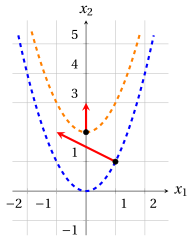
The tangent direction of a level set \(x_2 = x_1^2 + k\) at a point with first coordinate \(x_1\) is \(\begin{pmatrix} 1 \\ 2\,x_1 \end{pmatrix}\) (the derivative of \(x_1^2 + k\) is \(2\,x_1\)):
-
at \(\begin{pmatrix} 1 \\ 1 \end{pmatrix}\) the tangent direction is \(\begin{pmatrix} 1 \\ 2 \end{pmatrix}\) and \(\begin{pmatrix} -2 & 1 \end{pmatrix} \begin{pmatrix} 1 \\ 2 \end{pmatrix} = -2 + 2 = 0\);
-
at \(\begin{pmatrix} 0 \\ 2 \end{pmatrix}\) the tangent direction is \(\begin{pmatrix} 1 \\ 0 \end{pmatrix}\) and \(\begin{pmatrix} 0 & 1 \end{pmatrix} \begin{pmatrix} 1 \\ 0 \end{pmatrix} = 0\).
Therefore, both gradients are perpendicular to the level set through their point, and they point toward the level sets with larger values of \(k\).
-