Exercises · Convex sets
Exercises · Chapter 1 · each solution opens with a click · Chapter 1: Convex sets · Exercises, volume 1 (PDF)
Exercise 1.1: Convex sets (E1)
Consider the following two points in \(\R^2\):
and the following three points in \(\R^2\):
Questions
-
Compute the convex combinations of \({\boldsymbol p}\) and \({\boldsymbol w}\) with \(\lambda = \frac{1}{3}\), \(\lambda=\frac{1}{2}\) and \(\lambda=\frac{2}{3}\).
-
Draw the points \({\boldsymbol p}\) and \({\boldsymbol w}\), the three convex combinations and the set of all convex combinations of \({\boldsymbol p}\) and \({\boldsymbol w}\).
-
Determine which of the points \({\boldsymbol q}^{(1)}\), \({\boldsymbol q}^{(2)}\) and \({\boldsymbol q}^{(3)}\) are convex combinations of \({\boldsymbol p}\) and \({\boldsymbol w}\).
Solution
-
For every \(\lambda \in [0,1]\), the convex combination of \({\boldsymbol p}\) and \({\boldsymbol w}\) with the scalar \(\lambda\) is the point:
\[ \lambda \begin{pmatrix} 1 \\[0.3ex] 4 \end{pmatrix} + (1-\lambda) \begin{pmatrix} 7 \\[0.3ex] 1 \end{pmatrix} = \begin{pmatrix} \lambda + 7 - 7\lambda \\[0.3ex] 4\lambda + 1 - \lambda \end{pmatrix} = \begin{pmatrix} 7 - 6\lambda \\[0.3ex] 1 + 3\lambda \end{pmatrix}. \]Therefore, we have:
\[\begin{align*} \lambda = \frac{1}{3}: &\qquad \begin{pmatrix} \frac{1}{3}\cdot 1 + \frac{2}{3}\cdot 7 \\[1.2ex] \frac{1}{3}\cdot 4 + \frac{2}{3}\cdot 1 \end{pmatrix} = \begin{pmatrix} 5 \\[0.3ex] 2 \end{pmatrix}\\[2ex] \lambda = \frac{1}{2}: &\qquad \begin{pmatrix} \frac{1}{2}\cdot 1 + \frac{1}{2}\cdot 7 \\[1.2ex] \frac{1}{2}\cdot 4 + \frac{1}{2}\cdot 1 \end{pmatrix} = \begin{pmatrix} 4 \\[0.3ex] \frac{5}{2} \end{pmatrix}\\[2ex] \lambda = \frac{2}{3}: &\qquad \begin{pmatrix} \frac{2}{3}\cdot 1 + \frac{1}{3}\cdot 7 \\[1.2ex] \frac{2}{3}\cdot 4 + \frac{1}{3}\cdot 1 \end{pmatrix} = \begin{pmatrix} 3 \\[0.3ex] 3 \end{pmatrix} \end{align*}\] -
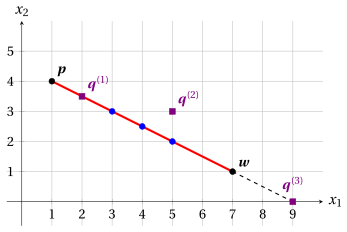
The set of all convex combinations of \({\boldsymbol p}\) and \({\boldsymbol w}\) is the segment joining the two points (red). The three convex combinations of the previous question are the blue points: with \(\lambda=\frac{1}{3}\) the point is closer to \({\boldsymbol w}\), with \(\lambda=\frac{2}{3}\) it is closer to \({\boldsymbol p}\).
-
A point \({\boldsymbol q} \in \R^2\) is a convex combination of \({\boldsymbol p}\) and \({\boldsymbol w}\) if and only if there exists \(\lambda \in [0,1]\) such that
\[ \begin{pmatrix} 7 - 6\lambda \\[0.3ex] 1 + 3\lambda \end{pmatrix} = \begin{pmatrix} q_1 \\[0.3ex] q_2 \end{pmatrix}. \]The first equation gives \(\lambda = \frac{7-q_1}{6}\); then we check the second equation and the condition \(\lambda \in [0,1]\).
-
For \({\boldsymbol q}^{(1)}\), the first equation gives \(\lambda = \frac{7-2}{6}=\frac{5}{6}\) and the second equation holds: \(1 + 3 \cdot \frac{5}{6} = \frac{7}{2}\). Since \(\frac{5}{6} \in [0,1]\), the point \({\boldsymbol q}^{(1)}\) is the convex combination of \({\boldsymbol p}\) and \({\boldsymbol w}\) with \(\lambda = \frac{5}{6}\).
-
For \({\boldsymbol q}^{(2)}\), the first equation gives \(\lambda = \frac{7-5}{6}=\frac{1}{3}\), but \(1 + 3 \cdot \frac{1}{3} = 2 \neq 3\). The point \({\boldsymbol q}^{(2)}\) is not even on the line through \({\boldsymbol p}\) and \({\boldsymbol w}\): it is not a convex combination of \({\boldsymbol p}\) and \({\boldsymbol w}\).
-
For \({\boldsymbol q}^{(3)}\), the first equation gives \(\lambda = \frac{7-9}{6}=-\frac{1}{3}\) and the second equation holds: \(1 + 3 \cdot \big(-\frac{1}{3}\big) = 0\). The point \({\boldsymbol q}^{(3)}\) is on the line through \({\boldsymbol p}\) and \({\boldsymbol w}\) (dashed in the figure), but \(-\frac{1}{3} \notin [0,1]\): it is not a convex combination of \({\boldsymbol p}\) and \({\boldsymbol w}\).
-
Exercise 1.2: Convex sets (E2)
Consider the following three points in \(\R^2\):
and the following two points in \(\R^2\):
Questions
-
Compute the convex combination of \({\boldsymbol p}^{(1)}\), \({\boldsymbol p}^{(2)}\) and \({\boldsymbol p}^{(3)}\) with \(\lambda_1 = \frac{1}{2}\), \(\lambda_2=\frac{1}{4}\) and \(\lambda_3=\frac{1}{4}\).
-
Compute the convex combination of \({\boldsymbol p}^{(1)}\), \({\boldsymbol p}^{(2)}\) and \({\boldsymbol p}^{(3)}\) with \(\lambda_1 = \lambda_2=\lambda_3=\frac{1}{3}\).
-
Show that \({\boldsymbol q}^{(1)}\) is a convex combination of \({\boldsymbol p}^{(1)}\), \({\boldsymbol p}^{(2)}\) and \({\boldsymbol p}^{(3)}\), and find the scalars.
-
Show that \({\boldsymbol q}^{(2)}\) is not a convex combination of \({\boldsymbol p}^{(1)}\), \({\boldsymbol p}^{(2)}\) and \({\boldsymbol p}^{(3)}\).
-
Draw the convex hull of \({\boldsymbol p}^{(1)}\), \({\boldsymbol p}^{(2)}\) and \({\boldsymbol p}^{(3)}\) and all the points of the previous questions.
Solution
-
The convex combination with \(\lambda_1 = \frac{1}{2}\), \(\lambda_2=\frac{1}{4}\) and \(\lambda_3=\frac{1}{4}\) (non-negative scalars with sum \(1\)) is the point:
\[ \frac{1}{2}\begin{pmatrix} 1 \\[0.3ex] 1 \end{pmatrix} +\frac{1}{4}\begin{pmatrix} 7 \\[0.3ex] 2 \end{pmatrix} +\frac{1}{4}\begin{pmatrix} 3 \\[0.3ex] 6 \end{pmatrix} = \begin{pmatrix} \frac{1}{2}+\frac{7}{4}+\frac{3}{4} \\[1.2ex] \frac{1}{2}+\frac{1}{2}+\frac{3}{2} \end{pmatrix} = \begin{pmatrix} 3 \\[0.3ex] \frac{5}{2} \end{pmatrix}. \] -
The convex combination with \(\lambda_1 = \lambda_2=\lambda_3=\frac{1}{3}\) (non-negative scalars with sum \(1\)) is the point:
\[ \frac{1}{3}\begin{pmatrix} 1 \\[0.3ex] 1 \end{pmatrix} +\frac{1}{3}\begin{pmatrix} 7 \\[0.3ex] 2 \end{pmatrix} +\frac{1}{3}\begin{pmatrix} 3 \\[0.3ex] 6 \end{pmatrix} = \begin{pmatrix} \frac{1+7+3}{3} \\[1.2ex] \frac{1+2+6}{3} \end{pmatrix} = \begin{pmatrix} \frac{11}{3} \\[0.6ex] 3 \end{pmatrix}. \] -
A point \({\boldsymbol q} \in \R^2\) is a convex combination of the three points if and only if there exist \(\lambda_1,\lambda_2,\lambda_3 \ge 0\) such that
\[ \left\{ \begin{array}{rcl} \lambda_1 + \lambda_2 + \lambda_3 & = & 1\\[1ex] \lambda_1 + 7\,\lambda_2 + 3\,\lambda_3 & = & q_1\\[1ex] \lambda_1 + 2\,\lambda_2 + 6\,\lambda_3 & = & q_2 \end{array} \right. \]Substituting \(\lambda_1 = 1 - \lambda_2 - \lambda_3\) in the last two equations, we obtain the system
\[ \left\{ \begin{array}{rcl} 6\,\lambda_2 + 2\,\lambda_3 & = & q_1 - 1\\[1ex] \lambda_2 + 5\,\lambda_3 & = & q_2 - 1 \end{array} \right. \]whose determinant is \(6 \cdot 5 - 2 \cdot 1 = 28 \neq 0\): the scalars are unique. For \({\boldsymbol q}^{(1)}\) we have \(q_1 - 1 = 2\) and \(q_2 - 1 = 3\), hence
\[ \lambda_2 = \frac{2 \cdot 5 - 2 \cdot 3}{28} = \frac{1}{7}, \qquad \lambda_3 = \frac{6 \cdot 3 - 2 \cdot 1}{28} = \frac{4}{7}, \qquad \lambda_1 = 1 - \frac{1}{7} - \frac{4}{7} = \frac{2}{7}. \]The three scalars are non-negative and their sum is \(1\), so \({\boldsymbol q}^{(1)}\) is a convex combination of the three points:
\[ \frac{2}{7}\begin{pmatrix} 1 \\[0.3ex] 1 \end{pmatrix} +\frac{1}{7}\begin{pmatrix} 7 \\[0.3ex] 2 \end{pmatrix} +\frac{4}{7}\begin{pmatrix} 3 \\[0.3ex] 6 \end{pmatrix} = \begin{pmatrix} \frac{2+7+12}{7} \\[1.2ex] \frac{2+2+24}{7} \end{pmatrix} = \begin{pmatrix} 3 \\[0.3ex] 4 \end{pmatrix}. \] -
For \({\boldsymbol q}^{(2)}\) we have \(q_1 - 1 = 5\) and \(q_2 - 1 = 4\), hence
\[ \lambda_2 = \frac{5 \cdot 5 - 2 \cdot 4}{28} = \frac{17}{28}, \qquad \lambda_3 = \frac{6 \cdot 4 - 5 \cdot 1}{28} = \frac{19}{28}, \qquad \lambda_1 = 1 - \frac{17}{28} - \frac{19}{28} = -\frac{2}{7}. \]These are the only scalars with sum \(1\) that give \({\boldsymbol q}^{(2)}\), and \(\lambda_1 < 0\): the point \({\boldsymbol q}^{(2)}\) is not a convex combination of the three points.
-
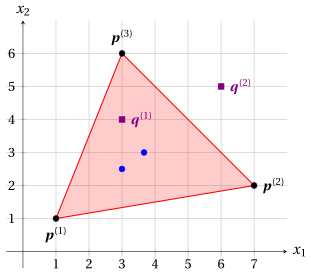
The convex hull of the three points is the triangle with vertices \({\boldsymbol p}^{(1)}\), \({\boldsymbol p}^{(2)}\) and \({\boldsymbol p}^{(3)}\) (red). The points of the first two questions are blue, \({\boldsymbol q}^{(1)}\) (inside the triangle) and \({\boldsymbol q}^{(2)}\) (outside the triangle) are violet.
Exercise 1.3: Convex sets (E3)
Consider the following set:
and the following two points in \(F\) and scalar:
Questions
-
Prove that \(F\) is a convex set.
-
Find the vertices of \(F\) and draw the set.
-
Compute the convex combination of \({\boldsymbol q}^{(1)}\) and \({\boldsymbol q}^{(2)}\) with the scalar \(\lambda\) and verify that it belongs to \(F\).
Solution
-
Each of the four inequalities that define \(F\) has the form \(a_1\,x_1 + a_2\,x_2 \le b\), with
\[ (a_1,a_2,b) \in \big\{\,(1,2,8),~(3,1,9),~(-1,0,0),~(0,-1,0)\,\big\} \](the last two are \(x_1 \ge 0\) and \(x_2 \ge 0\)). For every pair of points \({\boldsymbol p}, {\boldsymbol w} \in F\) and every \(\lambda \in [0,1]\), for each of the four inequalities we have:
\[\begin{align*} & a_1\,\big(\lambda p_1 + (1-\lambda) w_1\big) + a_2\,\big(\lambda p_2 + (1-\lambda) w_2\big) \\[2ex] &\quad = \lambda\,(a_1\,p_1 + a_2\,p_2) + (1-\lambda)\,(a_1\,w_1 + a_2\,w_2) \\[2ex] &\quad \le \lambda\, b + (1-\lambda)\, b \\[1ex] &\qquad\quad (\text{since } {\boldsymbol p}, {\boldsymbol w} \in F,~ \lambda \ge 0 \text{ and } 1-\lambda \ge 0)\\[2ex] &\quad = b \end{align*}\]Therefore, \(\lambda {\boldsymbol p} + (1-\lambda){\boldsymbol w} \in F\), and the set is convex.
The same computation shows that each of the four sets defined by one inequality (a half-plane) is convex: \(F\) is their intersection, which is convex since the intersection of convex sets is convex (chapter «Convex sets»).
-
The vertices of \(F\) are the origin, the points where the lines \(x_1 + 2\,x_2 = 8\) and \(3\,x_1 + x_2 = 9\) meet the axes inside \(F\), namely \(\begin{pmatrix} 0 \\[0.3ex] 4 \end{pmatrix}\) and \(\begin{pmatrix} 3 \\[0.3ex] 0 \end{pmatrix}\), and the intersection point of the two lines:
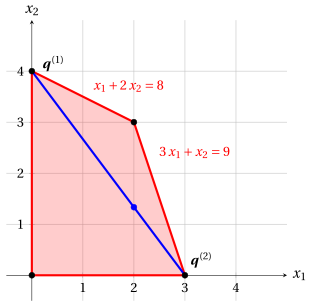
\[\begin{equation*} \left\{ \begin{array}{ll} x_1 + 2\,x_2 & = 8\\[2ex] 3\,x_1 + x_2 & = 9 \end{array} \right. ~~\Longrightarrow~~ \begin{pmatrix} x_1 \\[0.5ex] x_2 \end{pmatrix} = \begin{pmatrix} \frac{8 \cdot 1 - 2 \cdot 9}{1 \cdot 1 - 2 \cdot 3} \\[2ex] \frac{1 \cdot 9 - 8 \cdot 3}{1 \cdot 1 - 2 \cdot 3} \end{pmatrix} = \begin{pmatrix} 2 \\[0.5ex] 3 \end{pmatrix} \end{equation*}\]The set \(F\) is the quadrilateral with vertices \(\begin{pmatrix} 0 \\[0.3ex] 0 \end{pmatrix}\), \(\begin{pmatrix} 3 \\[0.3ex] 0 \end{pmatrix}\), \(\begin{pmatrix} 2 \\[0.3ex] 3 \end{pmatrix}\) and \(\begin{pmatrix} 0 \\[0.3ex] 4 \end{pmatrix}\) (red). The figure also shows the segment joining \({\boldsymbol q}^{(1)}\) and \({\boldsymbol q}^{(2)}\) (blue) and the convex combination of the next question.
-
The convex combination of \({\boldsymbol q}^{(1)}\) and \({\boldsymbol q}^{(2)}\) with \(\lambda = \frac{1}{3}\) is the point:
\[ \frac{1}{3}\begin{pmatrix} 0 \\[0.3ex] 4 \end{pmatrix} + \frac{2}{3}\begin{pmatrix} 3 \\[0.3ex] 0 \end{pmatrix} = \begin{pmatrix} 2 \\[0.3ex] \frac{4}{3} \end{pmatrix}. \]It belongs to \(F\), as guaranteed by the first question:
\[ 2 + 2 \cdot \frac{4}{3} = \frac{14}{3} \le 8, \qquad 3 \cdot 2 + \frac{4}{3} = \frac{22}{3} \le 9, \qquad 2 \ge 0, \qquad \frac{4}{3} \ge 0. \]
Exercise 1.4: Convex sets (E4)
Consider the following symmetric matrix
and the following set:
Questions
-
Show that \({\boldsymbol x}' \, {\boldsymbol Q} \, {\boldsymbol x} = x_1^2 + (x_1 - x_2)^2 + x_2^2\) for every \({\boldsymbol x} \in \R^2\).
-
Prove that \(F\) is a convex set.
-
Determine whether the points \(\begin{pmatrix} \frac{1}{2} \\[0.6ex] \frac{1}{2} \end{pmatrix}\) and \(\begin{pmatrix} \frac{1}{2} \\[0.6ex] -\frac{1}{2} \end{pmatrix}\) belong to \(F\).
-
Draw the set \(F\).
Solution
-
For every \({\boldsymbol x} \in \R^2\) we have:
\[\begin{align*} & \begin{pmatrix} x_1 & x_2 \end{pmatrix} \begin{pmatrix} 2 & -1 \\[1ex] -1 & 2 \end{pmatrix} \begin{pmatrix} x_1 \\[1ex] x_2 \end{pmatrix} \\[2ex] &\quad = (2\,x_1-x_2)\,x_1 + (-x_1+2\,x_2)\, x_2 \\[2ex] &\quad = 2\,x_1^2 - 2\,x_1\,x_2 + 2\,x_2^2 \\[2ex] &\quad = x_1^2+ \big(x_1^2 - 2\,x_1\,x_2 + x_2^2\big) + x_2^2 \\[2ex] &\quad = x_1^2 + (x_1-x_2)^2 + x_2^2 . \end{align*}\]Therefore, for every \({\boldsymbol x} \in \R^2\), the number \(\sqrt{{\boldsymbol x}' \, {\boldsymbol Q} \, {\boldsymbol x}}\) is the Euclidean norm of a vector of \(\R^3\):
\[ \sqrt{{\boldsymbol x}' \, {\boldsymbol Q} \, {\boldsymbol x}} = \big\| {\boldsymbol u}({\boldsymbol x}) \big\|_2, \qquad \text{where} \qquad {\boldsymbol u}({\boldsymbol x}) = \begin{pmatrix} x_1 \\[0.3ex] x_1 - x_2 \\[0.3ex] x_2 \end{pmatrix} \in \R^3 . \]The vector \({\boldsymbol u}({\boldsymbol x})\) depends linearly on \({\boldsymbol x}\): for every \({\boldsymbol p}, {\boldsymbol w} \in \R^2\) and every \(\lambda \in [0,1]\), we have \({\boldsymbol u}\big(\lambda {\boldsymbol p} + (1-\lambda){\boldsymbol w}\big) = \lambda\, {\boldsymbol u}({\boldsymbol p}) + (1-\lambda)\, {\boldsymbol u}({\boldsymbol w})\).
-
For every pair of points \({\boldsymbol p}, {\boldsymbol w} \in F\) and every \(\lambda \in [0,1]\), we have:
\[\begin{align*} & \sqrt{\big(\lambda {\boldsymbol p} + (1-\lambda){\boldsymbol w}\big)' \, {\boldsymbol Q} \, \big(\lambda {\boldsymbol p} + (1-\lambda){\boldsymbol w}\big)} \\[2ex] &\quad = \big\| \lambda\, {\boldsymbol u}({\boldsymbol p}) + (1-\lambda)\, {\boldsymbol u}({\boldsymbol w}) \big\|_2 \\[1ex] &\qquad\quad \text{(by the first question)}\\[2ex] &\quad \le \big\| \lambda\, {\boldsymbol u}({\boldsymbol p}) \big\|_2 + \big\| (1-\lambda)\, {\boldsymbol u}({\boldsymbol w}) \big\|_2 \\[1ex] &\qquad\quad \text{(by the triangle inequality)}\\[2ex] &\quad = |\lambda| \; \| {\boldsymbol u}({\boldsymbol p}) \|_2 + |1-\lambda| \; \| {\boldsymbol u}({\boldsymbol w}) \|_2 \\[1ex] &\qquad\quad \text{(by the absolute homogeneity)}\\[2ex] &\quad = \lambda \; \| {\boldsymbol u}({\boldsymbol p}) \|_2 + (1-\lambda) \; \| {\boldsymbol u}({\boldsymbol w}) \|_2 \\[1ex] &\qquad\quad (\text{since } \lambda \ge 0 \text{ and } 1-\lambda \ge 0)\\[2ex] &\quad = \lambda \, \sqrt{{\boldsymbol p}' \, {\boldsymbol Q} \, {\boldsymbol p}} + (1-\lambda) \, \sqrt{{\boldsymbol w}' \, {\boldsymbol Q} \, {\boldsymbol w}} \\[1ex] &\qquad\quad \text{(by the first question)}\\[2ex] &\quad \le \lambda \cdot 1 + (1-\lambda) \cdot 1 \\[1ex] &\qquad\quad (\text{since } {\boldsymbol p}, {\boldsymbol w} \in F,~ \lambda \ge 0 \text{ and } 1-\lambda \ge 0)\\[2ex] &\quad = 1 \end{align*}\]Therefore, \(\lambda {\boldsymbol p} + (1-\lambda){\boldsymbol w} \in F\), and the set is convex.
-
We have:
\[\begin{align*} \begin{pmatrix} \frac{1}{2} \\[0.6ex] \frac{1}{2} \end{pmatrix}:&\qquad \left(\frac{1}{2}\right)^2 + \left(\frac{1}{2} - \frac{1}{2}\right)^2 + \left(\frac{1}{2}\right)^2 = \frac{1}{2} \le 1 \quad \Longrightarrow \quad \text{it is in } F, \\[2ex] \begin{pmatrix} \frac{1}{2} \\[0.6ex] -\frac{1}{2} \end{pmatrix}:&\qquad \left(\frac{1}{2}\right)^2 + \left(\frac{1}{2} + \frac{1}{2}\right)^2 + \left(-\frac{1}{2}\right)^2 = \frac{3}{2} > 1 \quad \Longrightarrow \quad \text{it is not in } F. \end{align*}\](Since the square root is increasing, \(\sqrt{{\boldsymbol x}' \, {\boldsymbol Q} \, {\boldsymbol x}} \le 1\) if and only if \({\boldsymbol x}' \, {\boldsymbol Q} \, {\boldsymbol x} \le 1\).)
-
The boundary of \(F\) is given by the points with
\[ 2\,x_1^2 - 2\,x_1\,x_2 + 2\,x_2^2 = 1. \]We express \(x_2\) as a function of \(x_1\). Writing the previous equation as
\[ 2\,x_2^2 - 2\,x_1\,x_2 + (2\,x_1^2-1)=0, \]with \(a=2\), \(b=- 2\,x_1\) and \(c=2\,x_1^2-1\) we have \(x_2= \frac{-b \pm \sqrt{b^2 - 4 a c}}{2 a}\), hence:
\[\begin{align*} x_2 &= \frac{2\,x_1 \pm \sqrt{ 4\,x_1^2 - 8\,\big(2\,x_1^2-1\big)}}{4} = \frac{ 2\,x_1 \pm \sqrt{ 8 - 12\,x_1^2}}{4} = \frac{ x_1 \pm \sqrt{ 2 - 3\,x_1^2 }}{2}. \end{align*}\]These values exist if and only if
\[ 2 - 3\,x_1^2 \ge 0 ~~~\Longleftrightarrow~~~ x_1 \in \left[-\sqrt{\frac{2}{3}},\sqrt{\frac{2}{3}} \right]. \]Some reference points of the boundary:
-
if \(x_2=0\), then \(2\,x_1^2=1\), so \(x_1=\pm\frac{1}{\sqrt{2}}\); if \(x_1=0\), then \(2\,x_2^2=1\), so \(x_2=\pm\frac{1}{\sqrt{2}}\);
-
if \(x_1=\pm\sqrt{\frac{2}{3}}\), then \(2-3\,x_1^2=0\) and \(x_2=\frac{x_1}{2}=\pm\frac{1}{\sqrt{6}}\); in the same way, if \(x_2=\pm\sqrt{\frac{2}{3}}\), then \(x_1=\pm\frac{1}{\sqrt{6}}\).
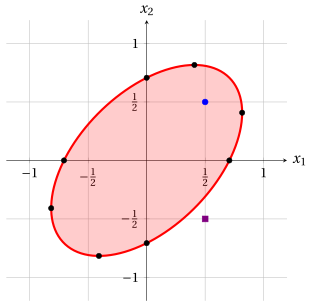
The set \(F\) is the region inside (and on the boundary of) an ellipse whose axes are the lines \(x_2 = x_1\) and \(x_2 = -x_1\) (red). The figure shows the reference points (black), the point \(\big(\frac{1}{2},\frac{1}{2}\big)\) that belongs to \(F\) (blue) and the point \(\big(\frac{1}{2},-\frac{1}{2}\big)\) that does not belong to \(F\) (violet).
-
Exercise 1.5: Convex sets (E5)
Consider the following sets:
Questions
-
Draw the sets \(A\) and \(B\).
-
Show that \(A\) is not a convex set.
-
Prove that \(B_1\) and \(B_2\) are convex sets.
-
Show that \(B\) is not a convex set.
Solution
-
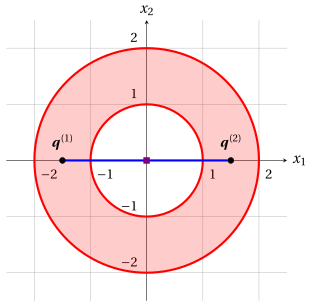
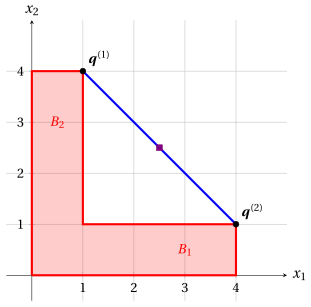
The set \(A\) is the ring between the circle of radius \(1\) and the circle of radius \(2\) centered at the origin (red, left). The set \(B\) is the L-shaped union of the rectangles \(B_1\) and \(B_2\) (red, right). The figures also show the segments used in the next questions (blue), whose midpoint (violet) does not belong to the set.
-
To show that a set is not convex, it is enough to find two points of the set and one scalar \(\lambda \in [0,1]\) whose convex combination does not belong to the set. Take
\[ {\boldsymbol q}^{(1)}=\begin{pmatrix} -\frac{3}{2} \\[0.6ex] 0 \end{pmatrix}, \qquad {\boldsymbol q}^{(2)}=\begin{pmatrix} \frac{3}{2} \\[0.6ex] 0 \end{pmatrix} \qquad \text{and} \qquad \lambda = \frac{1}{2}. \]Both points belong to \(A\), since \(\big(\pm\frac{3}{2}\big)^2 + 0^2 = \frac{9}{4} \in [1,4]\). Their convex combination is
\[ \frac{1}{2}\begin{pmatrix} -\frac{3}{2} \\[0.6ex] 0 \end{pmatrix} + \frac{1}{2}\begin{pmatrix} \frac{3}{2} \\[0.6ex] 0 \end{pmatrix} = \begin{pmatrix} 0 \\[0.3ex] 0 \end{pmatrix}, \qquad \text{with} \qquad 0^2 + 0^2 = 0 < 1 . \]The convex combination does not belong to \(A\): the set \(A\) is not convex.
-
Let \(k \in \{1,2\}\). The set \(B_k\) is defined by the bounds \(0 \le x_1 \le u_1\) and \(0 \le x_2 \le u_2\), with \((u_1,u_2) = (4,1)\) for \(B_1\) and \((u_1,u_2) = (1,4)\) for \(B_2\). For every pair of points \({\boldsymbol p}, {\boldsymbol w} \in B_k\) and every \(\lambda \in [0,1]\), for each coordinate \(i \in \{1,2\}\) we have:
\[\begin{align*} \lambda p_i + (1-\lambda) w_i &\in \big[\,\lambda \cdot 0 + (1-\lambda) \cdot 0,~~ \lambda\, u_i + (1-\lambda)\, u_i\,\big] \\[1ex] &\qquad\quad (\text{since } p_i, w_i \in [0,u_i],~ \lambda \ge 0 \text{ and } 1-\lambda \ge 0)\\[2ex] &= [\,0,~u_i\,] \end{align*}\]Therefore, \(\lambda {\boldsymbol p} + (1-\lambda){\boldsymbol w} \in B_k\), and the set \(B_k\) is convex.
-
Take
\[ {\boldsymbol q}^{(1)}=\begin{pmatrix} 1 \\[0.3ex] 4 \end{pmatrix} \in B_2, \qquad {\boldsymbol q}^{(2)}=\begin{pmatrix} 4 \\[0.3ex] 1 \end{pmatrix} \in B_1 \qquad \text{and} \qquad \lambda = \frac{1}{2}. \]Both points belong to \(B\). Their convex combination is
\[ \frac{1}{2}\begin{pmatrix} 1 \\[0.3ex] 4 \end{pmatrix} + \frac{1}{2}\begin{pmatrix} 4 \\[0.3ex] 1 \end{pmatrix} = \begin{pmatrix} \frac{5}{2} \\[0.6ex] \frac{5}{2} \end{pmatrix}, \]which does not belong to \(B_1\) (since \(x_2 = \frac{5}{2} > 1\)) nor to \(B_2\) (since \(x_1 = \frac{5}{2} > 1\)), hence it does not belong to \(B\): the set \(B\) is not convex.
The intersection of convex sets is always convex (chapter «Convex sets»), while the union of two convex sets, as \(B = B_1 \cup B_2\), may not be convex.