Exercises · Quadratic functions
Exercises · Chapter 4 · each solution opens with a click · Chapter 4: Quadratic functions · Exercises, volume 1 (PDF)
In the exercises of this chapter, convexity is proved only with the definition of convex function of the chapter «Convex and concave functions»: the quadratic function is written as a sum of squares of linear functions, and the inequality
of the same chapter is applied to each square.
Exercise 4.1: Quadratic functions (E1)
Consider the following real-valued function:
Questions
-
Write the function in the matrix form \(f({\boldsymbol x}) = {\boldsymbol x}' {\boldsymbol Q} \; {\boldsymbol x}\) with a symmetric matrix \({\boldsymbol Q}\).
-
Show that the non-symmetric matrix \(\begin{pmatrix} 1 & 6 \\ -4 & 5 \end{pmatrix}\) defines the same function, and that replacing each off-diagonal pair with its average gives the matrix \({\boldsymbol Q}\) of the first question.
-
Compute the gradient and the Hessian of the function, and the gradient at the points \(\begin{pmatrix} 1 \\ 1 \end{pmatrix}\) and \(\begin{pmatrix} -1 \\ 2 \end{pmatrix}\).
-
Show that \(f({\boldsymbol x}) = (x_1 + x_2)^2 + 4\,x_2^2\) and prove, from the definition, that the function is convex in its domain.
-
Draw the graph of the function.
Solution
-
The coefficient \(2\) of \(x_1 x_2\) is split equally between the two off-diagonal entries:
\[ f\left(\begin{pmatrix} x_1 \\ x_2 \end{pmatrix}\right) = \begin{pmatrix} x_1 & x_2 \end{pmatrix} \underbrace{\begin{pmatrix} 1 & 1 \\ 1 & 5 \end{pmatrix}}_{{\boldsymbol Q}} \begin{pmatrix} x_1 \\ x_2 \end{pmatrix} = x_1^2 + x_1 x_2 + x_2 x_1 + 5\,x_2^2 = x_1^2 + 2\,x_1 x_2 + 5\,x_2^2 \] -
With the non-symmetric matrix we have:
\[ \begin{pmatrix} x_1 & x_2 \end{pmatrix} \begin{pmatrix} 1 & 6 \\ -4 & 5 \end{pmatrix} \begin{pmatrix} x_1 \\ x_2 \end{pmatrix} = x_1^2 + 6\,x_1 x_2 - 4\,x_2 x_1 + 5\,x_2^2 = x_1^2 + 2\,x_1 x_2 + 5\,x_2^2 \]which is the same function. Replacing the off-diagonal pair with its average:
\[ \begin{pmatrix} 1 & \frac{6+(-4)}{2} \\[1ex] \frac{6+(-4)}{2} & 5 \end{pmatrix} = \begin{pmatrix} 1 & 1 \\ 1 & 5 \end{pmatrix} = {\boldsymbol Q} \] -
The gradient is \(2\,{\boldsymbol Q}\,{\boldsymbol x}\) and the Hessian is \(2\,{\boldsymbol Q}\):
\[ \nabla f\left(\begin{pmatrix} x_1 \\ x_2 \end{pmatrix}\right) = \begin{pmatrix} 2\,x_1 + 2\,x_2 \\[0.5ex] 2\,x_1 + 10\,x_2 \end{pmatrix}, \qquad \nabla^2 f\left(\begin{pmatrix} x_1 \\ x_2 \end{pmatrix}\right) = \begin{pmatrix} 2 & 2 \\ 2 & 10 \end{pmatrix} \]At the two points:
\[ \nabla f\left(\begin{pmatrix} 1 \\ 1 \end{pmatrix}\right) = \begin{pmatrix} 4 \\ 12 \end{pmatrix}, \qquad \nabla f\left(\begin{pmatrix} -1 \\ 2 \end{pmatrix}\right) = \begin{pmatrix} -2 + 4 \\ -2 + 20 \end{pmatrix} = \begin{pmatrix} 2 \\ 18 \end{pmatrix} \] -
Expanding the square:
\[ (x_1 + x_2)^2 + 4\,x_2^2 = x_1^2 + 2\,x_1 x_2 + x_2^2 + 4\,x_2^2 = x_1^2 + 2\,x_1 x_2 + 5\,x_2^2 = f({\boldsymbol x}) \]To prove that the function is convex in its domain, we observe that for every pair of points \({\boldsymbol p}, {\boldsymbol w} \in \R^2\) and every \(\lambda \in [0,1]\), we have:
\[\begin{align*} & f\big(\lambda {\boldsymbol p}+(1-\lambda){\boldsymbol w}\big) \\[2ex] &\quad = \big(\lambda p_1+(1-\lambda)w_1 + \lambda p_2+(1-\lambda)w_2\big)^2 + 4\,\big(\lambda p_2+(1-\lambda)w_2\big)^2 \\[2ex] &\quad = \big(\lambda (p_1+p_2)+(1-\lambda)(w_1+w_2)\big)^2 + 4\,\big(\lambda p_2+(1-\lambda)w_2\big)^2 \\[2ex] &\quad \le \lambda (p_1+p_2)^2+(1-\lambda)(w_1+w_2)^2 + 4\,\big(\lambda p_2^2+(1-\lambda)w_2^2\big) \\[1ex] &\qquad \text{(since } (\lambda a+(1-\lambda)b)^2\le \lambda a^2+(1-\lambda)b^2\text{, twice)} \\[2ex] &\quad = \lambda\,\big((p_1+p_2)^2+4\,p_2^2\big)+(1-\lambda)\,\big((w_1+w_2)^2+4\,w_2^2\big) \\[2ex] &\quad = \lambda f({\boldsymbol p})+(1-\lambda)f({\boldsymbol w}) \end{align*}\]Therefore,
\[ f(\lambda {\boldsymbol p} + (1-\lambda){\boldsymbol w}) \le \lambda f({\boldsymbol p}) + (1-\lambda) f({\boldsymbol w}) \]By nature, the domain \(\R^2\) is a convex set. Accordingly, the function is convex in its domain.
-
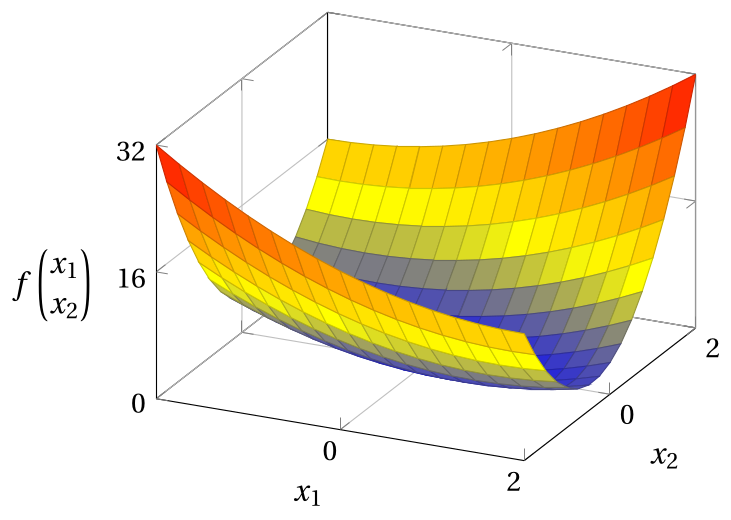
This is the graph of the function in the domain \(\begin{pmatrix} x_1 \\ x_2 \end{pmatrix} \in [-2,2] \times [-2,2]\); its lowest point is \(\big(0,0,f(0,0)\big) = (0,0,0)\) and its highest points are at \((2,2)\) and \((-2,-2)\), where \(f = 32\).
Exercise 4.2: Quadratic functions (E2)
Consider the following real-valued function:
Questions
-
Write the function in the matrix form \(f({\boldsymbol x}) = {\boldsymbol x}' {\boldsymbol Q} \; {\boldsymbol x}\) with a symmetric matrix \({\boldsymbol Q}\).
-
Compute the gradient of the function and its value at the four points \(\begin{pmatrix} 1 \\ 1 \end{pmatrix}\), \(\begin{pmatrix} -1 \\ 1 \end{pmatrix}\), \(\begin{pmatrix} -1 \\ -1 \end{pmatrix}\) and \(\begin{pmatrix} 1 \\ -1 \end{pmatrix}\).
-
Describe the level sets of the function for \(k=3\) and \(k=12\) (with their intersections with the axes) and draw them, together with the gradients of the previous question applied at their points.
-
Prove, from the definition, that the function is convex in its domain.
Solution
-
The function has no term \(x_1 x_2\), so the off-diagonal entries are zero:
\[ f\left(\begin{pmatrix} x_1 \\ x_2 \end{pmatrix}\right) = \begin{pmatrix} x_1 & x_2 \end{pmatrix} \underbrace{\begin{pmatrix} 1 & 0 \\ 0 & 2 \end{pmatrix}}_{{\boldsymbol Q}} \begin{pmatrix} x_1 \\ x_2 \end{pmatrix} = x_1^2 + 2\,x_2^2 \] -
The gradient is \(2\,{\boldsymbol Q}\,{\boldsymbol x}\):
\[ \nabla f\left(\begin{pmatrix} x_1 \\ x_2 \end{pmatrix}\right) = \begin{pmatrix} 2\,x_1 \\[0.5ex] 4\,x_2 \end{pmatrix} \]At the four points:
\[\begin{align*} \nabla f\left(\begin{pmatrix} 1 \\ 1 \end{pmatrix}\right) &= \begin{pmatrix} 2 \\ 4 \end{pmatrix}, & \nabla f\left(\begin{pmatrix} -1 \\ 1 \end{pmatrix}\right) &= \begin{pmatrix} -2 \\ 4 \end{pmatrix}, \\[1ex] \nabla f\left(\begin{pmatrix} -1 \\ -1 \end{pmatrix}\right) &= \begin{pmatrix} -2 \\ -4 \end{pmatrix}, & \nabla f\left(\begin{pmatrix} 1 \\ -1 \end{pmatrix}\right) &= \begin{pmatrix} 2 \\ -4 \end{pmatrix} \end{align*}\] -
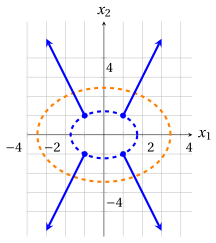
The level set for \(k=3\) is the ellipse \(x_1^2 + 2\,x_2^2 = 3\), which meets the \(x_1\)-axis at \(x_1 = \pm\sqrt{3}\) and the \(x_2\)-axis at \(x_2 = \pm\sqrt{3/2}\); it contains the four points of the previous question, since \(1 + 2 = 3\). The level set for \(k=12\) is the ellipse \(x_1^2 + 2\,x_2^2 = 12\), which meets the \(x_1\)-axis at \(x_1 = \pm\sqrt{12} = \pm 2\sqrt{3}\) and the \(x_2\)-axis at \(x_2 = \pm\sqrt{6}\); it contains the four points \(\begin{pmatrix} \pm 2 \\ \pm 2 \end{pmatrix}\), since \(4 + 8 = 12\). In the figure, the level set \(k=3\) is blue, the level set \(k=12\) is orange and the gradients at the four points of the level set \(k=3\) are blue arrows: each gradient is perpendicular to the level set.
-
To prove that the function is convex in its domain, we observe that for every pair of points \({\boldsymbol p}, {\boldsymbol w} \in \R^2\) and every \(\lambda \in [0,1]\), we have:
\[\begin{align*} f\big(\lambda {\boldsymbol p}+(1-\lambda){\boldsymbol w}\big) &= \big(\lambda p_1+(1-\lambda)w_1\big)^2 + 2\,\big(\lambda p_2+(1-\lambda)w_2\big)^2 \\[2ex] &\le \lambda p_1^2+(1-\lambda)w_1^2 + 2\,\big(\lambda p_2^2+(1-\lambda)w_2^2\big) \\[1ex] &\qquad \text{(since } (\lambda a+(1-\lambda)b)^2\le \lambda a^2+(1-\lambda)b^2\text{, twice)} \\[2ex] &= \lambda\,\big(p_1^2+2\,p_2^2\big)+(1-\lambda)\,\big(w_1^2+2\,w_2^2\big) \\[2ex] &= \lambda f({\boldsymbol p})+(1-\lambda)f({\boldsymbol w}) \end{align*}\]Therefore,
\[ f(\lambda {\boldsymbol p} + (1-\lambda){\boldsymbol w}) \le \lambda f({\boldsymbol p}) + (1-\lambda) f({\boldsymbol w}) \]By nature, the domain \(\R^2\) is a convex set. Accordingly, the function is convex in its domain.
Exercise 4.3: Quadratic functions (E3)
Consider the following real-valued function:
Questions
-
Write the function in the form \(g({\boldsymbol x}) = {\boldsymbol x}' {\boldsymbol Q} \; {\boldsymbol x} + {\boldsymbol c}' {\boldsymbol x} + d\) with a symmetric matrix \({\boldsymbol Q}\), a vector \({\boldsymbol c}\) and a scalar \(d\).
-
Compute the gradient of the function and the point at which the gradient is the zero vector.
-
Show that \(g({\boldsymbol x}) = (x_1 - x_2 - 1)^2 + (x_2 - 1)^2 + 2\) and deduce that \(g({\boldsymbol x}) \ge 2\) for every \({\boldsymbol x} \in \R^2\), with equality only at the point of the previous question.
-
Describe the level sets of the function for \(k=3\) and \(k=6\) and draw them.
-
Prove, from the definition, that the function is convex in its domain.
Solution
-
The coefficient \(-2\) of \(x_1 x_2\) is split equally between the two off-diagonal entries, and the linear part is \(-2\,x_1 + 0\,x_2\):
\[ {\boldsymbol Q} = \begin{pmatrix} 1 & -1 \\ -1 & 2 \end{pmatrix}, \qquad {\boldsymbol c} = \begin{pmatrix} -2 \\ 0 \end{pmatrix}, \qquad d = 4 \]Indeed:
\[ \begin{pmatrix} x_1 & x_2 \end{pmatrix} \begin{pmatrix} 1 & -1 \\ -1 & 2 \end{pmatrix} \begin{pmatrix} x_1 \\ x_2 \end{pmatrix} + \begin{pmatrix} -2 & 0 \end{pmatrix} \begin{pmatrix} x_1 \\ x_2 \end{pmatrix} + 4 = x_1^2 - 2\,x_1 x_2 + 2\,x_2^2 - 2\,x_1 + 4 \] -
The gradient is \(2\,{\boldsymbol Q}\,{\boldsymbol x} + {\boldsymbol c}\):
\[ \nabla g\left(\begin{pmatrix} x_1 \\ x_2 \end{pmatrix}\right) = \begin{pmatrix} 2\,x_1 - 2\,x_2 - 2 \\[0.5ex] -2\,x_1 + 4\,x_2 \end{pmatrix} \]The gradient is the zero vector when:
\[ \left\{ \begin{array}{rcl} 2\,x_1 - 2\,x_2 - 2 &=& 0 \\[0.5ex] -2\,x_1 + 4\,x_2 &=& 0 \end{array} \right. \]From the second equation \(x_1 = 2\,x_2\); substituting in the first, \(4\,x_2 - 2\,x_2 - 2 = 0\), that is \(x_2 = 1\) and \(x_1 = 2\). The point is \(\begin{pmatrix} 2 \\ 1 \end{pmatrix}\).
-
Expanding the squares:
\[\begin{align*} & (x_1 - x_2 - 1)^2 + (x_2 - 1)^2 + 2 \\[2ex] &\quad = x_1^2 + x_2^2 + 1 - 2\,x_1 x_2 - 2\,x_1 + 2\,x_2 + x_2^2 - 2\,x_2 + 1 + 2 \\[2ex] &\quad = x_1^2 - 2\,x_1 x_2 + 2\,x_2^2 - 2\,x_1 + 4 = g({\boldsymbol x}) \end{align*}\]Since the two squares are nonnegative, \(g({\boldsymbol x}) \ge 2\) for every \({\boldsymbol x} \in \R^2\). The equality holds only if both squares are zero, that is \(x_2 = 1\) and \(x_1 = x_2 + 1 = 2\): the point \(\begin{pmatrix} 2 \\ 1 \end{pmatrix}\) of the previous question, where \(g = 2\).
-
By the previous question, the level set for \(k=3\) is
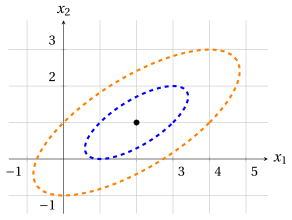
\[ \left\{ {\boldsymbol x} \in \R^2 : (x_1 - x_2 - 1)^2 + (x_2 - 1)^2 = 1 \right\} \]an ellipse centered at \(\begin{pmatrix} 2 \\ 1 \end{pmatrix}\) that contains, for instance, the points \(\begin{pmatrix} 3 \\ 1 \end{pmatrix}\), \(\begin{pmatrix} 1 \\ 1 \end{pmatrix}\), \(\begin{pmatrix} 3 \\ 2 \end{pmatrix}\) and \(\begin{pmatrix} 1 \\ 0 \end{pmatrix}\). The level set for \(k=6\) is
\[ \left\{ {\boldsymbol x} \in \R^2 : (x_1 - x_2 - 1)^2 + (x_2 - 1)^2 = 4 \right\} \]an ellipse with the same center that contains, for instance, the points \(\begin{pmatrix} 4 \\ 1 \end{pmatrix}\), \(\begin{pmatrix} 0 \\ 1 \end{pmatrix}\), \(\begin{pmatrix} 4 \\ 3 \end{pmatrix}\) and \(\begin{pmatrix} 0 \\ -1 \end{pmatrix}\). In the figure, the level set \(k=3\) is blue, the level set \(k=6\) is orange and the center \(\begin{pmatrix} 2 \\ 1 \end{pmatrix}\) is black.
-
To prove that the function is convex in its domain, we observe that for every pair of points \({\boldsymbol p}, {\boldsymbol w} \in \R^2\) and every \(\lambda \in [0,1]\), we have:
\[\begin{align*} & g\big(\lambda {\boldsymbol p}+(1-\lambda){\boldsymbol w}\big) \\[2ex] &\quad = \big(\lambda p_1+(1-\lambda)w_1 - \lambda p_2-(1-\lambda)w_2 - 1\big)^2 + \big(\lambda p_2+(1-\lambda)w_2 - 1\big)^2 + 2 \\[2ex] &\quad = \big(\lambda (p_1-p_2-1)+(1-\lambda)(w_1-w_2-1)\big)^2 + \big(\lambda (p_2-1)+(1-\lambda)(w_2-1)\big)^2 + 2 \\[1ex] &\qquad (\text{since } \lambda + (1-\lambda) = 1) \\[2ex] &\quad \le \lambda (p_1-p_2-1)^2+(1-\lambda)(w_1-w_2-1)^2 + \lambda (p_2-1)^2+(1-\lambda)(w_2-1)^2 + 2 \\[1ex] &\qquad \text{(since } (\lambda a+(1-\lambda)b)^2\le \lambda a^2+(1-\lambda)b^2\text{, twice)} \\[2ex] &\quad = \lambda\,\big((p_1-p_2-1)^2+(p_2-1)^2+2\big)+(1-\lambda)\,\big((w_1-w_2-1)^2+(w_2-1)^2+2\big) \\[1ex] &\qquad (\text{since } \lambda + (1-\lambda) = 1) \\[2ex] &\quad = \lambda g({\boldsymbol p})+(1-\lambda)g({\boldsymbol w}) \end{align*}\]Therefore,
\[ g(\lambda {\boldsymbol p} + (1-\lambda){\boldsymbol w}) \le \lambda g({\boldsymbol p}) + (1-\lambda) g({\boldsymbol w}) \]By nature, the domain \(\R^2\) is a convex set. Accordingly, the function is convex in its domain.
Exercise 4.4: Quadratic functions (E4)
Consider the following real-valued functions:
and
Questions
-
Find the symmetric matrix \({\boldsymbol Q}\) that defines the same function \(f\), and write \(f\) as a polynomial in \(x_1, x_2, x_3\).
-
Compute the gradient and the Hessian of \(f\), and the gradient at the point \(\begin{pmatrix} 1 \\ -1 \\ 1 \end{pmatrix}\).
-
Show that \(f({\boldsymbol x}) = (x_1 + x_2)^2 + (x_2 - x_3)^2 + 2\,x_3^2\) and prove, from the definition, that \(f\) is convex in its domain.
-
Write \(h\) in the matrix form with a symmetric matrix and show that \(h\) is not convex in its domain, by finding two points and a value of \(\lambda\) for which the inequality of the definition of convex function does not hold.
Solution
-
Replacing each off-diagonal pair with its average:
\[ {\boldsymbol Q} = \begin{pmatrix} 1 & \frac{4+(-2)}{2} & 0 \\[1ex] \frac{4+(-2)}{2} & 2 & \frac{-6+4}{2} \\[1ex] 0 & \frac{-6+4}{2} & 3 \end{pmatrix} = \begin{pmatrix} 1 & 1 & 0 \\ 1 & 2 & -1 \\ 0 & -1 & 3 \end{pmatrix} \]and the function is:
\[\begin{align*} f({\boldsymbol x}) &= x_1^2 + x_1x_2 + x_2x_1 + 2\,x_2^2 - x_2x_3 - x_3x_2 + 3\,x_3^2 \\[2ex] &= x_1^2 + 2\,x_2^2 + 3\,x_3^2 + 2\,x_1x_2 - 2\,x_2x_3 \end{align*}\] -
The gradient is \(2\,{\boldsymbol Q}\,{\boldsymbol x}\) and the Hessian is \(2\,{\boldsymbol Q}\):
\[ \nabla f({\boldsymbol x}) = \begin{pmatrix} 2\,x_1 + 2\,x_2 \\[0.5ex] 2\,x_1 + 4\,x_2 - 2\,x_3 \\[0.5ex] -2\,x_2 + 6\,x_3 \end{pmatrix}, \qquad \nabla^2 f({\boldsymbol x}) = \begin{pmatrix} 2 & 2 & 0 \\ 2 & 4 & -2 \\ 0 & -2 & 6 \end{pmatrix} \]At the point:
\[ \nabla f\left(\begin{pmatrix} 1 \\ -1 \\ 1 \end{pmatrix}\right) = \begin{pmatrix} 2 - 2 \\ 2 - 4 - 2 \\ 2 + 6 \end{pmatrix} = \begin{pmatrix} 0 \\ -4 \\ 8 \end{pmatrix} \] -
Expanding the squares:
\[\begin{align*} & (x_1 + x_2)^2 + (x_2 - x_3)^2 + 2\,x_3^2 \\[2ex] &\quad = x_1^2 + 2\,x_1x_2 + x_2^2 + x_2^2 - 2\,x_2x_3 + x_3^2 + 2\,x_3^2 \\[2ex] &\quad = x_1^2 + 2\,x_2^2 + 3\,x_3^2 + 2\,x_1x_2 - 2\,x_2x_3 = f({\boldsymbol x}) \end{align*}\]To prove that the function is convex in its domain, we observe that for every pair of points \({\boldsymbol p}, {\boldsymbol w} \in \R^3\) and every \(\lambda \in [0,1]\), we have:
\[\begin{align*} & f\big(\lambda {\boldsymbol p}+(1-\lambda){\boldsymbol w}\big) \\[2ex] &\quad = \big(\lambda (p_1+p_2)+(1-\lambda)(w_1+w_2)\big)^2 + \big(\lambda (p_2-p_3)+(1-\lambda)(w_2-w_3)\big)^2 \\[1ex] &\qquad + 2\,\big(\lambda p_3+(1-\lambda)w_3\big)^2 \\[2ex] &\quad \le \lambda (p_1+p_2)^2+(1-\lambda)(w_1+w_2)^2 + \lambda (p_2-p_3)^2+(1-\lambda)(w_2-w_3)^2 \\[1ex] &\qquad + 2\,\big(\lambda p_3^2+(1-\lambda)w_3^2\big) \\[1ex] &\qquad \text{(since } (\lambda a+(1-\lambda)b)^2\le \lambda a^2+(1-\lambda)b^2\text{, three times)} \\[2ex] &\quad = \lambda\,\big((p_1+p_2)^2+(p_2-p_3)^2+2\,p_3^2\big) \\[1ex] &\qquad +(1-\lambda)\,\big((w_1+w_2)^2+(w_2-w_3)^2+2\,w_3^2\big) \\[2ex] &\quad = \lambda f({\boldsymbol p})+(1-\lambda)f({\boldsymbol w}) \end{align*}\]Therefore,
\[ f(\lambda {\boldsymbol p} + (1-\lambda){\boldsymbol w}) \le \lambda f({\boldsymbol p}) + (1-\lambda) f({\boldsymbol w}) \]By nature, the domain \(\R^3\) is a convex set. Accordingly, the function is convex in its domain.
-
The coefficient \(4\) of \(x_1 x_2\) is split equally between the two off-diagonal entries:
\[ h\left(\begin{pmatrix} x_1 \\ x_2 \end{pmatrix}\right) = \begin{pmatrix} x_1 & x_2 \end{pmatrix} \begin{pmatrix} 1 & 2 \\ 2 & 1 \end{pmatrix} \begin{pmatrix} x_1 \\ x_2 \end{pmatrix} \]With \({\boldsymbol p} = \begin{pmatrix} 1 \\ -1 \end{pmatrix}\), \({\boldsymbol w} = \begin{pmatrix} -1 \\ 1 \end{pmatrix}\) and \(\lambda = \frac{1}{2}\), we have \(\frac{1}{2}\,{\boldsymbol p} + \frac{1}{2}\,{\boldsymbol w} = \begin{pmatrix} 0 \\ 0 \end{pmatrix}\) and:
\[ h({\boldsymbol p}) = 1 - 4 + 1 = -2, \qquad h({\boldsymbol w}) = 1 - 4 + 1 = -2, \qquad h\left(\begin{pmatrix} 0 \\ 0 \end{pmatrix}\right) = 0 \]Therefore,
\[ h\left(\frac{1}{2}\,{\boldsymbol p} + \frac{1}{2}\,{\boldsymbol w}\right) = 0 ~>~ -2 = \frac{1}{2}\,h({\boldsymbol p}) + \frac{1}{2}\,h({\boldsymbol w}) \]The inequality of the definition does not hold, so the function \(h\) is not convex in its domain. In agreement with the chapter, the matrix \(\begin{pmatrix} 1 & 2 \\ 2 & 1 \end{pmatrix}\) is not positive semidefinite, since \(h({\boldsymbol p}) = -2 < 0\).