Cover inequalities
Part 2 · Strengthening the formulation · Chapter 5 · Lecture notes, volume 1 (PDF) · Exercises: Cover inequalities
\(\newcommand{\LPcov}{\mathrm{LP}^{\mathrm{cov}}} \newcommand{\CSP}{\mathrm{ILP}_{\mathrm{CSP}}} \newcommand{\CSPKP}{\mathrm{ILP}^{2}_{\mathrm{CSP}}}\)
Prerequisites
-
From this module, Chapter 1 «Integer linear programming» and Chapter 2 «LP relaxation»: ILP problems, the LP relaxation, and the upper bound given by the LP relaxation.
-
From this module, Chapter 3 «Ideal formulations» and Chapter 4 «Valid inequalities»: the convex hull of the integer solutions, valid inequalities, and cuts that remove fractional points.
-
The LP relaxation of a binary problem with one constraint, solved by inserting the variables in non-increasing order of the ratio \(c_j/a_j\) between objective and constraint coefficients (Dantzig's rule).
Objectives
At the end of this chapter you will be able to:
-
write the cover inequalities of a \(\le\) constraint with positive coefficients of a binary MIP, and prove that they are valid;
-
list the covers and the minimal covers of an instance, and describe the cover closure;
-
separate a cover inequality from a fractional point by solving a cover separation problem, exactly or with the greedy heuristic algorithm;
-
strengthen a cover inequality into an extended cover inequality;
-
compute the violation of a cover inequality and the distance of a point from it.
5.1 A constraint with positive coefficients and its LP relaxation
Definition 5.1: constraint with positive coefficients of a binary MIP
Given binary variables \(x_j\), for \(j \in \mathscr{I} = \{1,2,\ldots,n\}\), integer coefficients \(a_j \in \Z_{\ge 1}\) and a right-hand side \(b \in \Z_{\ge 1}\), consider the constraint
Its set of feasible solutions is
and its LP relaxation is
-
Constraints of this type are called knapsack constraints or budget constraints.
-
We assume that
\[ a_j \le b ~~~~\text{for all}~~~~ j \in \mathscr{I} ~~~~~~~\text{and}~~~~~~~ \sum_{j \in \mathscr{I}} a_j>b. \]The first assumption guarantees that every variable can be set to \(1\), the second one that they cannot all be set to \(1\) together.
-
\(X\) is a finite set of binary points, and an exact description of its convex hull \(\operatorname{conv}(X)\) is generally hard to obtain. The aim is to strengthen \(P\) by removing fractional points without removing any point of \(X\).
-
A MIP can contain several constraints of this type, and further constraints. Valid inequalities for \(X\) remain valid when other constraints are imposed.
With objective coefficients \(c_j\), maximizing \(\sum_{j\in\mathscr{I}}c_jx_j\) over \(P\) gives an upper bound on the integer maximization problem; valid inequalities for \(X\) can improve this upper bound.
5.2 Covers and cover inequalities
Definition 5.2: Cover and collection of all covers
A cover is a subset \(C\subseteq\mathscr{I}\) whose total coefficient \(\sum_{j\in C}a_j\) exceeds the right-hand side \(b\). The collection of all covers is
Since coefficients and right-hand side are integer, the condition is equivalent to \(\sum_{j\in C}a_j\ge b+1\).
Definition 5.3: Cover inequality
Given \(C\in\mathcal{C}\), the associated cover inequality is
Proposition 5.4
For every cover \(C\in\mathcal{C}\), the cover inequality \(\eqref{eq:cover-cut}\) is valid for \(X\).
Proof
Suppose that a point \(\vet x\in X\) violates \(\eqref{eq:cover-cut}\). The sum of \(|C|\) binary variables is then greater than \(|C|-1\), hence \(x_j=1\) for every \(j\in C\). Since all coefficients are positive,
This contradicts the constraint \(\eqref{eq:main}\): at most \(|C|-1\) variables of \(C\) can be equal to \(1\) together. □
5.2.1 Minimal covers
Definition 5.5: Minimal cover
A cover \(C\) is minimal if no proper subset of \(C\) is a cover. Equivalently,
- Since the coefficients are positive, it suffices to remove one variable at a time: if each of these \(|C|\) subsets satisfies the constraint, every smaller subset satisfies it as well.
Proposition 5.6
The inequalities of the minimal covers, together with the upper bounds \(x_j\le1\) for all \(j\in\mathscr{I}\), imply every cover inequality.
Proof
Starting from a cover \(C\), remove variables as long as the remaining set is still a cover: this gives a minimal cover \(D\subseteq C\). Adding the cover inequality of \(D\) and the upper bounds of the variables in \(C\setminus D\) gives
□
5.2.2 The cover closure
Definition 5.7: Cover closure
The cover closure of \(P\) is the polyhedron
-
Since all cover inequalities are valid,
\[ \operatorname{conv}(X)\subseteq P^{\mathrm{cov}}\subseteq P, \]and in general the first inclusion is strict.
-
By Proposition 5.6, the inequalities of the minimal covers are sufficient to describe \(P^{\mathrm{cov}}\).
-
The number of covers can be exponential in \(n\). For example, if \(a_j=1\) for all \(j\in\mathscr{I}\) and \(b=1\), every subset with at least two indices is a cover, i.e., there are \(2^n-n-1\) covers. Also the minimal covers can be exponentially many: for \(a_j=1\) for all \(j\in\mathscr{I}\), \(n=2m\) and \(b=m\), they are the \(\binom{2m}{m+1}\) subsets of \(m+1\) indices.
-
Therefore, cover inequalities are not added all at once: they are added only when they are violated, i.e., they are separated (Section 5.4).
Example 5.1: A binary problem with one constraint of this form
Consider \(\mathscr{I}=\{1,2,3,4\}\), right-hand side \(b=9\), and the following objective coefficients \(c_j\) and constraint coefficients \(a_j\).
The associated \(\LP\) model is:
The ratios \(c_j/a_j\) are \(3,5/3,4/3,9/7\), in non-increasing order. Dantzig's rule sets to \(1\) the variables in this order, as long as the constraint is satisfied, and gives to the first variable that would violate it the largest fractional value allowed: this gives an optimal solution of \(\LP\). An optimal solution \(\tilde{\vet x}(\LP)\) is:
The optimal value \(z(\LP)\) is \(6+5+8(2/3)=49/3\).
Example 5.2: The cover closure of the four-variable instance
The instance of Example 5.1 has the following seven covers.
| \(C\) | \(\sum_{j\in C}a_j\) | \(|C|\) | Cover inequality | Minimal |
|---|---|---|---|---|
| \(\{2,4\}\) | \(10\) | \(2\) | \(x_2+x_4\le 1\) | yes |
| \(\{3,4\}\) | \(13\) | \(2\) | \(x_3+x_4\le 1\) | yes |
| \(\{1,2,3\}\) | \(11\) | \(3\) | \(x_1+x_2+x_3\le 2\) | yes |
| \(\{1,2,4\}\) | \(12\) | \(3\) | \(x_1+x_2+x_4\le 2\) | no |
| \(\{1,3,4\}\) | \(15\) | \(3\) | \(x_1+x_3+x_4\le 2\) | no |
| \(\{2,3,4\}\) | \(16\) | \(3\) | \(x_2+x_3+x_4\le 2\) | no |
| \(\{1,2,3,4\}\) | \(18\) | \(4\) | \(x_1+x_2+x_3+x_4\le 3\) | no |
Only the first three covers are minimal; their inequalities already describe the cover closure. Denote by \(\LPcov\) the LP obtained by adding them to \(\LP\). An optimal solution \(\tilde{\vet x}(\LPcov)\) is:
The optimal value is \(z(\LPcov)=79/5<z(\LP)=49/3\).
5.3 Geometric interpretation
-
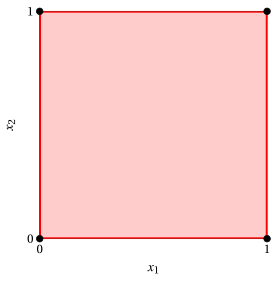
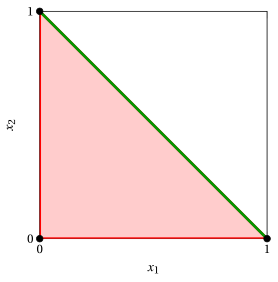
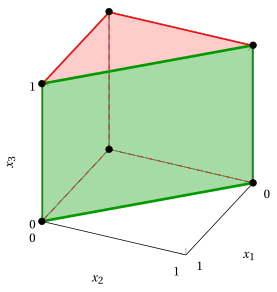
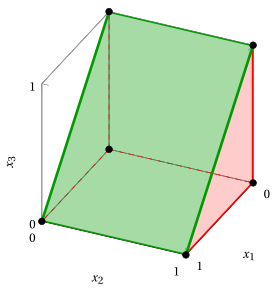
All coordinates in the figures are the actual variable values. The ticks mark the coordinates of the blue point and of the main vertices; a few vertices have no tick, to keep the axes readable. In 3D, dashed edges are hidden behind the visible faces.
-
Every step is illustrated both in two and in three dimensions, with the same colours in all figures: the red region is the continuous region under consideration; green identifies a cover inequality (an edge in 2D, a face in 3D); black points are the feasible binary points; the blue point is the fractional point discussed in the text.
-
First consider only the domain, \([0,1]^2\) or \([0,1]^3\): no constraint other than the bounds is imposed in the next two examples.
Example 5.3: A cover inequality in the unit square
In \([0,1]^2\), the inequality \(x_1+x_2\le1\) removes only the binary point \((1,1)\) and preserves the binary points \((0,0)\), \((1,0)\) and \((0,1)\).
Unit square: domain only.
Domain with \(x_1+x_2\le1\).
Example 5.4: Cover inequalities in the unit cube
-
In \([0,1]^3\), the inequality \(x_1+x_2\le1\) is independent of \(x_3\); its boundary is parallel to the \(x_3\) axis. Similarly, the boundary of \(x_1+x_3\le1\) is parallel to the \(x_2\) axis.
-
The two halfspaces remove different portions of the cube. Their intersection preserves exactly the binary points \((0,0,0),(1,0,0),(0,1,0),(0,0,1),(0,1,1)\).
-
The inequality \(x_1+x_2+x_3\le2\) removes only the binary point \(x_1=x_2=x_3=1\).
Domain with \(x_1+x_2\le1\).
Domain with \(x_1+x_3\le1\).
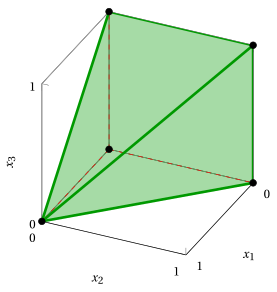
Domain with both inequalities.
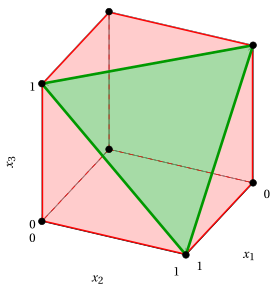
Domain with \(x_1+x_2+x_3\le2\).
Example 5.5: A cover in two dimensions
For \(\mathscr{I}=\{1,2\}\), consider
The cover \(C=\{1,2\}\) gives \(x_1+x_2\le1\). The point \(\tilde{x}_1=1\), \(\tilde{x}_2=2/5\) satisfies the constraint at equality, but violates the cover by \(2/5\). The original polygon has vertices
After adding the cut, the region is the triangle with vertices \((0,0),(1,0),(0,1)\). Thus all three feasible binary points are preserved, and the constraint becomes redundant, since \(10x_1+5x_2\le10<12\) on the triangle.
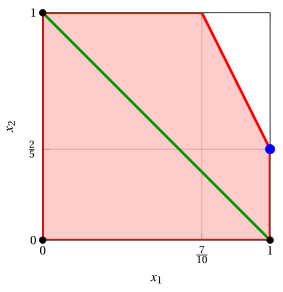
Original \(P_2\) and the boundary \(x_1+x_2=1\).
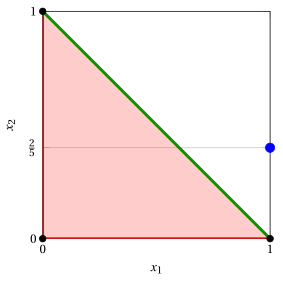
\(P_2\cap\{x_1+x_2\le1\}\): the blue point is removed.
Example 5.6: Successive cover cuts
For \(\mathscr{I}=\{1,2,3\}\), let
There are exactly three covers:
Only the last two are minimal. The blue point \(\tilde{x}_1=1\), \(\tilde{x}_2=2/5\), \(\tilde{x}_3=0\) lies in \(P_A\). It satisfies the first inequality and is on the boundary of the second; the third is violated by \(2/5\), exactly as in Example 5.5. Unlike the previous domain-only panels, every following panel includes the constraint \(10x_1+5x_2+6x_3\le12\).
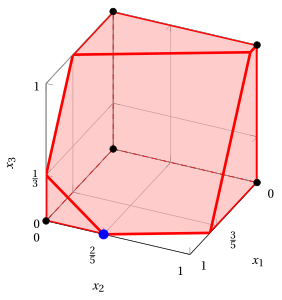
Original \(P_A\).
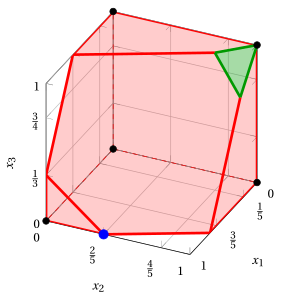
Add \(x_1+x_2+x_3\le2\).
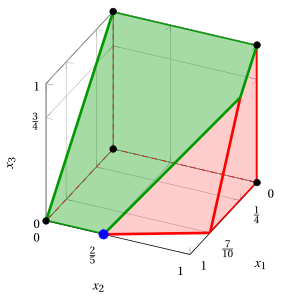
Also add \(x_1+x_3\le1\).
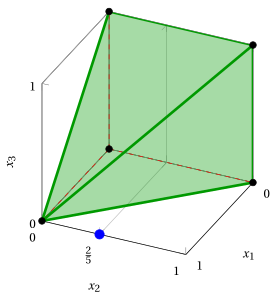
Also add \(x_1+x_2\le1\): the cover closure.
-
For the objective \(\max\,40x_1+15x_2+12x_3\), the optimal solution over \(P_A\) is \(\tilde{\vet x}=(1,2/5,0)\), with value \(46\). Over the cover closure, the optimal solution is \((1,0,0)\), with value \(40\), which is also optimal for the binary problem.
-
In this instance the cover closure coincides with \(\operatorname{conv}(X)\): its vertices, shown in the last panel, are all binary. This is a property of this instance, not of every cover closure.
Example 5.7: A different constraint
For \(\mathscr{I}=\{1,2,3\}\), consider now the instance
Every pair of variables satisfies the constraint, whereas the three coefficients sum to \(15>12\). Thus the only cover is \(\{1,2,3\}\) and it is minimal. Its inequality is \(x_1+x_2+x_3\le2\). The blue point \(\tilde{x}_1=\tilde{x}_2=1\), \(\tilde{x}_3=1/2\) has left-hand side \(12\) and violates this cut by \(1/2\).
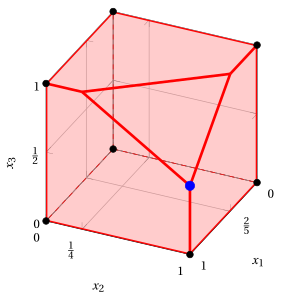
Original \(P_B\).
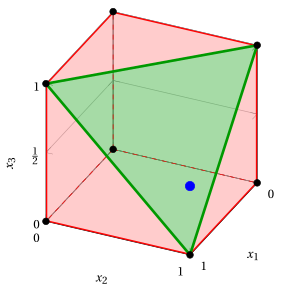
\(P_B\cap\{x_1+x_2+x_3\le2\}\).
-
The plane of the constraint intersects the cube edges at \((1,1,1/2)\), \((1,1/4,1)\) and \((2/5,1,1)\).
-
The cover removes these fractional vertices while preserving all seven feasible binary points. As in the 2D example, after the cut the constraint is redundant: the sum of the two largest coefficients is \(6+5=11<12\).
-
The polyhedron \(P_B\cap\{x_1+x_2+x_3\le2\}\) has only binary vertices (last panel): here a single cover inequality gives \(\operatorname{conv}(X)\).
5.4 Separation of cover inequalities
Given a point \(\tilde{\vet x}\in P\), the cover separation problem (CSP) consists in finding a cover inequality violated by \(\tilde{\vet x}\), or in proving that \(\tilde{\vet x}\) satisfies all the cover inequalities.
Formally, the CSP asks to find a cover
or to prove that
-
Typically, \(\tilde{\vet x}\) is an optimal solution of the current LP relaxation, but any point of \(P\) can be separated.
-
For a cover \(C\), the cover inequality is violated by \(\tilde{\vet x}\) if
\[\begin{equation*} \label{eq:violated} \sum_{j\in C}\tilde{x}_j>|C|-1. \tag{5.8} \end{equation*}\]Moving \(\sum_{j\in C}\tilde{x}_j\) to the right-hand side and \(1\) to the left-hand side, and writing \(|C|=\sum_{j\in C}1\), we obtain the equivalent conditions:
\[\begin{align*} |C|-\sum_{j\in C}\tilde{x}_j&<1, \\ \sum_{j\in C}1-\sum_{j\in C}\tilde{x}_j&<1, \\ \sum_{j\in C}(1-\tilde{x}_j)&<1. \label{eq:cost-test} \tag{5.9} \end{align*}\] -
Assigning to each index \(j\) the cost \(q_j=1-\tilde{x}_j\ge0\), the CSP amounts to finding a cover of minimum cost: a violated cover inequality exists if and only if this minimum cost is less than \(1\).
5.4.1 An ILP formulation for the CSP
-
Introduce \(n\) binary variables \(z_j\): \(z_j=1\) if \(j\) belongs to the cover and \(z_j=0\) otherwise.
-
The objective minimizes the total cover cost; the single constraint forces the selected set to be a cover.
Proposition 5.8
A cover inequality violated by \(\tilde{\vet x}\) exists if and only if \(z(\CSP)<1\).
Proof
Every feasible assignment of the binary variables \(z_j\) represents a cover \(C=\{j:z_j=1\}\), and its objective is \(\sum_{j\in C}(1-\tilde{x}_j)\). By \(\eqref{eq:cost-test}\), this is less than \(1\) exactly when the corresponding cut is violated. Taking the minimum over all covers proves both implications. The CSP is feasible because \(\mathscr{I}\) itself is a cover. □
Let \(\tilde{z}_1,\tilde{z}_2,\dots,\tilde{z}_n\) be an optimal solution of \(\CSP\). If \(z(\CSP)<1\), the cover
is associated with the cover inequality \(\sum_{j\in\tilde{C}}x_j\le|\tilde{C}|-1\) maximally violated by \(\tilde{\vet x}\). Otherwise, no cover inequality is violated by \(\tilde{\vet x}\).
-
To find a violated cover inequality, it is not necessary to solve \(\CSP\) to optimality: any feasible solution \(\bar{z}_1,\dots,\bar{z}_n\) of cost less than \(1\) gives the cover \(\bar{C}=\{j\in\mathscr{I}:\ \bar{z}_j=1\}\), whose cover inequality is violated by \(\tilde{\vet x}\).
-
Conversely, a feasible solution of cost at least \(1\) does not prove that no violated cover inequality exists: this requires the optimal value (or a lower bound) of \(\CSP\).
-
If \(z(\CSP)<1\), the maximum violation of a cover inequality at \(\tilde{\vet x}\) is \(1-z(\CSP)\).
Example 5.8: Separation of the cover inequalities
We consider again Example 5.1. The cover inequalities are separated iteratively: at each iteration, the current LP is solved, the \(\CSP\) is solved for its optimal solution \(\tilde{\vet x}\), and the maximally violated cover inequality is added, until no cover inequality is violated.
Iteration 1. An optimal solution of \(\LP\) is
The associated \(\CSP\) is:
An optimal solution of \(\CSP\) is \(\tilde{z}_1=\tilde{z}_2=\tilde{z}_3=1\), \(\tilde{z}_4=0\), with value \(z(\CSP)=\frac13<1\). Accordingly, \(\tilde{C}=\{j\in\mathscr{I}:\tilde{z}_j=1\}=\{1,2,3\}\) is the cover associated with the cover inequality maximally violated by \(\tilde{\vet x}\):
Iteration 2. Adding this cover inequality to \(\LP\), we obtain the following LP, denoted \(\LP_1\):
An optimal solution of \(\LP_1\) is
The associated \(\CSP\) is:
An optimal solution of \(\CSP\) is \(\tilde{z}_1=0\), \(\tilde{z}_2=1\), \(\tilde{z}_3=0\), \(\tilde{z}_4=1\), with value \(z(\CSP)=\frac37<1\) (the cover \(\{1,2,4\}\) has the same cost; we choose the minimal cover). Accordingly, \(\tilde{C}=\{j\in\mathscr{I}:\tilde{z}_j=1\}=\{2,4\}\) and the maximally violated cover inequality is
Iteration 3. Adding this cover inequality to \(\LP_1\), we obtain the following LP, denoted \(\LP_2\):
An optimal solution of \(\LP_2\) is
The associated \(\CSP\) is:
An optimal solution of \(\CSP\) is \(\tilde{z}_1=0\), \(\tilde{z}_2=1\), \(\tilde{z}_3=0\), \(\tilde{z}_4=1\), with value \(z(\CSP)=1\) (the covers \(\{1,2,3\}\) and \(\{1,2,4\}\) have the same cost): no cover inequality is violated by \(\tilde{\vet x}\), and the separation stops.
The final value \(z(\LP_2)=\frac{79}{5}\) coincides with the value \(z(\LPcov)\) of the cover closure (Example 5.2): the separation reaches the bound of the cover closure by adding only \(2\) of the \(7\) cover inequalities.
The solution \(\tilde{\vet x}\) is still fractional, although it satisfies all the cover inequalities: the cover closure does not coincide, in general, with the convex hull of the integer solutions.
5.5 Transforming the CSP into a complementary problem
-
Consider a feasible assignment of the CSP variables \(z_j\). Define the complementary binary variables \(y_j\) by
\[ y_j=1-z_j\qquad\forall j\in\mathscr{I}. \]Thus \(y_j=1\) if \(j\) is outside the cover, whereas \(y_j=0\) if \(j\) belongs to the cover.
-
The constraint becomes
\[ \sum_{j\in\mathscr{I}}a_j(1-y_j)\ge b+1 \quad\Longleftrightarrow\quad \sum_{j\in\mathscr{I}}a_jy_j\le\sum_{j\in\mathscr{I}}a_j-(b+1). \]By the assumption \(\sum_{j\in\mathscr{I}}a_j>b\), this right-hand side is non-negative.
-
The objective can be written as
\[ \sum_{j\in\mathscr{I}}(1-\tilde{x}_j)(1-y_j) =n-\sum_{j\in\mathscr{I}}\tilde{x}_j -\sum_{j\in\mathscr{I}}(1-\tilde{x}_j)y_j. \]Since the first two terms are constant, minimizing it is equivalent to the following problem, called the complementary problem, with non-negative (possibly zero) objective coefficients \(1-\tilde{x}_j\).
-
Complementation is a bijection between feasible solutions, so
\[\begin{equation*} \label{eq:values} z(\CSP) =n-\sum_{j\in\mathscr{I}}\tilde{x}_j-z(\CSPKP). \tag{5.12} \end{equation*}\]
Let \(\tilde{y}_1,\tilde{y}_2,\dots,\tilde{y}_n\) be an optimal solution of \(\CSPKP\). If \(n-\sum_{j\in\mathscr{I}}\tilde{x}_j-z(\CSPKP)<1\), the cover
is associated with the cover inequality \(\sum_{j\in\tilde{C}}x_j\le|\tilde{C}|-1\) maximally violated by \(\tilde{\vet x}\). Otherwise, no cover inequality is violated by \(\tilde{\vet x}\).
- Any feasible solution \(\bar{y}_1,\dots,\bar{y}_n\) of \(\CSPKP\) gives the cover \(\bar{C}=\{j\in\mathscr{I}:\ \bar{y}_j=0\}\), with cost \(n-\sum_{j\in\mathscr{I}}\tilde{x}_j-\sum_{j\in\mathscr{I}}(1-\tilde{x}_j)\bar{y}_j\): if this cost is less than \(1\), the cover inequality of \(\bar{C}\) is violated by \(\tilde{\vet x}\).
5.5.1 A greedy separation heuristic
The following greedy procedure constructs feasible values \(\bar{y}_j\) for the complementary problem.
-
Set \(\bar{y}_j=0\) for all \(j\in\mathscr{I}\) and the residual right-hand side \(r=\sum_{j\in\mathscr{I}}a_j-(b+1)\). Sort the indices by non-increasing ratio \(q_j/a_j=(1-\tilde{x}_j)/a_j\), breaking ties by increasing index.
-
Scan the indices in this order. If \(q_j>0\) and \(a_j\le r\), set \(\bar{y}_j=1\) and \(r:=r-a_j\); otherwise skip it.
-
Reconstruct the cover \(C=\{j:\bar{y}_j=0\}\) and evaluate its cost. If desired, reduce it to a minimal cover by removing indices as long as \(\sum_{j\in C}a_j\) exceeds \(b\).
-
Indices with \(q_j=0\) (\(\tilde{x}_j=1\)) are never selected: they remain in the cover, which may then be non-minimal.
-
Removing an index from a cover decreases its cost by \(q_j\ge0\): reducing a violated cover to a minimal one cannot decrease its violation.
-
The greedy algorithm is a heuristic for the complementary problem: if it does not find a violated cover inequality, we cannot conclude that none exists.
Example 5.9: Complementary problem and greedy scan
For the point \(\tilde{\vet x}=(1,1,\frac23,0)\) of Iteration 1 in Example 5.8,
The complementary problem is
| \(j\) | \(q_j\) | \(a_j\) | \(q_j/a_j\) | Decision | Residual |
|---|---|---|---|---|---|
| \(4\) | \(1\) | \(7\) | \(\frac{1}{7}\) | \(\bar{y}_j=1\) | \(1\) |
| \(3\) | \(\frac{1}{3}\) | \(6\) | \(\frac{1}{18}\) | \(\bar{y}_j=0\) | \(1\) |
| \(1\) | \(0\) | \(2\) | \(0\) | \(q_j=0\), \(\bar{y}_j=0\) | \(1\) |
| \(2\) | \(0\) | \(3\) | \(0\) | \(q_j=0\), \(\bar{y}_j=0\) | \(1\) |
The scan gives \(\bar{y}_1=\bar{y}_2=\bar{y}_3=0\) and \(\bar{y}_4=1\), of value \(1\). Indices \(3\) and \(4\) cannot be taken together; the only alternatives with positive objective coefficient have values \(1/3\) and \(1\). Thus this greedy solution is also optimal, and
The cover is \(\tilde{C}=\{j\in\mathscr{I}:\tilde{y}_j=0\}=\{1,2,3\}\), as found in Iteration 1 of Example 5.8.
5.6 Extended cover inequalities
-
A cover inequality can be strengthened by also considering the variables outside the cover whose coefficients are at least as large as every coefficient of the cover. Let
\[ \widehat{a}(C)=\max_{j\in C}a_j \]be the maximum coefficient of the variables in \(C\).
Definition 5.9: Extended cover inequality
For a cover \(C\), let
The associated extended cover inequality is
The right-hand side depends on \(|C|\), not on \(|E(C)|\).
Proposition 5.10
For every cover \(C\in\mathcal{C}\), the extended cover inequality \(\eqref{eq:extended}\) is valid for \(X\).
Proof
Let \(k=|C|\) and take any set \(S\subseteq E(C)\) with \(|S|=k\). The sets \(S\setminus C\) and \(C\setminus S\) have the same number of variables, and each coefficient \(a_j\) with \(j\in S\setminus C\) is at least \(\widehat{a}(C)\), i.e., at least as large as each coefficient with \(j\in C\setminus S\). Replacing the indices of \(C\setminus S\) with those of \(S\setminus C\) gives
Hence no point \(\vet x\in X\) can have \(k\) variables of \(E(C)\) equal to \(1\): at most \(k-1\) of them can be equal to \(1\) together. □
-
Since \(C\subseteq E(C)\) and the right-hand side is the same, the extended cover inequality dominates the cover inequality of \(C\).
-
It can be seen as a lifting of the coefficients of the variables in \(E(C)\setminus C\) from \(0\) to \(1\). It does not forbid a variable with a large coefficient to be equal to \(1\) together with variables of \(C\): it limits to \(|C|-1\) the number of variables of the whole set \(E(C)\) equal to \(1\).
Example 5.10: Strengthening the cover of the four-variable instance
In Example 5.1, consider the cover \(C=\{1,2,3\}\). Then \(\widehat{a}(C)=6\), and the coefficient of \(x_4\) is \(7\ge6\), so
The strengthened LP, denoted \(\LP_{\mathrm{ext}}\), is
An optimal solution of \(\LP_{\mathrm{ext}}\) is \(\tilde{\vet x}=(1,0,0,1)\), with value \(z(\LP_{\mathrm{ext}})=6+9=15\). Since it is binary, \(\tilde{\vet x}\) is also optimal for the binary problem. We have \(z(\LP_{\mathrm{ext}})=15<z(\LPcov)=79/5\): in this instance, one extended cover inequality is stronger than all the cover inequalities together.
5.7 Violation and distance from a cover inequality
-
Let \(C\subseteq\mathscr{I}\) be a cover. Its cover inequality is
\[ \sum_{j\in C}x_j\le |C|-1, \]and its boundary hyperplane is
\[ H_C=\left\{\vet x\in\mathbb{R}^n: \sum_{j\in C}x_j=|C|-1\right\}. \] -
The violation of the cover inequality at a point \(\tilde{\vet x}\) is
\[\begin{equation*} \label{eq:violation} v_C(\tilde{\vet x}) =\max\left\{0, \sum_{j\in C}\tilde{x}_j-(|C|-1)\right\}. \tag{5.14} \end{equation*}\]The point violates the cover inequality precisely when \(v_C(\tilde{\vet x})>0\).
-
The coefficients of the cover inequality are \(1\) for \(j\in C\) and \(0\) otherwise, so their Euclidean norm is \(\sqrt{|C|}\). Therefore, the Euclidean distance of \(\tilde{\vet x}\) from \(H_C\) is
\[\begin{equation*} \label{eq:distance} d(\tilde{\vet x},H_C) =\frac{\left|\sum_{j\in C}\tilde{x}_j-(|C|-1)\right|} {\sqrt{|C|}}. \tag{5.15} \end{equation*}\]If the cover inequality is violated,
\[ d(\tilde{\vet x},H_C)=\frac{v_C(\tilde{\vet x})}{\sqrt{|C|}}. \] -
The orthogonal projection \(\vet x^{\perp}\) of \(\tilde{\vet x}\) onto \(H_C\) has components
\[\begin{equation*} \label{eq:projection} x_j^{\perp} =\begin{cases} \displaystyle \tilde{x}_j- \dfrac{\sum_{k\in C}\tilde{x}_k-(|C|-1)}{|C|}, &j\in C,\\[2ex] \tilde{x}_j,&j\in\mathscr{I}\setminus C. \end{cases} \tag{5.16} \end{equation*}\]Indeed, substitution gives \(\sum_{j\in C}x_j^{\perp}=|C|-1\).
-
The CSP maximizes the violation, not the distance: when the covers have different cardinalities, the two criteria can rank them differently. For example, at the point \(\tilde{\vet x}=(1/10,1,1)\) of \(P_A\) (Example 5.6), the covers \(\{1,2\}\), \(\{1,3\}\) and \(\{1,2,3\}\) all have violation \(1/10\), but their distances are \(1/(10\sqrt2)\), \(1/(10\sqrt2)\) and \(1/(10\sqrt3)\), respectively.
Example 5.11: Orthogonal projection in two dimensions
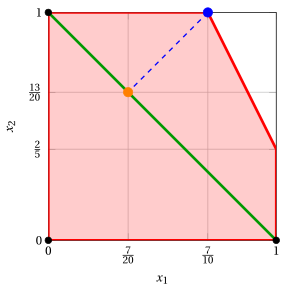
Take the vertex \(\tilde{x}_1=7/10\), \(\tilde{x}_2=1\) of \(P_2\) in Example 5.5 and the cover \(C=\{1,2\}\). Its cover inequality is \(x_1+x_2\le1\) and \(|C|=2\). Then
The red region is \(P_2\) and the green edge is the boundary \(H_C\). The blue dashed segment is perpendicular to \(H_C\) and the orange point is the orthogonal projection.
Example 5.12: Orthogonal projection in three dimensions
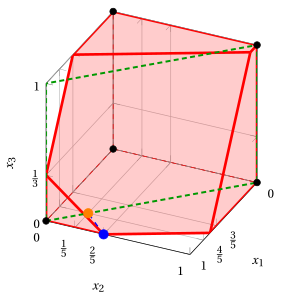
Take the point \(\tilde{x}_1=1\), \(\tilde{x}_2=2/5\), \(\tilde{x}_3=0\) of \(P_A\) in Example 5.6 and the cover \(C=\{1,2\}\). Its cover inequality is \(x_1+x_2\le1\) and \(|C|=2\). Then
The red region is \(P_A\) and the green dashed rectangle is \(H_C\) restricted to the unit cube. Since \(3\notin C\), the projection does not change \(\tilde{x}_3\).
5.8 Typical mistakes
Warning
-
Using a set that is not a cover. The inequality \(\sum_{j\in C}x_j\le|C|-1\) is valid only if the total coefficient \(\sum_{j\in C}a_j\) exceeds the right-hand side \(b\); check the coefficients before writing it.
-
Using \(|E(C)|-1\) for an extended cover. The right-hand side of the extended cover inequality is \(|C|-1\), where \(C\) is the cover, not \(|E(C)|-1\).
-
Removing all the indices with \(q_j=0\) from a cover. To obtain a minimal cover, remove indices one at a time as long as the remaining set is still a cover: removing all of them may leave a set that is not a cover.
-
Stopping the separation at a heuristic failure. If the greedy heuristic algorithm finds no violated cover inequality, we cannot conclude that none exists: only the optimal value of the separation problem proves it.
-
Confusing violation and distance. The cover separation problem maximizes the violation; covers with the same violation can have different distances from the point.
-
Believing that the cover closure is the convex hull. A point can satisfy all the cover inequalities and still be fractional (Example 5.8).
5.9 In summary
In summary
-
A cover is a set of variables whose total coefficient exceeds the right-hand side; its cover inequality allows at most \(|C|-1\) of its variables to be equal to \(1\), and it is valid for \(X\).
-
The minimal covers are enough: their inequalities imply all the others, but they can be exponentially many, so they are separated only when violated.
-
Separating a cover inequality means finding a cover of minimum cost \(\sum_{j\in C}(1-\tilde{x}_j)\): a violated inequality exists if and only if the minimum cost is less than \(1\); this is a 0–1 problem with one \(\le\) constraint, defined in the chapter.
-
An extended cover inequality dominates the cover inequality of the same cover.
-
The cover closure is closer to \(\operatorname{conv}(X)\) than the LP relaxation, but in general it is not equal to it.
Dashboard of the four-variable instance. The lower and upper bounds on the optimal value of the binary problem of Example 5.1. The objective coefficients are integer, so the upper bound is the rounded-down value of the LP relaxation.
| Source | Lower bound | Upper bound | From |
|---|---|---|---|
| LP relaxation | \(11\) | \(16\) | greedy solution \((1,1,0,0)\), \(\lfloor z(\LP)\rfloor\) with \(z(\LP)=\tfrac{49}{3}\) |
| Cover closure | \(11\) | \(15\) | \(\lfloor z(\LPcov)\rfloor\) with \(z(\LPcov)=\tfrac{79}{5}\), \(2\) separated covers |
| Extended cover | \(15\) | \(15\) | \(z(\LP_{\mathrm{ext}})=15\), optimal solution \((1,0,0,1)\) |
Exercises on this chapter: Cover inequalities