Exercises · Cover inequalities
Exercises · Chapter 5 · each solution opens with a click · Chapter 5: Cover inequalities · Exercises, volume 1 (PDF)
Cover separation
Exercise 5.1: Cover inequalities (P1)
Consider a binary problem with one constraint \(\sum_{j}a_jx_j\le b\), with positive integer coefficients \(a_j\) and right-hand side \(b=8\), on the binary variables indexed by the set \(\mathscr{I}=\{1,2,3,4\}\) of \(n=4\) variables with the following objective coefficients and constraint coefficients:
The associated \(\LP\) is:
An optimal solution \(\tilde{\boldsymbol{x}}\) of \(\LP\) and its value are:
Questions
-
List all the cover inequalities and identify the minimal covers.
-
For the point \(\tilde{\boldsymbol{x}}\), write the separation problem \(\CSP\) and its complementary problem \(\CSPKP\).
-
Apply the greedy heuristic to \(\CSPKP\) and, if possible, find a violated cover inequality.
-
Check whether the greedy solution is optimal.
A subset of indices \(C\subseteq\mathscr{I}\) with \(\sum_{j\in C}a_j>b\) is a cover, and the linear inequality
is the cover inequality associated with \(C\). Given a point \(\tilde{\boldsymbol{x}}\), a cover inequality violated by \(\tilde{\boldsymbol{x}}\) exists if and only if \(z(\CSP)<1\), where
Solution
Separation of the cover inequalities violated by \(\tilde{\boldsymbol{x}}\).
-
Cover inequalities
The covers are the subsets of indices whose total coefficient exceeds \(b=8\):\(C\) \(\sum_{j\in C}a_j\) \(|C|\) Cover inequality Minimal \(\{1,2\}\) \(11\) \(2\) \(x_1+x_2\le 1\) yes \(\{1,3\}\) \(9\) \(2\) \(x_1+x_3\le 1\) yes \(\{2,3\}\) \(12\) \(2\) \(x_2+x_3\le 1\) yes \(\{2,4\}\) \(10\) \(2\) \(x_2+x_4\le 1\) yes \(\{1,2,3\}\) \(16\) \(3\) \(x_1+x_2+x_3\le 2\) no \(\{1,2,4\}\) \(14\) \(3\) \(x_1+x_2+x_4\le 2\) no \(\{1,3,4\}\) \(12\) \(3\) \(x_1+x_3+x_4\le 2\) no \(\{2,3,4\}\) \(15\) \(3\) \(x_2+x_3+x_4\le 2\) no \(\{1,2,3,4\}\) \(19\) \(4\) \(x_1+x_2+x_3+x_4\le 3\) no There are \(9\) covers, of which \(4\) are minimal. The cover inequalities of the non-minimal covers are implied by those of the minimal covers and by the bounds \(x_j\le1\).
-
Separation problem
The costs \(q_j=1-\tilde{x}_j\) are \(q=\left(0,\tfrac{3}{7},1,1\right)\), and the separation problem \(\CSP\) is:\[ \begin{array}{rrcrcrcrcl} {\min} & & & {\frac{3}{7}\,z_2} & {+} & {z_3} & {+} & {z_4} & & \\[1ex] \text{subject to} & {4\,z_1} & {+} & {7\,z_2} & {+} & {5\,z_3} & {+} & {3\,z_4} & {\ge} & {9} \\[1ex] & {z_1,} & & {z_2,} & & {z_3,} & & {z_4} & {\in} & {\{0,1\}} \end{array} \]With \(y_j=1-z_j\), the constant term and the right-hand side of the complementary problem are
\[ n-\sum_{j\in\mathscr{I}}\tilde{x}_j=\frac{17}{7}, \qquad \sum_{j\in\mathscr{I}}a_j-(b+1)=19-9=10, \]and the complementary problem \(\CSPKP\) is:
\[ \begin{array}{rrcrcrcrcl} {\max} & & & {\frac{3}{7}\,y_2} & {+} & {y_3} & {+} & {y_4} & & \\[1ex] \text{subject to} & {4\,y_1} & {+} & {7\,y_2} & {+} & {5\,y_3} & {+} & {3\,y_4} & {\le} & {10} \\[1ex] & {y_1,} & & {y_2,} & & {y_3,} & & {y_4} & {\in} & {\{0,1\}} \end{array} \]with \(z(\CSP)=\frac{17}{7}-z(\CSPKP)\).
-
Greedy heuristic
The indices are scanned by non-increasing ratio \(q_j/a_j\), starting from the residual right-hand side \(10\):\(j\) \(q_j\) \(a_j\) \(q_j/a_j\) Decision Residual \(4\) \(1\) \(3\) \(\tfrac{1}{3}\) \(\bar{y}_j=1\) \(7\) \(3\) \(1\) \(5\) \(\tfrac{1}{5}\) \(\bar{y}_j=1\) \(2\) \(2\) \(\tfrac{3}{7}\) \(7\) \(\tfrac{3}{49}\) \(\bar{y}_j=0\) \(2\) \(1\) \(0\) \(4\) \(0\) \(q_j=0\), \(\bar{y}_j=0\) \(2\) The greedy solution is \(\bar{\boldsymbol{y}}=\left(0,0,1,1\right)\), with value \(2\). The corresponding cover is \(\bar{C}=\{j\in\mathscr{I}:\bar{y}_j=0\}=\{1,2\}\), of total coefficient \(11>8\) and cost \(\frac{17}{7}-2=\frac{3}{7}<1\). Hence the cover inequality
\[ x_1+x_2\le 1 \]is violated by \(\tilde{\boldsymbol{x}}\): \(1+\frac{4}{7}-1=\frac{4}{7}\).
-
Optimality check
Indices with \(q_j=0\) do not change the value of a solution. The non-empty subsets of the indices \(\{2,3,4\}\) with \(q_j>0\) that satisfy the constraint with right-hand side \(10\) are: \(\{2\}\) (value \(\frac{3}{7}\)), \(\{3\}\) (value \(1\)), \(\{4\}\) (value \(1\)), \(\{2,4\}\) (value \(\frac{10}{7}\)), \(\{3,4\}\) (value \(2\)). Hence \(z(\CSPKP)=2\), the greedy solution is optimal, \(z(\CSP)=\frac{3}{7}<1\), and the maximum violation of a cover inequality is \(\frac{4}{7}\).
Exercise 5.2: Cover inequalities (P2)
Consider a binary problem with one constraint \(\sum_{j}a_jx_j\le b\), with positive integer coefficients \(a_j\) and right-hand side \(b=15\), on the binary variables indexed by the set \(\mathscr{I}=\{1,2,3,4\}\) of \(n=4\) variables with the following objective coefficients and constraint coefficients:
The associated \(\LP\) is:
An optimal solution \(\tilde{\boldsymbol{x}}\) of \(\LP\) and its value are:
Questions
-
List all the cover inequalities and identify the minimal covers.
-
For the point \(\tilde{\boldsymbol{x}}\), write the separation problem \(\CSP\) and its complementary problem \(\CSPKP\).
-
Apply the greedy heuristic to \(\CSPKP\) and, if possible, find a violated cover inequality.
-
Check whether the greedy solution is optimal.
A subset of indices \(C\subseteq\mathscr{I}\) with \(\sum_{j\in C}a_j>b\) is a cover, and the linear inequality
is the cover inequality associated with \(C\). Given a point \(\tilde{\boldsymbol{x}}\), a cover inequality violated by \(\tilde{\boldsymbol{x}}\) exists if and only if \(z(\CSP)<1\), where
Solution
Separation of the cover inequalities violated by \(\tilde{\boldsymbol{x}}\).
-
Cover inequalities
The covers are the subsets of indices whose total coefficient exceeds \(b=15\):\(C\) \(\sum_{j\in C}a_j\) \(|C|\) Cover inequality Minimal \(\{1,2\}\) \(18\) \(2\) \(x_1+x_2\le 1\) yes \(\{1,3\}\) \(16\) \(2\) \(x_1+x_3\le 1\) yes \(\{1,2,3\}\) \(24\) \(3\) \(x_1+x_2+x_3\le 2\) no \(\{1,2,4\}\) \(23\) \(3\) \(x_1+x_2+x_4\le 2\) no \(\{1,3,4\}\) \(21\) \(3\) \(x_1+x_3+x_4\le 2\) no \(\{2,3,4\}\) \(19\) \(3\) \(x_2+x_3+x_4\le 2\) yes \(\{1,2,3,4\}\) \(29\) \(4\) \(x_1+x_2+x_3+x_4\le 3\) no There are \(7\) covers, of which \(3\) are minimal. The cover inequalities of the non-minimal covers are implied by those of the minimal covers and by the bounds \(x_j\le1\).
-
Separation problem
The costs \(q_j=1-\tilde{x}_j\) are \(q=\left(0,\tfrac{3}{8},1,1\right)\), and the separation problem \(\CSP\) is:\[ \begin{array}{rrcrcrcrcl} {\min} & & & {\frac{3}{8}\,z_2} & {+} & {z_3} & {+} & {z_4} & & \\[1ex] \text{subject to} & {10\,z_1} & {+} & {8\,z_2} & {+} & {6\,z_3} & {+} & {5\,z_4} & {\ge} & {16} \\[1ex] & {z_1,} & & {z_2,} & & {z_3,} & & {z_4} & {\in} & {\{0,1\}} \end{array} \]With \(y_j=1-z_j\), the constant term and the right-hand side of the complementary problem are
\[ n-\sum_{j\in\mathscr{I}}\tilde{x}_j=\frac{19}{8}, \qquad \sum_{j\in\mathscr{I}}a_j-(b+1)=29-16=13, \]and the complementary problem \(\CSPKP\) is:
\[ \begin{array}{rrcrcrcrcl} {\max} & & & {\frac{3}{8}\,y_2} & {+} & {y_3} & {+} & {y_4} & & \\[1ex] \text{subject to} & {10\,y_1} & {+} & {8\,y_2} & {+} & {6\,y_3} & {+} & {5\,y_4} & {\le} & {13} \\[1ex] & {y_1,} & & {y_2,} & & {y_3,} & & {y_4} & {\in} & {\{0,1\}} \end{array} \]with \(z(\CSP)=\frac{19}{8}-z(\CSPKP)\).
-
Greedy heuristic
The indices are scanned by non-increasing ratio \(q_j/a_j\), starting from the residual right-hand side \(13\):\(j\) \(q_j\) \(a_j\) \(q_j/a_j\) Decision Residual \(4\) \(1\) \(5\) \(\tfrac{1}{5}\) \(\bar{y}_j=1\) \(8\) \(3\) \(1\) \(6\) \(\tfrac{1}{6}\) \(\bar{y}_j=1\) \(2\) \(2\) \(\tfrac{3}{8}\) \(8\) \(\tfrac{3}{64}\) \(\bar{y}_j=0\) \(2\) \(1\) \(0\) \(10\) \(0\) \(q_j=0\), \(\bar{y}_j=0\) \(2\) The greedy solution is \(\bar{\boldsymbol{y}}=\left(0,0,1,1\right)\), with value \(2\). The corresponding cover is \(\bar{C}=\{j\in\mathscr{I}:\bar{y}_j=0\}=\{1,2\}\), of total coefficient \(18>15\) and cost \(\frac{19}{8}-2=\frac{3}{8}<1\). Hence the cover inequality
\[ x_1+x_2\le 1 \]is violated by \(\tilde{\boldsymbol{x}}\): \(1+\frac{5}{8}-1=\frac{5}{8}\).
-
Optimality check
Indices with \(q_j=0\) do not change the value of a solution. The non-empty subsets of the indices \(\{2,3,4\}\) with \(q_j>0\) that satisfy the constraint with right-hand side \(13\) are: \(\{2\}\) (value \(\frac{3}{8}\)), \(\{3\}\) (value \(1\)), \(\{4\}\) (value \(1\)), \(\{2,4\}\) (value \(\frac{11}{8}\)), \(\{3,4\}\) (value \(2\)). Hence \(z(\CSPKP)=2\), the greedy solution is optimal, \(z(\CSP)=\frac{3}{8}<1\), and the maximum violation of a cover inequality is \(\frac{5}{8}\).
Exercise 5.3: Cover inequalities (P3)
Consider a binary problem with one constraint \(\sum_{j}a_jx_j\le b\), with positive integer coefficients \(a_j\) and right-hand side \(b=12\), on the binary variables indexed by the set \(\mathscr{I}=\{1,2,3,4\}\) of \(n=4\) variables with the following objective coefficients and constraint coefficients:
The associated \(\LP\) is:
An optimal solution \(\tilde{\boldsymbol{x}}\) of \(\LP\) and its value are:
Questions
-
List all the cover inequalities and identify the minimal covers.
-
For the point \(\tilde{\boldsymbol{x}}\), write the separation problem \(\CSP\) and its complementary problem \(\CSPKP\).
-
Apply the greedy heuristic to \(\CSPKP\) and, if possible, find a violated cover inequality.
-
Check whether the greedy solution is optimal.
A subset of indices \(C\subseteq\mathscr{I}\) with \(\sum_{j\in C}a_j>b\) is a cover, and the linear inequality
is the cover inequality associated with \(C\). Given a point \(\tilde{\boldsymbol{x}}\), a cover inequality violated by \(\tilde{\boldsymbol{x}}\) exists if and only if \(z(\CSP)<1\), where
Solution
Separation of the cover inequalities violated by \(\tilde{\boldsymbol{x}}\).
-
Cover inequalities
The covers are the subsets of indices whose total coefficient exceeds \(b=12\):\(C\) \(\sum_{j\in C}a_j\) \(|C|\) Cover inequality Minimal \(\{1,3\}\) \(15\) \(2\) \(x_1+x_3\le 1\) yes \(\{3,4\}\) \(16\) \(2\) \(x_3+x_4\le 1\) yes \(\{1,2,3\}\) \(17\) \(3\) \(x_1+x_2+x_3\le 2\) no \(\{1,2,4\}\) \(13\) \(3\) \(x_1+x_2+x_4\le 2\) yes \(\{1,3,4\}\) \(21\) \(3\) \(x_1+x_3+x_4\le 2\) no \(\{2,3,4\}\) \(18\) \(3\) \(x_2+x_3+x_4\le 2\) no \(\{1,2,3,4\}\) \(23\) \(4\) \(x_1+x_2+x_3+x_4\le 3\) no There are \(7\) covers, of which \(3\) are minimal. The cover inequalities of the non-minimal covers are implied by those of the minimal covers and by the bounds \(x_j\le1\).
-
Separation problem
The costs \(q_j=1-\tilde{x}_j\) are \(q=\left(0,0,\tfrac{1}{2},1\right)\), and the separation problem \(\CSP\) is:\[ \begin{array}{rrcrcrcrcl} {\min} & & & & & {\frac{1}{2}\,z_3} & {+} & {z_4} & & \\[1ex] \text{subject to} & {5\,z_1} & {+} & {2\,z_2} & {+} & {10\,z_3} & {+} & {6\,z_4} & {\ge} & {13} \\[1ex] & {z_1,} & & {z_2,} & & {z_3,} & & {z_4} & {\in} & {\{0,1\}} \end{array} \]With \(y_j=1-z_j\), the constant term and the right-hand side of the complementary problem are
\[ n-\sum_{j\in\mathscr{I}}\tilde{x}_j=\frac{3}{2}, \qquad \sum_{j\in\mathscr{I}}a_j-(b+1)=23-13=10, \]and the complementary problem \(\CSPKP\) is:
\[ \begin{array}{rrcrcrcrcl} {\max} & & & & & {\frac{1}{2}\,y_3} & {+} & {y_4} & & \\[1ex] \text{subject to} & {5\,y_1} & {+} & {2\,y_2} & {+} & {10\,y_3} & {+} & {6\,y_4} & {\le} & {10} \\[1ex] & {y_1,} & & {y_2,} & & {y_3,} & & {y_4} & {\in} & {\{0,1\}} \end{array} \]with \(z(\CSP)=\frac{3}{2}-z(\CSPKP)\).
-
Greedy heuristic
The indices are scanned by non-increasing ratio \(q_j/a_j\), starting from the residual right-hand side \(10\):\(j\) \(q_j\) \(a_j\) \(q_j/a_j\) Decision Residual \(4\) \(1\) \(6\) \(\tfrac{1}{6}\) \(\bar{y}_j=1\) \(4\) \(3\) \(\tfrac{1}{2}\) \(10\) \(\tfrac{1}{20}\) \(\bar{y}_j=0\) \(4\) \(1\) \(0\) \(5\) \(0\) \(q_j=0\), \(\bar{y}_j=0\) \(4\) \(2\) \(0\) \(2\) \(0\) \(q_j=0\), \(\bar{y}_j=0\) \(4\) The greedy solution is \(\bar{\boldsymbol{y}}=\left(0,0,0,1\right)\), with value \(1\). The corresponding cover is \(\bar{C}=\{j\in\mathscr{I}:\bar{y}_j=0\}=\{1,2,3\}\), of total coefficient \(17>12\) and cost \(\frac{3}{2}-1=\frac{1}{2}<1\). Hence the cover inequality
\[ x_1+x_2+x_3\le 2 \]is violated by \(\tilde{\boldsymbol{x}}\): \(1+1+\frac{1}{2}-2=\frac{1}{2}\).
-
Optimality check
Indices with \(q_j=0\) do not change the value of a solution. The non-empty subsets of the indices \(\{3,4\}\) with \(q_j>0\) that satisfy the constraint with right-hand side \(10\) are: \(\{3\}\) (value \(\frac{1}{2}\)), \(\{4\}\) (value \(1\)). Hence \(z(\CSPKP)=1\), the greedy solution is optimal, \(z(\CSP)=\frac{1}{2}<1\), and the maximum violation of a cover inequality is \(\frac{1}{2}\).The cover \(\bar{C}\) is not minimal: removing an index with \(q_j=0\) gives the minimal cover \(\{1,3\}\), with the same cost \(\frac{1}{2}\). Its cover inequality \(x_1+x_3\le 1\) has the same violation \(\frac{1}{2}\) and is stronger.
Exercise 5.4: Cover inequalities (P4)
Consider a binary problem with one constraint \(\sum_{j}a_jx_j\le b\), with positive integer coefficients \(a_j\) and right-hand side \(b=11\), on the binary variables indexed by the set \(\mathscr{I}=\{1,2,3,4\}\) of \(n=4\) variables with the following objective coefficients and constraint coefficients:
The associated \(\LP\) is:
An optimal solution \(\tilde{\boldsymbol{x}}\) of \(\LP\) and its value are:
Questions
-
List all the cover inequalities and identify the minimal covers.
-
For the point \(\tilde{\boldsymbol{x}}\), write the separation problem \(\CSP\) and its complementary problem \(\CSPKP\).
-
Apply the greedy heuristic to \(\CSPKP\) and, if possible, find a violated cover inequality.
-
Check whether the greedy solution is optimal.
A subset of indices \(C\subseteq\mathscr{I}\) with \(\sum_{j\in C}a_j>b\) is a cover, and the linear inequality
is the cover inequality associated with \(C\). Given a point \(\tilde{\boldsymbol{x}}\), a cover inequality violated by \(\tilde{\boldsymbol{x}}\) exists if and only if \(z(\CSP)<1\), where
Solution
Separation of the cover inequalities violated by \(\tilde{\boldsymbol{x}}\).
-
Cover inequalities
The covers are the subsets of indices whose total coefficient exceeds \(b=11\):\(C\) \(\sum_{j\in C}a_j\) \(|C|\) Cover inequality Minimal \(\{1,2\}\) \(14\) \(2\) \(x_1+x_2\le 1\) yes \(\{1,3\}\) \(14\) \(2\) \(x_1+x_3\le 1\) yes \(\{2,3\}\) \(18\) \(2\) \(x_2+x_3\le 1\) yes \(\{2,4\}\) \(14\) \(2\) \(x_2+x_4\le 1\) yes \(\{3,4\}\) \(14\) \(2\) \(x_3+x_4\le 1\) yes \(\{1,2,3\}\) \(23\) \(3\) \(x_1+x_2+x_3\le 2\) no \(\{1,2,4\}\) \(19\) \(3\) \(x_1+x_2+x_4\le 2\) no \(\{1,3,4\}\) \(19\) \(3\) \(x_1+x_3+x_4\le 2\) no \(\{2,3,4\}\) \(23\) \(3\) \(x_2+x_3+x_4\le 2\) no \(\{1,2,3,4\}\) \(28\) \(4\) \(x_1+x_2+x_3+x_4\le 3\) no There are \(10\) covers, of which \(5\) are minimal. The cover inequalities of the non-minimal covers are implied by those of the minimal covers and by the bounds \(x_j\le1\).
-
Separation problem
The costs \(q_j=1-\tilde{x}_j\) are \(q=\left(0,\tfrac{1}{3},1,1\right)\), and the separation problem \(\CSP\) is:\[ \begin{array}{rrcrcrcrcl} {\min} & & & {\frac{1}{3}\,z_2} & {+} & {z_3} & {+} & {z_4} & & \\[1ex] \text{subject to} & {5\,z_1} & {+} & {9\,z_2} & {+} & {9\,z_3} & {+} & {5\,z_4} & {\ge} & {12} \\[1ex] & {z_1,} & & {z_2,} & & {z_3,} & & {z_4} & {\in} & {\{0,1\}} \end{array} \]With \(y_j=1-z_j\), the constant term and the right-hand side of the complementary problem are
\[ n-\sum_{j\in\mathscr{I}}\tilde{x}_j=\frac{7}{3}, \qquad \sum_{j\in\mathscr{I}}a_j-(b+1)=28-12=16, \]and the complementary problem \(\CSPKP\) is:
\[ \begin{array}{rrcrcrcrcl} {\max} & & & {\frac{1}{3}\,y_2} & {+} & {y_3} & {+} & {y_4} & & \\[1ex] \text{subject to} & {5\,y_1} & {+} & {9\,y_2} & {+} & {9\,y_3} & {+} & {5\,y_4} & {\le} & {16} \\[1ex] & {y_1,} & & {y_2,} & & {y_3,} & & {y_4} & {\in} & {\{0,1\}} \end{array} \]with \(z(\CSP)=\frac{7}{3}-z(\CSPKP)\).
-
Greedy heuristic
The indices are scanned by non-increasing ratio \(q_j/a_j\), starting from the residual right-hand side \(16\):\(j\) \(q_j\) \(a_j\) \(q_j/a_j\) Decision Residual \(4\) \(1\) \(5\) \(\tfrac{1}{5}\) \(\bar{y}_j=1\) \(11\) \(3\) \(1\) \(9\) \(\tfrac{1}{9}\) \(\bar{y}_j=1\) \(2\) \(2\) \(\tfrac{1}{3}\) \(9\) \(\tfrac{1}{27}\) \(\bar{y}_j=0\) \(2\) \(1\) \(0\) \(5\) \(0\) \(q_j=0\), \(\bar{y}_j=0\) \(2\) The greedy solution is \(\bar{\boldsymbol{y}}=\left(0,0,1,1\right)\), with value \(2\). The corresponding cover is \(\bar{C}=\{j\in\mathscr{I}:\bar{y}_j=0\}=\{1,2\}\), of total coefficient \(14>11\) and cost \(\frac{7}{3}-2=\frac{1}{3}<1\). Hence the cover inequality
\[ x_1+x_2\le 1 \]is violated by \(\tilde{\boldsymbol{x}}\): \(1+\frac{2}{3}-1=\frac{2}{3}\).
-
Optimality check
Indices with \(q_j=0\) do not change the value of a solution. The non-empty subsets of the indices \(\{2,3,4\}\) with \(q_j>0\) that satisfy the constraint with right-hand side \(16\) are: \(\{2\}\) (value \(\frac{1}{3}\)), \(\{3\}\) (value \(1\)), \(\{4\}\) (value \(1\)), \(\{2,4\}\) (value \(\frac{4}{3}\)), \(\{3,4\}\) (value \(2\)). Hence \(z(\CSPKP)=2\), the greedy solution is optimal, \(z(\CSP)=\frac{1}{3}<1\), and the maximum violation of a cover inequality is \(\frac{2}{3}\).
Exercise 5.5: Cover inequalities (P5)
Consider a binary problem with one constraint \(\sum_{j}a_jx_j\le b\), with positive integer coefficients \(a_j\) and right-hand side \(b=12\), on the binary variables indexed by the set \(\mathscr{I}=\{1,2,3,4\}\) of \(n=4\) variables with the following objective coefficients and constraint coefficients:
The associated \(\LP\) is:
An optimal solution \(\tilde{\boldsymbol{x}}\) of \(\LP\) and its value are:
Questions
-
List all the cover inequalities and identify the minimal covers.
-
For the point \(\tilde{\boldsymbol{x}}\), write the separation problem \(\CSP\) and its complementary problem \(\CSPKP\).
-
Apply the greedy heuristic to \(\CSPKP\) and, if possible, find a violated cover inequality.
-
Check whether the greedy solution is optimal.
A subset of indices \(C\subseteq\mathscr{I}\) with \(\sum_{j\in C}a_j>b\) is a cover, and the linear inequality
is the cover inequality associated with \(C\). Given a point \(\tilde{\boldsymbol{x}}\), a cover inequality violated by \(\tilde{\boldsymbol{x}}\) exists if and only if \(z(\CSP)<1\), where
Solution
Separation of the cover inequalities violated by \(\tilde{\boldsymbol{x}}\).
-
Cover inequalities
The covers are the subsets of indices whose total coefficient exceeds \(b=12\):\(C\) \(\sum_{j\in C}a_j\) \(|C|\) Cover inequality Minimal \(\{1,2,3\}\) \(13\) \(3\) \(x_1+x_2+x_3\le 2\) yes \(\{1,2,4\}\) \(13\) \(3\) \(x_1+x_2+x_4\le 2\) yes \(\{1,3,4\}\) \(13\) \(3\) \(x_1+x_3+x_4\le 2\) yes \(\{2,3,4\}\) \(15\) \(3\) \(x_2+x_3+x_4\le 2\) yes \(\{1,2,3,4\}\) \(18\) \(4\) \(x_1+x_2+x_3+x_4\le 3\) no There are \(5\) covers, of which \(4\) are minimal. The cover inequalities of the non-minimal covers are implied by those of the minimal covers and by the bounds \(x_j\le1\).
-
Separation problem
The costs \(q_j=1-\tilde{x}_j\) are \(q=\left(0,0,\tfrac{1}{5},1\right)\), and the separation problem \(\CSP\) is:\[ \begin{array}{rrcrcrcrcl} {\min} & & & & & {\frac{1}{5}\,z_3} & {+} & {z_4} & & \\[1ex] \text{subject to} & {3\,z_1} & {+} & {5\,z_2} & {+} & {5\,z_3} & {+} & {5\,z_4} & {\ge} & {13} \\[1ex] & {z_1,} & & {z_2,} & & {z_3,} & & {z_4} & {\in} & {\{0,1\}} \end{array} \]With \(y_j=1-z_j\), the constant term and the right-hand side of the complementary problem are
\[ n-\sum_{j\in\mathscr{I}}\tilde{x}_j=\frac{6}{5}, \qquad \sum_{j\in\mathscr{I}}a_j-(b+1)=18-13=5, \]and the complementary problem \(\CSPKP\) is:
\[ \begin{array}{rrcrcrcrcl} {\max} & & & & & {\frac{1}{5}\,y_3} & {+} & {y_4} & & \\[1ex] \text{subject to} & {3\,y_1} & {+} & {5\,y_2} & {+} & {5\,y_3} & {+} & {5\,y_4} & {\le} & {5} \\[1ex] & {y_1,} & & {y_2,} & & {y_3,} & & {y_4} & {\in} & {\{0,1\}} \end{array} \]with \(z(\CSP)=\frac{6}{5}-z(\CSPKP)\).
-
Greedy heuristic
The indices are scanned by non-increasing ratio \(q_j/a_j\), starting from the residual right-hand side \(5\):\(j\) \(q_j\) \(a_j\) \(q_j/a_j\) Decision Residual \(4\) \(1\) \(5\) \(\tfrac{1}{5}\) \(\bar{y}_j=1\) \(0\) \(3\) \(\tfrac{1}{5}\) \(5\) \(\tfrac{1}{25}\) \(\bar{y}_j=0\) \(0\) \(1\) \(0\) \(3\) \(0\) \(q_j=0\), \(\bar{y}_j=0\) \(0\) \(2\) \(0\) \(5\) \(0\) \(q_j=0\), \(\bar{y}_j=0\) \(0\) The greedy solution is \(\bar{\boldsymbol{y}}=\left(0,0,0,1\right)\), with value \(1\). The corresponding cover is \(\bar{C}=\{j\in\mathscr{I}:\bar{y}_j=0\}=\{1,2,3\}\), of total coefficient \(13>12\) and cost \(\frac{6}{5}-1=\frac{1}{5}<1\). Hence the cover inequality
\[ x_1+x_2+x_3\le 2 \]is violated by \(\tilde{\boldsymbol{x}}\): \(1+1+\frac{4}{5}-2=\frac{4}{5}\).
-
Optimality check
Indices with \(q_j=0\) do not change the value of a solution. The non-empty subsets of the indices \(\{3,4\}\) with \(q_j>0\) that satisfy the constraint with right-hand side \(5\) are: \(\{3\}\) (value \(\frac{1}{5}\)), \(\{4\}\) (value \(1\)). Hence \(z(\CSPKP)=1\), the greedy solution is optimal, \(z(\CSP)=\frac{1}{5}<1\), and the maximum violation of a cover inequality is \(\frac{4}{5}\).
Cover separation in three dimensions
Exercise 5.6: Cover inequalities in 3D (P1)
Consider a binary problem with one constraint \(\sum_{j}a_jx_j\le b\), with positive integer coefficients \(a_j\) and right-hand side \(b=8\), on the binary variables indexed by the set \(\mathscr{I}=\{1,2,3\}\) of \(n=3\) variables with the following objective coefficients and constraint coefficients:
The associated \(\LP\) is:
and the following points of its feasible region:
Questions
For each point:
-
write the separation problem \(\CSP\) and its complementary problem \(\CSPKP\);
-
apply the greedy heuristic to \(\CSPKP\) and, if possible, find a violated cover inequality;
-
check whether the greedy solution is optimal;
-
draw the LP relaxation together with the violated cover inequality, if any.
A subset of indices \(C\subseteq\mathscr{I}\) with \(\sum_{j\in C}a_j>b\) is a cover, and the linear inequality
is the cover inequality associated with \(C\). Given a point \(\tilde{\boldsymbol{x}}\), a cover inequality violated by \(\tilde{\boldsymbol{x}}\) exists if and only if \(z(\CSP)<1\), where
Solution
Separation of the cover inequalities violated by the three points.
-
Cover inequalities
All three points belong to the LP relaxation; the left-hand sides are\[ 5+4\cdot\frac{3}{4}+0=8,\qquad 5\cdot\frac{1}{5}+4+3=8,\qquad 5\cdot\frac{1}{3}+4\cdot\frac{1}{3}+3\cdot\frac{1}{3}=4\le 8. \]The covers are the subsets of indices whose total coefficient exceeds \(b=8\):
\(C\) \(\sum_{j\in C}a_j\) \(|C|\) Cover inequality Minimal \(\{1,2\}\) \(9\) \(2\) \(x_1+x_2\le 1\) yes \(\{1,2,3\}\) \(12\) \(3\) \(x_1+x_2+x_3\le 2\) no In all three cases, the right-hand side of the complementary problem is \(\sum_{j\in\mathscr{I}}a_j-(b+1)=12-9=3\).
-
Case (a): \(\tilde{\boldsymbol{x}}=\left(1,\tfrac{3}{4},0\right)\)
-
a) Separation problem
The costs \(q_j=1-\tilde{x}_j\) are \(q=\left(0,\tfrac{1}{4},1\right)\). The separation problem \(\CSP\) (left) and, with \(y_j=1-z_j\), the complementary problem \(\CSPKP\) (right) are:\[ \begin{array}{rrcrcrcl} {\min} & & & {\frac{1}{4}\,z_2} & {+} & {z_3} & & \\[1ex] \text{subject to} & {5\,z_1} & {+} & {4\,z_2} & {+} & {3\,z_3} & {\ge} & {9} \\[1ex] & {z_1,} & & {z_2,} & & {z_3} & {\in} & {\{0,1\}} \end{array} \]\[ \begin{array}{rrcrcrcl} {\max} & & & {\frac{1}{4}\,y_2} & {+} & {y_3} & & \\[1ex] \text{subject to} & {5\,y_1} & {+} & {4\,y_2} & {+} & {3\,y_3} & {\le} & {3} \\[1ex] & {y_1,} & & {y_2,} & & {y_3} & {\in} & {\{0,1\}} \end{array} \]with \(z(\CSP)=n-\sum_{j\in\mathscr{I}}\tilde{x}_j-z(\CSPKP)=\frac{5}{4}-z(\CSPKP)\).
-
b) Greedy heuristic
The indices are scanned by non-increasing ratio \(q_j/a_j\), starting from the residual right-hand side \(3\):\(j\) \(q_j\) \(a_j\) \(q_j/a_j\) Decision Residual \(3\) \(1\) \(3\) \(\tfrac{1}{3}\) \(\bar{y}_j=1\) \(0\) \(2\) \(\tfrac{1}{4}\) \(4\) \(\tfrac{1}{16}\) \(\bar{y}_j=0\) \(0\) \(1\) \(0\) \(5\) \(0\) \(q_j=0\), \(\bar{y}_j=0\) \(0\) The greedy solution is \(\bar{\boldsymbol{y}}=\left(0,0,1\right)\), with value \(1\). The corresponding cover is \(\bar{C}=\{j\in\mathscr{I}:\bar{y}_j=0\}=\{1,2\}\), of total coefficient \(9>8\) and cost \(\frac{5}{4}-1=\frac{1}{4}<1\). Hence the cover inequality
\[ x_1+x_2\le 1 \]is violated by \(\tilde{\boldsymbol{x}}\): \(1+\frac{3}{4}-1=\frac{3}{4}\).
-
c) Optimality check
Indices with \(q_j=0\) do not change the value of a solution. The non-empty subsets of the indices \(\{2,3\}\) with \(q_j>0\) that satisfy the constraint with right-hand side \(3\) are: \(\{3\}\) (value \(1\)). Hence \(z(\CSPKP)=1\), the greedy solution is optimal, \(z(\CSP)=\frac{1}{4}<1\), and the maximum violation of a cover inequality is \(\frac{3}{4}\).
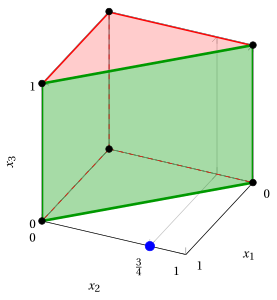
Case (a): the LP relaxation and the cover inequality \(x_1+x_2\le 1\).
-
-
Case (b): \(\tilde{\boldsymbol{x}}=\left(\tfrac{1}{5},1,1\right)\)
-
a) Separation problem
The costs \(q_j=1-\tilde{x}_j\) are \(q=\left(\tfrac{4}{5},0,0\right)\). The separation problem \(\CSP\) (left) and, with \(y_j=1-z_j\), the complementary problem \(\CSPKP\) (right) are:\[ \begin{array}{rrcrcrcl} {\min} & {\frac{4}{5}\,z_1} & & & & & & \\[1ex] \text{subject to} & {5\,z_1} & {+} & {4\,z_2} & {+} & {3\,z_3} & {\ge} & {9} \\[1ex] & {z_1,} & & {z_2,} & & {z_3} & {\in} & {\{0,1\}} \end{array} \]\[ \begin{array}{rrcrcrcl} {\max} & {\frac{4}{5}\,y_1} & & & & & & \\[1ex] \text{subject to} & {5\,y_1} & {+} & {4\,y_2} & {+} & {3\,y_3} & {\le} & {3} \\[1ex] & {y_1,} & & {y_2,} & & {y_3} & {\in} & {\{0,1\}} \end{array} \]with \(z(\CSP)=n-\sum_{j\in\mathscr{I}}\tilde{x}_j-z(\CSPKP)=\frac{4}{5}-z(\CSPKP)\).
-
b) Greedy heuristic
The indices are scanned by non-increasing ratio \(q_j/a_j\), starting from the residual right-hand side \(3\):\(j\) \(q_j\) \(a_j\) \(q_j/a_j\) Decision Residual \(1\) \(\tfrac{4}{5}\) \(5\) \(\tfrac{4}{25}\) \(\bar{y}_j=0\) \(3\) \(2\) \(0\) \(4\) \(0\) \(q_j=0\), \(\bar{y}_j=0\) \(3\) \(3\) \(0\) \(3\) \(0\) \(q_j=0\), \(\bar{y}_j=0\) \(3\) The greedy solution is \(\bar{\boldsymbol{y}}=\left(0,0,0\right)\), with value \(0\). The corresponding cover is \(\bar{C}=\{j\in\mathscr{I}:\bar{y}_j=0\}=\{1,2,3\}\), of total coefficient \(12>8\) and cost \(\frac{4}{5}-0=\frac{4}{5}<1\). Hence the cover inequality
\[ x_1+x_2+x_3\le 2 \]is violated by \(\tilde{\boldsymbol{x}}\): \(\frac{1}{5}+1+1-2=\frac{1}{5}\).
-
c) Optimality check
No index with \(q_j>0\) satisfies the constraint with right-hand side \(3\) alone, hence every feasible solution of \(\CSPKP\) has value \(0\). Hence \(z(\CSPKP)=0\), the greedy solution is optimal, \(z(\CSP)=\frac{4}{5}<1\), and the maximum violation of a cover inequality is \(\frac{1}{5}\).The cover \(\bar{C}\) is not minimal: removing an index with \(q_j=0\) gives the minimal cover \(\{1,2\}\), with the same cost \(\frac{4}{5}\). Its cover inequality \(x_1+x_2\le 1\) has the same violation \(\frac{1}{5}\) and is stronger.
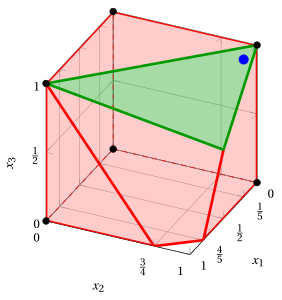
Case (b): the LP relaxation and the cover inequality \(x_1+x_2+x_3\le 2\).
-
-
Case (c): \(\tilde{\boldsymbol{x}}=\left(\tfrac{1}{3},\tfrac{1}{3},\tfrac{1}{3}\right)\)
-
a) Separation problem
The costs \(q_j=1-\tilde{x}_j\) are \(q=\left(\tfrac{2}{3},\tfrac{2}{3},\tfrac{2}{3}\right)\). The separation problem \(\CSP\) (left) and, with \(y_j=1-z_j\), the complementary problem \(\CSPKP\) (right) are:\[ \begin{array}{rrcrcrcl} {\min} & {\frac{2}{3}\,z_1} & {+} & {\frac{2}{3}\,z_2} & {+} & {\frac{2}{3}\,z_3} & & \\[1ex] \text{subject to} & {5\,z_1} & {+} & {4\,z_2} & {+} & {3\,z_3} & {\ge} & {9} \\[1ex] & {z_1,} & & {z_2,} & & {z_3} & {\in} & {\{0,1\}} \end{array} \]\[ \begin{array}{rrcrcrcl} {\max} & {\frac{2}{3}\,y_1} & {+} & {\frac{2}{3}\,y_2} & {+} & {\frac{2}{3}\,y_3} & & \\[1ex] \text{subject to} & {5\,y_1} & {+} & {4\,y_2} & {+} & {3\,y_3} & {\le} & {3} \\[1ex] & {y_1,} & & {y_2,} & & {y_3} & {\in} & {\{0,1\}} \end{array} \]with \(z(\CSP)=n-\sum_{j\in\mathscr{I}}\tilde{x}_j-z(\CSPKP)=2-z(\CSPKP)\).
-
b) Greedy heuristic
The indices are scanned by non-increasing ratio \(q_j/a_j\), starting from the residual right-hand side \(3\):\(j\) \(q_j\) \(a_j\) \(q_j/a_j\) Decision Residual \(3\) \(\tfrac{2}{3}\) \(3\) \(\tfrac{2}{9}\) \(\bar{y}_j=1\) \(0\) \(2\) \(\tfrac{2}{3}\) \(4\) \(\tfrac{1}{6}\) \(\bar{y}_j=0\) \(0\) \(1\) \(\tfrac{2}{3}\) \(5\) \(\tfrac{2}{15}\) \(\bar{y}_j=0\) \(0\) The greedy solution is \(\bar{\boldsymbol{y}}=\left(0,0,1\right)\), with value \(\frac{2}{3}\). The corresponding cover is \(\bar{C}=\{j\in\mathscr{I}:\bar{y}_j=0\}=\{1,2\}\), with cost \(2-\frac{2}{3}=\frac{4}{3}\ge1\): its cover inequality is not violated by \(\tilde{\boldsymbol{x}}\).
-
c) Optimality check
Indices with \(q_j=0\) do not change the value of a solution. The non-empty subsets of the indices \(\{1,2,3\}\) with \(q_j>0\) that satisfy the constraint with right-hand side \(3\) are: \(\{3\}\) (value \(\frac{2}{3}\)). Hence \(z(\CSPKP)=\frac{2}{3}\), the greedy solution is optimal, and \(z(\CSP)=\frac{4}{3}\ge1\): no cover inequality is violated by \(\tilde{\boldsymbol{x}}\).
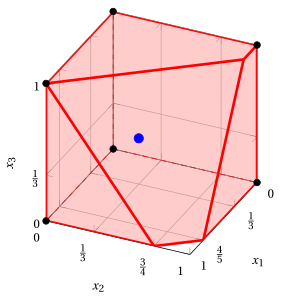
Case (c): the LP relaxation; no cover inequality is violated by the point.
-
Exercise 5.7: Cover inequalities in 3D (P2)
Consider a binary problem with one constraint \(\sum_{j}a_jx_j\le b\), with positive integer coefficients \(a_j\) and right-hand side \(b=11\), on the binary variables indexed by the set \(\mathscr{I}=\{1,2,3\}\) of \(n=3\) variables with the following objective coefficients and constraint coefficients:
The associated \(\LP\) is:
and the following points of its feasible region:
Questions
For each point:
-
write the separation problem \(\CSP\) and its complementary problem \(\CSPKP\);
-
apply the greedy heuristic to \(\CSPKP\) and, if possible, find a violated cover inequality;
-
check whether the greedy solution is optimal;
-
draw the LP relaxation together with the violated cover inequality, if any.
A subset of indices \(C\subseteq\mathscr{I}\) with \(\sum_{j\in C}a_j>b\) is a cover, and the linear inequality
is the cover inequality associated with \(C\). Given a point \(\tilde{\boldsymbol{x}}\), a cover inequality violated by \(\tilde{\boldsymbol{x}}\) exists if and only if \(z(\CSP)<1\), where
Solution
Separation of the cover inequalities violated by the three points.
-
Cover inequalities
All three points belong to the LP relaxation; the left-hand sides are\[ 2+3+9\cdot\frac{2}{3}=11,\qquad 0+3\cdot\frac{2}{3}+9=11,\qquad 2\cdot\frac{1}{3}+3\cdot\frac{1}{3}+9\cdot\frac{1}{3}=\frac{14}{3}\le 11. \]The covers are the subsets of indices whose total coefficient exceeds \(b=11\):
\(C\) \(\sum_{j\in C}a_j\) \(|C|\) Cover inequality Minimal \(\{2,3\}\) \(12\) \(2\) \(x_2+x_3\le 1\) yes \(\{1,2,3\}\) \(14\) \(3\) \(x_1+x_2+x_3\le 2\) no In all three cases, the right-hand side of the complementary problem is \(\sum_{j\in\mathscr{I}}a_j-(b+1)=14-12=2\).
-
Case (a): \(\tilde{\boldsymbol{x}}=\left(1,1,\tfrac{2}{3}\right)\)
-
a) Separation problem
The costs \(q_j=1-\tilde{x}_j\) are \(q=\left(0,0,\tfrac{1}{3}\right)\). The separation problem \(\CSP\) (left) and, with \(y_j=1-z_j\), the complementary problem \(\CSPKP\) (right) are:\[ \begin{array}{rrcrcrcl} {\min} & & & & & {\frac{1}{3}\,z_3} & & \\[1ex] \text{subject to} & {2\,z_1} & {+} & {3\,z_2} & {+} & {9\,z_3} & {\ge} & {12} \\[1ex] & {z_1,} & & {z_2,} & & {z_3} & {\in} & {\{0,1\}} \end{array} \]\[ \begin{array}{rrcrcrcl} {\max} & & & & & {\frac{1}{3}\,y_3} & & \\[1ex] \text{subject to} & {2\,y_1} & {+} & {3\,y_2} & {+} & {9\,y_3} & {\le} & {2} \\[1ex] & {y_1,} & & {y_2,} & & {y_3} & {\in} & {\{0,1\}} \end{array} \]with \(z(\CSP)=n-\sum_{j\in\mathscr{I}}\tilde{x}_j-z(\CSPKP)=\frac{1}{3}-z(\CSPKP)\).
-
b) Greedy heuristic
The indices are scanned by non-increasing ratio \(q_j/a_j\), starting from the residual right-hand side \(2\):\(j\) \(q_j\) \(a_j\) \(q_j/a_j\) Decision Residual \(3\) \(\tfrac{1}{3}\) \(9\) \(\tfrac{1}{27}\) \(\bar{y}_j=0\) \(2\) \(1\) \(0\) \(2\) \(0\) \(q_j=0\), \(\bar{y}_j=0\) \(2\) \(2\) \(0\) \(3\) \(0\) \(q_j=0\), \(\bar{y}_j=0\) \(2\) The greedy solution is \(\bar{\boldsymbol{y}}=\left(0,0,0\right)\), with value \(0\). The corresponding cover is \(\bar{C}=\{j\in\mathscr{I}:\bar{y}_j=0\}=\{1,2,3\}\), of total coefficient \(14>11\) and cost \(\frac{1}{3}-0=\frac{1}{3}<1\). Hence the cover inequality
\[ x_1+x_2+x_3\le 2 \]is violated by \(\tilde{\boldsymbol{x}}\): \(1+1+\frac{2}{3}-2=\frac{2}{3}\).
-
c) Optimality check
No index with \(q_j>0\) satisfies the constraint with right-hand side \(2\) alone, hence every feasible solution of \(\CSPKP\) has value \(0\). Hence \(z(\CSPKP)=0\), the greedy solution is optimal, \(z(\CSP)=\frac{1}{3}<1\), and the maximum violation of a cover inequality is \(\frac{2}{3}\).The cover \(\bar{C}\) is not minimal: removing an index with \(q_j=0\) gives the minimal cover \(\{2,3\}\), with the same cost \(\frac{1}{3}\). Its cover inequality \(x_2+x_3\le 1\) has the same violation \(\frac{2}{3}\) and is stronger.
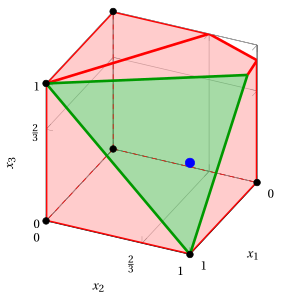
Case (a): the LP relaxation and the cover inequality \(x_1+x_2+x_3\le 2\).
-
-
Case (b): \(\tilde{\boldsymbol{x}}=\left(0,\tfrac{2}{3},1\right)\)
-
a) Separation problem
The costs \(q_j=1-\tilde{x}_j\) are \(q=\left(1,\tfrac{1}{3},0\right)\). The separation problem \(\CSP\) (left) and, with \(y_j=1-z_j\), the complementary problem \(\CSPKP\) (right) are:\[ \begin{array}{rrcrcrcl} {\min} & {z_1} & {+} & {\frac{1}{3}\,z_2} & & & & \\[1ex] \text{subject to} & {2\,z_1} & {+} & {3\,z_2} & {+} & {9\,z_3} & {\ge} & {12} \\[1ex] & {z_1,} & & {z_2,} & & {z_3} & {\in} & {\{0,1\}} \end{array} \]\[ \begin{array}{rrcrcrcl} {\max} & {y_1} & {+} & {\frac{1}{3}\,y_2} & & & & \\[1ex] \text{subject to} & {2\,y_1} & {+} & {3\,y_2} & {+} & {9\,y_3} & {\le} & {2} \\[1ex] & {y_1,} & & {y_2,} & & {y_3} & {\in} & {\{0,1\}} \end{array} \]with \(z(\CSP)=n-\sum_{j\in\mathscr{I}}\tilde{x}_j-z(\CSPKP)=\frac{4}{3}-z(\CSPKP)\).
-
b) Greedy heuristic
The indices are scanned by non-increasing ratio \(q_j/a_j\), starting from the residual right-hand side \(2\):\(j\) \(q_j\) \(a_j\) \(q_j/a_j\) Decision Residual \(1\) \(1\) \(2\) \(\tfrac{1}{2}\) \(\bar{y}_j=1\) \(0\) \(2\) \(\tfrac{1}{3}\) \(3\) \(\tfrac{1}{9}\) \(\bar{y}_j=0\) \(0\) \(3\) \(0\) \(9\) \(0\) \(q_j=0\), \(\bar{y}_j=0\) \(0\) The greedy solution is \(\bar{\boldsymbol{y}}=\left(1,0,0\right)\), with value \(1\). The corresponding cover is \(\bar{C}=\{j\in\mathscr{I}:\bar{y}_j=0\}=\{2,3\}\), of total coefficient \(12>11\) and cost \(\frac{4}{3}-1=\frac{1}{3}<1\). Hence the cover inequality
\[ x_2+x_3\le 1 \]is violated by \(\tilde{\boldsymbol{x}}\): \(\frac{2}{3}+1-1=\frac{2}{3}\).
-
c) Optimality check
Indices with \(q_j=0\) do not change the value of a solution. The non-empty subsets of the indices \(\{1,2\}\) with \(q_j>0\) that satisfy the constraint with right-hand side \(2\) are: \(\{1\}\) (value \(1\)). Hence \(z(\CSPKP)=1\), the greedy solution is optimal, \(z(\CSP)=\frac{1}{3}<1\), and the maximum violation of a cover inequality is \(\frac{2}{3}\).
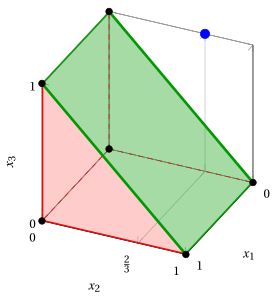
Case (b): the LP relaxation and the cover inequality \(x_2+x_3\le 1\).
-
-
Case (c): \(\tilde{\boldsymbol{x}}=\left(\tfrac{1}{3},\tfrac{1}{3},\tfrac{1}{3}\right)\)
-
a) Separation problem
The costs \(q_j=1-\tilde{x}_j\) are \(q=\left(\tfrac{2}{3},\tfrac{2}{3},\tfrac{2}{3}\right)\). The separation problem \(\CSP\) (left) and, with \(y_j=1-z_j\), the complementary problem \(\CSPKP\) (right) are:\[ \begin{array}{rrcrcrcl} {\min} & {\frac{2}{3}\,z_1} & {+} & {\frac{2}{3}\,z_2} & {+} & {\frac{2}{3}\,z_3} & & \\[1ex] \text{subject to} & {2\,z_1} & {+} & {3\,z_2} & {+} & {9\,z_3} & {\ge} & {12} \\[1ex] & {z_1,} & & {z_2,} & & {z_3} & {\in} & {\{0,1\}} \end{array} \]\[ \begin{array}{rrcrcrcl} {\max} & {\frac{2}{3}\,y_1} & {+} & {\frac{2}{3}\,y_2} & {+} & {\frac{2}{3}\,y_3} & & \\[1ex] \text{subject to} & {2\,y_1} & {+} & {3\,y_2} & {+} & {9\,y_3} & {\le} & {2} \\[1ex] & {y_1,} & & {y_2,} & & {y_3} & {\in} & {\{0,1\}} \end{array} \]with \(z(\CSP)=n-\sum_{j\in\mathscr{I}}\tilde{x}_j-z(\CSPKP)=2-z(\CSPKP)\).
-
b) Greedy heuristic
The indices are scanned by non-increasing ratio \(q_j/a_j\), starting from the residual right-hand side \(2\):\(j\) \(q_j\) \(a_j\) \(q_j/a_j\) Decision Residual \(1\) \(\tfrac{2}{3}\) \(2\) \(\tfrac{1}{3}\) \(\bar{y}_j=1\) \(0\) \(2\) \(\tfrac{2}{3}\) \(3\) \(\tfrac{2}{9}\) \(\bar{y}_j=0\) \(0\) \(3\) \(\tfrac{2}{3}\) \(9\) \(\tfrac{2}{27}\) \(\bar{y}_j=0\) \(0\) The greedy solution is \(\bar{\boldsymbol{y}}=\left(1,0,0\right)\), with value \(\frac{2}{3}\). The corresponding cover is \(\bar{C}=\{j\in\mathscr{I}:\bar{y}_j=0\}=\{2,3\}\), with cost \(2-\frac{2}{3}=\frac{4}{3}\ge1\): its cover inequality is not violated by \(\tilde{\boldsymbol{x}}\).
-
c) Optimality check
Indices with \(q_j=0\) do not change the value of a solution. The non-empty subsets of the indices \(\{1,2,3\}\) with \(q_j>0\) that satisfy the constraint with right-hand side \(2\) are: \(\{1\}\) (value \(\frac{2}{3}\)). Hence \(z(\CSPKP)=\frac{2}{3}\), the greedy solution is optimal, and \(z(\CSP)=\frac{4}{3}\ge1\): no cover inequality is violated by \(\tilde{\boldsymbol{x}}\).
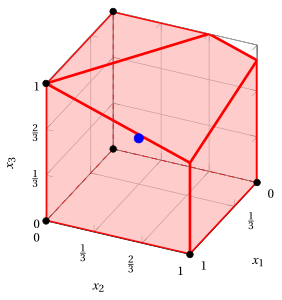
Case (c): the LP relaxation; no cover inequality is violated by the point.
-
Exercise 5.8: Cover inequalities in 3D (P3)
Consider a binary problem with one constraint \(\sum_{j}a_jx_j\le b\), with positive integer coefficients \(a_j\) and right-hand side \(b=9\), on the binary variables indexed by the set \(\mathscr{I}=\{1,2,3\}\) of \(n=3\) variables with the following objective coefficients and constraint coefficients:
The associated \(\LP\) is:
and the following points of its feasible region:
Questions
For each point:
-
write the separation problem \(\CSP\) and its complementary problem \(\CSPKP\);
-
apply the greedy heuristic to \(\CSPKP\) and, if possible, find a violated cover inequality;
-
check whether the greedy solution is optimal;
-
draw the LP relaxation together with the violated cover inequality, if any.
A subset of indices \(C\subseteq\mathscr{I}\) with \(\sum_{j\in C}a_j>b\) is a cover, and the linear inequality
is the cover inequality associated with \(C\). Given a point \(\tilde{\boldsymbol{x}}\), a cover inequality violated by \(\tilde{\boldsymbol{x}}\) exists if and only if \(z(\CSP)<1\), where
Solution
Separation of the cover inequalities violated by the three points.
-
Cover inequalities
All three points belong to the LP relaxation; the left-hand sides are\[ 5+6\cdot\frac{2}{3}+0=9,\qquad 0+6\cdot\frac{1}{3}+7=9,\qquad 5\cdot\frac{1}{3}+6\cdot\frac{1}{3}+7\cdot\frac{1}{3}=6\le 9. \]The covers are the subsets of indices whose total coefficient exceeds \(b=9\):
\(C\) \(\sum_{j\in C}a_j\) \(|C|\) Cover inequality Minimal \(\{1,2\}\) \(11\) \(2\) \(x_1+x_2\le 1\) yes \(\{1,3\}\) \(12\) \(2\) \(x_1+x_3\le 1\) yes \(\{2,3\}\) \(13\) \(2\) \(x_2+x_3\le 1\) yes \(\{1,2,3\}\) \(18\) \(3\) \(x_1+x_2+x_3\le 2\) no In all three cases, the right-hand side of the complementary problem is \(\sum_{j\in\mathscr{I}}a_j-(b+1)=18-10=8\).
-
Case (a): \(\tilde{\boldsymbol{x}}=\left(1,\tfrac{2}{3},0\right)\)
-
a) Separation problem
The costs \(q_j=1-\tilde{x}_j\) are \(q=\left(0,\tfrac{1}{3},1\right)\). The separation problem \(\CSP\) (left) and, with \(y_j=1-z_j\), the complementary problem \(\CSPKP\) (right) are:\[ \begin{array}{rrcrcrcl} {\min} & & & {\frac{1}{3}\,z_2} & {+} & {z_3} & & \\[1ex] \text{subject to} & {5\,z_1} & {+} & {6\,z_2} & {+} & {7\,z_3} & {\ge} & {10} \\[1ex] & {z_1,} & & {z_2,} & & {z_3} & {\in} & {\{0,1\}} \end{array} \]\[ \begin{array}{rrcrcrcl} {\max} & & & {\frac{1}{3}\,y_2} & {+} & {y_3} & & \\[1ex] \text{subject to} & {5\,y_1} & {+} & {6\,y_2} & {+} & {7\,y_3} & {\le} & {8} \\[1ex] & {y_1,} & & {y_2,} & & {y_3} & {\in} & {\{0,1\}} \end{array} \]with \(z(\CSP)=n-\sum_{j\in\mathscr{I}}\tilde{x}_j-z(\CSPKP)=\frac{4}{3}-z(\CSPKP)\).
-
b) Greedy heuristic
The indices are scanned by non-increasing ratio \(q_j/a_j\), starting from the residual right-hand side \(8\):\(j\) \(q_j\) \(a_j\) \(q_j/a_j\) Decision Residual \(3\) \(1\) \(7\) \(\tfrac{1}{7}\) \(\bar{y}_j=1\) \(1\) \(2\) \(\tfrac{1}{3}\) \(6\) \(\tfrac{1}{18}\) \(\bar{y}_j=0\) \(1\) \(1\) \(0\) \(5\) \(0\) \(q_j=0\), \(\bar{y}_j=0\) \(1\) The greedy solution is \(\bar{\boldsymbol{y}}=\left(0,0,1\right)\), with value \(1\). The corresponding cover is \(\bar{C}=\{j\in\mathscr{I}:\bar{y}_j=0\}=\{1,2\}\), of total coefficient \(11>9\) and cost \(\frac{4}{3}-1=\frac{1}{3}<1\). Hence the cover inequality
\[ x_1+x_2\le 1 \]is violated by \(\tilde{\boldsymbol{x}}\): \(1+\frac{2}{3}-1=\frac{2}{3}\).
-
c) Optimality check
Indices with \(q_j=0\) do not change the value of a solution. The non-empty subsets of the indices \(\{2,3\}\) with \(q_j>0\) that satisfy the constraint with right-hand side \(8\) are: \(\{2\}\) (value \(\frac{1}{3}\)), \(\{3\}\) (value \(1\)). Hence \(z(\CSPKP)=1\), the greedy solution is optimal, \(z(\CSP)=\frac{1}{3}<1\), and the maximum violation of a cover inequality is \(\frac{2}{3}\).
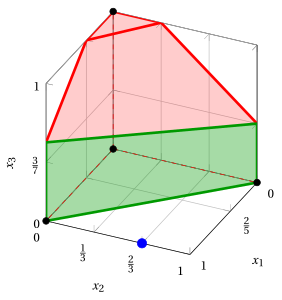
Case (a): the LP relaxation and the cover inequality \(x_1+x_2\le 1\).
-
-
Case (b): \(\tilde{\boldsymbol{x}}=\left(0,\tfrac{1}{3},1\right)\)
-
a) Separation problem
The costs \(q_j=1-\tilde{x}_j\) are \(q=\left(1,\tfrac{2}{3},0\right)\). The separation problem \(\CSP\) (left) and, with \(y_j=1-z_j\), the complementary problem \(\CSPKP\) (right) are:\[ \begin{array}{rrcrcrcl} {\min} & {z_1} & {+} & {\frac{2}{3}\,z_2} & & & & \\[1ex] \text{subject to} & {5\,z_1} & {+} & {6\,z_2} & {+} & {7\,z_3} & {\ge} & {10} \\[1ex] & {z_1,} & & {z_2,} & & {z_3} & {\in} & {\{0,1\}} \end{array} \]\[ \begin{array}{rrcrcrcl} {\max} & {y_1} & {+} & {\frac{2}{3}\,y_2} & & & & \\[1ex] \text{subject to} & {5\,y_1} & {+} & {6\,y_2} & {+} & {7\,y_3} & {\le} & {8} \\[1ex] & {y_1,} & & {y_2,} & & {y_3} & {\in} & {\{0,1\}} \end{array} \]with \(z(\CSP)=n-\sum_{j\in\mathscr{I}}\tilde{x}_j-z(\CSPKP)=\frac{5}{3}-z(\CSPKP)\).
-
b) Greedy heuristic
The indices are scanned by non-increasing ratio \(q_j/a_j\), starting from the residual right-hand side \(8\):\(j\) \(q_j\) \(a_j\) \(q_j/a_j\) Decision Residual \(1\) \(1\) \(5\) \(\tfrac{1}{5}\) \(\bar{y}_j=1\) \(3\) \(2\) \(\tfrac{2}{3}\) \(6\) \(\tfrac{1}{9}\) \(\bar{y}_j=0\) \(3\) \(3\) \(0\) \(7\) \(0\) \(q_j=0\), \(\bar{y}_j=0\) \(3\) The greedy solution is \(\bar{\boldsymbol{y}}=\left(1,0,0\right)\), with value \(1\). The corresponding cover is \(\bar{C}=\{j\in\mathscr{I}:\bar{y}_j=0\}=\{2,3\}\), of total coefficient \(13>9\) and cost \(\frac{5}{3}-1=\frac{2}{3}<1\). Hence the cover inequality
\[ x_2+x_3\le 1 \]is violated by \(\tilde{\boldsymbol{x}}\): \(\frac{1}{3}+1-1=\frac{1}{3}\).
-
c) Optimality check
Indices with \(q_j=0\) do not change the value of a solution. The non-empty subsets of the indices \(\{1,2\}\) with \(q_j>0\) that satisfy the constraint with right-hand side \(8\) are: \(\{1\}\) (value \(1\)), \(\{2\}\) (value \(\frac{2}{3}\)). Hence \(z(\CSPKP)=1\), the greedy solution is optimal, \(z(\CSP)=\frac{2}{3}<1\), and the maximum violation of a cover inequality is \(\frac{1}{3}\).
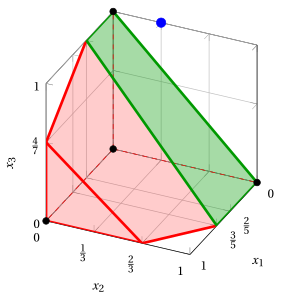
Case (b): the LP relaxation and the cover inequality \(x_2+x_3\le 1\).
-
-
Case (c): \(\tilde{\boldsymbol{x}}=\left(\tfrac{1}{3},\tfrac{1}{3},\tfrac{1}{3}\right)\)
-
a) Separation problem
The costs \(q_j=1-\tilde{x}_j\) are \(q=\left(\tfrac{2}{3},\tfrac{2}{3},\tfrac{2}{3}\right)\). The separation problem \(\CSP\) (left) and, with \(y_j=1-z_j\), the complementary problem \(\CSPKP\) (right) are:\[ \begin{array}{rrcrcrcl} {\min} & {\frac{2}{3}\,z_1} & {+} & {\frac{2}{3}\,z_2} & {+} & {\frac{2}{3}\,z_3} & & \\[1ex] \text{subject to} & {5\,z_1} & {+} & {6\,z_2} & {+} & {7\,z_3} & {\ge} & {10} \\[1ex] & {z_1,} & & {z_2,} & & {z_3} & {\in} & {\{0,1\}} \end{array} \]\[ \begin{array}{rrcrcrcl} {\max} & {\frac{2}{3}\,y_1} & {+} & {\frac{2}{3}\,y_2} & {+} & {\frac{2}{3}\,y_3} & & \\[1ex] \text{subject to} & {5\,y_1} & {+} & {6\,y_2} & {+} & {7\,y_3} & {\le} & {8} \\[1ex] & {y_1,} & & {y_2,} & & {y_3} & {\in} & {\{0,1\}} \end{array} \]with \(z(\CSP)=n-\sum_{j\in\mathscr{I}}\tilde{x}_j-z(\CSPKP)=2-z(\CSPKP)\).
-
b) Greedy heuristic
The indices are scanned by non-increasing ratio \(q_j/a_j\), starting from the residual right-hand side \(8\):\(j\) \(q_j\) \(a_j\) \(q_j/a_j\) Decision Residual \(1\) \(\tfrac{2}{3}\) \(5\) \(\tfrac{2}{15}\) \(\bar{y}_j=1\) \(3\) \(2\) \(\tfrac{2}{3}\) \(6\) \(\tfrac{1}{9}\) \(\bar{y}_j=0\) \(3\) \(3\) \(\tfrac{2}{3}\) \(7\) \(\tfrac{2}{21}\) \(\bar{y}_j=0\) \(3\) The greedy solution is \(\bar{\boldsymbol{y}}=\left(1,0,0\right)\), with value \(\frac{2}{3}\). The corresponding cover is \(\bar{C}=\{j\in\mathscr{I}:\bar{y}_j=0\}=\{2,3\}\), with cost \(2-\frac{2}{3}=\frac{4}{3}\ge1\): its cover inequality is not violated by \(\tilde{\boldsymbol{x}}\).
-
c) Optimality check
Indices with \(q_j=0\) do not change the value of a solution. The non-empty subsets of the indices \(\{1,2,3\}\) with \(q_j>0\) that satisfy the constraint with right-hand side \(8\) are: \(\{1\}\) (value \(\frac{2}{3}\)), \(\{2\}\) (value \(\frac{2}{3}\)), \(\{3\}\) (value \(\frac{2}{3}\)). Hence \(z(\CSPKP)=\frac{2}{3}\), the greedy solution is optimal, and \(z(\CSP)=\frac{4}{3}\ge1\): no cover inequality is violated by \(\tilde{\boldsymbol{x}}\).
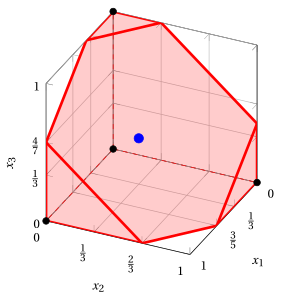
Case (c): the LP relaxation; no cover inequality is violated by the point.
-
Exercise 5.9: Cover inequalities in 3D (P4)
Consider a binary problem with one constraint \(\sum_{j}a_jx_j\le b\), with positive integer coefficients \(a_j\) and right-hand side \(b=5\), on the binary variables indexed by the set \(\mathscr{I}=\{1,2,3\}\) of \(n=3\) variables with the following objective coefficients and constraint coefficients:
The associated \(\LP\) is:
and the following points of its feasible region:
Questions
For each point:
-
write the separation problem \(\CSP\) and its complementary problem \(\CSPKP\);
-
apply the greedy heuristic to \(\CSPKP\) and, if possible, find a violated cover inequality;
-
check whether the greedy solution is optimal;
-
draw the LP relaxation together with the violated cover inequality, if any.
A subset of indices \(C\subseteq\mathscr{I}\) with \(\sum_{j\in C}a_j>b\) is a cover, and the linear inequality
is the cover inequality associated with \(C\). Given a point \(\tilde{\boldsymbol{x}}\), a cover inequality violated by \(\tilde{\boldsymbol{x}}\) exists if and only if \(z(\CSP)<1\), where
Solution
Separation of the cover inequalities violated by the three points.
-
Cover inequalities
All three points belong to the LP relaxation; the left-hand sides are\[ 2+5\cdot\frac{3}{5}+0=5,\qquad 2+0+5\cdot\frac{3}{5}=5,\qquad 2\cdot\frac{1}{3}+5\cdot\frac{1}{3}+5\cdot\frac{1}{3}=4\le 5. \]The covers are the subsets of indices whose total coefficient exceeds \(b=5\):
\(C\) \(\sum_{j\in C}a_j\) \(|C|\) Cover inequality Minimal \(\{1,2\}\) \(7\) \(2\) \(x_1+x_2\le 1\) yes \(\{1,3\}\) \(7\) \(2\) \(x_1+x_3\le 1\) yes \(\{2,3\}\) \(10\) \(2\) \(x_2+x_3\le 1\) yes \(\{1,2,3\}\) \(12\) \(3\) \(x_1+x_2+x_3\le 2\) no In all three cases, the right-hand side of the complementary problem is \(\sum_{j\in\mathscr{I}}a_j-(b+1)=12-6=6\).
-
Case (a): \(\tilde{\boldsymbol{x}}=\left(1,\tfrac{3}{5},0\right)\)
-
a) Separation problem
The costs \(q_j=1-\tilde{x}_j\) are \(q=\left(0,\tfrac{2}{5},1\right)\). The separation problem \(\CSP\) (left) and, with \(y_j=1-z_j\), the complementary problem \(\CSPKP\) (right) are:\[ \begin{array}{rrcrcrcl} {\min} & & & {\frac{2}{5}\,z_2} & {+} & {z_3} & & \\[1ex] \text{subject to} & {2\,z_1} & {+} & {5\,z_2} & {+} & {5\,z_3} & {\ge} & {6} \\[1ex] & {z_1,} & & {z_2,} & & {z_3} & {\in} & {\{0,1\}} \end{array} \]\[ \begin{array}{rrcrcrcl} {\max} & & & {\frac{2}{5}\,y_2} & {+} & {y_3} & & \\[1ex] \text{subject to} & {2\,y_1} & {+} & {5\,y_2} & {+} & {5\,y_3} & {\le} & {6} \\[1ex] & {y_1,} & & {y_2,} & & {y_3} & {\in} & {\{0,1\}} \end{array} \]with \(z(\CSP)=n-\sum_{j\in\mathscr{I}}\tilde{x}_j-z(\CSPKP)=\frac{7}{5}-z(\CSPKP)\).
-
b) Greedy heuristic
The indices are scanned by non-increasing ratio \(q_j/a_j\), starting from the residual right-hand side \(6\):\(j\) \(q_j\) \(a_j\) \(q_j/a_j\) Decision Residual \(3\) \(1\) \(5\) \(\tfrac{1}{5}\) \(\bar{y}_j=1\) \(1\) \(2\) \(\tfrac{2}{5}\) \(5\) \(\tfrac{2}{25}\) \(\bar{y}_j=0\) \(1\) \(1\) \(0\) \(2\) \(0\) \(q_j=0\), \(\bar{y}_j=0\) \(1\) The greedy solution is \(\bar{\boldsymbol{y}}=\left(0,0,1\right)\), with value \(1\). The corresponding cover is \(\bar{C}=\{j\in\mathscr{I}:\bar{y}_j=0\}=\{1,2\}\), of total coefficient \(7>5\) and cost \(\frac{7}{5}-1=\frac{2}{5}<1\). Hence the cover inequality
\[ x_1+x_2\le 1 \]is violated by \(\tilde{\boldsymbol{x}}\): \(1+\frac{3}{5}-1=\frac{3}{5}\).
-
c) Optimality check
Indices with \(q_j=0\) do not change the value of a solution. The non-empty subsets of the indices \(\{2,3\}\) with \(q_j>0\) that satisfy the constraint with right-hand side \(6\) are: \(\{2\}\) (value \(\frac{2}{5}\)), \(\{3\}\) (value \(1\)). Hence \(z(\CSPKP)=1\), the greedy solution is optimal, \(z(\CSP)=\frac{2}{5}<1\), and the maximum violation of a cover inequality is \(\frac{3}{5}\).
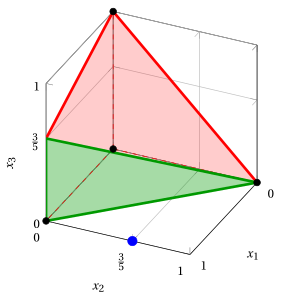
Case (a): the LP relaxation and the cover inequality \(x_1+x_2\le 1\).
-
-
Case (b): \(\tilde{\boldsymbol{x}}=\left(1,0,\tfrac{3}{5}\right)\)
-
a) Separation problem
The costs \(q_j=1-\tilde{x}_j\) are \(q=\left(0,1,\tfrac{2}{5}\right)\). The separation problem \(\CSP\) (left) and, with \(y_j=1-z_j\), the complementary problem \(\CSPKP\) (right) are:\[ \begin{array}{rrcrcrcl} {\min} & & & {z_2} & {+} & {\frac{2}{5}\,z_3} & & \\[1ex] \text{subject to} & {2\,z_1} & {+} & {5\,z_2} & {+} & {5\,z_3} & {\ge} & {6} \\[1ex] & {z_1,} & & {z_2,} & & {z_3} & {\in} & {\{0,1\}} \end{array} \]\[ \begin{array}{rrcrcrcl} {\max} & & & {y_2} & {+} & {\frac{2}{5}\,y_3} & & \\[1ex] \text{subject to} & {2\,y_1} & {+} & {5\,y_2} & {+} & {5\,y_3} & {\le} & {6} \\[1ex] & {y_1,} & & {y_2,} & & {y_3} & {\in} & {\{0,1\}} \end{array} \]with \(z(\CSP)=n-\sum_{j\in\mathscr{I}}\tilde{x}_j-z(\CSPKP)=\frac{7}{5}-z(\CSPKP)\).
-
b) Greedy heuristic
The indices are scanned by non-increasing ratio \(q_j/a_j\), starting from the residual right-hand side \(6\):\(j\) \(q_j\) \(a_j\) \(q_j/a_j\) Decision Residual \(2\) \(1\) \(5\) \(\tfrac{1}{5}\) \(\bar{y}_j=1\) \(1\) \(3\) \(\tfrac{2}{5}\) \(5\) \(\tfrac{2}{25}\) \(\bar{y}_j=0\) \(1\) \(1\) \(0\) \(2\) \(0\) \(q_j=0\), \(\bar{y}_j=0\) \(1\) The greedy solution is \(\bar{\boldsymbol{y}}=\left(0,1,0\right)\), with value \(1\). The corresponding cover is \(\bar{C}=\{j\in\mathscr{I}:\bar{y}_j=0\}=\{1,3\}\), of total coefficient \(7>5\) and cost \(\frac{7}{5}-1=\frac{2}{5}<1\). Hence the cover inequality
\[ x_1+x_3\le 1 \]is violated by \(\tilde{\boldsymbol{x}}\): \(1+\frac{3}{5}-1=\frac{3}{5}\).
-
c) Optimality check
Indices with \(q_j=0\) do not change the value of a solution. The non-empty subsets of the indices \(\{2,3\}\) with \(q_j>0\) that satisfy the constraint with right-hand side \(6\) are: \(\{2\}\) (value \(1\)), \(\{3\}\) (value \(\frac{2}{5}\)). Hence \(z(\CSPKP)=1\), the greedy solution is optimal, \(z(\CSP)=\frac{2}{5}<1\), and the maximum violation of a cover inequality is \(\frac{3}{5}\).
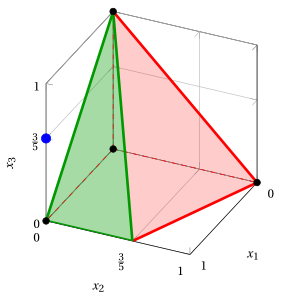
Case (b): the LP relaxation and the cover inequality \(x_1+x_3\le 1\).
-
-
Case (c): \(\tilde{\boldsymbol{x}}=\left(\tfrac{1}{3},\tfrac{1}{3},\tfrac{1}{3}\right)\)
-
a) Separation problem
The costs \(q_j=1-\tilde{x}_j\) are \(q=\left(\tfrac{2}{3},\tfrac{2}{3},\tfrac{2}{3}\right)\). The separation problem \(\CSP\) (left) and, with \(y_j=1-z_j\), the complementary problem \(\CSPKP\) (right) are:\[ \begin{array}{rrcrcrcl} {\min} & {\frac{2}{3}\,z_1} & {+} & {\frac{2}{3}\,z_2} & {+} & {\frac{2}{3}\,z_3} & & \\[1ex] \text{subject to} & {2\,z_1} & {+} & {5\,z_2} & {+} & {5\,z_3} & {\ge} & {6} \\[1ex] & {z_1,} & & {z_2,} & & {z_3} & {\in} & {\{0,1\}} \end{array} \]\[ \begin{array}{rrcrcrcl} {\max} & {\frac{2}{3}\,y_1} & {+} & {\frac{2}{3}\,y_2} & {+} & {\frac{2}{3}\,y_3} & & \\[1ex] \text{subject to} & {2\,y_1} & {+} & {5\,y_2} & {+} & {5\,y_3} & {\le} & {6} \\[1ex] & {y_1,} & & {y_2,} & & {y_3} & {\in} & {\{0,1\}} \end{array} \]with \(z(\CSP)=n-\sum_{j\in\mathscr{I}}\tilde{x}_j-z(\CSPKP)=2-z(\CSPKP)\).
-
b) Greedy heuristic
The indices are scanned by non-increasing ratio \(q_j/a_j\), starting from the residual right-hand side \(6\):\(j\) \(q_j\) \(a_j\) \(q_j/a_j\) Decision Residual \(1\) \(\tfrac{2}{3}\) \(2\) \(\tfrac{1}{3}\) \(\bar{y}_j=1\) \(4\) \(2\) \(\tfrac{2}{3}\) \(5\) \(\tfrac{2}{15}\) \(\bar{y}_j=0\) \(4\) \(3\) \(\tfrac{2}{3}\) \(5\) \(\tfrac{2}{15}\) \(\bar{y}_j=0\) \(4\) The greedy solution is \(\bar{\boldsymbol{y}}=\left(1,0,0\right)\), with value \(\frac{2}{3}\). The corresponding cover is \(\bar{C}=\{j\in\mathscr{I}:\bar{y}_j=0\}=\{2,3\}\), with cost \(2-\frac{2}{3}=\frac{4}{3}\ge1\): its cover inequality is not violated by \(\tilde{\boldsymbol{x}}\).
-
c) Optimality check
Indices with \(q_j=0\) do not change the value of a solution. The non-empty subsets of the indices \(\{1,2,3\}\) with \(q_j>0\) that satisfy the constraint with right-hand side \(6\) are: \(\{1\}\) (value \(\frac{2}{3}\)), \(\{2\}\) (value \(\frac{2}{3}\)), \(\{3\}\) (value \(\frac{2}{3}\)). Hence \(z(\CSPKP)=\frac{2}{3}\), the greedy solution is optimal, and \(z(\CSP)=\frac{4}{3}\ge1\): no cover inequality is violated by \(\tilde{\boldsymbol{x}}\).
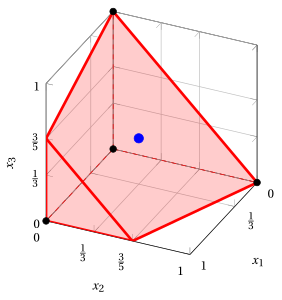
Case (c): the LP relaxation; no cover inequality is violated by the point.
-
Exercise 5.10: Cover inequalities in 3D (P5)
Consider a binary problem with one constraint \(\sum_{j}a_jx_j\le b\), with positive integer coefficients \(a_j\) and right-hand side \(b=10\), on the binary variables indexed by the set \(\mathscr{I}=\{1,2,3\}\) of \(n=3\) variables with the following objective coefficients and constraint coefficients:
The associated \(\LP\) is:
and the following points of its feasible region:
Questions
For each point:
-
write the separation problem \(\CSP\) and its complementary problem \(\CSPKP\);
-
apply the greedy heuristic to \(\CSPKP\) and, if possible, find a violated cover inequality;
-
check whether the greedy solution is optimal;
-
draw the LP relaxation together with the violated cover inequality, if any.
A subset of indices \(C\subseteq\mathscr{I}\) with \(\sum_{j\in C}a_j>b\) is a cover, and the linear inequality
is the cover inequality associated with \(C\). Given a point \(\tilde{\boldsymbol{x}}\), a cover inequality violated by \(\tilde{\boldsymbol{x}}\) exists if and only if \(z(\CSP)<1\), where
Solution
Separation of the cover inequalities violated by the three points.
-
Cover inequalities
All three points belong to the LP relaxation; the left-hand sides are\[ 5+4+6\cdot\frac{1}{6}=10,\qquad 5\cdot\frac{4}{5}+0+6=10,\qquad 5\cdot\frac{1}{3}+4\cdot\frac{1}{3}+6\cdot\frac{1}{3}=5\le 10. \]The covers are the subsets of indices whose total coefficient exceeds \(b=10\):
\(C\) \(\sum_{j\in C}a_j\) \(|C|\) Cover inequality Minimal \(\{1,3\}\) \(11\) \(2\) \(x_1+x_3\le 1\) yes \(\{1,2,3\}\) \(15\) \(3\) \(x_1+x_2+x_3\le 2\) no In all three cases, the right-hand side of the complementary problem is \(\sum_{j\in\mathscr{I}}a_j-(b+1)=15-11=4\).
-
Case (a): \(\tilde{\boldsymbol{x}}=\left(1,1,\tfrac{1}{6}\right)\)
-
a) Separation problem
The costs \(q_j=1-\tilde{x}_j\) are \(q=\left(0,0,\tfrac{5}{6}\right)\). The separation problem \(\CSP\) (left) and, with \(y_j=1-z_j\), the complementary problem \(\CSPKP\) (right) are:\[ \begin{array}{rrcrcrcl} {\min} & & & & & {\frac{5}{6}\,z_3} & & \\[1ex] \text{subject to} & {5\,z_1} & {+} & {4\,z_2} & {+} & {6\,z_3} & {\ge} & {11} \\[1ex] & {z_1,} & & {z_2,} & & {z_3} & {\in} & {\{0,1\}} \end{array} \]\[ \begin{array}{rrcrcrcl} {\max} & & & & & {\frac{5}{6}\,y_3} & & \\[1ex] \text{subject to} & {5\,y_1} & {+} & {4\,y_2} & {+} & {6\,y_3} & {\le} & {4} \\[1ex] & {y_1,} & & {y_2,} & & {y_3} & {\in} & {\{0,1\}} \end{array} \]with \(z(\CSP)=n-\sum_{j\in\mathscr{I}}\tilde{x}_j-z(\CSPKP)=\frac{5}{6}-z(\CSPKP)\).
-
b) Greedy heuristic
The indices are scanned by non-increasing ratio \(q_j/a_j\), starting from the residual right-hand side \(4\):\(j\) \(q_j\) \(a_j\) \(q_j/a_j\) Decision Residual \(3\) \(\tfrac{5}{6}\) \(6\) \(\tfrac{5}{36}\) \(\bar{y}_j=0\) \(4\) \(1\) \(0\) \(5\) \(0\) \(q_j=0\), \(\bar{y}_j=0\) \(4\) \(2\) \(0\) \(4\) \(0\) \(q_j=0\), \(\bar{y}_j=0\) \(4\) The greedy solution is \(\bar{\boldsymbol{y}}=\left(0,0,0\right)\), with value \(0\). The corresponding cover is \(\bar{C}=\{j\in\mathscr{I}:\bar{y}_j=0\}=\{1,2,3\}\), of total coefficient \(15>10\) and cost \(\frac{5}{6}-0=\frac{5}{6}<1\). Hence the cover inequality
\[ x_1+x_2+x_3\le 2 \]is violated by \(\tilde{\boldsymbol{x}}\): \(1+1+\frac{1}{6}-2=\frac{1}{6}\).
-
c) Optimality check
No index with \(q_j>0\) satisfies the constraint with right-hand side \(4\) alone, hence every feasible solution of \(\CSPKP\) has value \(0\). Hence \(z(\CSPKP)=0\), the greedy solution is optimal, \(z(\CSP)=\frac{5}{6}<1\), and the maximum violation of a cover inequality is \(\frac{1}{6}\).The cover \(\bar{C}\) is not minimal: removing an index with \(q_j=0\) gives the minimal cover \(\{1,3\}\), with the same cost \(\frac{5}{6}\). Its cover inequality \(x_1+x_3\le 1\) has the same violation \(\frac{1}{6}\) and is stronger.
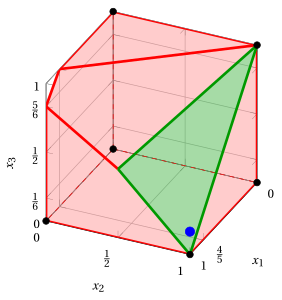
Case (a): the LP relaxation and the cover inequality \(x_1+x_2+x_3\le 2\).
-
-
Case (b): \(\tilde{\boldsymbol{x}}=\left(\tfrac{4}{5},0,1\right)\)
-
a) Separation problem
The costs \(q_j=1-\tilde{x}_j\) are \(q=\left(\tfrac{1}{5},1,0\right)\). The separation problem \(\CSP\) (left) and, with \(y_j=1-z_j\), the complementary problem \(\CSPKP\) (right) are:\[ \begin{array}{rrcrcrcl} {\min} & {\frac{1}{5}\,z_1} & {+} & {z_2} & & & & \\[1ex] \text{subject to} & {5\,z_1} & {+} & {4\,z_2} & {+} & {6\,z_3} & {\ge} & {11} \\[1ex] & {z_1,} & & {z_2,} & & {z_3} & {\in} & {\{0,1\}} \end{array} \]\[ \begin{array}{rrcrcrcl} {\max} & {\frac{1}{5}\,y_1} & {+} & {y_2} & & & & \\[1ex] \text{subject to} & {5\,y_1} & {+} & {4\,y_2} & {+} & {6\,y_3} & {\le} & {4} \\[1ex] & {y_1,} & & {y_2,} & & {y_3} & {\in} & {\{0,1\}} \end{array} \]with \(z(\CSP)=n-\sum_{j\in\mathscr{I}}\tilde{x}_j-z(\CSPKP)=\frac{6}{5}-z(\CSPKP)\).
-
b) Greedy heuristic
The indices are scanned by non-increasing ratio \(q_j/a_j\), starting from the residual right-hand side \(4\):\(j\) \(q_j\) \(a_j\) \(q_j/a_j\) Decision Residual \(2\) \(1\) \(4\) \(\tfrac{1}{4}\) \(\bar{y}_j=1\) \(0\) \(1\) \(\tfrac{1}{5}\) \(5\) \(\tfrac{1}{25}\) \(\bar{y}_j=0\) \(0\) \(3\) \(0\) \(6\) \(0\) \(q_j=0\), \(\bar{y}_j=0\) \(0\) The greedy solution is \(\bar{\boldsymbol{y}}=\left(0,1,0\right)\), with value \(1\). The corresponding cover is \(\bar{C}=\{j\in\mathscr{I}:\bar{y}_j=0\}=\{1,3\}\), of total coefficient \(11>10\) and cost \(\frac{6}{5}-1=\frac{1}{5}<1\). Hence the cover inequality
\[ x_1+x_3\le 1 \]is violated by \(\tilde{\boldsymbol{x}}\): \(\frac{4}{5}+1-1=\frac{4}{5}\).
-
c) Optimality check
Indices with \(q_j=0\) do not change the value of a solution. The non-empty subsets of the indices \(\{1,2\}\) with \(q_j>0\) that satisfy the constraint with right-hand side \(4\) are: \(\{2\}\) (value \(1\)). Hence \(z(\CSPKP)=1\), the greedy solution is optimal, \(z(\CSP)=\frac{1}{5}<1\), and the maximum violation of a cover inequality is \(\frac{4}{5}\).
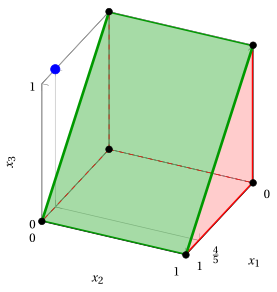
Case (b): the LP relaxation and the cover inequality \(x_1+x_3\le 1\).
-
-
Case (c): \(\tilde{\boldsymbol{x}}=\left(\tfrac{1}{3},\tfrac{1}{3},\tfrac{1}{3}\right)\)
-
a) Separation problem
The costs \(q_j=1-\tilde{x}_j\) are \(q=\left(\tfrac{2}{3},\tfrac{2}{3},\tfrac{2}{3}\right)\). The separation problem \(\CSP\) (left) and, with \(y_j=1-z_j\), the complementary problem \(\CSPKP\) (right) are:\[ \begin{array}{rrcrcrcl} {\min} & {\frac{2}{3}\,z_1} & {+} & {\frac{2}{3}\,z_2} & {+} & {\frac{2}{3}\,z_3} & & \\[1ex] \text{subject to} & {5\,z_1} & {+} & {4\,z_2} & {+} & {6\,z_3} & {\ge} & {11} \\[1ex] & {z_1,} & & {z_2,} & & {z_3} & {\in} & {\{0,1\}} \end{array} \]\[ \begin{array}{rrcrcrcl} {\max} & {\frac{2}{3}\,y_1} & {+} & {\frac{2}{3}\,y_2} & {+} & {\frac{2}{3}\,y_3} & & \\[1ex] \text{subject to} & {5\,y_1} & {+} & {4\,y_2} & {+} & {6\,y_3} & {\le} & {4} \\[1ex] & {y_1,} & & {y_2,} & & {y_3} & {\in} & {\{0,1\}} \end{array} \]with \(z(\CSP)=n-\sum_{j\in\mathscr{I}}\tilde{x}_j-z(\CSPKP)=2-z(\CSPKP)\).
-
b) Greedy heuristic
The indices are scanned by non-increasing ratio \(q_j/a_j\), starting from the residual right-hand side \(4\):\(j\) \(q_j\) \(a_j\) \(q_j/a_j\) Decision Residual \(2\) \(\tfrac{2}{3}\) \(4\) \(\tfrac{1}{6}\) \(\bar{y}_j=1\) \(0\) \(1\) \(\tfrac{2}{3}\) \(5\) \(\tfrac{2}{15}\) \(\bar{y}_j=0\) \(0\) \(3\) \(\tfrac{2}{3}\) \(6\) \(\tfrac{1}{9}\) \(\bar{y}_j=0\) \(0\) The greedy solution is \(\bar{\boldsymbol{y}}=\left(0,1,0\right)\), with value \(\frac{2}{3}\). The corresponding cover is \(\bar{C}=\{j\in\mathscr{I}:\bar{y}_j=0\}=\{1,3\}\), with cost \(2-\frac{2}{3}=\frac{4}{3}\ge1\): its cover inequality is not violated by \(\tilde{\boldsymbol{x}}\).
-
c) Optimality check
Indices with \(q_j=0\) do not change the value of a solution. The non-empty subsets of the indices \(\{1,2,3\}\) with \(q_j>0\) that satisfy the constraint with right-hand side \(4\) are: \(\{2\}\) (value \(\frac{2}{3}\)). Hence \(z(\CSPKP)=\frac{2}{3}\), the greedy solution is optimal, and \(z(\CSP)=\frac{4}{3}\ge1\): no cover inequality is violated by \(\tilde{\boldsymbol{x}}\).
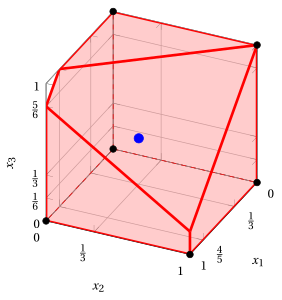
Case (c): the LP relaxation; no cover inequality is violated by the point.
-
Closure and separation
Exercise 5.11: Cover closure by separation (P1)
Consider a binary problem with one constraint \(\sum_{j}a_jx_j\le b\), with positive integer coefficients \(a_j\) and right-hand side \(b=9\), on the binary variables indexed by the set \(\mathscr{I}=\{1,2,3,4\}\) of \(n=4\) variables with the following objective coefficients and constraint coefficients:
The associated \(\LP\) is:
An optimal solution \(\tilde{\boldsymbol{x}}\) of \(\LP\) and its value are:
Questions
-
Starting from \(\tilde{\boldsymbol{x}}\), separate the cover inequalities by solving the complementary problem \(\CSPKP\) to optimality. Add the maximally violated cover inequality to the LP, solve it again, and repeat until no cover inequality is violated. If \(\CSPKP\) has several optimal solutions, choose the one that selects the largest number of variables.
-
What is the optimal value over the cover closure? Is the final solution integer?
The cover closure is the polyhedron obtained by adding to \(\LP\) all the cover inequalities \(\sum_{j\in C}x_j\le|C|-1\), \(C\in\mathcal{C}\). Given a point \(\tilde{\boldsymbol{x}}\), let \(\tilde{y}_1,\dots,\tilde{y}_n\) be an optimal solution of the complementary problem
If \(n-\sum_{j\in\mathscr{I}}\tilde{x}_j-z(\CSPKP)<1\), the cover \(\tilde{C}=\{j\in\mathscr{I}:\tilde{y}_j=0\}\) is associated with the cover inequality maximally violated by \(\tilde{\boldsymbol{x}}\); otherwise, no cover inequality is violated by \(\tilde{\boldsymbol{x}}\).
Solution
Separation of the cover inequalities with the complementary problem; in all the iterations, the right-hand side of \(\CSPKP\) is \(\sum_{j\in\mathscr{I}}a_j-(b+1)=23-10=13\).
-
Iteration 1
The optimal solution of \(\LP\) is \(\tilde{\boldsymbol{x}}=\left(1,\tfrac{4}{9},0,0\right)\), with value \(z(\LP)=\frac{110}{3}\).The costs are \(q=\left(0,\tfrac{5}{9},1,1\right)\), the constant term is \(n-\sum_{j\in\mathscr{I}}\tilde{x}_j=\frac{23}{9}\), and the complementary problem is:
\[ \begin{array}{rrcrcrcrcl} {\max} & & & {\frac{5}{9}\,y_2} & {+} & {y_3} & {+} & {y_4} & & \\[1ex] \text{subject to} & {5\,y_1} & {+} & {9\,y_2} & {+} & {3\,y_3} & {+} & {6\,y_4} & {\le} & {13} \\[1ex] & {y_1,} & & {y_2,} & & {y_3,} & & {y_4} & {\in} & {\{0,1\}} \end{array} \]The maximal subsets of indices that satisfy the constraint with right-hand side \(13\) are: \(\{1,3\}\) (value \(1\)), \(\{1,4\}\) (value \(1\)), \(\{2,3\}\) (value \(\frac{14}{9}\)), \(\{3,4\}\) (value \(2\)). An optimal solution of \(\CSPKP\) is \(\tilde{y}_1=0,~\tilde{y}_2=0,~\tilde{y}_3=1,~\tilde{y}_4=1\), with value \(z(\CSPKP)=2\):
\[ n-\sum_{j\in\mathscr{I}}\tilde{x}_j-z(\CSPKP)=\frac{23}{9}-2=\frac{5}{9}<1. \]Accordingly, \(\tilde{C}=\{j\in\mathscr{I}:\tilde{y}_j=0\}=\{1,2\}\) and the cover inequality
\[ x_1+x_2\le 1 \]is maximally violated by \(\tilde{\boldsymbol{x}}\): \(1+\frac{4}{9}-1=\frac{4}{9}\).
-
Iteration 2
Adding the cover inequality \(x_1+x_2\le 1\), we obtain the following LP, denoted \(\mathrm{LP}_{1}\):\[ \begin{array}{rrcrcrcrcl} {\max} & {22\,x_1} & {+} & {33\,x_2} & {+} & {9\,x_3} & {+} & {13\,x_4} & & \\[1ex] \text{subject to} & {5\,x_1} & {+} & {9\,x_2} & {+} & {3\,x_3} & {+} & {6\,x_4} & {\le} & {9} \\[1ex] & {x_1} & {+} & {x_2} & & & & & {\le} & {1} \\[1ex] & {x_1} & & & & & & & {\le} & {1} \\[0.5ex] & & & {x_2} & & & & & {\le} & {1} \\[0.5ex] & & & & & {x_3} & & & {\le} & {1} \\[0.5ex] & & & & & & & {x_4} & {\le} & {1} \\[0.5ex] & {x_1,} & & {x_2,} & & {x_3,} & & {x_4} & {\ge} & {0} \end{array} \]An optimal solution of \(\mathrm{LP}_{1}\) is \(\tilde{\boldsymbol{x}}=\left(\tfrac{3}{4},\tfrac{1}{4},1,0\right)\), with value \(z(\mathrm{LP}_{1})=\frac{135}{4}\).
The costs are \(q=\left(\tfrac{1}{4},\tfrac{3}{4},0,1\right)\), the constant term is \(n-\sum_{j\in\mathscr{I}}\tilde{x}_j=2\), and the complementary problem is:
\[ \begin{array}{rrcrcrcrcl} {\max} & {\frac{1}{4}\,y_1} & {+} & {\frac{3}{4}\,y_2} & & & {+} & {y_4} & & \\[1ex] \text{subject to} & {5\,y_1} & {+} & {9\,y_2} & {+} & {3\,y_3} & {+} & {6\,y_4} & {\le} & {13} \\[1ex] & {y_1,} & & {y_2,} & & {y_3,} & & {y_4} & {\in} & {\{0,1\}} \end{array} \]The maximal subsets of indices that satisfy the constraint with right-hand side \(13\) are: \(\{1,3\}\) (value \(\frac{1}{4}\)), \(\{1,4\}\) (value \(\frac{5}{4}\)), \(\{2,3\}\) (value \(\frac{3}{4}\)), \(\{3,4\}\) (value \(1\)). An optimal solution of \(\CSPKP\) is \(\tilde{y}_1=1,~\tilde{y}_2=0,~\tilde{y}_3=0,~\tilde{y}_4=1\), with value \(z(\CSPKP)=\frac{5}{4}\):
\[ n-\sum_{j\in\mathscr{I}}\tilde{x}_j-z(\CSPKP)=2-\frac{5}{4}=\frac{3}{4}<1. \]Accordingly, \(\tilde{C}=\{j\in\mathscr{I}:\tilde{y}_j=0\}=\{2,3\}\) and the cover inequality
\[ x_2+x_3\le 1 \]is maximally violated by \(\tilde{\boldsymbol{x}}\): \(\frac{1}{4}+1-1=\frac{1}{4}\).
-
Iteration 3
Adding the cover inequality \(x_2+x_3\le 1\), we obtain the following LP, denoted \(\mathrm{LP}_{2}\):\[ \begin{array}{rrcrcrcrcl} {\max} & {22\,x_1} & {+} & {33\,x_2} & {+} & {9\,x_3} & {+} & {13\,x_4} & & \\[1ex] \text{subject to} & {5\,x_1} & {+} & {9\,x_2} & {+} & {3\,x_3} & {+} & {6\,x_4} & {\le} & {9} \\[1ex] & {x_1} & {+} & {x_2} & & & & & {\le} & {1} \\[1ex] & & & {x_2} & {+} & {x_3} & & & {\le} & {1} \\[1ex] & {x_1} & & & & & & & {\le} & {1} \\[0.5ex] & & & {x_2} & & & & & {\le} & {1} \\[0.5ex] & & & & & {x_3} & & & {\le} & {1} \\[0.5ex] & & & & & & & {x_4} & {\le} & {1} \\[0.5ex] & {x_1,} & & {x_2,} & & {x_3,} & & {x_4} & {\ge} & {0} \end{array} \]An optimal solution of \(\mathrm{LP}_{2}\) is \(\tilde{\boldsymbol{x}}=\left(1,0,1,\tfrac{1}{6}\right)\), with value \(z(\mathrm{LP}_{2})=\frac{199}{6}\).
The costs are \(q=\left(0,1,0,\tfrac{5}{6}\right)\), the constant term is \(n-\sum_{j\in\mathscr{I}}\tilde{x}_j=\frac{11}{6}\), and the complementary problem is:
\[ \begin{array}{rrcrcrcrcl} {\max} & & & {y_2} & & & {+} & {\frac{5}{6}\,y_4} & & \\[1ex] \text{subject to} & {5\,y_1} & {+} & {9\,y_2} & {+} & {3\,y_3} & {+} & {6\,y_4} & {\le} & {13} \\[1ex] & {y_1,} & & {y_2,} & & {y_3,} & & {y_4} & {\in} & {\{0,1\}} \end{array} \]The maximal subsets of indices that satisfy the constraint with right-hand side \(13\) are: \(\{1,3\}\) (value \(0\)), \(\{1,4\}\) (value \(\frac{5}{6}\)), \(\{2,3\}\) (value \(1\)), \(\{3,4\}\) (value \(\frac{5}{6}\)). An optimal solution of \(\CSPKP\) is \(\tilde{y}_1=0,~\tilde{y}_2=1,~\tilde{y}_3=1,~\tilde{y}_4=0\), with value \(z(\CSPKP)=1\):
\[ n-\sum_{j\in\mathscr{I}}\tilde{x}_j-z(\CSPKP)=\frac{11}{6}-1=\frac{5}{6}<1. \]Accordingly, \(\tilde{C}=\{j\in\mathscr{I}:\tilde{y}_j=0\}=\{1,4\}\) and the cover inequality
\[ x_1+x_4\le 1 \]is maximally violated by \(\tilde{\boldsymbol{x}}\): \(1+\frac{1}{6}-1=\frac{1}{6}\).
-
Iteration 4
Adding the cover inequality \(x_1+x_4\le 1\), we obtain the following LP, denoted \(\mathrm{LP}_{3}\):\[ \begin{array}{rrcrcrcrcl} {\max} & {22\,x_1} & {+} & {33\,x_2} & {+} & {9\,x_3} & {+} & {13\,x_4} & & \\[1ex] \text{subject to} & {5\,x_1} & {+} & {9\,x_2} & {+} & {3\,x_3} & {+} & {6\,x_4} & {\le} & {9} \\[1ex] & {x_1} & {+} & {x_2} & & & & & {\le} & {1} \\[1ex] & & & {x_2} & {+} & {x_3} & & & {\le} & {1} \\[1ex] & {x_1} & & & & & {+} & {x_4} & {\le} & {1} \\[1ex] & {x_1} & & & & & & & {\le} & {1} \\[0.5ex] & & & {x_2} & & & & & {\le} & {1} \\[0.5ex] & & & & & {x_3} & & & {\le} & {1} \\[0.5ex] & & & & & & & {x_4} & {\le} & {1} \\[0.5ex] & {x_1,} & & {x_2,} & & {x_3,} & & {x_4} & {\ge} & {0} \end{array} \]An optimal solution of \(\mathrm{LP}_{3}\) is \(\tilde{\boldsymbol{x}}=\left(\tfrac{6}{7},\tfrac{1}{7},\tfrac{6}{7},\tfrac{1}{7}\right)\), with value \(z(\mathrm{LP}_{3})=\frac{232}{7}\).
The costs are \(q=\left(\tfrac{1}{7},\tfrac{6}{7},\tfrac{1}{7},\tfrac{6}{7}\right)\), the constant term is \(n-\sum_{j\in\mathscr{I}}\tilde{x}_j=2\), and the complementary problem is:
\[ \begin{array}{rrcrcrcrcl} {\max} & {\frac{1}{7}\,y_1} & {+} & {\frac{6}{7}\,y_2} & {+} & {\frac{1}{7}\,y_3} & {+} & {\frac{6}{7}\,y_4} & & \\[1ex] \text{subject to} & {5\,y_1} & {+} & {9\,y_2} & {+} & {3\,y_3} & {+} & {6\,y_4} & {\le} & {13} \\[1ex] & {y_1,} & & {y_2,} & & {y_3,} & & {y_4} & {\in} & {\{0,1\}} \end{array} \]The maximal subsets of indices that satisfy the constraint with right-hand side \(13\) are: \(\{1,3\}\) (value \(\frac{2}{7}\)), \(\{1,4\}\) (value \(1\)), \(\{2,3\}\) (value \(1\)), \(\{3,4\}\) (value \(1\)). The optimal value of \(\CSPKP\) is \(z(\CSPKP)=1\):
\[ n-\sum_{j\in\mathscr{I}}\tilde{x}_j-z(\CSPKP)=2-1=1\ge1. \]No cover inequality is violated by \(\tilde{\boldsymbol{x}}=\left(\tfrac{6}{7},\tfrac{1}{7},\tfrac{6}{7},\tfrac{1}{7}\right)\): the separation stops after \(3\) cover inequalities. The optimal value over the cover closure is
\[ z(\mathrm{LP}^{\mathrm{cov}})=z(\mathrm{LP}_{3})=\frac{232}{7}<z(\LP)=\frac{110}{3}, \]and \(\tilde{\boldsymbol{x}}\) is fractional: the cover closure does not coincide with the convex hull of the integer solutions.
Exercise 5.12: Cover closure by separation (P2)
Consider a binary problem with one constraint \(\sum_{j}a_jx_j\le b\), with positive integer coefficients \(a_j\) and right-hand side \(b=17\), on the binary variables indexed by the set \(\mathscr{I}=\{1,2,3,4\}\) of \(n=4\) variables with the following objective coefficients and constraint coefficients:
The associated \(\LP\) is:
An optimal solution \(\tilde{\boldsymbol{x}}\) of \(\LP\) and its value are:
Questions
-
Starting from \(\tilde{\boldsymbol{x}}\), separate the cover inequalities by solving the complementary problem \(\CSPKP\) to optimality. Add the maximally violated cover inequality to the LP, solve it again, and repeat until no cover inequality is violated. If \(\CSPKP\) has several optimal solutions, choose the one that selects the largest number of variables.
-
What is the optimal value over the cover closure? Is the final solution integer?
The cover closure is the polyhedron obtained by adding to \(\LP\) all the cover inequalities \(\sum_{j\in C}x_j\le|C|-1\), \(C\in\mathcal{C}\). Given a point \(\tilde{\boldsymbol{x}}\), let \(\tilde{y}_1,\dots,\tilde{y}_n\) be an optimal solution of the complementary problem
If \(n-\sum_{j\in\mathscr{I}}\tilde{x}_j-z(\CSPKP)<1\), the cover \(\tilde{C}=\{j\in\mathscr{I}:\tilde{y}_j=0\}\) is associated with the cover inequality maximally violated by \(\tilde{\boldsymbol{x}}\); otherwise, no cover inequality is violated by \(\tilde{\boldsymbol{x}}\).
Solution
Separation of the cover inequalities with the complementary problem; in all the iterations, the right-hand side of \(\CSPKP\) is \(\sum_{j\in\mathscr{I}}a_j-(b+1)=33-18=15\).
-
Iteration 1
The optimal solution of \(\LP\) is \(\tilde{\boldsymbol{x}}=\left(1,1,\tfrac{1}{5},0\right)\), with value \(z(\LP)=\frac{317}{5}\).The costs are \(q=\left(0,0,\tfrac{4}{5},1\right)\), the constant term is \(n-\sum_{j\in\mathscr{I}}\tilde{x}_j=\frac{9}{5}\), and the complementary problem is:
\[ \begin{array}{rrcrcrcrcl} {\max} & & & & & {\frac{4}{5}\,y_3} & {+} & {y_4} & & \\[1ex] \text{subject to} & {5\,y_1} & {+} & {10\,y_2} & {+} & {10\,y_3} & {+} & {8\,y_4} & {\le} & {15} \\[1ex] & {y_1,} & & {y_2,} & & {y_3,} & & {y_4} & {\in} & {\{0,1\}} \end{array} \]The maximal subsets of indices that satisfy the constraint with right-hand side \(15\) are: \(\{1,2\}\) (value \(0\)), \(\{1,3\}\) (value \(\frac{4}{5}\)), \(\{1,4\}\) (value \(1\)). An optimal solution of \(\CSPKP\) is \(\tilde{y}_1=1,~\tilde{y}_2=0,~\tilde{y}_3=0,~\tilde{y}_4=1\), with value \(z(\CSPKP)=1\):
\[ n-\sum_{j\in\mathscr{I}}\tilde{x}_j-z(\CSPKP)=\frac{9}{5}-1=\frac{4}{5}<1. \]Accordingly, \(\tilde{C}=\{j\in\mathscr{I}:\tilde{y}_j=0\}=\{2,3\}\) and the cover inequality
\[ x_2+x_3\le 1 \]is maximally violated by \(\tilde{\boldsymbol{x}}\): \(1+\frac{1}{5}-1=\frac{1}{5}\).
-
Iteration 2
Adding the cover inequality \(x_2+x_3\le 1\), we obtain the following LP, denoted \(\mathrm{LP}_{1}\):\[ \begin{array}{rrcrcrcrcl} {\max} & {29\,x_1} & {+} & {29\,x_2} & {+} & {27\,x_3} & {+} & {21\,x_4} & & \\[1ex] \text{subject to} & {5\,x_1} & {+} & {10\,x_2} & {+} & {10\,x_3} & {+} & {8\,x_4} & {\le} & {17} \\[1ex] & & & {x_2} & {+} & {x_3} & & & {\le} & {1} \\[1ex] & {x_1} & & & & & & & {\le} & {1} \\[0.5ex] & & & {x_2} & & & & & {\le} & {1} \\[0.5ex] & & & & & {x_3} & & & {\le} & {1} \\[0.5ex] & & & & & & & {x_4} & {\le} & {1} \\[0.5ex] & {x_1,} & & {x_2,} & & {x_3,} & & {x_4} & {\ge} & {0} \end{array} \]An optimal solution of \(\mathrm{LP}_{1}\) is \(\tilde{\boldsymbol{x}}=\left(1,1,0,\tfrac{1}{4}\right)\), with value \(z(\mathrm{LP}_{1})=\frac{253}{4}\).
The costs are \(q=\left(0,0,1,\tfrac{3}{4}\right)\), the constant term is \(n-\sum_{j\in\mathscr{I}}\tilde{x}_j=\frac{7}{4}\), and the complementary problem is:
\[ \begin{array}{rrcrcrcrcl} {\max} & & & & & {y_3} & {+} & {\frac{3}{4}\,y_4} & & \\[1ex] \text{subject to} & {5\,y_1} & {+} & {10\,y_2} & {+} & {10\,y_3} & {+} & {8\,y_4} & {\le} & {15} \\[1ex] & {y_1,} & & {y_2,} & & {y_3,} & & {y_4} & {\in} & {\{0,1\}} \end{array} \]The maximal subsets of indices that satisfy the constraint with right-hand side \(15\) are: \(\{1,2\}\) (value \(0\)), \(\{1,3\}\) (value \(1\)), \(\{1,4\}\) (value \(\frac{3}{4}\)). An optimal solution of \(\CSPKP\) is \(\tilde{y}_1=1,~\tilde{y}_2=0,~\tilde{y}_3=1,~\tilde{y}_4=0\), with value \(z(\CSPKP)=1\):
\[ n-\sum_{j\in\mathscr{I}}\tilde{x}_j-z(\CSPKP)=\frac{7}{4}-1=\frac{3}{4}<1. \]Accordingly, \(\tilde{C}=\{j\in\mathscr{I}:\tilde{y}_j=0\}=\{2,4\}\) and the cover inequality
\[ x_2+x_4\le 1 \]is maximally violated by \(\tilde{\boldsymbol{x}}\): \(1+\frac{1}{4}-1=\frac{1}{4}\).
-
Iteration 3
Adding the cover inequality \(x_2+x_4\le 1\), we obtain the following LP, denoted \(\mathrm{LP}_{2}\):\[ \begin{array}{rrcrcrcrcl} {\max} & {29\,x_1} & {+} & {29\,x_2} & {+} & {27\,x_3} & {+} & {21\,x_4} & & \\[1ex] \text{subject to} & {5\,x_1} & {+} & {10\,x_2} & {+} & {10\,x_3} & {+} & {8\,x_4} & {\le} & {17} \\[1ex] & & & {x_2} & {+} & {x_3} & & & {\le} & {1} \\[1ex] & & & {x_2} & & & {+} & {x_4} & {\le} & {1} \\[1ex] & {x_1} & & & & & & & {\le} & {1} \\[0.5ex] & & & {x_2} & & & & & {\le} & {1} \\[0.5ex] & & & & & {x_3} & & & {\le} & {1} \\[0.5ex] & & & & & & & {x_4} & {\le} & {1} \\[0.5ex] & {x_1,} & & {x_2,} & & {x_3,} & & {x_4} & {\ge} & {0} \end{array} \]An optimal solution of \(\mathrm{LP}_{2}\) is \(\tilde{\boldsymbol{x}}=\left(1,\tfrac{3}{4},\tfrac{1}{4},\tfrac{1}{4}\right)\), with value \(z(\mathrm{LP}_{2})=\frac{251}{4}\).
The costs are \(q=\left(0,\tfrac{1}{4},\tfrac{3}{4},\tfrac{3}{4}\right)\), the constant term is \(n-\sum_{j\in\mathscr{I}}\tilde{x}_j=\frac{7}{4}\), and the complementary problem is:
\[ \begin{array}{rrcrcrcrcl} {\max} & & & {\frac{1}{4}\,y_2} & {+} & {\frac{3}{4}\,y_3} & {+} & {\frac{3}{4}\,y_4} & & \\[1ex] \text{subject to} & {5\,y_1} & {+} & {10\,y_2} & {+} & {10\,y_3} & {+} & {8\,y_4} & {\le} & {15} \\[1ex] & {y_1,} & & {y_2,} & & {y_3,} & & {y_4} & {\in} & {\{0,1\}} \end{array} \]The maximal subsets of indices that satisfy the constraint with right-hand side \(15\) are: \(\{1,2\}\) (value \(\frac{1}{4}\)), \(\{1,3\}\) (value \(\frac{3}{4}\)), \(\{1,4\}\) (value \(\frac{3}{4}\)). The optimal value of \(\CSPKP\) is \(z(\CSPKP)=\frac{3}{4}\):
\[ n-\sum_{j\in\mathscr{I}}\tilde{x}_j-z(\CSPKP)=\frac{7}{4}-\frac{3}{4}=1\ge1. \]No cover inequality is violated by \(\tilde{\boldsymbol{x}}=\left(1,\tfrac{3}{4},\tfrac{1}{4},\tfrac{1}{4}\right)\): the separation stops after \(2\) cover inequalities. The optimal value over the cover closure is
\[ z(\mathrm{LP}^{\mathrm{cov}})=z(\mathrm{LP}_{2})=\frac{251}{4}<z(\LP)=\frac{317}{5}, \]and \(\tilde{\boldsymbol{x}}\) is fractional: the cover closure does not coincide with the convex hull of the integer solutions.
Exercise 5.13: Cover closure by separation (P3)
Consider a binary problem with one constraint \(\sum_{j}a_jx_j\le b\), with positive integer coefficients \(a_j\) and right-hand side \(b=15\), on the binary variables indexed by the set \(\mathscr{I}=\{1,2,3,4\}\) of \(n=4\) variables with the following objective coefficients and constraint coefficients:
The associated \(\LP\) is:
An optimal solution \(\tilde{\boldsymbol{x}}\) of \(\LP\) and its value are:
Questions
-
Starting from \(\tilde{\boldsymbol{x}}\), separate the cover inequalities by solving the complementary problem \(\CSPKP\) to optimality. Add the maximally violated cover inequality to the LP, solve it again, and repeat until no cover inequality is violated. If \(\CSPKP\) has several optimal solutions, choose the one that selects the largest number of variables.
-
What is the optimal value over the cover closure? Is the final solution integer?
The cover closure is the polyhedron obtained by adding to \(\LP\) all the cover inequalities \(\sum_{j\in C}x_j\le|C|-1\), \(C\in\mathcal{C}\). Given a point \(\tilde{\boldsymbol{x}}\), let \(\tilde{y}_1,\dots,\tilde{y}_n\) be an optimal solution of the complementary problem
If \(n-\sum_{j\in\mathscr{I}}\tilde{x}_j-z(\CSPKP)<1\), the cover \(\tilde{C}=\{j\in\mathscr{I}:\tilde{y}_j=0\}\) is associated with the cover inequality maximally violated by \(\tilde{\boldsymbol{x}}\); otherwise, no cover inequality is violated by \(\tilde{\boldsymbol{x}}\).
Solution
Separation of the cover inequalities with the complementary problem; in all the iterations, the right-hand side of \(\CSPKP\) is \(\sum_{j\in\mathscr{I}}a_j-(b+1)=25-16=9\).
-
Iteration 1
The optimal solution of \(\LP\) is \(\tilde{\boldsymbol{x}}=\left(1,1,\tfrac{8}{9},0\right)\), with value \(z(\LP)=46\).The costs are \(q=\left(0,0,\tfrac{1}{9},1\right)\), the constant term is \(n-\sum_{j\in\mathscr{I}}\tilde{x}_j=\frac{10}{9}\), and the complementary problem is:
\[ \begin{array}{rrcrcrcrcl} {\max} & & & & & {\frac{1}{9}\,y_3} & {+} & {y_4} & & \\[1ex] \text{subject to} & {5\,y_1} & {+} & {2\,y_2} & {+} & {9\,y_3} & {+} & {9\,y_4} & {\le} & {9} \\[1ex] & {y_1,} & & {y_2,} & & {y_3,} & & {y_4} & {\in} & {\{0,1\}} \end{array} \]The maximal subsets of indices that satisfy the constraint with right-hand side \(9\) are: \(\{3\}\) (value \(\frac{1}{9}\)), \(\{4\}\) (value \(1\)), \(\{1,2\}\) (value \(0\)). An optimal solution of \(\CSPKP\) is \(\tilde{y}_1=0,~\tilde{y}_2=0,~\tilde{y}_3=0,~\tilde{y}_4=1\), with value \(z(\CSPKP)=1\):
\[ n-\sum_{j\in\mathscr{I}}\tilde{x}_j-z(\CSPKP)=\frac{10}{9}-1=\frac{1}{9}<1. \]Accordingly, \(\tilde{C}=\{j\in\mathscr{I}:\tilde{y}_j=0\}=\{1,2,3\}\) and the cover inequality
\[ x_1+x_2+x_3\le 2 \]is maximally violated by \(\tilde{\boldsymbol{x}}\): \(1+1+\frac{8}{9}-2=\frac{8}{9}\).
-
Iteration 2
Adding the cover inequality \(x_1+x_2+x_3\le 2\), we obtain the following LP, denoted \(\mathrm{LP}_{1}\):\[ \begin{array}{rrcrcrcrcl} {\max} & {30\,x_1} & {+} & {8\,x_2} & {+} & {9\,x_3} & {+} & {6\,x_4} & & \\[1ex] \text{subject to} & {5\,x_1} & {+} & {2\,x_2} & {+} & {9\,x_3} & {+} & {9\,x_4} & {\le} & {15} \\[1ex] & {x_1} & {+} & {x_2} & {+} & {x_3} & & & {\le} & {2} \\[1ex] & {x_1} & & & & & & & {\le} & {1} \\[0.5ex] & & & {x_2} & & & & & {\le} & {1} \\[0.5ex] & & & & & {x_3} & & & {\le} & {1} \\[0.5ex] & & & & & & & {x_4} & {\le} & {1} \\[0.5ex] & {x_1,} & & {x_2,} & & {x_3,} & & {x_4} & {\ge} & {0} \end{array} \]An optimal solution of \(\mathrm{LP}_{1}\) is \(\tilde{\boldsymbol{x}}=\left(1,1,0,\tfrac{8}{9}\right)\), with value \(z(\mathrm{LP}_{1})=\frac{130}{3}\).
The costs are \(q=\left(0,0,1,\tfrac{1}{9}\right)\), the constant term is \(n-\sum_{j\in\mathscr{I}}\tilde{x}_j=\frac{10}{9}\), and the complementary problem is:
\[ \begin{array}{rrcrcrcrcl} {\max} & & & & & {y_3} & {+} & {\frac{1}{9}\,y_4} & & \\[1ex] \text{subject to} & {5\,y_1} & {+} & {2\,y_2} & {+} & {9\,y_3} & {+} & {9\,y_4} & {\le} & {9} \\[1ex] & {y_1,} & & {y_2,} & & {y_3,} & & {y_4} & {\in} & {\{0,1\}} \end{array} \]The maximal subsets of indices that satisfy the constraint with right-hand side \(9\) are: \(\{3\}\) (value \(1\)), \(\{4\}\) (value \(\frac{1}{9}\)), \(\{1,2\}\) (value \(0\)). An optimal solution of \(\CSPKP\) is \(\tilde{y}_1=0,~\tilde{y}_2=0,~\tilde{y}_3=1,~\tilde{y}_4=0\), with value \(z(\CSPKP)=1\):
\[ n-\sum_{j\in\mathscr{I}}\tilde{x}_j-z(\CSPKP)=\frac{10}{9}-1=\frac{1}{9}<1. \]Accordingly, \(\tilde{C}=\{j\in\mathscr{I}:\tilde{y}_j=0\}=\{1,2,4\}\) and the cover inequality
\[ x_1+x_2+x_4\le 2 \]is maximally violated by \(\tilde{\boldsymbol{x}}\): \(1+1+\frac{8}{9}-2=\frac{8}{9}\).
-
Iteration 3
Adding the cover inequality \(x_1+x_2+x_4\le 2\), we obtain the following LP, denoted \(\mathrm{LP}_{2}\):\[ \begin{array}{rrcrcrcrcl} {\max} & {30\,x_1} & {+} & {8\,x_2} & {+} & {9\,x_3} & {+} & {6\,x_4} & & \\[1ex] \text{subject to} & {5\,x_1} & {+} & {2\,x_2} & {+} & {9\,x_3} & {+} & {9\,x_4} & {\le} & {15} \\[1ex] & {x_1} & {+} & {x_2} & {+} & {x_3} & & & {\le} & {2} \\[1ex] & {x_1} & {+} & {x_2} & & & {+} & {x_4} & {\le} & {2} \\[1ex] & {x_1} & & & & & & & {\le} & {1} \\[0.5ex] & & & {x_2} & & & & & {\le} & {1} \\[0.5ex] & & & & & {x_3} & & & {\le} & {1} \\[0.5ex] & & & & & & & {x_4} & {\le} & {1} \\[0.5ex] & {x_1,} & & {x_2,} & & {x_3,} & & {x_4} & {\ge} & {0} \end{array} \]An optimal solution of \(\mathrm{LP}_{2}\) is \(\tilde{\boldsymbol{x}}=\left(1,\tfrac{1}{2},\tfrac{1}{2},\tfrac{1}{2}\right)\), with value \(z(\mathrm{LP}_{2})=\frac{83}{2}\).
The costs are \(q=\left(0,\tfrac{1}{2},\tfrac{1}{2},\tfrac{1}{2}\right)\), the constant term is \(n-\sum_{j\in\mathscr{I}}\tilde{x}_j=\frac{3}{2}\), and the complementary problem is:
\[ \begin{array}{rrcrcrcrcl} {\max} & & & {\frac{1}{2}\,y_2} & {+} & {\frac{1}{2}\,y_3} & {+} & {\frac{1}{2}\,y_4} & & \\[1ex] \text{subject to} & {5\,y_1} & {+} & {2\,y_2} & {+} & {9\,y_3} & {+} & {9\,y_4} & {\le} & {9} \\[1ex] & {y_1,} & & {y_2,} & & {y_3,} & & {y_4} & {\in} & {\{0,1\}} \end{array} \]The maximal subsets of indices that satisfy the constraint with right-hand side \(9\) are: \(\{3\}\) (value \(\frac{1}{2}\)), \(\{4\}\) (value \(\frac{1}{2}\)), \(\{1,2\}\) (value \(\frac{1}{2}\)). The optimal value of \(\CSPKP\) is \(z(\CSPKP)=\frac{1}{2}\):
\[ n-\sum_{j\in\mathscr{I}}\tilde{x}_j-z(\CSPKP)=\frac{3}{2}-\frac{1}{2}=1\ge1. \]No cover inequality is violated by \(\tilde{\boldsymbol{x}}=\left(1,\tfrac{1}{2},\tfrac{1}{2},\tfrac{1}{2}\right)\): the separation stops after \(2\) cover inequalities. The optimal value over the cover closure is
\[ z(\mathrm{LP}^{\mathrm{cov}})=z(\mathrm{LP}_{2})=\frac{83}{2}<z(\LP)=46, \]and \(\tilde{\boldsymbol{x}}\) is fractional: the cover closure does not coincide with the convex hull of the integer solutions.
Exercise 5.14: Cover closure by separation (P4)
Consider a binary problem with one constraint \(\sum_{j}a_jx_j\le b\), with positive integer coefficients \(a_j\) and right-hand side \(b=9\), on the binary variables indexed by the set \(\mathscr{I}=\{1,2,3,4\}\) of \(n=4\) variables with the following objective coefficients and constraint coefficients:
The associated \(\LP\) is:
An optimal solution \(\tilde{\boldsymbol{x}}\) of \(\LP\) and its value are:
Questions
-
Starting from \(\tilde{\boldsymbol{x}}\), separate the cover inequalities by solving the complementary problem \(\CSPKP\) to optimality. Add the maximally violated cover inequality to the LP, solve it again, and repeat until no cover inequality is violated. If \(\CSPKP\) has several optimal solutions, choose the one that selects the largest number of variables.
-
What is the optimal value over the cover closure? Is the final solution integer?
The cover closure is the polyhedron obtained by adding to \(\LP\) all the cover inequalities \(\sum_{j\in C}x_j\le|C|-1\), \(C\in\mathcal{C}\). Given a point \(\tilde{\boldsymbol{x}}\), let \(\tilde{y}_1,\dots,\tilde{y}_n\) be an optimal solution of the complementary problem
If \(n-\sum_{j\in\mathscr{I}}\tilde{x}_j-z(\CSPKP)<1\), the cover \(\tilde{C}=\{j\in\mathscr{I}:\tilde{y}_j=0\}\) is associated with the cover inequality maximally violated by \(\tilde{\boldsymbol{x}}\); otherwise, no cover inequality is violated by \(\tilde{\boldsymbol{x}}\).
Solution
Separation of the cover inequalities with the complementary problem; in all the iterations, the right-hand side of \(\CSPKP\) is \(\sum_{j\in\mathscr{I}}a_j-(b+1)=25-10=15\).
-
Iteration 1
The optimal solution of \(\LP\) is \(\tilde{\boldsymbol{x}}=\left(1,\tfrac{1}{6},0,0\right)\), with value \(z(\LP)=\frac{199}{6}\).The costs are \(q=\left(0,\tfrac{5}{6},1,1\right)\), the constant term is \(n-\sum_{j\in\mathscr{I}}\tilde{x}_j=\frac{17}{6}\), and the complementary problem is:
\[ \begin{array}{rrcrcrcrcl} {\max} & & & {\frac{5}{6}\,y_2} & {+} & {y_3} & {+} & {y_4} & & \\[1ex] \text{subject to} & {8\,y_1} & {+} & {6\,y_2} & {+} & {3\,y_3} & {+} & {8\,y_4} & {\le} & {15} \\[1ex] & {y_1,} & & {y_2,} & & {y_3,} & & {y_4} & {\in} & {\{0,1\}} \end{array} \]The maximal subsets of indices that satisfy the constraint with right-hand side \(15\) are: \(\{1,2\}\) (value \(\frac{5}{6}\)), \(\{1,3\}\) (value \(1\)), \(\{2,3\}\) (value \(\frac{11}{6}\)), \(\{2,4\}\) (value \(\frac{11}{6}\)), \(\{3,4\}\) (value \(2\)). An optimal solution of \(\CSPKP\) is \(\tilde{y}_1=0,~\tilde{y}_2=0,~\tilde{y}_3=1,~\tilde{y}_4=1\), with value \(z(\CSPKP)=2\):
\[ n-\sum_{j\in\mathscr{I}}\tilde{x}_j-z(\CSPKP)=\frac{17}{6}-2=\frac{5}{6}<1. \]Accordingly, \(\tilde{C}=\{j\in\mathscr{I}:\tilde{y}_j=0\}=\{1,2\}\) and the cover inequality
\[ x_1+x_2\le 1 \]is maximally violated by \(\tilde{\boldsymbol{x}}\): \(1+\frac{1}{6}-1=\frac{1}{6}\).
-
Iteration 2
Adding the cover inequality \(x_1+x_2\le 1\), we obtain the following LP, denoted \(\mathrm{LP}_{1}\):\[ \begin{array}{rrcrcrcrcl} {\max} & {31\,x_1} & {+} & {13\,x_2} & {+} & {5\,x_3} & {+} & {9\,x_4} & & \\[1ex] \text{subject to} & {8\,x_1} & {+} & {6\,x_2} & {+} & {3\,x_3} & {+} & {8\,x_4} & {\le} & {9} \\[1ex] & {x_1} & {+} & {x_2} & & & & & {\le} & {1} \\[1ex] & {x_1} & & & & & & & {\le} & {1} \\[0.5ex] & & & {x_2} & & & & & {\le} & {1} \\[0.5ex] & & & & & {x_3} & & & {\le} & {1} \\[0.5ex] & & & & & & & {x_4} & {\le} & {1} \\[0.5ex] & {x_1,} & & {x_2,} & & {x_3,} & & {x_4} & {\ge} & {0} \end{array} \]An optimal solution of \(\mathrm{LP}_{1}\) is \(\tilde{\boldsymbol{x}}=\left(1,0,\tfrac{1}{3},0\right)\), with value \(z(\mathrm{LP}_{1})=\frac{98}{3}\).
The costs are \(q=\left(0,1,\tfrac{2}{3},1\right)\), the constant term is \(n-\sum_{j\in\mathscr{I}}\tilde{x}_j=\frac{8}{3}\), and the complementary problem is:
\[ \begin{array}{rrcrcrcrcl} {\max} & & & {y_2} & {+} & {\frac{2}{3}\,y_3} & {+} & {y_4} & & \\[1ex] \text{subject to} & {8\,y_1} & {+} & {6\,y_2} & {+} & {3\,y_3} & {+} & {8\,y_4} & {\le} & {15} \\[1ex] & {y_1,} & & {y_2,} & & {y_3,} & & {y_4} & {\in} & {\{0,1\}} \end{array} \]The maximal subsets of indices that satisfy the constraint with right-hand side \(15\) are: \(\{1,2\}\) (value \(1\)), \(\{1,3\}\) (value \(\frac{2}{3}\)), \(\{2,3\}\) (value \(\frac{5}{3}\)), \(\{2,4\}\) (value \(2\)), \(\{3,4\}\) (value \(\frac{5}{3}\)). An optimal solution of \(\CSPKP\) is \(\tilde{y}_1=0,~\tilde{y}_2=1,~\tilde{y}_3=0,~\tilde{y}_4=1\), with value \(z(\CSPKP)=2\):
\[ n-\sum_{j\in\mathscr{I}}\tilde{x}_j-z(\CSPKP)=\frac{8}{3}-2=\frac{2}{3}<1. \]Accordingly, \(\tilde{C}=\{j\in\mathscr{I}:\tilde{y}_j=0\}=\{1,3\}\) and the cover inequality
\[ x_1+x_3\le 1 \]is maximally violated by \(\tilde{\boldsymbol{x}}\): \(1+\frac{1}{3}-1=\frac{1}{3}\).
-
Iteration 3
Adding the cover inequality \(x_1+x_3\le 1\), we obtain the following LP, denoted \(\mathrm{LP}_{2}\):\[ \begin{array}{rrcrcrcrcl} {\max} & {31\,x_1} & {+} & {13\,x_2} & {+} & {5\,x_3} & {+} & {9\,x_4} & & \\[1ex] \text{subject to} & {8\,x_1} & {+} & {6\,x_2} & {+} & {3\,x_3} & {+} & {8\,x_4} & {\le} & {9} \\[1ex] & {x_1} & {+} & {x_2} & & & & & {\le} & {1} \\[1ex] & {x_1} & & & {+} & {x_3} & & & {\le} & {1} \\[1ex] & {x_1} & & & & & & & {\le} & {1} \\[0.5ex] & & & {x_2} & & & & & {\le} & {1} \\[0.5ex] & & & & & {x_3} & & & {\le} & {1} \\[0.5ex] & & & & & & & {x_4} & {\le} & {1} \\[0.5ex] & {x_1,} & & {x_2,} & & {x_3,} & & {x_4} & {\ge} & {0} \end{array} \]An optimal solution of \(\mathrm{LP}_{2}\) is \(\tilde{\boldsymbol{x}}=\left(1,0,0,\tfrac{1}{8}\right)\), with value \(z(\mathrm{LP}_{2})=\frac{257}{8}\).
The costs are \(q=\left(0,1,1,\tfrac{7}{8}\right)\), the constant term is \(n-\sum_{j\in\mathscr{I}}\tilde{x}_j=\frac{23}{8}\), and the complementary problem is:
\[ \begin{array}{rrcrcrcrcl} {\max} & & & {y_2} & {+} & {y_3} & {+} & {\frac{7}{8}\,y_4} & & \\[1ex] \text{subject to} & {8\,y_1} & {+} & {6\,y_2} & {+} & {3\,y_3} & {+} & {8\,y_4} & {\le} & {15} \\[1ex] & {y_1,} & & {y_2,} & & {y_3,} & & {y_4} & {\in} & {\{0,1\}} \end{array} \]The maximal subsets of indices that satisfy the constraint with right-hand side \(15\) are: \(\{1,2\}\) (value \(1\)), \(\{1,3\}\) (value \(1\)), \(\{2,3\}\) (value \(2\)), \(\{2,4\}\) (value \(\frac{15}{8}\)), \(\{3,4\}\) (value \(\frac{15}{8}\)). An optimal solution of \(\CSPKP\) is \(\tilde{y}_1=0,~\tilde{y}_2=1,~\tilde{y}_3=1,~\tilde{y}_4=0\), with value \(z(\CSPKP)=2\):
\[ n-\sum_{j\in\mathscr{I}}\tilde{x}_j-z(\CSPKP)=\frac{23}{8}-2=\frac{7}{8}<1. \]Accordingly, \(\tilde{C}=\{j\in\mathscr{I}:\tilde{y}_j=0\}=\{1,4\}\) and the cover inequality
\[ x_1+x_4\le 1 \]is maximally violated by \(\tilde{\boldsymbol{x}}\): \(1+\frac{1}{8}-1=\frac{1}{8}\).
-
Iteration 4
Adding the cover inequality \(x_1+x_4\le 1\), we obtain the following LP, denoted \(\mathrm{LP}_{3}\):\[ \begin{array}{rrcrcrcrcl} {\max} & {31\,x_1} & {+} & {13\,x_2} & {+} & {5\,x_3} & {+} & {9\,x_4} & & \\[1ex] \text{subject to} & {8\,x_1} & {+} & {6\,x_2} & {+} & {3\,x_3} & {+} & {8\,x_4} & {\le} & {9} \\[1ex] & {x_1} & {+} & {x_2} & & & & & {\le} & {1} \\[1ex] & {x_1} & & & {+} & {x_3} & & & {\le} & {1} \\[1ex] & {x_1} & & & & & {+} & {x_4} & {\le} & {1} \\[1ex] & {x_1} & & & & & & & {\le} & {1} \\[0.5ex] & & & {x_2} & & & & & {\le} & {1} \\[0.5ex] & & & & & {x_3} & & & {\le} & {1} \\[0.5ex] & & & & & & & {x_4} & {\le} & {1} \\[0.5ex] & {x_1,} & & {x_2,} & & {x_3,} & & {x_4} & {\ge} & {0} \end{array} \]An optimal solution of \(\mathrm{LP}_{3}\) is \(\tilde{\boldsymbol{x}}=\left(1,0,0,0\right)\), with value \(z(\mathrm{LP}_{3})=31\).
The costs are \(q=\left(0,1,1,1\right)\), the constant term is \(n-\sum_{j\in\mathscr{I}}\tilde{x}_j=3\), and the complementary problem is:
\[ \begin{array}{rrcrcrcrcl} {\max} & & & {y_2} & {+} & {y_3} & {+} & {y_4} & & \\[1ex] \text{subject to} & {8\,y_1} & {+} & {6\,y_2} & {+} & {3\,y_3} & {+} & {8\,y_4} & {\le} & {15} \\[1ex] & {y_1,} & & {y_2,} & & {y_3,} & & {y_4} & {\in} & {\{0,1\}} \end{array} \]The maximal subsets of indices that satisfy the constraint with right-hand side \(15\) are: \(\{1,2\}\) (value \(1\)), \(\{1,3\}\) (value \(1\)), \(\{2,3\}\) (value \(2\)), \(\{2,4\}\) (value \(2\)), \(\{3,4\}\) (value \(2\)). The optimal value of \(\CSPKP\) is \(z(\CSPKP)=2\):
\[ n-\sum_{j\in\mathscr{I}}\tilde{x}_j-z(\CSPKP)=3-2=1\ge1. \]No cover inequality is violated by \(\tilde{\boldsymbol{x}}=\left(1,0,0,0\right)\): the separation stops after \(3\) cover inequalities. The optimal value over the cover closure is
\[ z(\mathrm{LP}^{\mathrm{cov}})=z(\mathrm{LP}_{3})=31<z(\LP)=\frac{199}{6}, \]and \(\tilde{\boldsymbol{x}}\) is integer, hence it is also optimal for the binary problem.
Exercise 5.15: Cover closure by separation (P5)
Consider a binary problem with one constraint \(\sum_{j}a_jx_j\le b\), with positive integer coefficients \(a_j\) and right-hand side \(b=12\), on the binary variables indexed by the set \(\mathscr{I}=\{1,2,3,4\}\) of \(n=4\) variables with the following objective coefficients and constraint coefficients:
The associated \(\LP\) is:
An optimal solution \(\tilde{\boldsymbol{x}}\) of \(\LP\) and its value are:
Questions
-
Starting from \(\tilde{\boldsymbol{x}}\), separate the cover inequalities by solving the complementary problem \(\CSPKP\) to optimality. Add the maximally violated cover inequality to the LP, solve it again, and repeat until no cover inequality is violated. If \(\CSPKP\) has several optimal solutions, choose the one that selects the largest number of variables.
-
What is the optimal value over the cover closure? Is the final solution integer?
The cover closure is the polyhedron obtained by adding to \(\LP\) all the cover inequalities \(\sum_{j\in C}x_j\le|C|-1\), \(C\in\mathcal{C}\). Given a point \(\tilde{\boldsymbol{x}}\), let \(\tilde{y}_1,\dots,\tilde{y}_n\) be an optimal solution of the complementary problem
If \(n-\sum_{j\in\mathscr{I}}\tilde{x}_j-z(\CSPKP)<1\), the cover \(\tilde{C}=\{j\in\mathscr{I}:\tilde{y}_j=0\}\) is associated with the cover inequality maximally violated by \(\tilde{\boldsymbol{x}}\); otherwise, no cover inequality is violated by \(\tilde{\boldsymbol{x}}\).
Solution
Separation of the cover inequalities with the complementary problem; in all the iterations, the right-hand side of \(\CSPKP\) is \(\sum_{j\in\mathscr{I}}a_j-(b+1)=24-13=11\).
-
Iteration 1
The optimal solution of \(\LP\) is \(\tilde{\boldsymbol{x}}=\left(1,1,\tfrac{1}{7},0\right)\), with value \(z(\LP)=56\).The costs are \(q=\left(0,0,\tfrac{6}{7},1\right)\), the constant term is \(n-\sum_{j\in\mathscr{I}}\tilde{x}_j=\frac{13}{7}\), and the complementary problem is:
\[ \begin{array}{rrcrcrcrcl} {\max} & & & & & {\frac{6}{7}\,y_3} & {+} & {y_4} & & \\[1ex] \text{subject to} & {7\,y_1} & {+} & {4\,y_2} & {+} & {7\,y_3} & {+} & {6\,y_4} & {\le} & {11} \\[1ex] & {y_1,} & & {y_2,} & & {y_3,} & & {y_4} & {\in} & {\{0,1\}} \end{array} \]The maximal subsets of indices that satisfy the constraint with right-hand side \(11\) are: \(\{1,2\}\) (value \(0\)), \(\{2,3\}\) (value \(\frac{6}{7}\)), \(\{2,4\}\) (value \(1\)). An optimal solution of \(\CSPKP\) is \(\tilde{y}_1=0,~\tilde{y}_2=1,~\tilde{y}_3=0,~\tilde{y}_4=1\), with value \(z(\CSPKP)=1\):
\[ n-\sum_{j\in\mathscr{I}}\tilde{x}_j-z(\CSPKP)=\frac{13}{7}-1=\frac{6}{7}<1. \]Accordingly, \(\tilde{C}=\{j\in\mathscr{I}:\tilde{y}_j=0\}=\{1,3\}\) and the cover inequality
\[ x_1+x_3\le 1 \]is maximally violated by \(\tilde{\boldsymbol{x}}\): \(1+\frac{1}{7}-1=\frac{1}{7}\).
-
Iteration 2
Adding the cover inequality \(x_1+x_3\le 1\), we obtain the following LP, denoted \(\mathrm{LP}_{1}\):\[ \begin{array}{rrcrcrcrcl} {\max} & {38\,x_1} & {+} & {16\,x_2} & {+} & {14\,x_3} & {+} & {4\,x_4} & & \\[1ex] \text{subject to} & {7\,x_1} & {+} & {4\,x_2} & {+} & {7\,x_3} & {+} & {6\,x_4} & {\le} & {12} \\[1ex] & {x_1} & & & {+} & {x_3} & & & {\le} & {1} \\[1ex] & {x_1} & & & & & & & {\le} & {1} \\[0.5ex] & & & {x_2} & & & & & {\le} & {1} \\[0.5ex] & & & & & {x_3} & & & {\le} & {1} \\[0.5ex] & & & & & & & {x_4} & {\le} & {1} \\[0.5ex] & {x_1,} & & {x_2,} & & {x_3,} & & {x_4} & {\ge} & {0} \end{array} \]An optimal solution of \(\mathrm{LP}_{1}\) is \(\tilde{\boldsymbol{x}}=\left(1,1,0,\tfrac{1}{6}\right)\), with value \(z(\mathrm{LP}_{1})=\frac{164}{3}\).
The costs are \(q=\left(0,0,1,\tfrac{5}{6}\right)\), the constant term is \(n-\sum_{j\in\mathscr{I}}\tilde{x}_j=\frac{11}{6}\), and the complementary problem is:
\[ \begin{array}{rrcrcrcrcl} {\max} & & & & & {y_3} & {+} & {\frac{5}{6}\,y_4} & & \\[1ex] \text{subject to} & {7\,y_1} & {+} & {4\,y_2} & {+} & {7\,y_3} & {+} & {6\,y_4} & {\le} & {11} \\[1ex] & {y_1,} & & {y_2,} & & {y_3,} & & {y_4} & {\in} & {\{0,1\}} \end{array} \]The maximal subsets of indices that satisfy the constraint with right-hand side \(11\) are: \(\{1,2\}\) (value \(0\)), \(\{2,3\}\) (value \(1\)), \(\{2,4\}\) (value \(\frac{5}{6}\)). An optimal solution of \(\CSPKP\) is \(\tilde{y}_1=0,~\tilde{y}_2=1,~\tilde{y}_3=1,~\tilde{y}_4=0\), with value \(z(\CSPKP)=1\):
\[ n-\sum_{j\in\mathscr{I}}\tilde{x}_j-z(\CSPKP)=\frac{11}{6}-1=\frac{5}{6}<1. \]Accordingly, \(\tilde{C}=\{j\in\mathscr{I}:\tilde{y}_j=0\}=\{1,4\}\) and the cover inequality
\[ x_1+x_4\le 1 \]is maximally violated by \(\tilde{\boldsymbol{x}}\): \(1+\frac{1}{6}-1=\frac{1}{6}\).
-
Iteration 3
Adding the cover inequality \(x_1+x_4\le 1\), we obtain the following LP, denoted \(\mathrm{LP}_{2}\):\[ \begin{array}{rrcrcrcrcl} {\max} & {38\,x_1} & {+} & {16\,x_2} & {+} & {14\,x_3} & {+} & {4\,x_4} & & \\[1ex] \text{subject to} & {7\,x_1} & {+} & {4\,x_2} & {+} & {7\,x_3} & {+} & {6\,x_4} & {\le} & {12} \\[1ex] & {x_1} & & & {+} & {x_3} & & & {\le} & {1} \\[1ex] & {x_1} & & & & & {+} & {x_4} & {\le} & {1} \\[1ex] & {x_1} & & & & & & & {\le} & {1} \\[0.5ex] & & & {x_2} & & & & & {\le} & {1} \\[0.5ex] & & & & & {x_3} & & & {\le} & {1} \\[0.5ex] & & & & & & & {x_4} & {\le} & {1} \\[0.5ex] & {x_1,} & & {x_2,} & & {x_3,} & & {x_4} & {\ge} & {0} \end{array} \]An optimal solution of \(\mathrm{LP}_{2}\) is \(\tilde{\boldsymbol{x}}=\left(1,1,0,0\right)\), with value \(z(\mathrm{LP}_{2})=54\).
The costs are \(q=\left(0,0,1,1\right)\), the constant term is \(n-\sum_{j\in\mathscr{I}}\tilde{x}_j=2\), and the complementary problem is:
\[ \begin{array}{rrcrcrcrcl} {\max} & & & & & {y_3} & {+} & {y_4} & & \\[1ex] \text{subject to} & {7\,y_1} & {+} & {4\,y_2} & {+} & {7\,y_3} & {+} & {6\,y_4} & {\le} & {11} \\[1ex] & {y_1,} & & {y_2,} & & {y_3,} & & {y_4} & {\in} & {\{0,1\}} \end{array} \]The maximal subsets of indices that satisfy the constraint with right-hand side \(11\) are: \(\{1,2\}\) (value \(0\)), \(\{2,3\}\) (value \(1\)), \(\{2,4\}\) (value \(1\)). The optimal value of \(\CSPKP\) is \(z(\CSPKP)=1\):
\[ n-\sum_{j\in\mathscr{I}}\tilde{x}_j-z(\CSPKP)=2-1=1\ge1. \]No cover inequality is violated by \(\tilde{\boldsymbol{x}}=\left(1,1,0,0\right)\): the separation stops after \(2\) cover inequalities. The optimal value over the cover closure is
\[ z(\mathrm{LP}^{\mathrm{cov}})=z(\mathrm{LP}_{2})=54<z(\LP)=56, \]and \(\tilde{\boldsymbol{x}}\) is integer, hence it is also optimal for the binary problem.