Exercises · Valid inequalities
Exercises · Chapter 4 · each solution opens with a click · Chapter 4: Valid inequalities · Exercises, volume 1 (PDF)
Exercise 4.1: A valid inequality by rounding (P2)
Consider the following ILP problem in canonical maximization form with \(n=2\) integer variables and \(m=2\) constraints:
The optimal solution of its LP relaxation is \(\tilde{\vet x}(\LP) = (\tfrac{5}{2},\tfrac{9}{2})\), with \(z(\LP) = 16\).
Questions
-
Using the multipliers \((\frac{3}{34}, \frac{2}{17})\), show that \(x_2 \le 4\) is a valid inequality.
-
Is the inequality tight? Does it cut off the optimal solution of the LP relaxation?
-
Add the inequality to the formulation and compute the new upper bound.
Solution
-
Multiplying the constraints by the non-negative multipliers \((\tfrac{3}{34}, \tfrac{2}{17})\) and summing, \(\tfrac{3}{34} \cdot (-4\,x_1 + 10\,x_2 \le 35) + \tfrac{2}{17} \cdot (3\,x_1 + x_2 \le 12)\), we get
\[ x_2 \le \dfrac{9}{2}. \]Since \(x_j \ge 0\) and the coefficients \(0 \ge 0\), \(1 \ge 1\) are at least those of \(x_2\), every feasible solution satisfies \(x_2 \le x_2 \le \tfrac{9}{2}\). The left-hand side is an integer, so
\[ x_2 \le \left\lfloor \dfrac{9}{2} \right\rfloor = 4 \]is a valid inequality.
-
The feasible solutions \((2,4)\) satisfy \(x_2 = 4\), so the inequality is tight. It cuts off \(\tilde{\vet x}(\LP) = (\tfrac{5}{2},\tfrac{9}{2})\), since \(0 \cdot \tfrac{5}{2} + 1 \cdot \tfrac{9}{2} = \tfrac{9}{2} > 4\).
-
Graphically, we have:
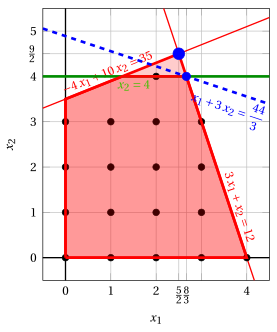
The LP relaxation with the valid inequality \(x_2 \le 4\) (green): the optimal solution \((\frac{5}{2},\frac{9}{2})\) of the original LP relaxation (blue circle) is cut off, and the new optimal solution is blue, with its objective line (dashed).
Formulation \(\tilde{\vet x}(\LP)\) \(z(\LP)\) upper bound original \((\tfrac{5}{2},\tfrac{9}{2})\) \(16\) \(16\) with \(x_2 \le 4\) \((\tfrac{8}{3},4)\) \(\tfrac{44}{3}\) \(14\) \(x_2 \le 4\) is valid and tight, it cuts off \(\tilde{\vet x}(\LP)\), and the upper bound improves from \(16\) to \(14\) (the optimal value is \(z(\ILP) = 14\)).
Exercise 4.2: Valid or not valid (P4)
Consider the following ILP problem in canonical maximization form with \(n=2\) integer variables and \(m=2\) constraints:
The optimal solution of its LP relaxation is \(\tilde{\vet x}(\LP) = (\tfrac{16}{3},\tfrac{10}{3})\), with \(z(\LP) = \dfrac{110}{3}\).
Questions
-
Is \(x_1 + x_2 \le 7\) a valid inequality?
-
Show that \(x_1 + x_2 \le 8\) is a valid inequality, using the multipliers \((\frac{7}{15},\frac{1}{15})\). Does it cut off the optimal solution of the LP relaxation?
-
Add \(x_1 + x_2 \le 8\) to the formulation and solve the new LP relaxation. What can you conclude?
Solution
-
No. The point \((6,2)\) is feasible, \(2 \cdot 6 + 1 \cdot 2 = 14 \le 14, \quad 1 \cdot 6 + 8 \cdot 2 = 22 \le 32\), and it violates the inequality: \(6 + 2 = 8 > 7\); the same holds for the feasible point \((5,3)\). A valid inequality must be satisfied by all the feasible solutions.
-
Multiplying the constraints by the non-negative multipliers \((\tfrac{7}{15}, \tfrac{1}{15})\) and summing, \(\tfrac{7}{15} \cdot (2\,x_1 + x_2 \le 14) + \tfrac{1}{15} \cdot (x_1 + 8\,x_2 \le 32)\), we get
\[ x_1 + x_2 \le \dfrac{26}{3}. \]Since \(x_j \ge 0\) and the coefficients \(1 \ge 1\), \(1 \ge 1\) are at least those of \(x_1 + x_2\), every feasible solution satisfies \(x_1 + x_2 \le x_1 + x_2 \le \tfrac{26}{3}\). The left-hand side is an integer, so
\[ x_1 + x_2 \le \left\lfloor \dfrac{26}{3} \right\rfloor = 8 \]is a valid inequality. It cuts off \(\tilde{\vet x}(\LP) = (\tfrac{16}{3},\tfrac{10}{3})\), since \(1 \cdot \tfrac{16}{3} + 1 \cdot \tfrac{10}{3} = \tfrac{26}{3} > 8\).
-
Graphically, we have:
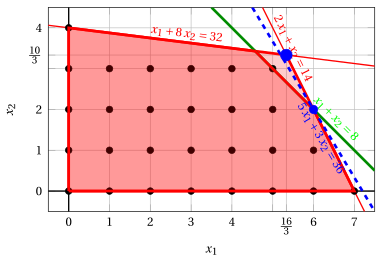
The LP relaxation with the valid inequality \(x_1 + x_2 \le 8\) (green): the old optimal solution (blue circle) is cut off and the new optimal solution \((6,2)\) (blue) is integer.
Formulation \(\tilde{\vet x}(\LP)\) \(z(\LP)\) upper bound original \((\tfrac{16}{3},\tfrac{10}{3})\) \(\tfrac{110}{3}\) \(36\) with \(x_1 + x_2 \le 8\) \((6,2)\) \(36\) \(36\) The new LP relaxation has the integer optimal solution \((6,2)\): it is an optimal ILP solution, \(z(\ILP) = 36\), and the inequality \(x_1 + x_2 \le 7\), which removes it, is not valid.
Exercise 4.3: Rounding and tightening (P5)
Consider the following ILP problem in canonical maximization form with \(n=2\) integer variables and \(m=2\) constraints:
The optimal solution of its LP relaxation is \(\tilde{\vet x}(\LP) = (\tfrac{7}{2},\tfrac{8}{3})\), with \(z(\LP) = 15\).
Questions
-
Multiply both constraints by \(\frac{1}{7}\), sum them, and derive a valid inequality \(2\,x_1 + 3\,x_2 \le \beta\) by rounding. Does it cut off the optimal solution of the LP relaxation?
-
Make the inequality tight with Step 1 of the algorithm of the chapter: decrease \(\beta\) until a feasible integer point lies on the line \(2\,x_1 + 3\,x_2 = \beta\).
-
Add the tight inequality to the formulation. What is the new upper bound?
Solution
-
Multiplying the constraints by the non-negative multipliers \((\tfrac{1}{7}, \tfrac{1}{7})\) and summing, \(\tfrac{1}{7} \cdot (6\,x_1 + 21\,x_2 \le 77) + \tfrac{1}{7} \cdot (8\,x_1 + 3\,x_2 \le 36)\), we get
\[ 2\,x_1 + \dfrac{24}{7}\,x_2 \le \dfrac{113}{7}. \]Since \(x_j \ge 0\) and the coefficients \(2 \ge 2\), \(\tfrac{24}{7} \ge 3\) are at least those of \(2\,x_1 + 3\,x_2\), every feasible solution satisfies \(2\,x_1 + 3\,x_2 \le 2\,x_1 + \tfrac{24}{7}\,x_2 \le \tfrac{113}{7}\). The left-hand side is an integer, so
\[ 2\,x_1 + 3\,x_2 \le \left\lfloor \dfrac{113}{7} \right\rfloor = 16 \]is a valid inequality. It does not cut off \(\tilde{\vet x}(\LP) = (\tfrac{7}{2},\tfrac{8}{3})\), since \(2 \cdot \tfrac{7}{2} + 3 \cdot \tfrac{8}{3} = 15 \le 16\). The inequality is valid but useless for the bound.
-
For two variables the integer points of the line \(2\,x_1 + 3\,x_2 = \beta\) with \(x_1, x_2 \ge 0\) are finitely many, and we check each of them against the constraints.
-
\(\beta = 16\). The integer points of \(2\,x_1 + 3\,x_2 = 16\) with \(x \ge 0\): \((2,4)\) violates constraint 1 (\(6 \cdot 2 + 21 \cdot 4 = 96 > 77\)); \((5,2)\) violates constraint 2 (\(8 \cdot 5 + 3 \cdot 2 = 46 > 36\)); \((8,0)\) violates constraint 2 (\(8 \cdot 8 + 3 \cdot 0 = 64 > 36\)). Hence no feasible point: set \(\beta = 15\).
-
\(\beta = 15\). The integer points of \(2\,x_1 + 3\,x_2 = 15\) with \(x \ge 0\): \((0,5)\) violates constraint 1 (\(6 \cdot 0 + 21 \cdot 5 = 105 > 77\)); \((3,3)\) violates constraint 1 (\(6 \cdot 3 + 21 \cdot 3 = 81 > 77\)); \((6,1)\) violates constraint 2 (\(8 \cdot 6 + 3 \cdot 1 = 51 > 36\)). Hence no feasible point: set \(\beta = 14\).
-
\(\beta = 14\). The integer points of \(2\,x_1 + 3\,x_2 = 14\) with \(x \ge 0\): \((1,4)\) violates constraint 1 (\(6 \cdot 1 + 21 \cdot 4 = 90 > 77\)); \((4,2)\) violates constraint 2 (\(8 \cdot 4 + 3 \cdot 2 = 38 > 36\)); \((7,0)\) violates constraint 2 (\(8 \cdot 7 + 3 \cdot 0 = 56 > 36\)). Hence no feasible point: set \(\beta = 13\).
-
\(\beta = 13\). The integer points of \(2\,x_1 + 3\,x_2 = 13\) with \(x \ge 0\): \((2,3)\) is feasible; \((5,1)\) violates constraint 2 (\(8 \cdot 5 + 3 \cdot 1 = 43 > 36\)). Hence a feasible point exists: the inequality is tight.
STOP.
The tight valid inequality is \(2\,x_1 + 3\,x_2 \le 13\). It cuts off \(\tilde{\vet x}(\LP) = (\tfrac{7}{2},\tfrac{8}{3})\), since \(2 \cdot \tfrac{7}{2} + 3 \cdot \tfrac{8}{3} = 15 > 13\).
-
-
The tight inequality has the same coefficients as the objective function, so the new LP relaxation has optimal value \(z(\LP) = 13\), attained for example at \((\tfrac{23}{6},\tfrac{16}{9})\).
Formulation \(\tilde{\vet x}(\LP)\) \(z(\LP)\) upper bound original \((\tfrac{7}{2},\tfrac{8}{3})\) \(15\) \(15\) with \(2\,x_1 + 3\,x_2 \le 13\) \((\tfrac{23}{6},\tfrac{16}{9})\) \(13\) \(13\) The rounding gives \(2\,x_1 + 3\,x_2 \le 16\), which does not cut off the LP optimum; the tight version \(2\,x_1 + 3\,x_2 \le 13\) gives \(\UB = 13\), equal to the value of the feasible point \((2,3)\): \(z(\ILP) = 13\) is certified.
Exercise 4.4: Reaching the convex hull by rounding (P1)
Consider the following ILP problem in canonical maximization form with \(n=2\) integer variables and \(m=1\) constraint:
The optimal solution of its LP relaxation is \(\tilde{\vet x}(\LP) = (0,\tfrac{8}{3})\), with \(z(\LP) = \dfrac{64}{3}\).
Questions
-
Derive a valid inequality \(x_2 \le \beta_1\) with the multiplier \(\frac{1}{6}\), and a valid inequality \(x_1 + 2\,x_2 \le \beta_2\) with the multiplier \(\frac{1}{3}\).
-
Compute the upper bound given by the LP relaxation after adding each inequality alone, and after adding both.
-
Show that the formulation with both inequalities is ideal.
Solution
-
-
Multiplying the constraints by the non-negative multipliers \((\tfrac{1}{6})\) and summing, \(\tfrac{1}{6} \cdot (3\,x_1 + 6\,x_2 \le 16)\), we get
\[ \dfrac{1}{2}\,x_1 + x_2 \le \dfrac{8}{3}. \]Since \(x_j \ge 0\) and the coefficients \(\tfrac{1}{2} \ge 0\), \(1 \ge 1\) are at least those of \(x_2\), every feasible solution satisfies \(x_2 \le \tfrac{1}{2}\,x_1 + x_2 \le \tfrac{8}{3}\). The left-hand side is an integer, so
\[ x_2 \le \left\lfloor \dfrac{8}{3} \right\rfloor = 2 \]is a valid inequality.
-
Multiplying the constraints by the non-negative multipliers \((\tfrac{1}{3})\) and summing, \(\tfrac{1}{3} \cdot (3\,x_1 + 6\,x_2 \le 16)\), we get
\[ x_1 + 2\,x_2 \le \dfrac{16}{3}. \]Since \(x_j \ge 0\) and the coefficients \(1 \ge 1\), \(2 \ge 2\) are at least those of \(x_1 + 2\,x_2\), every feasible solution satisfies \(x_1 + 2\,x_2 \le x_1 + 2\,x_2 \le \tfrac{16}{3}\). The left-hand side is an integer, so
\[ x_1 + 2\,x_2 \le \left\lfloor \dfrac{16}{3} \right\rfloor = 5 \]is a valid inequality.
-
-
Graphically, we have:
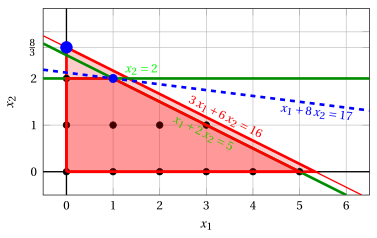
The LP relaxation (light red) with the valid inequalities \(x_2 \le 2\) and \(x_1 + 2\,x_2 \le 5\) (green): the new polyhedron (red) has the integer optimal vertex \((1,2)\) (blue); the old optimal solution is the blue circle.
Formulation \(\tilde{\vet x}(\LP)\) \(z(\LP)\) upper bound original \((0,\tfrac{8}{3})\) \(\tfrac{64}{3}\) \(21\) with \(x_2 \le 2\) \((\tfrac{4}{3},2)\) \(\tfrac{52}{3}\) \(17\) with \(x_1 + 2\,x_2 \le 5\) \((0,\tfrac{5}{2})\) \(20\) \(20\) with both \((1,2)\) \(17\) \(17\) Each inequality alone cuts off \(\tilde{\vet x}(\LP)\) but leaves a fractional optimum; together they give the integer optimum \((1,2)\).
-
The polyhedron with both inequalities has the vertices \((0,0)\), \((0,2)\), \((1,2)\), \((5,0)\), all integer: it is the convex hull of the feasible solutions, so the formulation is ideal.
With \(x_2 \le 2\) and \(x_1 + 2\,x_2 \le 5\), both obtained by rounding, the LP relaxation gives \(z(\LP) = 17 = z(\ILP)\) at the integer vertex \((1,2)\).
Exercise 4.5: Rounding with three variables (P42)
Consider the following ILP problem in canonical maximization form with \(n=3\) integer variables and \(m=3\) constraints:
The optimal solution of its LP relaxation is \(\tilde{\vet x}(\LP) = (\tfrac{5}{2},\tfrac{3}{2},0)\), with \(z(\LP) = \dfrac{21}{2}\).
Questions
-
Multiply the second constraint by \(\frac{1}{2}\), round down its coefficients and its right-hand side, and show that the result is a valid inequality.
-
Does it cut off the optimal solution of the LP relaxation?
-
Add the inequality to the formulation. The new LP relaxation has the optimal solution \((2,2,0)\): what can you conclude?
Solution
-
The second constraint multiplied by \(\frac{1}{2}\) is \(x_1 + \dfrac{3}{2}\,x_3 \le \dfrac{5}{2}\). Rounding down the coefficients gives \(x_1 + x_3\), whose coefficients are not larger. Multiplying the constraints by the non-negative multipliers \((0, \tfrac{1}{2}, 0)\) and summing, \(\tfrac{1}{2} \cdot (2\,x_1 + 3\,x_3 \le 5)\), we get
\[ x_1 + \dfrac{3}{2}\,x_3 \le \dfrac{5}{2}. \]Since \(x_j \ge 0\) and the coefficients \(1 \ge 1\), \(0 \ge 0\), \(\tfrac{3}{2} \ge 1\) are at least those of \(x_1 + x_3\), every feasible solution satisfies \(x_1 + x_3 \le x_1 + \tfrac{3}{2}\,x_3 \le \tfrac{5}{2}\). The left-hand side is an integer, so
\[ x_1 + x_3 \le \left\lfloor \dfrac{5}{2} \right\rfloor = 2 \]is a valid inequality.
-
It cuts off \(\tilde{\vet x}(\LP) = (\tfrac{5}{2},\tfrac{3}{2},0)\), since \(1 \cdot \tfrac{5}{2} + 0 \cdot \tfrac{3}{2} + 1 \cdot 0 = \tfrac{5}{2} > 2\).
-
The new LP relaxation has the integer optimal solution \((2,2,0)\), with value \(10\). By the proposition on the LP relaxation, it is an optimal ILP solution.
The valid inequality \(x_1 + x_3 \le 2\) lowers the upper bound from \(\lfloor \dfrac{21}{2} \rfloor = 10\) to \(10\) and gives the optimal solution \((2,2,0)\), \(z(\ILP) = 10\).