Exercises · Integer linear programming
Exercises · Chapter 1 · each solution opens with a click · Chapter 1: Integer linear programming · Exercises, volume 1 (PDF)
Exercise 1.1: Integer linear programming (P7)
Consider the following input data of an ILP problem with \(n=2\) variables and \(m=2\) constraints:
Questions
-
Write the ILP problem in canonical maximization form.
-
Draw the feasible region of the ILP problem and list all its feasible solutions.
-
Find an optimal solution graphically, and check it by complete enumeration.
Solution
-
The ILP problem in canonical maximization form with \(n=2\) non-negative integer variables and \(m=2\) less-than-or-equal-to linear constraints reads as follows:
\[ \begin{array}{rrrrrrr} {\max} & {3}\, {x_1} & {+} & {x_2} \\[1.5ex] & {x_1} & {+} & {4}\, {x_2} & {\le} & {12} \\[1.5ex] & {2}\, {x_1} & {+} & {x_2} & {\le} & {5} \\[1.5ex] & {x_1,} & & {x_2} & {\in} & {\Z_{\ge 0}} \end{array} \] -
Both constraints have non-negative coefficients, so every feasible solution satisfies \(x_1 \le \lfloor \frac{5}{2} \rfloor = 2\) (constraint 2). For each value of \(x_1\) the constraints give the integer values of \(x_2\):
\(x_1\) bounds on \(x_2\) feasible points \(0\) \(x_2 \le 3,~~x_2 \le 5\) \((0,0)\), \((0,1)\), \((0,2)\), \((0,3)\) \(1\) \(x_2 \le \tfrac{11}{4},~~x_2 \le 3\) \((1,0)\), \((1,1)\), \((1,2)\) \(2\) \(x_2 \le \tfrac{5}{2},~~x_2 \le 1\) \((2,0)\), \((2,1)\) The feasible region \(F\) is made of the \(9\) black points of the figure, the integer points of the polyhedron \(P\) (red):
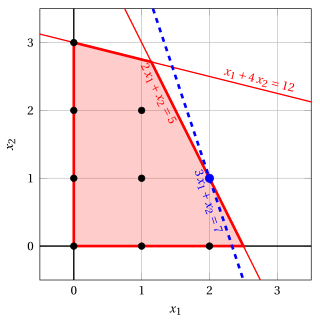
Feasible region of the ILP problem: the integer points (black) inside the polyhedron of the constraints (red). The optimal solution \((2,1)\) is blue, with the objective line \(3\,x_1 + x_2 = 7\) (dashed).
-
The gradient of the objective function is \(\nabla f = (3,1)\). Moving the level line \(3\,x_1 + x_2 = z\) in the direction of \(\nabla f\), the last point of \(F\) reached is \((2,1)\), on the dashed line \(3\,x_1 + x_2 = 7\) of the figure; no other point of \(F\) lies on this line.
Complete enumeration of the \(9\) feasible solutions confirms it (the optimum in bold):
\[ \begin{array}{ccc|ccc|ccc} \hline {x_1} & {x_2} & {z} & {x_1} & {x_2} & {z} & {x_1} & {x_2} & {z} \\ \hline {0} & {0} & {0} & {0} & {3} & {3} & {1} & {2} & {5} \\ {0} & {1} & {1} & {1} & {0} & {3} & {2} & {0} & {6} \\ {0} & {2} & {2} & {1} & {1} & {4} & {\mathbf{2}} & {\mathbf{1}} & {\mathbf{7}} \\ \hline \end{array} \]The ILP problem has the unique optimal solution \(\tilde{\vet x}(\ILP) = (2,1)\), with optimal value \(z(\ILP) = 7\).
Exercise 1.2: Canonical maximization form (P13)
Consider the following ILP problem with \(n=2\) integer variables:
Questions
-
Write the ILP problem in canonical maximization form, and give its data \(\vet c\), \(\boldsymbol A\) and \(\vet b\).
-
Draw the feasible region. Is it a finite set?
-
Explain why the ILP problem has an optimal solution, and find it graphically.
Solution
-
The minimization of \(x_1 + 3\,x_2\) is the maximization of \(-x_1 - 3\,x_2\), with \(\min \{x_1 + 3\,x_2\} = -\max\{-x_1 - 3\,x_2\}\). Each constraint \(\ge\) is multiplied by \(-1\):
\[ x_1 + 2\,x_2 \ge 6 \iff -x_1 - 2\,x_2 \le -6, \qquad -x_1 + 4\,x_2 \ge 6 \iff x_1 - 4\,x_2 \le -6. \]The ILP problem in canonical maximization form (problem \(P13\) of the catalogue) is
\[ \begin{array}{rrrrrrr} {\max} & {-}{x_1} & {-} & {3}\, {x_2} \\[1.5ex] & {-}{x_1} & {-} & {2}\, {x_2} & {\le} & {-6} \\[1.5ex] & {x_1} & {-} & {4}\, {x_2} & {\le} & {-6} \\[1.5ex] & {2}\, {x_1} & {-} & {2}\, {x_2} & {\le} & {3} \\[1.5ex] & {x_1,} & & {x_2} & {\in} & {\Z_{\ge 0}} \end{array} \]with data
\[ \vet c = \begin{pmatrix} -1 \\[1ex] -3 \end{pmatrix} \qquad \boldsymbol A = \begin{pmatrix} -1 & -2 \\[1ex] 1 & -4 \\[1ex] 2 & -2 \end{pmatrix} \qquad \vet b = \begin{pmatrix} -6 \\[1ex] -6 \\[1ex] 3 \end{pmatrix} \] -
The polyhedron of the constraints is drawn in red inside the box \(0 \le x_1, x_2 \le 5\); it continues upwards without limit.
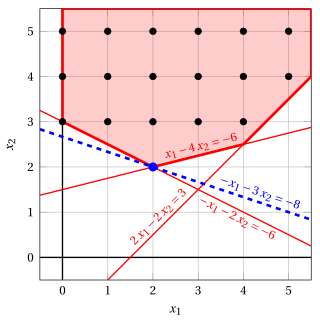
Feasible region of \(P13\) inside the box (red), its integer points (black) and the optimal solution \((2,2)\) (blue), with the objective line \(-x_1 - 3\,x_2 = -8\) (dashed).
The feasible region is not finite: for every integer \(k \ge 3\) the point \((0,k)\) satisfies \(-2k \le -6\), \(-4k \le -6\) and \(-2k \le 3\), so it belongs to \(F\).
-
All the costs of the maximization problem are negative and \(x_1, x_2 \ge 0\), so \(-x_1 - 3\,x_2 \le 0\) on \(F\): the objective function is bounded from above. The feasible point \((0,3)\) has value \(-9\), and only the finitely many points with \(x_1 + 3\,x_2 < 9\) can do better: an optimal solution exists.
The gradient is \(\nabla f = (-1,-3)\): the level line moves towards the origin. The last point of \(F\) reached is \((2,2)\), on the dashed line \(-x_1 - 3\,x_2 = -8\). The row \(x_2 = 1\) contains no feasible point, because \(x_1 + 2 \ge 6\) requires \(x_1 \ge 4\) and \(-x_1 + 4 \ge 6\) requires \(x_1 \le -2\).
The ILP problem has the unique optimal solution \(\tilde{\vet x}(\ILP) = (2,2)\), with optimal value \(z(\ILP) = -8\) in canonical maximization form, that is, a minimum value \(x_1 + 3\,x_2 = 8\) of the original problem.
Exercise 1.3: Complete enumeration (P43)
Consider the following input data of an ILP problem with \(n=3\) variables and \(m=2\) constraints:
Questions
-
Write the ILP problem in canonical maximization form.
-
Derive an upper bound on each variable from the constraints, and list all the feasible solutions.
-
Find an optimal solution by complete enumeration. Is it unique?
Solution
-
The ILP problem in canonical maximization form with \(n=3\) non-negative integer variables and \(m=2\) less-than-or-equal-to linear constraints reads as follows:
\[ \begin{array}{rrrrrrrrr} {\max} & {x_1} & {+} & {2}\, {x_2} & {+} & {7}\, {x_3} \\[1.5ex] & {x_1} & & & {+} & {2}\, {x_3} & {\le} & {2} \\[1.5ex] & & & {x_2} & {+} & {2}\, {x_3} & {\le} & {2} \\[1.5ex] & {x_1,} & & {x_2,} & & {x_3} & {\in} & {\Z_{\ge 0}} \end{array} \] -
All the coefficients are non-negative, so each variable is at most the right-hand side divided by its coefficient, rounded down:
\[ x_1 \le \lfloor 2/1 \rfloor = 2, \qquad x_2 \le \lfloor 2/1 \rfloor = 2, \qquad x_3 \le \min\left\{ \lfloor 2/2 \rfloor, \lfloor 2/2 \rfloor \right\} = 1. \]-
If \(x_3 = 1\), the constraints become \(x_1 \le 0\) and \(x_2 \le 0\): the only point is \((0,0,1)\).
-
If \(x_3 = 0\), the constraints become \(x_1 \le 2\) and \(x_2 \le 2\): the \(9\) points \((x_1,x_2,0)\) with \(x_1, x_2 \in \{0,1,2\}\).
The feasible region has \(10\) points.
-
-
The values of the objective function \(x_1 + 2\,x_2 + 7\,x_3\) are (the optimum in bold):
\[ \begin{array}{cccc|cccc} \hline {x_1} & {x_2} & {x_3} & {z} & {x_1} & {x_2} & {x_3} & {z} \\ \hline {0} & {0} & {0} & {0} & {1} & {2} & {0} & {5} \\ {0} & {1} & {0} & {2} & {2} & {0} & {0} & {2} \\ {0} & {2} & {0} & {4} & {2} & {1} & {0} & {4} \\ {1} & {0} & {0} & {1} & {2} & {2} & {0} & {6} \\ {1} & {1} & {0} & {3} & {\mathbf{0}} & {\mathbf{0}} & {\mathbf{1}} & {\mathbf{7}} \\ \hline \end{array} \]The best point with \(x_3 = 0\) is \((2,2,0)\), of value \(6\): it is worse than \((0,0,1)\), of value \(7\).
Complete enumeration gives the unique optimal solution \(\tilde{\vet x}(\ILP) = (0,0,1)\), with optimal value \(z(\ILP) = 7\).
Exercise 1.4: Possible outcomes: an infeasible ILP problem
Consider the following ILP problem in canonical maximization form with \(n=2\) integer variables and \(m=4\) constraints:
Questions
-
Draw the polyhedron \(P\) of the constraints, and decide whether the LP problem with the same data (with \(x_1, x_2 \ge 0\) instead of \(x_1, x_2 \in \Z_{\ge 0}\)) is feasible.
-
Decide the outcome of the ILP problem.
-
Find an optimal solution of the LP problem with the same data.
Solution
-
The four constraints are \(-\frac{1}{2} \le x_1 - x_2 \le \frac{1}{2}\) and \(\frac{1}{2} \le x_1 + x_2 \le \frac{3}{2}\): the polyhedron \(P\) is the square with vertices \((0,\dfrac{1}{2})\), \((\dfrac{1}{2},0)\), \((\dfrac{1}{2},1)\), \((1,\dfrac{1}{2})\).
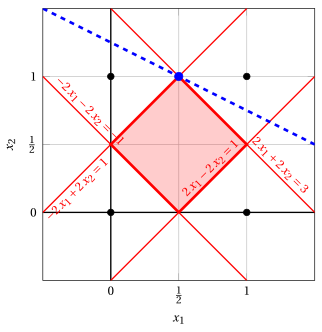
The polyhedron \(P\) (red) contains no integer point: the four integer points nearest to it (black) are outside. The optimal solution \((\frac{1}{2},1)\) of the LP problem is blue, with the objective line \(x_1 + 2\,x_2 = \frac{5}{2}\) (dashed).
The point \((\frac{1}{2},\frac{1}{2})\) satisfies all the constraints, so the LP problem is feasible.
-
-
From the first two constraints, an integer point has \(x_1 - x_2 \in \Z\) and \(|x_1 - x_2| \le \frac{1}{2}\), hence \(x_1 = x_2\).
-
With \(x_1 = x_2\) the last two constraints read \(1 \le 4\,x_1 \le 3\), that is \(\frac{1}{4} \le x_1 \le \frac{3}{4}\): no integer value of \(x_1\) satisfies them.
The feasible region \(F = P \cap \Z^2\) is empty: the ILP problem is infeasible, although the LP problem with the same data is feasible.
-
-
The polyhedron \(P\) is bounded and non-empty, so the LP problem has an optimal vertex. The values of \(x_1 + 2\,x_2\) at the four vertices are
\[ (0,\tfrac{1}{2}) \mapsto 1,\qquad (\tfrac{1}{2},0) \mapsto \dfrac{1}{2},\qquad (\tfrac{1}{2},1) \mapsto \dfrac{5}{2},\qquad (1,\tfrac{1}{2}) \mapsto 2 \]so the optimal solution is \(\tilde{\vet x}(\LP) = (\frac{1}{2},1)\), with \(z(\LP) = \frac{5}{2}\) (see the figure).
Exercise 1.5: Possible outcomes: an unbounded feasible region
Consider the constraints
and the three ILP problems in canonical maximization form with these constraints and the objective functions
Questions
-
Draw the feasible region. Is it a finite set?
-
Decide the outcome of each of the three ILP problems (a), (b) and (c), and give an optimal solution when it exists.
Solution
-
The feasible region is not finite: for every \(k \in \Z_{\ge 0}\) the point \((2k,k)\) satisfies \(-2k + k = -k \le 2\) and \(2k - 2k = 0 \le 2\).
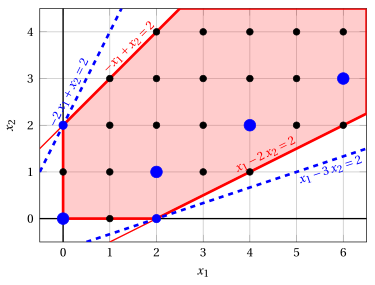
Feasible region inside the box \(0 \le x_1 \le 6\), \(0 \le x_2 \le 4\) (red), its integer points (black), the points \((2k,k)\) (blue circles), and the optimal solutions \((0,2)\) of (b) and \((2,0)\) of (c) (blue) with their objective lines (dashed).
-
-
(a) The points \((2k,k)\) are feasible with value \(3k\), which grows without limit: the ILP problem (a) is unbounded.
-
(b) For every feasible point, \(-2\,x_1 + x_2 = (-x_1 + x_2) - x_1 \le 2 - x_1 \le 2\). The value \(2\) requires \(x_1 = 0\) and \(-x_1 + x_2 = 2\), that is, the point \((0,2)\), which is feasible: the unique optimal solution is \((0,2)\), with optimal value \(2\).
-
(c) For every feasible point, \(x_1 - 3\,x_2 = (x_1 - 2\,x_2) - x_2 \le 2 - x_2 \le 2\). The value \(2\) requires \(x_2 = 0\) and \(x_1 - 2\,x_2 = 2\), that is, the point \((2,0)\): the unique optimal solution is \((2,0)\), with optimal value \(2\).
With the same unbounded feasible region, problem (a) is unbounded, while problems (b) and (c) have an optimal solution: \((0,2)\) and \((2,0)\), both of value \(2\).
-