The Master Theorem
Part 5 · Recursion · Chapter 16 · Lecture notes, volume 5 (PDF) · Exercises: The Master Theorem · App: The Master Theorem
Introduction
In the chapter Recurrences we solved recurrences by expansion, by substitution and with recursion trees. Each method requires some computation, and for divide-and-conquer recurrences the computation is always the same: draw the tree, sum the level costs, compare the root with the leaves. At the end of that chapter we observed three possible behaviours: the leaves dominate, all the levels cost the same, or the root dominates.
The Master Theorem turns these three behaviours into a ready-to-use result. In this chapter we
-
recall the recurrences in standard form and the algorithms that produce them (Section 16.1);
-
state the theorem and explain its three cases (Section 16.2);
-
apply it with a fixed five-step scheme to many examples (Section 16.3), and show the situations in which it cannot be applied (Section 16.4);
-
prove it (Section 16.5), first for exact powers of \(b\) and then for every natural number.
16.1 Recurrences in standard form
-
In the chapter Recurrences we have seen that the number of steps executed by a recursive algorithm is naturally described by a recurrence, i.e., an equation that expresses the value of a function on an input of size \(n\) in terms of its values on smaller inputs.
-
A large family of divide-and-conquer algorithms produces recurrences of a very specific shape, called the standard form:
\[ \blue{T(n) = a\, T\left(\frac{n}{b}\right) + f(n)} \]where:
-
\(n\) is the size of the input;
-
\(a\) is the number of subproblems generated by each recursive call (\(a \ge 1\), constant);
-
\(\frac{n}{b}\) is the size of each subproblem (\(b > 1\), constant); when \(n/b\) is not a natural number it is understood as \(\lfloor n/b \rfloor\) or \(\lceil n/b \rceil\);
-
\(f(n)\) is the cost of dividing the problem into the \(a\) subproblems and of combining their solutions (everything that is done outside the recursive calls). We always assume that \(f(n)\) is asymptotically positive, i.e., \(f(n)>0\) for all sufficiently large \(n\).
-
-
For sufficiently small \(n\) (for example \(n=1\)) the recursion stops and \(T(n)=\Theta(1)\): solving a problem of constant size requires a constant number of steps. For this reason the base case is usually not even written.
In this chapter a recurrence is a mathematical object: we use a generic function \(T(n)\). When we analyse a recursive algorithm, the function described by the recurrence is the number of steps \(S(n)\) executed in the worst case on an input of size parameter \(n\); the worst-case running time \(T(|I|)\) is then obtained from \(S(n)\) exactly as in the chapter Running time.
-
Examples of recurrences in standard form (they will all be solved in Section 16.3):
Algorithm Recurrence \(a\) \(b\) \(f(n)\) Binary search (recursive) \(T(n)=T(n/2)+1\) \(1\) \(2\) \(1\) Array sum (recursive) \(T(n)=2T(n/2)+1\) \(2\) \(2\) \(1\) Merge sort \(T(n)=2T(n/2)+n\) \(2\) \(2\) \(n\) Karatsuba multiplication \(T(n)=3T(n/2)+n\) \(3\) \(2\) \(n\) Strassen matrix multiplication \(T(n)=7T(n/2)+n^2\) \(7\) \(2\) \(n^2\) -
The Master Theorem gives the order of growth of \(T(n)\) for most recurrences in standard form, directly from \(a\), \(b\) and \(f(n)\), without any computation of the recursion.
16.2 The Master Theorem
Theorem 16.1: Master Theorem
Let \(a \ge 1\) and \(b>1\) be constants, let \(f(n)\) be an asymptotically positive function, and let \(T(n)\) be defined on the natural numbers by the recurrence
where \(n/b\) is interpreted as either \(\lfloor n/b\rfloor\) or \(\lceil n/b\rceil\), and \(T(n)=\Theta(1)\) for sufficiently small \(n\). Then \(T(n)\) has the following asymptotic bounds.
-
Case 1: if \(f(n) = O\big(n^{\log_b a - \epsilon}\big)\) for some constant \(\epsilon>0\), then
\[ \blue{T(n)=\Theta\big(n^{\log_b a}\big)}; \] -
Case 2: if \(f(n) = \Theta\big(n^{\log_b a}\log^k n\big)\) for some constant \(k\ge 0\), then
\[ \blue{T(n)=\Theta\big(n^{\log_b a}\log^{k+1} n\big)}; \] -
Case 3: if \(f(n) = \Omega\big(n^{\log_b a + \epsilon}\big)\) for some constant \(\epsilon>0\), and if
\[ a\, f\left(\frac{n}{b}\right) \le c\, f(n) \]for some constant \(c<1\) and all sufficiently large \(n\) (regularity condition), then
\[ \blue{T(n)=\Theta\big(f(n)\big)}. \]
-
This is the classical statement of the theorem (as in the textbook of Cormen, Leiserson, Rivest and Stein, Introduction to Algorithms), with the extended case 2: for \(k=0\) we obtain the basic statement “if \(f(n)=\Theta(n^{\log_b a})\) then \(T(n)=\Theta(n^{\log_b a}\log n)\)”.
-
The notations \(O\), \(\Omega\) and \(\Theta\) in the statement are those defined in chapter 9 «Asymptotic notation».
-
The proof is given in Section 16.5.
16.2.1 Rule of thumb
-
In each of the three cases we compare the function \(f(n)\) with the function
\[ n^{\log_b a}, \]which (as we will see in Lemma 16.3) is the number of leaves of the recursion tree. As a rule of thumb, check:
\[ n^{\log_b a } \quad \begin{cases} \text{polynomially larger than } f(n) & \longrightarrow \quad \text{\red{case 1}:}\quad T(n)=\Theta\big(n^{\log_b a}\big)\\[2mm] \text{of the same order as } f(n) \text{ (up to } \log^k n) &\longrightarrow \quad \text{\red{case 2}:}\quad T(n)=\Theta\big(n^{\log_b a}\log^{k+1} n\big) \\[2mm] \text{polynomially smaller than } f(n) & \longrightarrow \quad \text{\red{case 3}:}\quad T(n)=\Theta\big(f(n)\big) \end{cases} \]and determine the order of growth of \(T(n)\) accordingly (if possible).
-
Intuitively, the larger of the two functions determines the solution of the recurrence.
-
Polynomially smaller (larger) means smaller (larger) by a factor \(n^{\epsilon}\) for some constant \(\epsilon>0\). For example:
-
\(n\) is polynomially smaller than \(n^2\) (factor \(n^1\)), and \(n^{2}\) is polynomially smaller than \(n^{2.1}\) (factor \(n^{0.1}\));
-
\(n\) is smaller than \(n\log n\), but not polynomially smaller: for every \(\epsilon>0\)
\[ \lim_{n\to\infty}\frac{n\log n}{n^{1+\epsilon}}=\lim_{n\to\infty}\frac{\log n}{n^{\epsilon}} = 0^+, \]hence \(n\log n\) grows more slowly than \(n\cdot n^{\epsilon}\), whatever \(\epsilon>0\) we choose.
-
16.2.2 Intuition
-
Unfolding the recurrence (see the recursion tree in Figure 16.1) the total cost is
\[ T(n) = \underbrace{\Theta\big(n^{\log_b a}\big)}_{\text{cost of the leaves}} \; + \; \underbrace{\sum_{j=0}^{\log_b n -1} a^j f\left(\frac{n}{b^j}\right)}_{\text{cost of the internal levels}} \]where level \(j\) of the tree contains \(a^j\) subproblems of size \(n/b^j\).
-
Consider the simple case \(f(n)=n^d\). The cost of level \(j\) is
\[ a^j \left(\frac{n}{b^j}\right)^{d} = n^d\left(\frac{a}{b^d}\right)^{j}, \]so the costs of the levels form a geometric progression with ratio \(a/b^d\). Since \(a/b^d>1 \iff d<\log_b a\):
-
case 1 (\(d<\log_b a\)): the level costs increase geometrically from the root to the leaves; the total is dominated by the leaves, i.e., by \(n^{\log_b a}\);
-
case 2 (\(d=\log_b a\)): all the \(\log_b n\) levels have the same cost \(n^{d}=n^{\log_b a}\); the total is \(n^{\log_b a}\) times the number of levels, i.e., \(n^{\log_b a}\log n\);
-
case 3 (\(d>\log_b a\)): the level costs decrease geometrically; the total is dominated by the root, i.e., by \(f(n)\).
-
16.2.3 The gaps between the cases
-
The three cases do not cover all the possible functions \(f(n)\).
-
There is a gap between case 1 and case 2 when \(f(n)\) is smaller than \(n^{\log_b a}\) but not polynomially smaller (and not of the form \(n^{\log_b a}\log^k n\) with \(k\ge0\)), e.g., \(f(n)=n^{\log_b a}/\log n\).
-
There is a gap between case 2 and case 3 when \(f(n)\) is larger than \(n^{\log_b a}\) but not polynomially larger (and not of the form \(n^{\log_b a}\log^k n\)), e.g., \(f(n)=n^{\log_b a}\, 2^{\sqrt{\log_2 n}}\).
-
Case 3 does not apply also when \(f(n)\) is polynomially larger than \(n^{\log_b a}\) but the regularity condition fails.
-
-
In these situations the Master Theorem cannot be used, and the recurrence must be solved with other techniques (recursion tree, iteration, substitution method), see Section 16.4.
16.2.4 A remark on the base of the logarithms
-
Since \(\log_c n = \dfrac{\log_2 n}{\log_2 c}\) for every base \(c>1\), we have
\[ \log_c^k n = \frac{1}{\log_2^k c}\,\log_2^k n = \Theta\big(\log_2^k n\big). \]Thus, inside \(\Theta\), \(O\) and \(\Omega\) the base of the logarithm is irrelevant: in case 2 we simply write \(\log^k n\).
-
On the contrary, the base \(b\) in the exponent \(n^{\log_b a}\) is essential: for instance \(n^{\log_2 4}=n^2\) whereas \(n^{\log_4 4}=n\), and \(n^{2}\neq\Theta(n)\).
-
The Master Theorem compares the cost of the root, \(f(n)\), with the number of leaves of the recursion tree, \(n^{\log_b a}\): the larger of the two determines \(T(n)\); when they are of the same order (up to \(\log^k n\)) one more factor \(\log n\) appears.
-
“Larger” and “smaller” must be polynomial (by a factor \(n^\epsilon\)); in case 3 the regularity condition must also hold.
-
When \(f(n)\) falls in a gap between the cases, the theorem gives no answer.
16.3 Applying the Master Theorem
To solve a recurrence with the Master Theorem we always follow this scheme:
-
identify \(a\), \(b\) and \(f(n)\) (and check that \(a\ge 1\), \(b>1\) are constants and \(f(n)\) is asymptotically positive);
-
compute \(n^{\log_b a}\);
-
compare \(n^{\log_b a}\) with \(f(n)\) and guess the case;
-
verify the hypothesis of the case: find \(\epsilon>0\) (case 1 or 3), find \(k\ge0\) (case 2), and check the regularity condition (case 3);
-
conclude.
We start with three recurrences, one for each case, and then solve the recurrences of the algorithms listed in Section 16.1.
Example 16.1: \(T(n)=16\,T(n/4)+n\)
-
\(a=16\), \(b=4\), \(f(n)=n\).
-
\(n^{\log_b a}=n^{\log_4 16}=n^2\).
-
\(n^2\) is polynomially larger than \(f(n)=n\) \(\longrightarrow\) case 1.
-
\(f(n)=n=O\big(n^{2-\epsilon}\big)\) with \(\epsilon=1\).
-
\(T(n)=\Theta\big(n^{\log_4 16}\big)=\Theta(n^2)\).
Example 16.2: \(T(n)=8\,T(n/2)+n^3\)
-
\(a=8\), \(b=2\), \(f(n)=n^3\).
-
\(n^{\log_b a}=n^{\log_2 8}=n^3\).
-
\(n^3\) and \(f(n)=n^3\) have the same order \(\longrightarrow\) case 2.
-
\(f(n)=n^3=\Theta\big(n^{3}\log^k n\big)\) with \(k=0\).
-
\(T(n)=\Theta\big(n^{3}\log^{k+1} n\big)=\Theta(n^3\log n)\).
Example 16.3: \(T(n)=8\,T(n/3)+n^2\)
-
\(a=8\), \(b=3\), \(f(n)=n^2\).
-
\(n^{\log_b a}=n^{\log_3 8}\approx n^{1.893}\).
-
\(n^{1.893}\) is polynomially smaller than \(f(n)=n^2\) \(\longrightarrow\) case 3.
-
\(f(n)=n^2=\Omega\big(n^{\log_3 8+\epsilon}\big)\) for every \(0<\epsilon\le 2-\log_3 8\approx 0.107\).
Regularity condition: we look for a constant \(c<1\) such that, for all large \(n\),\[ 8\, f\left(\frac{n}{3}\right) \le c\, f(n) \quad\Longleftrightarrow\quad 8\left(\frac{n}{3}\right)^2 \le c\, n^2 \quad\Longleftrightarrow\quad \frac{8}{9}\, n^2 \le c\, n^2 , \]which holds for every \(c\) with \(\frac{8}{9}\le c<1\), e.g., \(c=\frac{8}{9}\).
-
\(T(n)=\Theta(n^2)\).
Example 16.4: Binary search: \(T(n)=T(n/2)+1\)
-
\(a=1\), \(b=2\), \(f(n)=1\).
-
\(n^{\log_b a}=n^{\log_2 1}=n^0=1\).
-
\(1\) and \(f(n)=1\) have the same order \(\longrightarrow\) case 2.
-
\(f(n)=1=\Theta\big(n^{0}\log^k n\big)\) with \(k=0\).
-
\(T(n)=\Theta\big(n^{0}\log n\big)=\Theta(\log n)\).
Example 16.5: Merge sort: \(T(n)=2\,T(n/2)+n\)
-
\(a=2\), \(b=2\), \(f(n)=n\).
-
\(n^{\log_b a}=n^{\log_2 2}=n\).
-
\(n\) and \(f(n)=n\) have the same order \(\longrightarrow\) case 2.
-
\(f(n)=n=\Theta\big(n\log^k n\big)\) with \(k=0\).
-
\(T(n)=\Theta(n\log n)\).
Example 16.6: Array sum: \(T(n)=2\,T(n/2)+1\)
-
\(a=2\), \(b=2\), \(f(n)=1\).
-
\(n^{\log_b a}=n^{\log_2 2}=n\).
-
\(n\) is polynomially larger than \(f(n)=1\) \(\longrightarrow\) case 1.
-
\(f(n)=1=O\big(n^{1-\epsilon}\big)\) with \(\epsilon=1\) (indeed \(n^{1-1}=n^0=1\)).
-
\(T(n)=\Theta(n)\).
The recursive sum of an array that splits the array into two halves (the algorithm RecursiveSum of the chapter «Recursive algorithms») is an algorithm of this kind.
Each call does a constant amount of work outside the recursive calls, and the total number of calls is \(\Theta(n)\): counting them (in the Colab notebooks of the chapter), on \(n=8\), \(1000\) and \(2^{20}=1\,048\,576\) entries we obtain \(15\), \(1\,999\) and \(2\,097\,151\) calls, that is, exactly \(2n-1\).
Example 16.7: Karatsuba: \(T(n)=3\,T(n/2)+n\)
-
\(a=3\), \(b=2\), \(f(n)=n\).
-
\(n^{\log_b a}=n^{\log_2 3}\approx n^{1.585}\).
-
\(n^{1.585}\) is polynomially larger than \(f(n)=n\) \(\longrightarrow\) case 1.
-
\(f(n)=n=O\big(n^{\log_2 3-\epsilon}\big)\) with \(\epsilon=\log_2 3-1\approx 0.585>0\).
-
\(T(n)=\Theta\big(n^{\log_2 3}\big)\approx\Theta\big(n^{1.585}\big)\): Karatsuba's algorithm is asymptotically faster than the schoolbook \(\Theta(n^2)\) multiplication.
Example 16.8: Strassen: \(T(n)=7\,T(n/2)+n^2\)
-
\(a=7\), \(b=2\), \(f(n)=n^2\).
-
\(n^{\log_b a}=n^{\log_2 7}\approx n^{2.807}\).
-
\(n^{2.807}\) is polynomially larger than \(f(n)=n^2\) \(\longrightarrow\) case 1.
-
\(f(n)=n^2=O\big(n^{\log_2 7-\epsilon}\big)\) with \(\epsilon=\log_2 7-2\approx 0.807>0\).
-
\(T(n)=\Theta\big(n^{\log_2 7}\big)\approx\Theta\big(n^{2.807}\big)\), better than the \(\Theta(n^3)\) of the standard matrix multiplication (whose divide-and-conquer recurrence is \(T(n)=8T(n/2)+n^2\)).
Example 16.9: \(T(n)=2\,T(n/2)+n\log n\)
-
\(a=2\), \(b=2\), \(f(n)=n\log n\).
-
\(n^{\log_b a}=n^{\log_2 2}=n\).
-
\(f(n)=n\log n\) is larger than \(n\), but only by a factor \(\log n\), not polynomially \(\longrightarrow\) not case 3; it has the form \(n^{\log_b a}\log^k n\) \(\longrightarrow\) case 2.
-
\(f(n)=n\log n=\Theta\big(n\log^k n\big)\) with \(k=1\).
-
\(T(n)=\Theta\big(n\log^{2} n\big)\).
Example 16.10: \(T(n)=3\,T(n/4)+n\log n\)
-
\(a=3\), \(b=4\), \(f(n)=n\log n\) (logarithm in base 2).
-
\(n^{\log_b a}=n^{\log_4 3}\approx n^{0.792}\).
-
\(n^{0.792}\) is polynomially smaller than \(f(n)=n\log n\) \(\longrightarrow\) case 3.
-
Since \(n\log n\ge n\) for \(n\ge 2\), we have \(f(n)=\Omega\big(n^{\log_4 3+\epsilon}\big)\) with \(\epsilon=1-\log_4 3\approx 0.208\).
Regularity condition: for every \(n\ge 4\),\[ 3\, f\left(\frac{n}{4}\right) = 3\, \frac{n}{4}\,\log\frac{n}{4} \le \frac{3}{4}\, n\log n = c\, f(n) \qquad\text{with } c=\frac{3}{4}<1, \]because \(\log(n/4)\le \log n\).
-
\(T(n)=\Theta(n\log n)\).
Example 16.11: \(T(n)=T(2n/3)+1\)
-
\(a=1\), \(b=\frac{3}{2}\) (indeed \(\frac{2n}{3}=\frac{n}{3/2}\)), \(f(n)=1\). Note that \(b\) does not need to be an integer.
-
\(n^{\log_b a}=n^{\log_{3/2} 1}=n^0=1\).
-
\(1\) and \(f(n)=1\) have the same order \(\longrightarrow\) case 2.
-
\(f(n)=1=\Theta\big(n^{0}\log^k n\big)\) with \(k=0\).
-
\(T(n)=\Theta(\log n)\).
- A numerical check. For each of the recurrences above with \(b\) integer we computed \(T(n)\) exactly from the recurrence, with \(T(1)=1\) and \(n=b^L\), and divided it by the order of growth \(g(n)\) given by the theorem (logarithms in base \(2\)). The ratio stays bounded between two positive constants, as the theorem guarantees, and approaches the limit in the last column.
| Recurrence | \(g(n)\) | \(L=5\) | \(L=10\) | \(L=20\) | limit |
|---|---|---|---|---|---|
| \(16\,T(n/4)+n\) | \(n^2\) | 1.3330 | 1.3333 | 1.3333 | \(4/3\) |
| \(8\,T(n/2)+n^3\) | \(n^3\log n\) | 1.2000 | 1.1000 | 1.0500 | \(1\) |
| \(8\,T(n/3)+n^2\) | \(n^2\) | 4.5606 | 6.5364 | 8.2414 | \(9\) |
| \(T(n/2)+1\) | \(\log n\) | 1.2000 | 1.1000 | 1.0500 | \(1\) |
| \(2\,T(n/2)+n\) | \(n\log n\) | 1.2000 | 1.1000 | 1.0500 | \(1\) |
| \(2\,T(n/2)+1\) | \(n\) | 1.9688 | 1.9990 | 2.0000 | \(2\) |
| \(3\,T(n/2)+n\) | \(n^{\log_2 3}\) | 2.7366 | 2.9653 | 2.9994 | \(3\) |
| \(7\,T(n/2)+n^2\) | \(n^{\log_2 7}\) | 2.2521 | 2.3284 | 2.3333 | \(7/3\) |
| \(2\,T(n/2)+n\log n\) | \(n\log^2 n\) | 0.6400 | 0.5600 | 0.5275 | \(1/2\) |
| \(3\,T(n/4)+n\log n\) | \(n\log n\) | 2.1933 | 2.8704 | 3.4020 | \(4\) |
- For merge sort, for instance, \(T(2^{L})=2^{L}(L+1)\), so \(T(n)=n\log_2 n+n\) and \(\frac{T(n)}{n\log_2 n}=1+\frac{1}{L}\). In case 3 the convergence is slow: the ratio tends to \(\frac{1}{1-c}\) (\(9\) for \(c=\frac{8}{9}\), \(4\) for \(c=\frac{3}{4}\)), the bound that appears in the proof of the theorem.
The theorem gives the order of growth, not the constant: in the table the ratios tend to different constants, but they never grow or vanish.
16.4 When the Master Theorem does not apply
- Before applying the theorem, always check that all its hypotheses hold. Here are typical situations in which the theorem cannot be applied.
Example 16.12: A gap between case 1 and case 2: \(T(n)=2\,T(n/2)+n/\log_2 n\)
-
\(a=2\), \(b=2\), \(f(n)=n/\log_2 n\), and \(n^{\log_b a}=n\).
-
Not case 1: \(f(n)\) is smaller than \(n\), but not polynomially smaller. For every \(\epsilon>0\)
\[ \lim_{n\to\infty}\frac{n/\log_2 n}{n^{1-\epsilon}}=\lim_{n\to\infty}\frac{n^{\epsilon}}{\log_2 n}=+\infty, \]hence \(f(n)\neq O(n^{1-\epsilon})\).
-
Not case 2: \(f(n)=n\log^{-1} n\) would require \(k=-1<0\).
-
Not case 3: \(f(n)\) is smaller than \(n\).
-
Solution with the recursion tree (Lemma 16.3), for \(n=2^L\) and \(T(1)=1\): level \(j\) costs
\[ 2^j\,\frac{n/2^j}{\log_2(n/2^j)}=\frac{n}{L-j}, \qquad\text{so}\qquad T(n)=n+\sum_{j=0}^{L-1}\frac{n}{L-j}=n+n\sum_{i=1}^{L}\frac{1}{i}=n\,(1+H_L), \]where \(H_L=\sum_{i=1}^{L}\frac1i\) is the \(L\)-th harmonic number. Since \(\ln(L+1)\le H_L\le 1+\ln L\) (comparison with \(\int \frac{dx}{x}\)), \(H_L=\Theta(\log L)\) and
\[ T(n)=\Theta(n\log\log n). \]
Example 16.13: Not in standard form: \(T(n)=T(n-1)+n\)
-
The subproblem has size \(n-1\), not \(n/b\) with a constant \(b>1\): the recurrence is not in standard form.
-
Solution by iteration (with \(T(1)=1\)):
\[ T(n)=n+(n-1)+\dots+2+T(1)=\sum_{i=1}^{n} i=\frac{n(n+1)}{2}=\Theta(n^2). \]
Example 16.14: Subproblems of different sizes: \(T(n)=T(n/3)+T(2n/3)+n\)
-
The two subproblems have different sizes \(n/3\) and \(2n/3\): the recurrence is not of the form \(a\,T(n/b)+f(n)\).
-
Recursion tree: every complete level has total size \(n\), hence cost \(n\). The shortest root-to-leaf path (always \(n/3\)) has length \(\log_3 n\), the longest (always \(2n/3\)) has length \(\log_{3/2} n\). Therefore the first \(\log_3 n\) levels are complete (cost \(\ge n\log_3 n\)), and there are at most \(\log_{3/2} n+1\) levels, each of cost at most \(n\). Hence
\[ T(n)=\Theta(n\log n). \]
Example 16.15: \(a\) is not constant: \(T(n)=2^n\,T(n/2)+n^n\)
- The number of subproblems \(a=2^n\) depends on \(n\): the Master Theorem requires \(a\) to be a constant.
Example 16.16: \(a<1\): \(T(n)=0.5\,T(n/2)+1/n\)
- Here \(a=0.5<1\): the theorem requires \(a\ge 1\) (there must be at least one subproblem).
Example 16.17: The regularity condition fails: \(T(n)=T(n/2)+n(2-\cos n)\)
-
\(a=1\), \(b=2\), \(n^{\log_b a}=n^0=1\), \(f(n)=n(2-\cos n)\). Since \(1\le 2-\cos n\le 3\), we have \(n\le f(n)\le 3n\), so
\[ f(n)=\Theta(n)=\Omega\big(n^{0+\epsilon}\big)\quad\text{with }\epsilon=1: \]\(f(n)\) is polynomially larger than \(n^{\log_b a}\), and we would expect case 3.
-
The regularity condition fails. Take an even \(n=2m\). Then
\[ \frac{a\,f(n/2)}{f(n)}=\frac{m\,(2-\cos m)}{2m\,(2-\cos 2m)}=\frac{2-\cos m}{2\,(2-\cos 2m)}. \]If \(\cos m\le -0.9\), then \(2-\cos m\ge 2.9\) and \(\cos 2m=2\cos^2 m-1\ge 2\cdot 0.81-1=0.62\), so \(2(2-\cos 2m)\le 2.76\) and the ratio is \(>1\). Since \(\pi\) is irrational, the values \(m \bmod 2\pi\) (\(m\in\N\)) are dense in \([0,2\pi)\), so there are infinitely many \(m\) with \(\cos m\le -0.9\) (e.g., \(m=3,9,16,22,28,\dots\)). For \(m=22\): \(\cos 22\approx-0.99996\), \(\cos 44\approx 0.99984\), and the ratio is \(\approx 1.4997\).
Hence there is no constant \(c<1\) such that \(a f(n/2)\le c f(n)\) for all large \(n\): case 3 cannot be applied. -
Nevertheless the recurrence can be solved directly (with \(n/2\) meaning \(\lfloor n/2\rfloor\)): unfolding it,
\[ n\le f(n)\le T(n)\le \sum_{j\ge 0} 3\,\frac{n}{2^j}+T(1)=6n+T(1), \qquad\text{so}\qquad T(n)=\Theta(n). \]
16.5 Proof of the Master Theorem
-
We follow the classical proof, which has two parts:
-
we first assume that \(n\) is an exact power of \(b\), i.e., \(n=b^L\) for some \(L\in\N\); then all the subproblem sizes \(n/b, n/b^2,\dots\) are exact powers of \(b\) and no floor or ceiling is needed (Lemmas 16.3, Lemma 16.4 and Lemma 16.5);
-
we then extend the result to every natural number \(n\), when \(n/b\) is \(\lceil n/b\rceil\) or \(\lfloor n/b\rfloor\) (Section 16.5.5).
-
16.5.1 Setting
-
Throughout the proof we set
\[ \blue{p=\log_b a}, \qquad\text{so that}\qquad b^p=a \quad\text{and}\quad p\ge 0 \ (\text{since } a\ge1). \] -
For \(n\) exact power of \(b\) we consider the recurrence
\[\begin{equation*} \label{eq:recPowers} T(n)=\begin{cases} d & \text{if } n=1,\\ a\,T(n/b)+f(n) & \text{if } n=b^i,\ i\ge 1, \end{cases} \tag{16.1} \end{equation*}\]where \(d>0\) is a constant (this is the meaning of \(T(1)=\Theta(1)\)).
-
We assume \(f(m)>0\) for every \(m\ge1\). This is always true when \(f\) counts steps of an algorithm; in general, since \(f\) is asymptotically positive, only finitely many values are affected and only the constants of the proof change.
-
The hypotheses of the three cases hold “for all sufficiently large \(n\)”, i.e., for \(n\ge n_0\). The following observation allows us to use them for every exact power of \(b\) at least \(b\).
Observation 16.2: from large powers to all powers
Let \(f(m)>0\) and \(h(m)>0\) for every exact power \(m\ge b\) of \(b\). If there are constants \(c>0\) and \(n_0\) such that \(f(m)\le c\,h(m)\) (resp. \(f(m)\ge c\,h(m)\)) for all exact powers \(m\ge n_0\), then there is a constant \(c'>0\) such that \(f(m)\le c'\,h(m)\) (resp. \(f(m)\ge c'\,h(m)\)) for all exact powers \(m\ge b\) of \(b\).
Proof
There are only finitely many exact powers of \(b\) in the interval \([b,n_0)\). Let
where \(m\) ranges over exact powers of \(b\). Then \(f(m)\le c'h(m)\) (resp. \(\ge\)) both for \(m<n_0\), by the choice of \(c'\), and for \(m\ge n_0\), since \(c\le c'\) (resp. \(c\ge c'\)). □
- We will apply it with \(h(m)=m^{p-\epsilon}\) and \(h(m)=m^{p}\log_b^k m\), which are positive for \(m\ge b\) (note \(\log_b m\ge 1\) for \(m\ge b\)).
16.5.2 The recursion tree
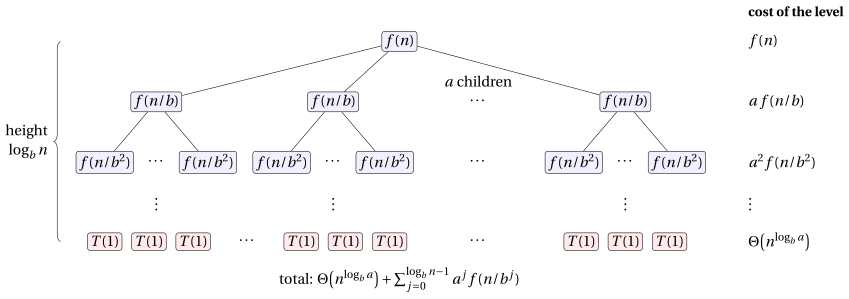
Figure 16.1: Recursion tree of \(T(n)=aT(n/b)+f(n)\) for \(n\) exact power of \(b\). Each internal node has \(a\) children; level \(j\) has \(a^j\) nodes, each a subproblem of size \(n/b^j\) with cost \(f(n/b^j)\); the leaves are at depth \(\log_b n\).
-
The root (level \(0\)) is a problem of size \(n\); it costs \(f(n)\) and generates \(a\) subproblems of size \(n/b\).
-
By induction, level \(j\) contains \(a^j\) nodes, each a subproblem of size \(n/b^j\) and cost \(f(n/b^j)\): the total cost of level \(j\) is \(a^j f(n/b^j)\).
-
The subproblem size reaches \(1\) when \(n/b^j=1\), i.e., at depth \(j=\log_b n\): the leaves are the \(a^{\log_b n}\) nodes of level \(\log_b n\), each with cost \(T(1)=d\).
Lemma 16.3: Cost of the recursion tree
Let \(a\ge1\) and \(b>1\) be constants and let \(f(n)>0\) for \(n\ge1\). For every \(n\) exact power of \(b\), the solution of recurrence \(\eqref{eq:recPowers}\) is
Proof
Let \(n=b^L\). We first prove by induction on \(i\in\{0,1,\dots,L\}\) that
For \(i=0\) the sum is empty and \(\eqref{eq:unfold}\) reads \(T(n)=T(n)\). Assume \(\eqref{eq:unfold}\) holds for some \(i<L\). Since \(n/b^{i}=b^{L-i}\) with \(L-i\ge1\), the recurrence gives \(T(n/b^{i})=a\,T(n/b^{i+1})+f(n/b^{i})\), so
which is \(\eqref{eq:unfold}\) for \(i+1\). For \(i=L=\log_b n\) we have \(T(n/b^L)=T(1)=d\), hence
It remains to show that \(a^{\log_b n}=n^{\log_b a}\). Writing \(a=b^{\log_b a}\) and \(n=b^{\log_b n}\),
Finally, \(d>0\) is a constant, so \(d\,n^{\log_b a}=\Theta(n^{\log_b a})\). □
- The first term is the cost of the leaves: there are exactly \(n^{\log_b a}\) leaves. The sum is the cost of the internal nodes (levels \(0,\dots,\log_b n-1\)).
Example 16.18: Lemma 16.3 for \(T(n)=2T(n/2)+n\), \(T(1)=1\), \(n=8\)
Here \(a=2\), \(b=2\), \(f(n)=n\), \(d=1\), \(\log_2 8=3\).
| level \(j\) | nodes \(a^j\) | size \(n/b^j\) | cost per node | cost of the level |
|---|---|---|---|---|
| 0 | 1 | 8 | \(f(8)=8\) | 8 |
| 1 | 2 | 4 | \(f(4)=4\) | 8 |
| 2 | 4 | 2 | \(f(2)=2\) | 8 |
| 3 (leaves) | \(8=8^{\log_2 2}\) | 1 | \(T(1)=1\) | 8 |
| total | 32 |
Lemma 16.3 gives \(T(8)=1\cdot 8^{\log_2 2}+(8+8+8)=8+24=32\). Directly from the recurrence:
16.5.3 Bounding the sum
-
By Lemma 16.3, to solve the recurrence we need the order of growth of
\[ \blue{g(n)=\sum_{j=0}^{\log_b n-1}a^j f\left(\frac{n}{b^j}\right)}. \] -
A key identity, used many times: since \(b^p=a\),
\[\begin{equation*} \label{eq:keyIdentity} a^j\left(\frac{n}{b^j}\right)^{p}=\frac{a^j}{(b^{p})^j}\,n^{p}=\frac{a^j}{a^j}\,n^p=n^{p} \qquad\text{for every } j. \tag{16.3} \end{equation*}\] -
In the sum, \(j\le \log_b n-1\), so the sizes \(m=n/b^j\) are exact powers of \(b\) with \(m\ge b\): by Observation 16.2, the bounds on \(f\) of cases 1 and 2 can be used for all of them.
Lemma 16.4: Bounds on the sum
Let \(a\ge1\) and \(b>1\) be constants, \(p=\log_b a\), let \(f(m)>0\) for \(m\ge1\), and let \(g(n)\) be defined, for \(n\) exact power of \(b\), as above. Then:
-
if \(f(n)=O(n^{p-\epsilon})\) for some constant \(\epsilon>0\), then \(g(n)=O(n^{p})\);
-
if \(f(n)=\Theta(n^{p}\log^k n)\) for some constant \(k\ge0\), then \(g(n)=\Theta(n^{p}\log^{k+1} n)\);
-
if \(f(n)=\Omega(n^{p+\epsilon})\) for some constant \(\epsilon>0\), and \(a\,f(n/b)\le c\,f(n)\) for some constant \(c<1\) and all exact powers \(n\ge n_0\), then \(g(n)=\Theta(f(n))\).
Proof (Proof of case 1)
By Observation 16.2 there is a constant \(c>0\) such that \(f(m)\le c\,m^{p-\epsilon}\) for every exact power \(m\ge b\). Hence, using \(\eqref{eq:keyIdentity}\),
This is a finite geometric series with ratio \(b^\epsilon>1\) (since \(b>1\) and \(\epsilon>0\)):
Therefore
and since \(\frac{c}{b^\epsilon-1}\) is a positive constant, \(g(n)=O(n^{p})\). □
Example 16.19: Case 1 of Lemma 16.4: \(T(n)=16T(n/4)+n\), \(n=64\)
Here \(p=\log_4 16=2\), \(f(m)=m=m^{2-1}\), so \(c=1\), \(\epsilon=1\). The internal levels cost
the costs grow by the factor \(b^\epsilon=4\) from one level to the next (they are dominated by the deepest levels). The formula of the proof gives exactly \(n^{p-\epsilon}\frac{n^\epsilon-1}{b^\epsilon-1}=64\cdot\frac{63}{3}=1344\), and the bound \(\frac{c}{b^\epsilon-1}n^p=\frac{4096}{3}\approx 1365.3\) holds. Adding the leaves, \(T(64)=4096+1344=5440\) with \(T(1)=1\).
Proof (Proof of case 2)
Since \(\log^k n\) and \(\log_b^k n\) differ by a constant factor, the hypothesis is \(f(n)=\Theta(n^p\log_b^k n)\). By Observation 16.2 there are constants \(c_1,c_2>0\) such that
Let \(L=\log_b n\). For the term \(j\) of the sum, \(m=n/b^j\) and \(\log_b m=L-j\); by \(\eqref{eq:keyIdentity}\),
Hence, setting \(i=L-j\) (as \(j\) goes from \(0\) to \(L-1\), \(i\) goes from \(L\) down to \(1\)),
We now prove that \(\big(\tfrac{L}{2}\big)^{k+1}\le S_k(L)\le L^{k+1}\), i.e., \(S_k(L)=\Theta(L^{k+1})\).
-
Upper bound: each of the \(L\) terms satisfies \(i^k\le L^k\) (since \(k\ge 0\)), so \(S_k(L)\le L\cdot L^k=L^{k+1}\).
-
Lower bound: keep only the terms with \(i\ge \lceil L/2\rceil\) (all terms are nonnegative). There are \(L-\lceil L/2\rceil+1\ge L/2\) of them and each is at least \((L/2)^k\). Hence \(S_k(L)\ge \frac{L}{2}\left(\frac{L}{2}\right)^k=\left(\frac{L}{2}\right)^{k+1}\).
Therefore
that is, \(g(n)=\Theta(n^p\log_b^{k+1}n)=\Theta(n^p\log^{k+1}n)\). □
Example 16.20: Case 2 of Lemma 16.4: \(2T(n/2)+n\) and \(2T(n/2)+n\log_2 n\), \(n=16\)
Here \(p=\log_2 2=1\) and \(L=\log_2 16=4\).
-
\(f(n)=n\) (\(k=0\)): every level costs \(2^j\cdot\frac{16}{2^j}=16=n^p\), so \(g(16)=4\cdot 16=64=n\,S_0(4)\), with \(S_0(4)=4=L\).
-
\(f(n)=n\log_2 n\) (\(k=1\)): level \(j\) costs \(n^p(L-j)=16\,(4-j)\):
\[ g(16)=64+48+32+16=160=16\,(4+3+2+1)=n\,S_1(4). \]The bounds of the proof give \(\left(\frac{L}{2}\right)^{2}=4\le S_1(4)=10\le L^2=16\), hence \(64\le g(16)\le 256\).
Proof (Proof of case 3)
Lower bound. All terms of \(g(n)\) are positive and the term \(j=0\) is \(f(n)\): hence \(g(n)\ge f(n)\).
Upper bound. Let \(L=\log_b n\). We first prove, by induction on \(j\), that
For \(j=0\) it is an equality. Let \(j\ge1\) with \(n/b^{j-1}\ge n_0\). Then also \(n/b^{j-2}\ge n_0\), so the induction hypothesis holds for \(j-1\); applying the regularity condition to the exact power \(n/b^{j-1}\ge n_0\),
We split \(g(n)\) into the terms that satisfy \(n/b^{j-1}\ge n_0\) (top levels) and the others (bottom levels).
-
Top levels: by \(\eqref{eq:regIter}\) and the infinite geometric series with ratio \(0<c<1\),
\[ \sum_{\text{top}}a^jf\left(\frac{n}{b^j}\right)\le f(n)\sum_{j=0}^{\infty}c^j=\frac{f(n)}{1-c}. \] -
Bottom levels: if \(n/b^{j-1}<n_0\), then \(m=n/b^j<n_0\) is an exact power of \(b\) with \(m\ge b\), so \(f(m)\le M\), where \(M\) is the maximum of \(f\) over the finitely many exact powers of \(b\) in \([b,n_0)\). Moreover \(a^j\le a^{L}=n^p\) (Lemma 16.3), and the number of bottom levels is at most \(h=\lceil\log_b n_0\rceil\) (they correspond to \(m=b,b^2,\dots\) with \(m<n_0\)). Hence
\[ \sum_{\text{bottom}}a^jf\left(\frac{n}{b^j}\right)\le h\,M\,n^p . \]
Finally, \(f(n)=\Omega(n^{p+\epsilon})\) implies \(n^p=O(f(n))\) (indeed \(n^p\le n^{p+\epsilon}\)). Therefore \(g(n)\le \frac{f(n)}{1-c}+hMn^p=O(f(n))\), and together with the lower bound \(g(n)=\Theta(f(n))\). □
Example 16.21: Case 3 of Lemma 16.4: \(T(n)=8T(n/3)+n^2\), \(n=27\)
Here \(p=\log_3 8\approx1.893\), \(c=\frac{8}{9}\) and the regularity condition holds for every \(n\) (so \(n_0=1\), and there are no bottom levels). Level \(j\) costs \(8^j\left(\frac{27}{3^j}\right)^2=729\left(\frac{8}{9}\right)^j\):
The level costs decrease geometrically (they are dominated by the root). With \(T(1)=1\): \(T(27)=8^{3}+1953=512+1953=2465\).
16.5.4 Proof for exact powers of \(b\)
Lemma 16.5: Master Theorem for exact powers
The three cases of Theorem 16.1 hold for recurrence \(\eqref{eq:recPowers}\), i.e., when \(n\) ranges over the exact powers of \(b\).
Proof
By Lemma 16.3, \(T(n)=\Theta(n^{p})+g(n)\), with \(g(n)>0\). We use Lemma 16.4.
-
Case 1: \(g(n)=O(n^p)\), hence \(\Theta(n^p)\le T(n)\le \Theta(n^p)+O(n^p)\), i.e., \(T(n)=\Theta(n^{p})=\Theta(n^{\log_b a})\).
-
Case 2: \(g(n)=\Theta(n^p\log^{k+1}n)\). Since \(n^p=O(n^p\log^{k+1}n)\), the leaves are negligible: \(T(n)=\Theta(n^p\log^{k+1}n)=\Theta(n^{\log_b a}\log^{k+1}n)\).
-
Case 3: \(g(n)=\Theta(f(n))\). Since \(f(n)=\Omega(n^{p+\epsilon})\), we have \(n^p=O(f(n))\), so again the leaves are negligible: \(T(n)=\Theta(f(n))\).
□
16.5.5 Floors and ceilings
-
We now consider every natural number \(n\). We treat in detail the recurrence with ceilings,
\[\begin{equation*} \label{eq:recCeil} T(n)=a\,T\big(\lceil n/b\rceil\big)+f(n)\quad\text{for } n\ge n', \qquad d_1\le T(n)\le d_2\quad\text{for } 1\le n<n', \tag{16.5} \end{equation*}\]where \(n'\) and \(0<d_1\le d_2\) are constants, and \(f(n)>0\) for every \(n\ge1\). In case 3 the regularity condition reads \(a\,f(\lceil n/b\rceil)\le c\,f(n)\) for all \(n\ge n_0\).
-
Enlarging the threshold. The values \(T(m)\) for \(1\le m<N\) are finitely many positive numbers for every constant \(N\ge n'\). Hence, replacing \(d_1\) by their minimum and \(d_2\) by their maximum, we may assume that the recurrence is used only for \(n\ge N\), where we choose
\[ N\ge \max\left\{n',\ n_0,\ \frac{2b-1}{b-1}\right\}. \]Then the hypotheses on \(f\) (and the regularity condition) hold for every argument \(\ge N\).
-
Sizes of the subproblems. At depth \(j\) of the recursion tree all subproblems have the same size \(n_j\), where
\[ n_0^{*}=n,\qquad n_j=\big\lceil n_{j-1}/b\big\rceil\quad (j\ge1) \](we write \(n_0^{*}\) for the size at depth \(0\) to avoid confusion with the threshold \(n_0\)).
Lemma 16.6: Sizes with ceilings
For every \(j\ge0\):
Proof
By induction on \(j\). For \(j=0\), \(n_0^*=n\). For \(j\ge1\), using \(x\le\lceil x\rceil<x+1\) and the induction hypothesis,
□
Lemma 16.7: Master Theorem with ceilings
The three cases of Theorem 16.1 hold for recurrence \(\eqref{eq:recCeil}\), for every natural number \(n\).
Proof
Let \(n\ge N\) and \(L=\log_b n\) (a real number, not necessarily an integer).
Step 1: depth of the tree. Let \(D\) be the smallest \(j\) such that \(n_j<N\) (the depth at which the recursion stops). For \(j\ge L\), Lemma 16.6 gives \(n_j<1+\frac{b}{b-1}=\frac{2b-1}{b-1}\le N\); hence \(D\le\lceil L\rceil<L+1\). For \(j\le L-\log_b N\), \(n_j\ge n/b^j\ge N\); hence \(D>L-\log_b N\). Thus
Step 2: unfolding. Exactly as in the proof of Lemma 16.3 (the recurrence holds at every size \(n_j\ge N\), i.e., for \(j<D\)),
Since \(d_1\le T(n_D)\le d_2\) and, by Step 1, \(\frac{n^p}{N^p}=a^{L-\log_b N}\le a^{D}\le a^{L+1}=a\,n^p\), the first term is \(\Theta(n^p)\).
Step 3: bounding \(g(n)=\sum_{j=0}^{D-1}a^jf(n_j)\). Let \(m_j=n/b^j\). For \(0\le j\le D-1\) we have \(j<L\), so \(m_j>1\), and by Lemma 16.6
while \(n_j\ge N\), so the bounds on \(f\) hold at \(n_j\). Recall \(a^jm_j^p=n^p\) by \(\eqref{eq:keyIdentity}\).
-
Case 1: \(f(n_j)\le c\,n_j^{p-\epsilon}\le c\,C'\,m_j^{p-\epsilon}\) with \(C'=\max\{1,C^{p-\epsilon}\}\) (if \(p-\epsilon\ge0\) use \(n_j<Cm_j\), otherwise \(n_j\ge m_j\)). As in Lemma 16.4,
\[ g(n)\le cC'n^{p-\epsilon}\sum_{j=0}^{D-1}(b^\epsilon)^j\le cC'n^{p-\epsilon}\frac{b^{\epsilon D}}{b^\epsilon-1}\le cC'n^{p-\epsilon}\frac{b^{\epsilon}n^{\epsilon}}{b^\epsilon-1}=O(n^p). \] -
Case 2: Upper bound: \(\log_b n_j<\log_b C+\log_b m_j\le\log_b C+L\), so
\[ a^jf(n_j)\le c_2\,a^j\,C^pm_j^p\,(L+\log_b C)^k=c_2C^p\,n^p(L+\log_b C)^k, \]and summing the \(D<L+1\) terms, \(g(n)\le c_2C^pn^p(L+1)(L+\log_bC)^k=O(n^p\log^{k+1}n)\).
Lower bound: \(n_j\ge m_j>1\) gives \(a^jf(n_j)\ge c_1a^jm_j^p\log_b^km_j=c_1n^p(L-j)^k\). For \(n\) large enough \(D-1\ge L/2\) (because \(D>L-\log_bN\)), so keeping only the terms \(0\le j\le L/2\) (at least \(L/2\) terms, each \(\ge (L/2)^k\)),\[ g(n)\ge c_1n^p\left(\frac{L}{2}\right)^{k+1}=\Omega(n^p\log^{k+1}n). \] -
Case 3: \(g(n)\ge f(n)\) (term \(j=0\)). For \(1\le j\le D-1\) we have \(n_{j-1}\ge N\ge n_0\), so the regularity condition gives \(a\,f(n_j)=a\,f(\lceil n_{j-1}/b\rceil)\le c\,f(n_{j-1})\); by induction (as in \(\eqref{eq:regIter}\)) \(a^jf(n_j)\le c^jf(n)\), hence \(g(n)\le\frac{f(n)}{1-c}\) and \(g(n)=\Theta(f(n))\).
Step 4: conclusion. \(T(n)=\Theta(n^p)+g(n)\) with the same bounds on \(g(n)\) as in Lemma 16.4; the three cases follow exactly as in the proof of Lemma 16.5. □
-
Floors. For \(T(n)=a\,T(\lfloor n/b\rfloor)+f(n)\) the proof is the same, with \(n_j=\lfloor n_{j-1}/b\rfloor\) and the bounds
\[ \frac{n}{b^j}-\frac{b}{b-1}<n_j\le\frac{n}{b^j} \](proved as Lemma 16.6, using \(x-1<\lfloor x\rfloor\le x\)). Choosing also \(N\ge\max\{b,\frac{2b}{b-1}\}\), for \(j<D\) we get \(m_j\ge n_j\ge N\), hence \(\frac{b}{b-1}\le\frac{m_j}{2}\) and \(\frac{m_j}{2}<n_j\le m_j\), which replaces \(\eqref{eq:sandwichCeil}\); moreover \(L-\log_b\!\big(N+\frac{b}{b-1}\big)\le D\le L-\log_bN+1\). Only the constants change.
-
This completes the proof of Theorem 16.1. \(\blacksquare\)
Example 16.22: \(T(n)=T(\lceil n/2\rceil)+T(\lfloor n/2\rfloor)+n\), \(T(1)=1\)
This is the exact recurrence of merge sort on an array of any length \(n\). It is not of the form \(aT(\lceil n/b\rceil)+f(n)\), but it is sandwiched between two recurrences of that form:
-
\(U\) and \(W\) are nondecreasing (by strong induction: if \(n<n''\) then \(\lceil n/2\rceil\le\lceil n''/2\rceil\) and the added term \(n\) is smaller).
-
By strong induction, \(W(n)\le T(n)\le U(n)\): for \(n\ge2\), using that \(U\) is nondecreasing and \(\lfloor n/2\rfloor\le\lceil n/2\rceil\),
\[ T(n)\le U(\lceil n/2\rceil)+U(\lfloor n/2\rfloor)+n\le 2\,U(\lceil n/2\rceil)+n=U(n), \]and symmetrically \(T(n)\ge 2\,W(\lfloor n/2\rfloor)+n=W(n)\).
-
By Lemma 16.7 (case 2, \(k=0\)) and its floor version, \(U(n)=\Theta(n\log n)\) and \(W(n)=\Theta(n\log n)\). Hence \(T(n)=\Theta(n\log n)\) for every \(n\), not only for powers of 2.
Numerically: \(T(1000)=10976\) and \(T(10^6)=20951424\), with \(\frac{T(n)}{n\log_2 n}\approx 1.101\) and \(\approx1.051\), respectively.
16.5.6 The regularity condition
- In case 3 the hypothesis \(f(n)=\Omega(n^{p+\epsilon})\) is in fact implied by the regularity condition (for positive \(f\)). This explains why, in practice, one only has to check the regularity condition.
Observation 16.8: regularity implies polynomial growth
Let \(a\ge1\), \(b>1\), \(p=\log_b a\), and let \(f(m)>0\) for every exact power \(m\) of \(b\). If \(a\,f(n/b)\le c\,f(n)\) for some constant \(0<c<1\) and for all exact powers \(n\ge n_0\) of \(b\), then
Proof
Since \(0<c<1\), \(\epsilon=-\log_b c>0\) and \(\frac{a}{c}>a\ge 1\). The regularity condition can be rewritten as
Let \(n\ge n_0\) be an exact power of \(b\), and let \(j\ge0\) be the number of times we can apply this inequality, i.e., the smallest \(j\) such that \(m=n/b^j\) satisfies \(m<b\,n_0\) (so \(n_0\le m<b\,n_0\) when \(n\ge n_0\); every intermediate size \(n/b^i\), \(i<j\), is \(\ge b n_0 \ge n_0\)). Applying the inequality \(j\) times,
where \(\mu>0\) is the minimum of \(f\) over the finitely many exact powers of \(b\) in \([n_0,bn_0)\). Since \(b^j=n/m>\frac{n}{bn_0}\) and \(\frac{a}{c}=b^{\log_b(a/c)}\) with \(\log_b(a/c)>0\),
Finally \(\log_b(a/c)=\log_b a-\log_b c=p+\epsilon\), hence
that is, \(f(n)=\Omega(n^{p+\epsilon})\). □
-
For example, in Example 16.3 (\(8T(n/3)+n^2\), \(c=8/9\)) the observation gives \(\epsilon=-\log_3\frac{8}{9}=2-\log_3 8\approx0.107\), exactly the largest \(\epsilon\) found there.
-
The converse is false: in Example 16.17, \(f(n)=\Omega(n^{p+1})\) but the regularity condition does not hold.
16.6 Summary
How to solve a recurrence \(T(n)\).
-
Is it in standard form \(T(n)=a\,T(n/b)+f(n)\) with constants \(a\ge1\), \(b>1\) and \(f(n)\) asymptotically positive?
-
No \(\longrightarrow\) use another method: iteration, recursion tree, substitution.
-
Yes \(\longrightarrow\) compute \(n^{\log_b a}\) and compare it with \(f(n)\).
-
-
\(f(n)=O(n^{\log_b a-\epsilon})\) for some \(\epsilon>0\) (polynomially smaller)?
\(\longrightarrow\) case 1: \(\blue{T(n)=\Theta(n^{\log_b a})}\). -
\(f(n)=\Theta(n^{\log_b a}\log^k n)\) for some \(k\ge0\)?
\(\longrightarrow\) case 2: \(\blue{T(n)=\Theta(n^{\log_b a}\log^{k+1}n)}\). -
\(f(n)=\Omega(n^{\log_b a+\epsilon})\) for some \(\epsilon>0\) (polynomially larger)? Check the regularity condition \(a\,f(n/b)\le c\,f(n)\) with \(c<1\):
-
holds \(\longrightarrow\) case 3: \(\blue{T(n)=\Theta(f(n))}\);
-
fails \(\longrightarrow\) the theorem does not apply.
-
-
None of the above (a gap, e.g., \(f(n)=n^{\log_b a}/\log n\)) \(\longrightarrow\) the theorem does not apply: use the recursion tree \(T(n)=\Theta(n^{\log_b a})+\sum_{j=0}^{\log_b n-1}a^jf(n/b^j)\) (Lemma 16.3).
Base of the logarithms: irrelevant in \(\log^k n\), essential in \(n^{\log_b a}\).
Exercises on this chapter: The Master Theorem
Interactive lab
The algorithm of the chapter, one step at a time: move the sliders and press ▶. The same graph full page, with the other ones of the course, is in the interactive lab.