Representation of numbers
Part 1 · Basic algorithms · Chapter 1 · Lecture notes, volume 1 (PDF) · Exercises: Representation of numbers · App: Number representation
Introduction
An algorithm manipulates data, and before we can describe how an algorithm works we have to agree on how its data are written down. For numbers, this question has a precise answer: a computer stores every number as a finite sequence of symbols, and only finitely many numbers can be written with a given number of symbols. This simple fact has important consequences: every representation has a representation interval, outside of which numbers cannot be stored, and the representation of real numbers is, in general, only approximate.
In this chapter we study three representations:
-
the representation of natural numbers in a positional numeral system with base \(b\), in particular the binary system used by computers;
-
the representation of integer numbers, first in sign-magnitude and then in two's complement, which is the representation used by modern computers;
-
the representation of real numbers in floating point, according to the IEEE 754 standard.
For each representation we compute the largest and the smallest number that can be represented with a given number of digits, and the minimum number of digits needed to represent a given number.
1.1 Representation of natural numbers
1.1.1 Positional numeral systems
We are used to writing numbers in the decimal system, where the same digit has a different value depending on where it appears: in \(555\) the three digits are equal, but they stand for \(500\), \(50\) and \(5\). This is the idea of a positional numeral system.
Definition 1.1: positional numeral system
A positional numeral system is a way to encode the natural numbers using a sequence of digits, where each digit (single symbol) contributes differently depending on its position.
Definition 1.2: base of a positional numeral system
The number of different digits in a positional numeral system is called the base \(b\) of the system.
-
The base \(b\) of a positional numeral system must be greater than or equal to two.
-
The unary system is not a positional numeral system: natural numbers are represented by repeating the digit \(1\) as many times as necessary (e.g., \(3\) is represented as \(111\)).
-
Some of the principal positional numeral systems are:
Positional numeral system base \(b\) different digits Binary system 2 \(0,~1\) Octal system 8 \(0,~1,~2,~3,~4,~5,~6,~7\) Decimal system 10 \(0,~1,~2,~3,~4,~5,~6,~7,~8,~9\) Hexadecimal system 16 \(0,~1,~2,~3,~4,~5,~6,~7,~8,~9,~A,~B,~C,~D,~E,~F\) -
In the hexadecimal system the six letters \(A\), \(B\), \(C\), \(D\), \(E\), \(F\) are digits, with the values \(10\), \(11\), \(12\), \(13\), \(14\), \(15\).
Definition 1.3: sequence of digits
A sequence of \(k\) digits representing a natural number in base \(b\) is denoted as:
where the positions are counted from right to left, starting at \(0\) and increasing up to \(k-1\). The Least Significant Digit (LSD) is \(d_0\). The Most Significant Digit (MSD) is \(d_{k-1}\).
The digit in position \(i\) is multiplied by the \(i\)-th power of the base. Summing all these contributions we obtain the number represented by the sequence.
Given a sequence of \(k\) digits in a positional numeral system in base \(b\), the natural number it represents in base ten is given by the following sequence of digits:
Example 1.1: sequences of digits
The number one hundred written in the four positional numeral systems of the table above. The value of each sequence is computed with formula \(\eqref{eq:value}\), position by position, starting from the least significant digit \(d_0\).
| Sequence of digits | \(b\) | \(k\) | decimal representation |
|---|---|---|---|
| \((100)_2\) | \(2\) | \(3\) | \((0 \cdot 2^0 + 0 \cdot 2^1 + 1 \cdot 2^2)_{10} = (4)_{10}\) |
| \((1100100)_2\) | \(2\) | \(7\) | \((0 \cdot 2^0 + 0 \cdot 2^1 + 1 \cdot 2^2 + 0 \cdot 2^3 + 0 \cdot 2^4 + 1 \cdot 2^5 + 1 \cdot 2^6)_{10}\) |
| \(= (4 + 32 + 64)_{10} = (100)_{10}\) | |||
| \((144)_8\) | \(8\) | \(3\) | \((4 \cdot 8^0 + 4 \cdot 8^1 + 1 \cdot 8^2)_{10} = (4 + 32 + 64)_{10} = (100)_{10}\) |
| \((100)_{10}\) | \(10\) | \(3\) | \((0 \cdot 10^0 + 0 \cdot 10^1 + 1 \cdot 10^2)_{10} = (100)_{10}\) |
| \((64)_{16}\) | \(16\) | \(2\) | \((4 \cdot 16^0 + 6 \cdot 16^1)_{10} = (4 + 96)_{10} = (100)_{10}\) |
The same sequence of digits \(100\) represents different numbers in different bases, and the same number needs more digits when the base is smaller.
Example 1.2: all the sequences of four binary digits
With \(k=4\) binary digits we can write \(2^4 = 16\) different sequences, which represent the natural numbers from \(0\) to \(15\):
| Sequence of digits | \(b\) | \(k\) | decimal representation |
|---|---|---|---|
| \((0000)_2\) | \(2\) | \(4\) | \((0 \cdot 2^3 + 0 \cdot 2^2 + 0 \cdot 2^1 + 0 \cdot 2^0)_{10} = (0)_{10}\) |
| \((0001)_2\) | \(2\) | \(4\) | \((0 \cdot 2^3 + 0 \cdot 2^2 + 0 \cdot 2^1 + 1 \cdot 2^0)_{10} = (1)_{10}\) |
| \((0010)_2\) | \(2\) | \(4\) | \((0 \cdot 2^3 + 0 \cdot 2^2 + 1 \cdot 2^1 + 0 \cdot 2^0)_{10} = (2)_{10}\) |
| \((0011)_2\) | \(2\) | \(4\) | \((0 \cdot 2^3 + 0 \cdot 2^2 + 1 \cdot 2^1 + 1 \cdot 2^0)_{10} = (3)_{10}\) |
| \((0100)_2\) | \(2\) | \(4\) | \((0 \cdot 2^3 + 1 \cdot 2^2 + 0 \cdot 2^1 + 0 \cdot 2^0)_{10} = (4)_{10}\) |
| \((0101)_2\) | \(2\) | \(4\) | \((0 \cdot 2^3 + 1 \cdot 2^2 + 0 \cdot 2^1 + 1 \cdot 2^0)_{10} = (5)_{10}\) |
| \((0110)_2\) | \(2\) | \(4\) | \((0 \cdot 2^3 + 1 \cdot 2^2 + 1 \cdot 2^1 + 0 \cdot 2^0)_{10} = (6)_{10}\) |
| \((0111)_2\) | \(2\) | \(4\) | \((0 \cdot 2^3 + 1 \cdot 2^2 + 1 \cdot 2^1 + 1 \cdot 2^0)_{10} = (7)_{10}\) |
| \((1000)_2\) | \(2\) | \(4\) | \((1 \cdot 2^3 + 0 \cdot 2^2 + 0 \cdot 2^1 + 0 \cdot 2^0)_{10} = (8)_{10}\) |
| \((1001)_2\) | \(2\) | \(4\) | \((1 \cdot 2^3 + 0 \cdot 2^2 + 0 \cdot 2^1 + 1 \cdot 2^0)_{10} = (9)_{10}\) |
| \((1010)_2\) | \(2\) | \(4\) | \((1 \cdot 2^3 + 0 \cdot 2^2 + 1 \cdot 2^1 + 0 \cdot 2^0)_{10} = (10)_{10}\) |
| \((1011)_2\) | \(2\) | \(4\) | \((1 \cdot 2^3 + 0 \cdot 2^2 + 1 \cdot 2^1 + 1 \cdot 2^0)_{10} = (11)_{10}\) |
| \((1100)_2\) | \(2\) | \(4\) | \((1 \cdot 2^3 + 1 \cdot 2^2 + 0 \cdot 2^1 + 0 \cdot 2^0)_{10} = (12)_{10}\) |
| \((1101)_2\) | \(2\) | \(4\) | \((1 \cdot 2^3 + 1 \cdot 2^2 + 0 \cdot 2^1 + 1 \cdot 2^0)_{10} = (13)_{10}\) |
| \((1110)_2\) | \(2\) | \(4\) | \((1 \cdot 2^3 + 1 \cdot 2^2 + 1 \cdot 2^1 + 0 \cdot 2^0)_{10} = (14)_{10}\) |
| \((1111)_2\) | \(2\) | \(4\) | \((1 \cdot 2^3 + 1 \cdot 2^2 + 1 \cdot 2^1 + 1 \cdot 2^0)_{10} = (15)_{10}\) |
Typically, for sequences of digits in base ten, the parentheses are omitted, and if no parentheses are present, the base is assumed to be ten.
1.1.2 Representation intervals
The table of Example 1.2 stops at \(15\): with four binary digits there is no way of writing \(16\). In general, a fixed number \(k\) of digits can only represent the natural numbers up to a certain bound, which we now compute.
Observation 1.4
Given \(k\) digits in base \(b\), the largest natural number that can be represented is:
and the associated representation interval for the natural numbers is:
Proof
The largest natural number in base \(b\) with \(k\) digits consists of only the largest digit \((b-1)\) repeated \(k\) times:
Accordingly, using the sum of the geometric progression \(\sum_{i=0}^{k-1} b^i = \frac{b^k-1}{b-1}\) (valid since \(b \ge 2\)), the largest natural number in decimal is:
The smallest natural number is \(0\), represented by \(k\) digits equal to \(0\). Every natural number between \(0\) and \(b^k-1\) can be represented: the \(b^k\) different sequences of \(k\) digits represent \(b^k\) different numbers, all in the interval \([0, b^k-1]\), which contains exactly \(b^k\) natural numbers. □
Digits in the binary system are called bits and \(8\) bits are called a byte.
Example 1.3: representation intervals in binary
For \(b=2\) the representation interval with \(k\) bits is \([0, 2^k-1]\). The last three rows correspond to \(1\), \(2\), \(4\) and \(8\) bytes.
| \(k\) | \(b\) | \(b^k-1\) | representation interval |
|---|---|---|---|
| 1 | 2 | \(2^1-1=1\) | \([0,1]\) |
| 2 | 2 | \(2^2-1=3\) | \([0,3]\) |
| 3 | 2 | \(2^3-1=7\) | \([0,7]\) |
| 4 | 2 | \(2^4-1=15\) | \([0,15]\) |
| 8 | 2 | \(2^8-1=255\) | \([0,255]\) |
| 16 | 2 | \(2^{16}-1=65{,}535\) | \([0,65{,}535]\) |
| 32 | 2 | \(2^{32}-1=4{,}294{,}967{,}295\) | \([0,4{,}294{,}967{,}295]\) |
| 64 | 2 | \(2^{64}-1\) | \([0,2^{64}-1]\) |
1 Representation interval of unsigned int in C and C++ (4 bytes).
2 Representation interval of unsigned long long int in C and C++ (8 bytes); \(2^{64}=18{,}446{,}744{,}073{,}709{,}551{,}616\).
The observation can also be read in the opposite direction: given a natural number \(n\), how many digits do we need to write it?
Observation 1.5
The minimum number of digits to write a natural number \(n\ge 1\) in base \(b\) is:
Proof
By Observation 1.4, the number \(n\) can be written with \(k\) digits if and only if:
where the first equivalence holds because \(n\) and \(b^k\) are integers, and the second because the logarithm in base \(b \ge 2\) is an increasing function. The smallest integer \(k\) strictly greater than \(\log_b n\) is \(\lfloor \log_b n\rfloor +1\). Accordingly, \(\lfloor \log_b n\rfloor +1\) is the minimum number of digits to write a natural number \(n\) in base \(b\). □
Example 1.4: minimum number of digits of one hundred
We compute the minimum number of digits of \(n = 100\) in base \(2\) and in base \(10\).
-
Step 1 (base \(2\)): since \(2^6 = 64 \le 100 < 128 = 2^7\), we have \(6 \le \log_2 100 < 7\) (indeed \(\log_2 100 \approx 6.644\)), hence:
\[ \lfloor \log_2 100\rfloor +1 = 6+1 = 7 \] -
Step 2 (base \(10\)): since \(10^2 = 100\), we have \(\log_{10} 100 = 2\), hence:
\[ \lfloor \log_{10} 100\rfloor +1 = 2+1 = 3 \]
Both results agree with Example 1.1: \((1100100)_2\) has \(7\) digits and \((100)_{10}\) has \(3\) digits.
Example 1.5: minimum number of digits in binary
For the powers of two \(n = 2^m\) we have \(\log_2 n = m\), so the minimum number of bits is \(m+1\): one digit \(1\) followed by \(m\) digits \(0\).
| \(n\) | \(b\) | \(\log_b n\) | \(\lfloor \log_b n\rfloor +1\) |
|---|---|---|---|
| \(2 = 2^1\) | 2 | \(\log_2 2 = 1\) | \(\lfloor \log_2 2\rfloor +1=2\) |
| \(4 = 2^2\) | 2 | \(\log_2 4 = 2\) | \(\lfloor \log_2 4\rfloor +1=3\) |
| \(8 = 2^3\) | 2 | \(\log_2 8 = 3\) | \(\lfloor \log_2 8\rfloor +1=4\) |
| \(16 = 2^4\) | 2 | \(\log_2 16 = 4\) | \(\lfloor \log_2 16\rfloor +1=5\) |
| \(32 = 2^5\) | 2 | \(\log_2 32 = 5\) | \(\lfloor \log_2 32\rfloor +1=6\) |
| \(64 = 2^6\) | 2 | \(\log_2 64 = 6\) | \(\lfloor \log_2 64\rfloor +1=7\) |
| \(128 = 2^7\) | 2 | \(\log_2 128 = 7\) | \(\lfloor \log_2 128\rfloor +1=8\) |
| \(256 = 2^8\) | 2 | \(\log_2 256 = 8\) | \(\lfloor \log_2 256\rfloor +1=9\) |
| \(512 = 2^9\) | 2 | \(\log_2 512 = 9\) | \(\lfloor \log_2 512\rfloor +1=10\) |
| \(1{,}024 = 2^{10}\) | 2 | \(\log_2 1{,}024 = 10\) | \(\lfloor \log_2 1{,}024\rfloor +1=11\) |
| \(2{,}048 = 2^{11}\) | 2 | \(\log_2 2{,}048 = 11\) | \(\lfloor \log_2 2{,}048\rfloor +1=12\) |
| \(4{,}096 = 2^{12}\) | 2 | \(\log_2 4{,}096 = 12\) | \(\lfloor \log_2 4{,}096\rfloor +1=13\) |
| \(8{,}192 = 2^{13}\) | 2 | \(\log_2 8{,}192 = 13\) | \(\lfloor \log_2 8{,}192\rfloor +1=14\) |
| \(16{,}384 = 2^{14}\) | 2 | \(\log_2 16{,}384 = 14\) | \(\lfloor \log_2 16{,}384\rfloor +1=15\) |
| \(32{,}768 = 2^{15}\) | 2 | \(\log_2 32{,}768 = 15\) | \(\lfloor \log_2 32{,}768\rfloor +1=16\) |
| \(65{,}536 = 2^{16}\) | 2 | \(\log_2 65{,}536 = 16\) | \(\lfloor \log_2 65{,}536\rfloor +1=17\) |
| \(131{,}072 = 2^{17}\) | 2 | \(\log_2 131{,}072 = 17\) | \(\lfloor \log_2 131{,}072\rfloor +1=18\) |
| \(262{,}144 = 2^{18}\) | 2 | \(\log_2 262{,}144 = 18\) | \(\lfloor \log_2 262{,}144\rfloor +1=19\) |
| \(524{,}288 = 2^{19}\) | 2 | \(\log_2 524{,}288 = 19\) | \(\lfloor \log_2 524{,}288\rfloor +1=20\) |
| \(1{,}048{,}576 = 2^{20}\) | 2 | \(\log_2 1{,}048{,}576 = 20\) | \(\lfloor \log_2 1{,}048{,}576\rfloor +1=21\) |
Key points on natural numbers.
-
The sequence \((d_{k-1} \dots d_1 d_0)_b\) represents the natural number \(\sum_{i=0}^{k-1} d_i\, b^i\).
-
With \(k\) digits in base \(b\) we represent exactly the \(b^k\) natural numbers of the interval \([0, b^k-1]\).
-
A natural number \(n \ge 1\) needs at least \(\lfloor \log_b n\rfloor +1\) digits in base \(b\).
1.2 Representation of integer numbers
Integer numbers include both positive and negative values, plus zero. With \(k\) bits we still have only \(2^k\) different sequences, but now we have to use them to represent the sign as well. Two approaches are studied: sign-magnitude, which is the most natural, and two's complement, which is the standard in modern computers because of its arithmetic advantages. In this section the base is always \(b=2\).
1.2.1 Sign-magnitude representation
Definition 1.6: sign-magnitude representation
In the sign-magnitude representation, an integer number \(n\) is represented using exactly \(k \ge 2\) bits, where:
-
the most significant bit represents the sign: \(0\) if \(n \ge 0\) and \(1\) if \(n < 0\);
-
the remaining \(k-1\) bits represent the magnitude \(|n|\) (absolute value) in base \(2\).
Observation 1.7
Given \(k\) bits, the largest integer number that can be represented in sign-magnitude is:
and the associated representation interval for the integer numbers is:
Proof
The magnitude is a natural number written with \(k-1\) bits. By Observation 1.4 with \(b=2\) and \(k-1\) digits, the largest magnitude consists of the digit \(1\) repeated \(k-1\) times:
With sign bit \(0\) we obtain the largest integer \(2^{k-1}-1\), and with sign bit \(1\) the smallest integer \(-(2^{k-1}-1)\). Every integer in between is represented, since its absolute value is at most \(2^{k-1}-1\). □
Example 1.6: sign-magnitude with 4 bits
With \(k=4\) bits, the first bit is the sign and the last three bits are the magnitude:
| Binary | \(k\) | Sign | Decimal |
|---|---|---|---|
| \((0000)_2\) | \(4\) | \(0\) (non-negative) | \(+(0 \cdot 2^2 + 0 \cdot 2^1 + 0 \cdot 2^0) = +0\) |
| \((0001)_2\) | \(4\) | \(0\) (non-negative) | \(+(0 \cdot 2^2 + 0 \cdot 2^1 + 1 \cdot 2^0) = 1\) |
| \((0010)_2\) | \(4\) | \(0\) (non-negative) | \(+(0 \cdot 2^2 + 1 \cdot 2^1 + 0 \cdot 2^0) = 2\) |
| \((0011)_2\) | \(4\) | \(0\) (non-negative) | \(+(0 \cdot 2^2 + 1 \cdot 2^1 + 1 \cdot 2^0) = 3\) |
| \((0100)_2\) | \(4\) | \(0\) (non-negative) | \(+(1 \cdot 2^2 + 0 \cdot 2^1 + 0 \cdot 2^0) = 4\) |
| \((0101)_2\) | \(4\) | \(0\) (non-negative) | \(+(1 \cdot 2^2 + 0 \cdot 2^1 + 1 \cdot 2^0) = 5\) |
| \((0110)_2\) | \(4\) | \(0\) (non-negative) | \(+(1 \cdot 2^2 + 1 \cdot 2^1 + 0 \cdot 2^0) = 6\) |
| \((0111)_2\) | \(4\) | \(0\) (non-negative) | \(+(1 \cdot 2^2 + 1 \cdot 2^1 + 1 \cdot 2^0) = 7\) |
| \((1000)_2\) | \(4\) | \(1\) (negative) | \(-(0 \cdot 2^2 + 0 \cdot 2^1 + 0 \cdot 2^0) = -0\) |
| \((1001)_2\) | \(4\) | \(1\) (negative) | \(-(0 \cdot 2^2 + 0 \cdot 2^1 + 1 \cdot 2^0) = -1\) |
| \((1010)_2\) | \(4\) | \(1\) (negative) | \(-(0 \cdot 2^2 + 1 \cdot 2^1 + 0 \cdot 2^0) = -2\) |
| \((1011)_2\) | \(4\) | \(1\) (negative) | \(-(0 \cdot 2^2 + 1 \cdot 2^1 + 1 \cdot 2^0) = -3\) |
| \((1100)_2\) | \(4\) | \(1\) (negative) | \(-(1 \cdot 2^2 + 0 \cdot 2^1 + 0 \cdot 2^0) = -4\) |
| \((1101)_2\) | \(4\) | \(1\) (negative) | \(-(1 \cdot 2^2 + 0 \cdot 2^1 + 1 \cdot 2^0) = -5\) |
| \((1110)_2\) | \(4\) | \(1\) (negative) | \(-(1 \cdot 2^2 + 1 \cdot 2^1 + 0 \cdot 2^0) = -6\) |
| \((1111)_2\) | \(4\) | \(1\) (negative) | \(-(1 \cdot 2^2 + 1 \cdot 2^1 + 1 \cdot 2^0) = -7\) |
The representation interval is \([-7, 7]\), as stated by Observation 1.7 with \(2^{4-1}-1 = 7\).
The table of Example 1.6 shows the two weak points of sign-magnitude.
-
Zero has two representations: \((0000)_2 = +0\) and \((1000)_2 = -0\). Hence only \(2^k-1\) different integers are represented with \(2^k\) sequences.
-
The addition of two integers cannot be performed as the addition of the two sequences seen as natural numbers. For example, \(3 + (-1) = 2\), but adding \((0011)_2\) and \((1001)_2\) as natural numbers gives \(3 + 9 = 12 = (1100)_2\), which in sign-magnitude represents \(-4\). The sign bits must be handled separately, and this complicates arithmetic operations.
For these reasons sign-magnitude is not the standard representation of integers in computers.
1.2.2 Two's complement representation
Two's complement solves both problems: zero has a unique representation, and addition works exactly as for natural numbers.
Definition 1.8: two's complement representation
In the two's complement representation (base \(2\)), an integer \(n\) is represented using exactly \(k\) bits as follows:
-
if \(n \ge 0\), use the standard binary representation of \(n\) with \(k\) bits;
-
if \(n < 0\), the representation of \(n\) is the binary representation of the natural number \(2^k+n\) with \(k\) bits.
In two's complement, the most significant bit indicates the sign:
-
\(0\): non-negative number;
-
\(1\): negative number.
To read a sequence whose most significant bit is \(1\), compute its value \(r\) as a natural number: the integer represented is \(r - 2^k\).
-
Zero has a unique representation: \((00\dots0)_2\).
-
Addition and subtraction are performed in the same way as for natural numbers, modulo \(2^k\).
-
This is the standard representation used in modern computers.
Example 1.7: two's complement with 4 bits
With \(k=4\) bits, the sequences with most significant bit \(0\) represent \(0, 1, \dots, 7\); the sequences with most significant bit \(1\) represent their natural value minus \(2^4 = 16\):
| Binary | \(k\) | Sign | Decimal |
|---|---|---|---|
| \((0000)_2\) | 4 | non-negative | \(0\) |
| \((0001)_2\) | 4 | non-negative | \(1\) |
| \((0010)_2\) | 4 | non-negative | \(2\) |
| \((0011)_2\) | 4 | non-negative | \(3\) |
| \((0100)_2\) | 4 | non-negative | \(4\) |
| \((0101)_2\) | 4 | non-negative | \(5\) |
| \((0110)_2\) | 4 | non-negative | \(6\) |
| \((0111)_2\) | 4 | non-negative | \(7\) |
| \((1000)_2\) | 4 | negative | \(8-16=-8\) |
| \((1001)_2\) | 4 | negative | \(9-16=-7\) |
| \((1010)_2\) | 4 | negative | \(10-16=-6\) |
| \((1011)_2\) | 4 | negative | \(11-16=-5\) |
| \((1100)_2\) | 4 | negative | \(12-16=-4\) |
| \((1101)_2\) | 4 | negative | \(13-16=-3\) |
| \((1110)_2\) | 4 | negative | \(14-16=-2\) |
| \((1111)_2\) | 4 | negative | \(15-16=-1\) |
Figure 1.1 arranges the \(16\) sequences of Example 1.7 on a circle: moving one step clockwise adds \(1\) to the natural value of the sequence, modulo \(2^4=16\). The integers represented grow from \(-8\) to \(7\), and the only jump is between \((0111)_2 = 7\) and \((1000)_2 = -8\).
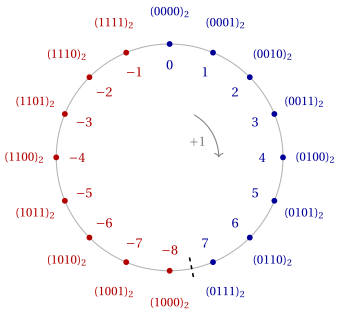
Figure 1.1: The \(16\) sequences of \(4\) bits on a circle, with the integers they represent in two's complement: non-negative integers in blue (most significant bit \(0\)), negative integers in red (most significant bit \(1\)). The dashed mark between \((0111)_2 = 7\) and \((1000)_2 = -8\) is the only point where the integer represented jumps.
Computing \(2^k + n\) by a subtraction is not the only way to obtain the representation of a negative integer: the following observation gives a procedure that works directly on the bits.
Observation 1.9
Let \(n\) be an integer with \(-2^{k-1} \le n < 0\). The two's complement representation of \(n\) with \(k\) bits is obtained from the binary representation of \(|n|\) with \(k\) bits in two steps:
-
invert all the bits (each \(0\) becomes \(1\) and each \(1\) becomes \(0\));
-
add \(1\) to the result, as a natural number.
Proof
Let \((d_{k-1} \dots d_1 d_0)_2\) be the binary representation of \(|n|\) with \(k\) bits. Inverting the bits gives the digits \(1-d_i\), hence the natural number:
Adding \(1\) we obtain \(2^k - |n| = 2^k + n\), which is the two's complement representation of \(n\) by Definition 1.8. Since \(1 \le |n| \le 2^{k-1}\), we have \(2^{k-1} \le 2^k + n \le 2^k - 1\), so the result still has \(k\) bits. □
Example 1.8: two's complement of \(-5\) with \(8\) bits
We compute the representation of \(n=-5\) with \(k=8\) bits in both ways.
-
Step 1: binary representation of \(|n| = 5\) with \(8\) bits: \((00000101)_2\).
-
Step 2: invert all the bits: \((11111010)_2\), whose natural value is \(250 = (2^8-1) - 5\).
-
Step 3: add \(1\): \((11111010)_2 + 1 = (11111011)_2\).
-
Check with Definition 1.8: \(2^8 + (-5) = 256 - 5 = 251 = 128+64+32+16+8+2+1 = (11111011)_2\).
1.2.3 Representation interval
Observation 1.10
Given \(k\) bits, the largest integer that can be represented in two's complement is:
the smallest integer that can be represented is:
and therefore the representation interval is:
Proof
With \(k\) bits, there are \(2^k\) possible binary strings, whose natural values are \(0, 1, \dots, 2^k-1\).
The strings whose most significant bit is \(0\) have natural values \(0, 1, \dots, 2^{k-1}-1\) and represent the non-negative integers:
The strings whose most significant bit is \(1\) have natural values \(r = 2^{k-1}, \dots, 2^k-1\) and represent the integers \(r - 2^k\), i.e., the negative integers:
Hence the largest representable integer is \(2^{k-1}-1\), the smallest representable integer is \(-2^{k-1}\), and the interval is:
□
Compared with sign-magnitude, the interval contains one more integer, \(-2^{k-1}\): the sequence \((10\dots0)_2\), which was \(-0\) in sign-magnitude, now represents \(-2^{k-1}\). All the \(2^k\) sequences represent different integers.
Example 1.9: representation intervals in two's complement
| \(k\) | \(-2^{k-1}\) | \(2^{k-1}-1\) | representation interval |
|---|---|---|---|
| 1 | \(-1\) | \(0\) | \([-1,0]\) |
| 2 | \(-2\) | \(1\) | \([-2,1]\) |
| 3 | \(-4\) | \(3\) | \([-4,3]\) |
| 4 | \(-8\) | \(7\) | \([-8,7]\) |
| 8 | \(-128\) | \(127\) | \([-128,127]\) |
| 16 | \(-32{,}768\) | \(32{,}767\) | \([-32{,}768,\,32{,}767]\) |
| 32 | \(-2{,}147{,}483{,}648\) | \(2{,}147{,}483{,}647\) | \([-2{,}147{,}483{,}648,\,2{,}147{,}483{,}647]\) |
| 64 | \(-2^{63}\) | \(2^{63}-1\) | \([-2^{63},\,2^{63}-1]\) |
1 Representation interval of int in C and C++ (4 bytes).
2 Representation interval of long long int in C and C++ (8 bytes); \(2^{63}=9{,}223{,}372{,}036{,}854{,}775{,}808\).
1.2.4 Minimum number of bits
Observation 1.11
The minimum number of bits needed to represent an integer \(n\) in two's complement is the smallest integer \(k \ge 1\) such that
Proof
By Observation 1.10, an integer represented with \(k\) bits in two's complement belongs to the interval
and every integer of this interval can be represented with \(k\) bits. Therefore, the minimum number of bits required to represent \(n\) is exactly the smallest \(k\) for which
□
As for the natural numbers, the condition of Observation 1.11 can be turned into an explicit formula with logarithms.
Corollary 1.12
The minimum number of bits needed to represent an integer \(n\) in two's complement is:
Proof
With \(k=1\) the interval is \([-1, 0]\), which gives the first case.
-
If \(n > 0\), the condition of Observation 1.11 reduces to \(n \le 2^{k-1}-1\), i.e., \(n < 2^{k-1}\), i.e., \(\log_2 n < k-1\). The smallest integer \(k-1\) strictly greater than \(\log_2 n\) is \(\lfloor \log_2 n \rfloor + 1\), hence \(k = \lfloor \log_2 n \rfloor + 2\).
-
If \(n < 0\), the condition reduces to \(-2^{k-1} \le n\), i.e., \(|n| \le 2^{k-1}\), i.e., \(\log_2 |n| \le k-1\). The smallest integer \(k-1\) greater than or equal to \(\log_2 |n|\) is \(\lceil \log_2 |n| \rceil\), hence \(k = \lceil \log_2 |n| \rceil + 1\) (for \(n=-1\) this gives \(k=1\), in agreement with the first case).
□
Example 1.10: minimum number of bits in two's complement
The last column shows the representation of \(n\) with the minimum number of bits.
| \(n\) | minimum number of bits | representation |
|---|---|---|
| \(-1\) | 1 | \(1\) |
| \(0\) | 1 | \(0\) |
| \(1\) | 2 | \(01\) |
| \(-2\) | 2 | \(10\) |
| \(2\) | 3 | \(010\) |
| \(-4\) | 3 | \(100\) |
| \(4\) | 4 | \(0100\) |
| \(-8\) | 4 | \(1000\) |
| \(8\) | 5 | \(01000\) |
| \(-16\) | 5 | \(10000\) |
For instance, for \(n = 8\) Corollary 1.12 gives \(\lfloor \log_2 8 \rfloor + 2 = 3 + 2 = 5\), and for \(n=-16\) it gives \(\lceil \log_2 16 \rceil + 1 = 4 + 1 = 5\).
1.2.5 Addition and overflow
The main advantage of two's complement is that integers are added exactly as natural numbers: we add the two sequences of \(k\) bits column by column, from right to left, with carries, and we discard the carry that goes out of the most significant position.
Observation 1.13
Let \(n_1\) and \(n_2\) be two integers represented with \(k\) bits in two's complement. Add their representations as natural numbers and keep only the \(k\) least significant bits of the sum.
-
If \(n_1 + n_2 \in [-2^{k-1}, 2^{k-1}-1]\), the result is the two's complement representation of \(n_1 + n_2\).
-
Otherwise, the sum cannot be represented with \(k\) bits and we have an overflow. An overflow occurs if and only if \(n_1\) and \(n_2\) have the same sign and the result has the opposite sign bit.
Proof
Let \(r_1\) and \(r_2\) be the natural values of the two representations: by Definition 1.8, \(r_j = n_j\) or \(r_j = 2^k + n_j\), so \(r_1 + r_2\) differs from \(n_1 + n_2\) by \(0\), \(2^k\) or \(2^{k+1}\). Keeping the \(k\) least significant bits means subtracting \(2^k\) when \(r_1 + r_2 \ge 2^k\) (the discarded carry). Hence the result \(r\) satisfies \(r \in [0, 2^k-1]\) and \(r - (n_1+n_2)\) is a multiple of \(2^k\).
If \(n_1 + n_2 \in [-2^{k-1}, 2^{k-1}-1]\), its representation \(\bar r\) also lies in \([0, 2^k-1]\) and \(\bar r - (n_1+n_2)\) is \(0\) or \(2^k\). Then \(r - \bar r\) is a multiple of \(2^k\) with \(|r - \bar r| \le 2^k - 1\), so \(r = \bar r\).
If \(n_1\) and \(n_2\) have different signs, \(n_1 + n_2\) lies between \(n_1\) and \(n_2\), which belong to the interval: no overflow. If both are non-negative, \(n_1+n_2 \in [0, 2^k-2]\), no carry is discarded and \(r = n_1 + n_2\): an overflow occurs if and only if \(n_1 + n_2 \ge 2^{k-1}\), i.e., if and only if the sign bit of \(r\) is \(1\). If both are negative, \(r_1 + r_2 = 2^{k+1} + n_1 + n_2 \ge 2^k\), so \(r = 2^k + n_1 + n_2\): an overflow occurs if and only if \(n_1 + n_2 < -2^{k-1}\), i.e., if and only if \(r < 2^{k-1}\), i.e., the sign bit of \(r\) is \(0\). □
In the examples, the first row of each addition contains the carries: the carry written above a column is the one coming from the column on its right. The leftmost column receives the carry out of the most significant position, which is discarded.
Example 1.11: addition without overflow
We compute \(3 + (-1)\) with \(k=4\) bits, interval \([-8, 7]\).
-
Step 1: representations: \(3 = (0011)_2\) and \(-1 \rightarrow 2^4 - 1 = 15 = (1111)_2\).
-
Step 2: column addition:
carry 1 1 1 1 0 0 1 1 1 1 1 1 sum 1 0 0 1 0 -
Step 3: discard the carry out: the result is \((0010)_2 = 2 = 3 + (-1)\).
Example 1.12: addition with overflow
We compute \(6 + 3\) with \(k=4\) bits, interval \([-8, 7]\). Since \(6+3 = 9 > 7\), an overflow is expected.
-
Step 1: representations: \(6 = (0110)_2\) and \(3 = (0011)_2\).
-
Step 2: column addition:
carry 0 1 1 0 0 1 1 0 0 0 1 1 sum 0 1 0 0 1 -
Step 3: the result \((1001)_2\) has sign bit \(1\) and represents \(9 - 16 = -7\), although both operands are positive: an overflow has occurred.
Key points on integer numbers.
-
Sign-magnitude with \(k\) bits: interval \([-(2^{k-1}-1), 2^{k-1}-1]\), two representations of zero, addition requires a special treatment of the sign.
-
Two's complement with \(k\) bits: a negative \(n\) is represented by \(2^k+n\) (equivalently: invert the bits of \(|n|\) and add \(1\)); interval \([-2^{k-1}, 2^{k-1}-1]\); a unique zero.
-
In two's complement, addition is the addition of natural numbers modulo \(2^k\); an overflow occurs only when two operands with the same sign give a result with the opposite sign.
1.3 Representation of real numbers
Natural and integer numbers are represented exactly, as long as they lie in the representation interval. Real numbers are different: between any two real numbers there are infinitely many others, and most real numbers (for instance \(\frac{1}{3}\) or \(\sqrt 2\)) have infinitely many digits in any base. With a finite number of bits, a real number can therefore be represented, in general, only approximately. In this section we study the floating-point representation used by computers.
1.3.1 Digits after the point
Positional numeral systems extend to the digits after the point: the digits on the right of the point are multiplied by the negative powers of the base.
Definition 1.14: sequence of digits with a fractional part
A sequence of \(k\) digits before the point and \(h\) digits after the point in base \(b\) is denoted as:
and represents the number:
Example 1.13: binary numbers with a fractional part
-
\((101.11)_2 = 1 \cdot 2^2 + 0 \cdot 2^1 + 1 \cdot 2^0 + 1 \cdot 2^{-1} + 1 \cdot 2^{-2} = 4 + 1 + 0.5 + 0.25 = 5.75\)
-
\((0.011)_2 = 0 \cdot 2^{-1} + 1 \cdot 2^{-2} + 1 \cdot 2^{-3} = 0.25 + 0.125 = 0.375\)
-
The decimal number \(0.1\) has no finite binary representation: its binary digits after the point repeat forever,
\[ 0.1 = (0.0\,0011\,0011\,0011\dots)_2 \]
Writing a number with a fixed number of digits before and after the point (fixed point) wastes digits: very large numbers need many digits before the point, very small numbers many digits after it. The floating-point representation lets the point “float”, as in the scientific notation \(6.02 \times 10^{23}\).
Definition 1.15: normalized binary scientific notation
Every real number \(x \neq 0\) can be written in the normalized binary scientific notation:
where \(s \in \{0, 1\}\) is the sign, the sequence \((1.f_1 f_2 f_3 \dots)_2\) is the significand (or mantissa), whose bits \(f_1, f_2, f_3, \dots\) after the point form the fraction, and the integer \(e\) is the exponent.
The significand is always between \(1\) (included) and \(2\) (excluded): its first digit is always \(1\), so it does not need to be stored. For example, \(5.75 = (101.11)_2 = (1.0111)_2 \cdot 2^2\): the point moves two positions to the left and the exponent is \(2\).
1.3.2 The IEEE 754 standard
Computers store floating-point numbers according to the IEEE 754 standard (IEEE: Institute of Electrical and Electronics Engineers). We describe its two most common formats, focusing on the 32-bit one.
Definition 1.16: IEEE 754 single precision
In the IEEE 754 single precision format, a real number is stored with \(32\) bits divided into three fields:
-
the sign \(s\): \(1\) bit;
-
the biased exponent \(E\): \(8\) bits, storing the natural number \(E = e + 127\), where \(e\) is the exponent and \(127\) is the bias;
-
the fraction \(f\): \(23\) bits, storing the bits \(f_1 f_2 \dots f_{23}\) of the significand after the point.
For \(1 \le E \le 254\) (normalized numbers), the number represented is:

Figure 1.2: The \(32\) bits of the IEEE 754 single precision format, numbered from \(31\) (most significant) to \(0\) (least significant).
-
The exponent is stored with a bias instead of in two's complement, so that \(E\) is a natural number between \(0\) and \(255\).
-
The two extreme values of \(E\) are reserved. \(E = 0\) is used for zero (all fraction bits equal to \(0\); there are two zeros, \(+0\) and \(-0\), as in sign-magnitude) and for very small numbers called subnormal. \(E = 255\) is used for \(+\infty\) and \(-\infty\) (fraction equal to \(0\), e.g., the result of \(1/0\)) and for NaN, “Not a Number” (fraction different from \(0\), e.g., the result of \(0/0\)).
-
The double precision format has the same structure with \(64\) bits: \(1\) bit of sign, \(11\) bits of exponent with bias \(1023\), and \(52\) bits of fraction.
| Format | total bits | sign | exponent | fraction | bias |
|---|---|---|---|---|---|
single precision (C++ float) |
\(32\) | \(1\) | \(8\) | \(23\) | \(127\) |
double precision (C++ double) |
\(64\) | \(1\) | \(11\) | \(52\) | \(1023\) |
Example 1.14: from a real number to its IEEE 754 single precision representation
We represent \(x = 5.75\) in single precision.
-
Step 1 (binary): \(5.75 = 4 + 1 + 0.5 + 0.25 = (101.11)_2\).
-
Step 2 (normalization): \((101.11)_2 = (1.0111)_2 \cdot 2^2\), hence \(s=0\), \(e=2\) and the fraction starts with \(0111\).
-
Step 3 (biased exponent): \(E = e + 127 = 129 = 128 + 1 = (10000001)_2\).
-
Step 4 (fraction): the bits after the point, completed with zeros up to \(23\) bits: \(01110000000000000000000\).
The \(32\) bits are:
Example 1.15: from an IEEE 754 single precision representation to a real number
We read the \(32\) bits:
-
Step 1 (sign): \(s = 1\), the number is negative.
-
Step 2 (exponent): \(E = (10000010)_2 = 128 + 2 = 130\), hence \(e = E - 127 = 3\).
-
Step 3 (significand): \((1.01)_2 = 1 + 0.25 = 1.25\).
-
Step 4 (value): \(x = (-1)^1 \cdot 1.25 \cdot 2^3 = -10\).
When the binary digits of a number do not fit in the \(23\) bits of the fraction, the number is rounded to the nearest representable one.
Example 1.16: the number \(0.1\) is not representable exactly
By Example 1.13, \(0.1 = (0.0\,0011\,0011\dots)_2 = (1.1001\,1001\,1001\dots)_2 \cdot 2^{-4}\), whose fraction never ends. In single precision the fraction is rounded to \(23\) bits, and the bits stored are:
The number actually stored is \(0.100000001490116119384765625\), not \(0.1\). In double precision the error is smaller but still present: the stored value is \(0.1000000000000000055511151231\dots\), and for this reason the computation \(0.1 + 0.2\) in double precision gives \(0.30000000000000004\) and not the double precision value of \(0.3\).
1.3.3 Range and precision
The finite number of bits of the exponent limits the range of the representable numbers, and the finite number of bits of the fraction limits their precision.
Observation 1.17
In IEEE 754 single precision:
-
the largest finite number is \((2 - 2^{-23}) \cdot 2^{127} \approx 3.4028235 \times 10^{38}\);
-
the smallest positive normalized number is \(2^{-126} \approx 1.1754944 \times 10^{-38}\);
-
the distance between \(1\) and the next representable number is \(2^{-23} \approx 1.1920929 \times 10^{-7}\) (called the machine epsilon).
Proof
The largest finite number has \(s=0\), the largest normalized biased exponent \(E = 254\), i.e., \(e = 127\), and all \(23\) fraction bits equal to \(1\). Its significand is:
hence the number is \((2-2^{-23}) \cdot 2^{127}\). The smallest positive normalized number has \(E=1\), i.e., \(e = -126\), and all fraction bits equal to \(0\), hence it is \(1 \cdot 2^{-126}\). Finally, \(1 = (1.00\dots0)_2 \cdot 2^0\), and the next representable number is obtained by setting to \(1\) the last fraction bit, which has weight \(2^{-23}\) when \(e=0\): it is \(1 + 2^{-23}\). □
The machine epsilon measures the relative precision of the format: single precision corresponds to about \(7\) significant decimal digits, double precision (machine epsilon \(2^{-52} \approx 2.2 \times 10^{-16}\)) to about \(16\). As a consequence, two expressions that are mathematically equal may give different floating-point results, and floating-point numbers should not be compared with the equality operator without care.
Key points on real numbers.
-
A floating-point number is stored as a sign, an exponent and a fraction: \(x = (-1)^s \cdot (1.f)_2 \cdot 2^{E - \textrm{bias}}\).
-
IEEE 754 single precision: \(1 + 8 + 23\) bits, bias \(127\); double precision: \(1 + 11 + 52\) bits, bias \(1023\).
-
The exponent bits determine the range, the fraction bits the precision; most real numbers (for instance \(0.1\)) are stored with a rounding error.
Exercises on this chapter: Representation of numbers
Interactive lab
The algorithm of the chapter, one step at a time: move the sliders and press ▶. The same graph full page, with the other ones of the course, is in the interactive lab.