Vehicles: minimum lot and a bonus for variety
Class: MILP · Links: minimum lot (semi-integer), counting the types, if and only if · Script: python/fam09_3_vehicles.py
Difficulty: ★★★★☆ · Time: 45–60 min

Problem 9.3
A company produces \(s \in \mathbb{Z}_{\ge 1}\) types of vehicle using \(k \in \mathbb{Z}_{\ge 1}\) resources. For every resource \(i \in \{1, 2, \dots, k\}\) and every type \(j \in \{1, 2, \dots, s\}\), the value \(a_{ij} \in \mathbb{Q}_{\ge 0}\) is the amount of resource \(i\) needed for one unit of type \(j\), and \(b_i \in \mathbb{Q}_{>0}\) is the availability of resource \(i\). For every type \(j\), the value \(\bar p_j \in \mathbb{Q}_{>0}\) is the profit of one unit and \(\bar q_j \in \mathbb{Z}_{\ge 1}\) the minimum quantity to be produced if that type is chosen. If the production includes at least two different types, the company collects a bonus \(\bar r \in \mathbb{Q}_{>0}\) (a grant for diversification). The company wants to maximise the total profit.
The problem in words. We decide how many units of each type to produce. The objective: maximum profit, bonus included. The constraints: the resources are not exceeded; and of a type one produces either zero units or at least \(\bar q_j\).
Model
Variables. \(x_j \in \mathbb{Z}_{\ge 0}\) units produced of type \(j\); \(y_j \in \{0,1\}\) equals \(1\) if type \(j\) is produced; \(z \in \{0,1\}\) equals \(1\) if the bonus is collected. The datum \(M_j = \min \{ \lfloor b_i / a_{ij} \rfloor : a_{ij} > 0 \}\) is the maximum producible of type \(j\) alone: the minimum runs over the resources the type actually consumes, because a resource with \(a_{ij} = 0\) does not limit it.
Description. The objective adds up the profits of the vehicles produced and the bonus for variety. The resource constraints, one per resource, are the availabilities. The minimum lot and activation constraints, one per type each, make \(x_j\) semi-integer: either zero, or at least \(\bar q_j\) and at most \(M_j\). The bonus constraint, a single one, says that the bonus is collected only if at least two types are active.
The link between the variables: semi-integrality
The two constraints together say
If \(y_j = 0\) both give \(x_j = 0\); if \(y_j = 1\) one gets \(\bar q_j \le x_j \le M_j\). Neither is enough on its own: without the activation a type could be produced with \(y_j = 0\); without the minimum lot the threshold would be vacuous.
| \(y_j\) | what the two constraints impose | \(x_j\) |
|---|---|---|
| \(0\) | \(0 \le x_j \le 0\) | \(x_j = 0\) |
| \(1\) | \(\bar q_j \le x_j \le M_j\) | lot allowed |
The bonus is collected only with at least two types
The constraint reads \(2 z \le \sum_{j=1}^{s} y_j\). If \(z = 1\) then \(\sum_j y_j \ge 2\): at least two types are activated and, by semi-integrality, actually produced. The converse — if two types are active then \(z = 1\) — is imposed by no constraint, but follows from optimality: setting \(z = 1\) stays feasible and increases the objective by \(\bar r > 0\). With \(\bar r = 0\) the argument breaks down and \(z\) stops being a faithful indicator (question 9.3.2).
The model in gurobipy
mm = gp.Model("vehicles")
x = mm.addVars(n, vtype=GRB.INTEGER, name="x")
y = mm.addVars(n, vtype=GRB.BINARY, name="y")
z = mm.addVar(vtype=GRB.BINARY, name="z")
mm.setObjective(gp.quicksum(p[j] * x[j] for j in range(n)) + r * z, GRB.MAXIMIZE)
mm.addConstrs((gp.quicksum(a[i][j] * x[j] for j in range(n)) <= b[i]
               for i in range(m)), name="resource")
mm.addConstrs((x[j] - q[j] * y[j] >= 0 for j in range(n)), name="minimum_lot")
mm.addConstrs((x[j] - M[j] * y[j] <= 0 for j in range(n)), name="activate")
mm.addConstr(-gp.quicksum(y[j] for j in range(n)) + 2 * z <= 0, name="bonus")
The instance
\(s = 3\) types, \(k = 2\) resources (steel in tonnes and labour hours), \(\bar q_j = 10\) for every type, \(\bar r = 500\).
| \(a_{ij}\) | \(j=1\) | \(j=2\) | \(j=3\) | \(b_i\) | |
|---|---|---|---|---|---|
| \(i=1\) (steel) | 2 | 3 | 5 | 100 | |
| \(i=2\) (hours) | 30 | 25 | 40 | 1200 |
| \(j=1\) | \(j=2\) | \(j=3\) | |
|---|---|---|---|
| \(\bar p_j\) | 200 | 250 | 300 |
| \(\bar q_j\) | 10 | 10 | 10 |
| \(M_j\) | 40 | 33 | 20 |
The big-Ms are computed from the data: \(M_1 = \min(\lfloor 100/2 \rfloor, \lfloor 1200/30 \rfloor) = 40\), and likewise \(M_2 = 33\), \(M_3 = 20\).
The model written on the data of the instance:
Constructive heuristic: the primal bound
The problem is a maximisation, so the heuristic gives the primal bound, which sits below the optimum. The types are sorted by profit relative to the consumption of the tightest resource, the two best ones are activated at their minimum lot (so the bonus is guaranteed) and then one fills up with the most profitable among those activated.
On the instance types \(2\) and \(1\) are activated at their minimum lot, then one fills up: the production is \((11, 26, 0)\), the steel runs out and \(220\) hours are left. The profit is \(8700\) plus the bonus of \(500\):
LP relaxation and dual: the dual bound
The primal is a maximisation with \(\le\) and \(\ge\) constraints: following the conversion table, one associates \(\pi_i \ge 0\) with the resources, \(\ell_j \ge 0\) with the minimum lot (written as \(-\lambda_j\)), \(\beta_j \ge 0\) with the activation and \(\gamma \ge 0\) with the bonus.
The same dual, written on the data of the instance:
Description. \(\pi_i\) is the price of one unit of resource \(i\); \(\ell_j\) and \(\beta_j\) are the prices of the two semi-integrality constraints of type \(j\), and \(\gamma\) that of the bonus. The objective prices all the available resources. The first group are the columns of the \(x_j\): the resources one unit of type \(j\) consumes, corrected by the two semi-integrality constraints, must cover the profit \(\bar p_j\). The second are the columns of the \(y_j\): switching on type \(j\) forces at least \(\bar q_j\) units and allows at most \(M_j\), and the balance must cover the bonus \(\gamma\). The last is the column of \(z\): the bonus is collected only with two active types, and indeed it has to be covered by \(2\gamma\).
Recipe, in three steps.
- The constraint on \(z\) forces \(\gamma \ge \bar r/2\): take the minimum, \(\bar\gamma = 250\).
- Set \(\bar\beta_j = 0\) and read off the smallest feasible \(\ell_j\), \(\bar\ell_j = \bar\gamma / \bar q_j = 25\) for every \(j\): every activated type "carries" its own share of the bonus.
- What remains is \(\sum_i a_{ij}\, \pi_i \ge \bar p_j + \bar\ell_j\). Price one resource only, at the price that covers all the types, and keep the one that gives the smaller bound.
The better bound is the one from the steel: \(z(\mathit{MILP}) \le \mathit{UB} = 11\,250\).
Optimal solution
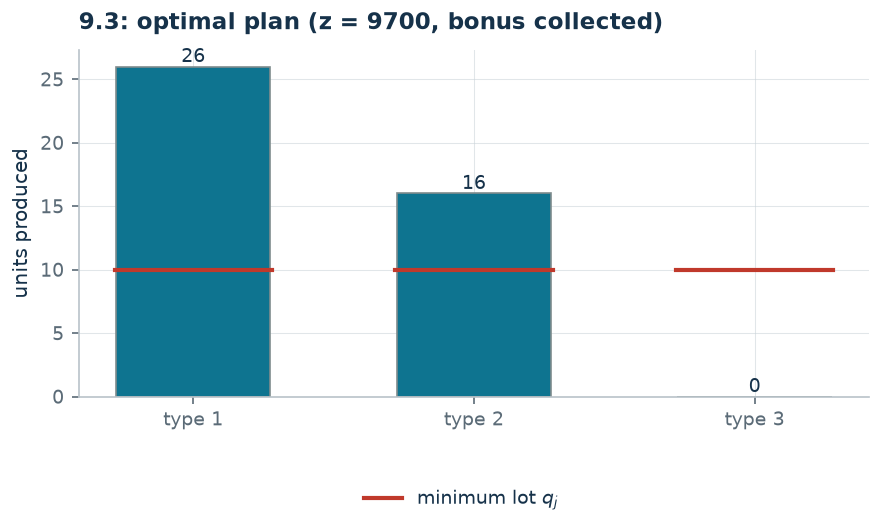
The optimal production is \((26, 16, 0)\): types \(1\) and \(2\) are activated, the bonus is collected, all \(100\) tonnes of steel and \(1180\) of the \(1200\) available hours are used.
| \(LB\) (heuristic) | \(z(\mathit{MILP})\) | \(z(\mathit{LP}^+)\) | \(z(\mathit{LP})\) | \(UB\) (dual) | heuristic gap |
|---|---|---|---|---|---|
| 9200 | 9700 | 9750 | \(20625/2\) | 11250 | \(5.2\%\) |
Here the relaxation with the bounds beats the hand-built dual
This is the only problem in the chapter where \(z(\mathit{LP}^+) = 9750\) is better than the hand-built dual bound (\(11\,250\)), and barely worse than the optimum (\(9700\)). The reason is that the relaxation without the bounds lets \(y_j\) and \(z\) grow above \(1\), and with them the bonus: \(z(\mathit{LP}) = 20625/2 \approx 10\,312\). Adding \(y_j \le 1\) and \(z \le 1\) removes exactly that freedom. When a model contains rewarded indicators, the relaxation with the bounds is not a detail.
Additional considerations
- The big-M \(M_j\) is the maximum producible of type \(j\) alone, not of the whole plan: it is already far tighter than an arbitrary constant.
- If for some type one had \(\bar q_j > M_j\), that type would be impossible to produce and could be removed from the model by a check on the data.
- The bonus is modelled with one binary and one constraint. With a different threshold (at least \(f\) types) it is enough to replace the coefficient \(2\) by \(f\); with several tiered bonuses one would need a variable per tier and a chain of constraints, as in the piecewise functions.
Additional modelling questions
9.3.1 — Zero bonus
The diversification grant is abolished, that is \(\bar r = 0\). What happens to the variable \(z\)?
A worked variant: a more demanding bonus
The bonus is collected only if at least three different types are produced.
Only one coefficient changes: constraint becomes
On the instance the new optimum is \(9200\), that is \(500\) less. Activating the third type would cost more than the bonus: it is better to give up the bonus, and indeed at the optimum \(z = 0\). The value coincides, by coincidence, with that of the heuristic solution of the original problem.
The bonus constraint touches a single column of the dual, the one of \(z\), which now sees \(\bar r / 3\) instead of \(\bar r / 2\); the rest of the dual is identical. The recipe is the one of the base problem with \(\gamma = \bar r / 3 = 500/3\), and the bound drops from \(11250\) to \(32500/3\): asking for three types instead of two spreads the bonus over more activations, so each type carries less of it and the dual prices fall. The heuristic starts from the base plan, tries to switch on a third type at its minimum lot and with these resources does not manage: it stays at \(8700\), and the optimum drops from \(9700\) to \(9200\).
| value | what it is | |
|---|---|---|
| \(\mathit{UB}\) | \(\frac{32500}{3}\) | dual certificate built by hand |
| \(\mathit{LB}\) | \(8700\) | heuristic solution |
| \(z(\mathit{LP})\) | \(\frac{29875}{3}\) | relaxation without the bounds |
| \(z(\mathit{LP}^+)\) | \(\frac{28750}{3}\) | relaxation with the bounds |
| \(z(\mathit{MILP})\) | \(9200\) | optimum of the MILP |
Code
Complete script —
python/fam09_3_vehicles.py
(reproducible with python3 python/fam09_3_vehicles.py from the python/
folder). Notebook —
notebooks/fam09_3_vehicles.ipynb
— which opens in Colab from the badge at the top of the page.
Show the complete script — python/fam09_3_vehicles.py (289 lines)
"""Problem 9.3 -- Vehicles: minimum lot and a bonus for variety.

Three techniques together: the semi-integer variable of the minimum lot (3.3),
the count of the active types (3.11) and a bonus paid "if and only if" at least
two types are produced (3.10). The bonus is collected only if the count reaches
two: the missing direction follows from optimality, because the bonus is positive.
"""
import gurobipy as gp
import pandas as pd
from gurobipy import GRB

from mip import (ammissibile, dualita_forte, due_rilassamenti, frazione,
                 nuovo_modello, registra_bound, rilassamenti, risolvi, valuta)
from stile import ARANCIO, BLU, ROSSO, TEAL, VERDE, intestazione, plt, salva_dati, salva_figura
from esteso import salva_modello

R = range

# ---------- 1. MODEL AND INSTANCE ----------
intestazione("9.3 Vehicles: minimum lot per type and a bonus for at least two types")
a3 = [[2, 3, 5],        # steel (tons) per unit of the three types
      [30, 25, 40]]     # labour hours per unit
b3 = [100, 1200]        # steel and hours available
p3 = [200, 250, 300]    # profit per unit
q3 = [10, 10, 10]       # minimum quantity if the type is produced
r3 = 500                # bonus if at least two types are produced
n3, m3 = 3, 2
# the smallest valid big-M per type: how many units the resources allow at most
M3 = [min(b3[i] // a3[i][j] for i in R(m3)) for j in R(n3)]
salva_dati(pd.DataFrame({"type": R(1, n3 + 1), "steel": a3[0], "hours": a3[1],
                         "profit": p3, "minimum": q3, "M": M3}), "fam09_3_dati")
print(f"  Resources: {b3[0]} t of steel, {b3[1]} hours. Big-M per type (from the data "
      f"alone): {M3}")


def modello_3(a, b, p, q, r):
    n, m = len(p), len(b)
    M = [min(b[i] // a[i][j] for i in R(m)) for j in R(n)]
    mm = nuovo_modello("vehicles")
    x = mm.addVars(n, vtype=GRB.INTEGER, name="x")     # units produced
    y = mm.addVars(n, vtype=GRB.BINARY, name="y")      # type activated
    z = mm.addVar(vtype=GRB.BINARY, name="z")          # bonus for variety
    mm.setObjective(gp.quicksum(p[j] * x[j] for j in R(n)) + r * z, GRB.MAXIMIZE)
    mm.addConstrs((gp.quicksum(a[i][j] * x[j] for j in R(n)) <= b[i] for i in R(m)),
                  name="resource")
    mm.addConstrs((x[j] - q[j] * y[j] >= 0 for j in R(n)), name="minimum_lot")
    mm.addConstrs((x[j] - M[j] * y[j] <= 0 for j in R(n)), name="activate")
    mm.addConstr(-gp.quicksum(y[j] for j in R(n)) + 2 * z <= 0, name="bonus")
    return mm, x, y, z


def duale_3(a, b, p, q, r):
    """min sum_i b_i pi_i;  sum_i a_ij pi_i - alpha_j + beta_j >= p_j;
    q_j alpha_j - M_j beta_j + gamma >= 0;  -2 gamma >= r;  pi, alpha, beta >= 0, gamma <= 0.
    (written with the signs of the conversion table for a maximisation primal)"""
    n, m = len(p), len(b)
    M = [min(b[i] // a[i][j] for i in R(m)) for j in R(n)]
    dl = nuovo_modello("dual_vehicles")
    pi = dl.addVars(m, name="pi")                                   # resources (<= in a max)
    alpha = dl.addVars(n, lb=-GRB.INFINITY, ub=0.0, name="alpha")   # minimum lot (>= in a max)
    beta = dl.addVars(n, name="beta")                               # activation (<=)
    gamma = dl.addVar(name="gamma")                                 # bonus (<=)
    dl.setObjective(gp.quicksum(b[i] * pi[i] for i in R(m)), GRB.MINIMIZE)
    dl.addConstrs((gp.quicksum(a[i][j] * pi[i] for i in R(m)) + alpha[j] + beta[j] >= p[j]
                   for j in R(n)), name="rc_x")
    dl.addConstrs((-q[j] * alpha[j] - M[j] * beta[j] - gamma >= 0 for j in R(n)), name="rc_y")
    dl.addConstr(2 * gamma >= r, name="rc_z")
    return dl


m3m, x3, y3, z3 = modello_3(a3, b3, p3, q3, r3)
salva_modello(m3m, "fam09_3_primale")

# ---------- 2. THE LP RELAXATION ----------
zlp3, zlp3r, _ = rilassamenti(m3m)

# ---------- 3. THE DUAL OF THE RELAXATION (UPPER BOUND: IT IS A MAXIMUM) ----------
dl3 = duale_3(a3, b3, p3, q3, r3)
salva_modello(dl3, "fam09_3_duale")
# recipe: gamma = r/2 (the smallest value allowed by 2 gamma >= r), beta = 0, and
# lambda_j = gamma / q_j (every activated type "carries" its share of the bonus); then
# a single resource is priced so that it covers all types, and the better bound is kept
gamma = r3 / 2
lam = [gamma / q3[j] for j in R(n3)]
bound = {}
for i in R(m3):
    prezzo = max((p3[j] + lam[j]) / a3[i][j] for j in R(n3))
    bound[i] = b3[i] * prezzo
critica = min(bound, key=bound.get)
prezzo = max((p3[j] + lam[j]) / a3[critica][j] for j in R(n3))
mano = {"gamma": gamma} | {f"pi[{i}]": 0.0 for i in R(m3)} \
    | {f"alpha[{j}]": -lam[j] for j in R(n3)} | {f"beta[{j}]": 0.0 for j in R(n3)}
mano[f"pi[{critica}]"] = prezzo
ub3, viol = valuta(dl3, mano)
assert viol <= 1e-9, (viol, mano)
print(f"  Hand-built dual: gamma = r/2 = {frazione(gamma)} (the smallest value satisfying")
print(f"  2 gamma >= r), beta = 0 and lambda_j = gamma / q_j = "
      + ", ".join(frazione(v) for v in lam))
print("  so every activated type carries its share of the bonus. Then a single resource is")
print("  priced at max_j (p_j + lambda_j) / a_ij, and the tighter bound is kept:")
for i in R(m3):
    print(f"    resource {i + 1}: price "
          f"{frazione(max((p3[j] + lam[j]) / a3[i][j] for j in R(n3)))}"
          f"  ->  b_i * price = {frazione(bound[i])}")
print(f"  The smallest is resource {critica + 1}:  ub = {frazione(ub3)}")
dualita_forte(dl3, zlp3)

# ---------- 4. CONSTRUCTIVE HEURISTIC (LOWER BOUND: IT IS A MAXIMUM) ----------
# constructive heuristic: two types are activated (to collect the bonus) starting from the highest
# profit per unit of the scarcest resource, then one fills up with the best type
def euristica(a, b, p, q, r):
    n, m = len(p), len(b)
    # profit / consumption ratio of the tightest resource
    ordine = sorted(R(n), key=lambda j: -p[j] / max(a[i][j] / b[i] for i in R(m)))
    x = [0] * n
    res = list(b)
    attivi = []
    for j in ordine:                       # first the minimum lot of the two best types
        if len(attivi) < 2 and all(res[i] >= a[i][j] * q[j] for i in R(m)):
            x[j] = q[j]
            for i in R(m):
                res[i] -= a[i][j] * q[j]
            attivi.append(j)
    for j in ordine:                       # then fill up with the most profitable type
        if x[j] == 0:
            continue
        extra = min(res[i] // a[i][j] for i in R(m))
        x[j] += extra
        for i in R(m):
            res[i] -= a[i][j] * extra
    return x, attivi, res


x_eur, attivi, res = euristica(a3, b3, p3, q3, r3)
lb3 = sum(p3[j] * x_eur[j] for j in R(n3)) + (r3 if len(attivi) >= 2 else 0)
sol_eur = {f"x[{j}]": x_eur[j] for j in R(n3)} \
    | {f"y[{j}]": 1 if x_eur[j] > 0 else 0 for j in R(n3)} | {"z": 1 if len(attivi) >= 2 else 0}
assert ammissibile(m3m, sol_eur)
print(f"  Heuristic: types {[j + 1 for j in attivi]} are activated at their minimum lot, then")
print(f"  one fills up with the most profitable one; production {x_eur}, resources left {res}")
print(f"  lb = {sum(p3[j] * x_eur[j] for j in R(n3))} + {r3} of bonus = {frazione(lb3)}")

# ---------- 5. OPTIMUM OF THE MILP ----------
z3v = risolvi(m3m)
print("  Optimal solution: production " + ", ".join(str(round(x3[j].X)) for j in R(n3))
      + f"; active types {[j + 1 for j in R(n3) if y3[j].X > 0.5]}; bonus collected: "
      + ("yes" if z3.X > 0.5 else "no"))
print("  Resources used: " + ", ".join(
    f"{frazione(sum(a3[i][j] * round(x3[j].X) for j in R(n3)))} out of {b3[i]}" for i in R(m3)))
riga = registra_bound("3 vehicles", ub3, lb3, zlp3, zlp3r, z3v, senso="max")
salva_dati(pd.DataFrame([riga]), "fam09_3_bound")
assert lb3 <= z3v <= zlp3 + 1e-6 <= ub3 + 1e-6

# ---------- 6. ADDITIONAL MODELLING QUESTIONS ----------
varianti = {}


def variante(nome, m):
    z = risolvi(m)
    print(f"  {nome:70s} z = {frazione(z)}")
    return z


# 3a: the bonus requires at least three different types
m, x, y, z = modello_3(a3, b3, p3, q3, r3)
m.update()
m.remove([c for c in m.getConstrs() if c.ConstrName == "bonus"])
m.addConstr(-gp.quicksum(y[j] for j in R(n3)) + 3 * z <= 0, name="bonus3")
varianti["3a"] = variante("3a. The bonus is paid only with at least three types", m)
# 3b: the bonus is zero -- what happens to the "if and only if" link?
m, x, y, z = modello_3(a3, b3, p3, q3, 0)
zz = risolvi(m)
print(f"  {'3b. The bonus is 0: z is no longer a faithful indicator':70s} z = {frazione(zz)}")
print(f"      active types {[j + 1 for j in R(n3) if y[j].X > 0.5]}, but z = {round(z.X)}: with")
print("      a zero bonus the optimum has no reason to raise z, and the constraint alone")
print("      does not force it. Making it a faithful indicator needs the other direction too.")
varianti["3b"] = zz
salva_dati(pd.DataFrame({"variant": list(varianti), "z": list(varianti.values())}),
           "fam09_3_varianti")

# ---------- 7. THE SANDWICH ON THE VARIANT 3a ----------
intestazione("9.3a The sandwich on the variant: the bonus requires at least three types")
SOGLIA = 3


def modello_3a(a, b, p, q, r, soglia=SOGLIA):
    mm, xx, yy, zz = modello_3(a, b, p, q, r)
    mm.update()                                   # constraint names exist after the update
    mm.remove(mm.getConstrByName("bonus"))
    mm.addConstr(-gp.quicksum(yy[j] for j in R(len(p))) + soglia * zz <= 0, name="bonus")
    return mm, xx, yy, zz


def duale_3a(a, b, p, q, r, soglia=SOGLIA):
    """Only one row changes with respect to the dual of 9.3: the column of z,
    which now sees the bonus divided by `soglia` instead of by two. The rest of
    the dual is identical --- the bonus constraint touches only that column."""
    nn, mm_ = len(p), len(b)
    MM = [min(b[i] // a[i][j] for i in R(mm_)) for j in R(nn)]
    dl = nuovo_modello("duale_veicoli_3a")
    pi = dl.addVars(mm_, name="pi")
    alpha = dl.addVars(nn, lb=-GRB.INFINITY, ub=0.0, name="alpha")
    beta = dl.addVars(nn, name="beta")
    gm = dl.addVar(name="gamma")
    dl.setObjective(gp.quicksum(b[i] * pi[i] for i in R(mm_)), GRB.MINIMIZE)
    dl.addConstrs((gp.quicksum(a[i][j] * pi[i] for i in R(mm_)) + alpha[j] + beta[j] >= p[j]
                   for j in R(nn)), name="rc_x")
    dl.addConstrs((-q[j] * alpha[j] - MM[j] * beta[j] - gm >= 0 for j in R(nn)), name="rc_y")
    dl.addConstr(soglia * gm >= r, name="rc_z")
    return dl


m3a, x3a, y3a, z3a = modello_3a(a3, b3, p3, q3, r3)
salva_modello(m3a, "fam09_3a_primale")

# -- feasible heuristic: the base one, then a third type is switched on if the bonus pays --
print("Constructive heuristic: start from the solution of the base problem; if the active")
print("types are fewer than three, a third is switched on at its minimum lot, taking units")
print("from the least profitable type until the resources suffice. The best plan is kept.")
x_3a = list(x_eur)
attivi_3a = [j for j in R(n3) if x_3a[j] > 0]
base_3a = sum(p3[j] * x_3a[j] for j in R(n3)) + (r3 if len(attivi_3a) >= SOGLIA else 0)
print(f"  base solution: active types {[j + 1 for j in attivi_3a]}, value {frazione(base_3a)}")
migliore_3a = (base_3a, list(x_3a))
if len(attivi_3a) < SOGLIA:
    for spento in (j for j in R(n3) if x_3a[j] == 0):
        prova = list(x_3a)
        prova[spento] = q3[spento]
        peggiore = min(attivi_3a, key=lambda j: p3[j])
        while any(sum(a3[i][j] * prova[j] for j in R(n3)) > b3[i] for i in R(m3)):
            if prova[peggiore] == 0:
                break
            prova[peggiore] -= 1
        if all(sum(a3[i][j] * prova[j] for j in R(n3)) <= b3[i] for i in R(m3)) \
                and sum(1 for j in R(n3) if prova[j] > 0) >= SOGLIA:
            valore = sum(p3[j] * prova[j] for j in R(n3)) + r3
            print(f"  switching on type {spento + 1} at the minimum {q3[spento]}: {frazione(valore)}")
            if valore > migliore_3a[0]:
                migliore_3a = (valore, prova)
lb3a, x_mig = migliore_3a
att_mig = [j for j in R(n3) if x_mig[j] > 0]
sol_3a = ({f"x[{j}]": x_mig[j] for j in R(n3)}
          | {f"y[{j}]": (1 if x_mig[j] > 0 else 0) for j in R(n3)}
          | {"z": 1 if len(att_mig) >= SOGLIA else 0})
assert ammissibile(m3a, sol_3a), "the heuristic solution of the variant must be feasible"
print(f"  plan chosen {x_mig}  ->  lb = {frazione(lb3a)}")

# -- dual certificate: the bonus is divided by three instead of two --
dl3a = duale_3a(a3, b3, p3, q3, r3)
salva_modello(dl3a, "fam09_3a_duale")
gamma_3a = r3 / SOGLIA
lam_3a = [gamma_3a / q3[j] for j in R(n3)]
bound_3a = {i: b3[i] * max((p3[j] + lam_3a[j]) / a3[i][j] for j in R(n3)) for i in R(m3)}
critica_3a = min(bound_3a, key=bound_3a.get)
prezzo_3a = max((p3[j] + lam_3a[j]) / a3[critica_3a][j] for j in R(n3))
mano_3a = ({"gamma": gamma_3a} | {f"pi[{i}]": 0.0 for i in R(m3)}
           | {f"alpha[{j}]": -lam_3a[j] for j in R(n3)} | {f"beta[{j}]": 0.0 for j in R(n3)})
mano_3a[f"pi[{critica_3a}]"] = prezzo_3a
ub3a, viol_3a = valuta(dl3a, mano_3a)
assert viol_3a <= 1e-9, (viol_3a, mano_3a)
print(f"Dual solution by hand: the same recipe as the base problem, with gamma = r/{SOGLIA} =")
print(f"  {frazione(gamma_3a)} instead of r/2: asking for three types instead of two spreads")
print("  the bonus over more activations, so each type carries less of it and prices fall.")
print(f"  lambda_j = gamma/q_j = {[frazione(v) for v in lam_3a]}; critical resource: "
      f"the {critica_3a + 1}")
print(f"  ->  ub = {frazione(ub3a)}  (with the threshold at two it was {frazione(ub3)})")
zlp3a, zlp3ar, _ = due_rilassamenti(m3a, dl3a)
z3a_val = risolvi(m3a)
riga_3a = registra_bound("3a bonus with three types", ub3a, lb3a, zlp3a, zlp3ar, z3a_val, senso="max")
salva_dati(pd.DataFrame([riga_3a]), "fam09_3a_bound")
assert lb3a <= z3a_val <= zlp3a + 1e-9 <= ub3a + 1e-9

# ---------- 8. FIGURE ----------
fig, ax = plt.subplots(figsize=(6.8, 3.0))
tipi = list(R(1, n3 + 1))
colori = [TEAL if y3[j].X > 0.5 else "#F4F6F7" for j in R(n3)]
ax.bar(tipi, [x3[j].X for j in R(n3)], color=colori, edgecolor="#7F8C8D", width=0.55)
for j in R(n3):
    ax.plot([j + 0.72, j + 1.28], [q3[j], q3[j]], color=ROSSO, lw=2)
ax.plot([], [], color=ROSSO, lw=2, label="minimum lot $q_j$")
for j in R(n3):
    ax.annotate(str(round(x3[j].X)), (j + 1, x3[j].X), ha="center", va="bottom", fontsize=9)
ax.set_xticks(tipi)
ax.set_xticklabels([f"type {j}" for j in tipi])
ax.set_ylabel("units produced")
ax.set_title(f"9.3: optimal plan (z = {frazione(z3v)}, bonus collected)")
ax.legend(fontsize=8)
salva_figura(fig, "cap09_veicoli_ottimo")
print("Done.")