Hub location with maximum cost
Class: MILP · Links: aggregated activation, maximum variable · Script: python/fam08_4_hub.py
Difficulty: ★★★★☆ · Time: 45–60 min

Problem 8.4
\(n \in \mathbb{Z}_{\ge 1}\) terminals, each to be connected to exactly one hub; \(m \in \mathbb{Z}_{\ge 1}\) hubs, each with capacity \(k \in \mathbb{Z}_{\ge 1}\) terminals and activation cost \(f_j \in \mathbb{Q}_{\ge 0}\). \(c_{ij} \in \mathbb{Q}_{\ge 0}\) is the cost of connecting terminal \(i\) to hub \(j\). We minimize the sum of activation costs and the maximum connection cost of each hub.
The problem in words. We decide which hubs to activate and which hub to connect each terminal to. The objective: activation plus, for each hub, the highest connection cost (not the sum). The constraints: every terminal to exactly one hub; an inactive hub serves no one, an active one serves at most \(k\).
Model
Decision variables. \(n\,m\) binaries \(x_{ij}\), \(m\) binaries \(y_j\) (hub activated), \(m\) non-negative continuous \(z_j\) (maximum cost of hub \(j\)).
- the objective minimizes activation costs plus the maximum cost per hub;
- the first constraint assigns every terminal to one hub (\(n\) constraints);
- the second links assignment and activation, in aggregated form, and imposes capacity (\(m\) constraints);
- the third links assignment and the maximum variable (\(n\,m\) constraints).
First link: aggregated activation. If a terminal is connected to hub \(j\), \(j\) must be activated; from the contrapositive, an inactive hub serves no one. Both imposed directly by the second constraint. The opposite direction — an activated hub serves at least one terminal — is not imposed by the constraints: \(y_j = 1\) with all \(x_{ij} = 0\) is feasible. It follows from optimality, with a strength that depends on the sign of \(f_j\): if \(f_j > 0\), switching off an empty hub strictly reduces the cost, so in every optimum no activated hub is left empty; if \(f_j = 0\) — which the statement allows, having declared \(f_j \in \mathbb{Q}_{\ge 0}\) — the exchange does not improve anything and the correct conclusion is the weaker "there exists an optimum in which the empty hubs are switched off". On the instance \(f = (5,6,7)\) the strong version holds. As in problem 7.2.
Second link: maximum variable. If terminal \(i\) is connected to \(j\), \(z_j \ge c_{ij}\): imposed directly. At the optimum, \(z_j = \max_{i:x_{ij}=1} c_{ij}\) exactly, because the objective minimizes \(z_j\) and no other constraint involves it. As in problem 7.4.
The model in gurobipy
mod = gp.Model("hub_max")
x = mod.addVars(n, m, vtype=GRB.BINARY, name="x")
y = mod.addVars(m, vtype=GRB.BINARY, name="y")
z = mod.addVars(m, name="z")
mod.setObjective(gp.quicksum(f[j] * y[j] for j in range(m)) + z.sum(), GRB.MINIMIZE)
mod.addConstrs((gp.quicksum(x[i, j] for j in range(m)) == 1 for i in range(n)), name="assignment")
mod.addConstrs((-gp.quicksum(x[i, j] for i in range(n)) + k * y[j] >= 0 for j in range(m)), name="activation")
mod.addConstrs((-c[i][j] * x[i, j] + z[j] >= 0 for i in range(n) for j in range(m)), name="maximum")
The instance
\(n=3\) terminals, \(m=3\) hubs, \(k=2\):
| \(c_{ij}\) | \(j=1\) | \(j=2\) | \(j=3\) |
|---|---|---|---|
| \(i=1\) | 5 | 10 | 2 |
| \(i=2\) | 5 | 4 | 6 |
| \(i=3\) | 5 | 4 | 6 |
| \(j=1\) | \(j=2\) | \(j=3\) | |
|---|---|---|---|
| \(f_j\) | 5 | 6 | 7 |
The model written on the data of the instance:
Constructive heuristic: the primal bound
A next-fit heuristic (bin packing): one hub at a time, up to \(k\)
terminals — the same generic heuristic as scheduling, reused from
euristiche.py. Terminals 1 and 2 on hub 1 (full), terminal 3 on hub 2.
Maximum costs: \(z_1=\max(5,5)=5\), \(z_2=4\). Value \(5+6+5+4=20\):
\(z(\mathit{MILP}) \le \mathit{UB} = 20\).
LP relaxation and dual: the dual bound
The dual of the linear relaxation, one variable per constraint of the primal:
The same dual, written on the data of the instance:
With \(\bar\gamma_{ij}=0\) and \(\bar\beta_j = f_j/k\) (the largest value allowed), the constraint on \(\alpha_i\) holds for every hub \(j\), not only the most convenient one: \(\bar\alpha_i = \min_j \bar\beta_j\).
of value \(3\cdot5/2=15/2\). By weak duality, \(\mathit{LB}=15/2 \le z(\mathit{LP}) \le z(\mathit{MILP}) \le \mathit{UB}=20\).
A common trap
The constraint on \(\alpha_i\) holds for every hub \(j\): setting \(\bar\gamma_{ij}=0\) only for the "inconvenient" hubs is not enough to free \(\alpha_i\) from that constraint. \(\alpha_i\) stays bounded by the minimum over all hubs, not by a single one.
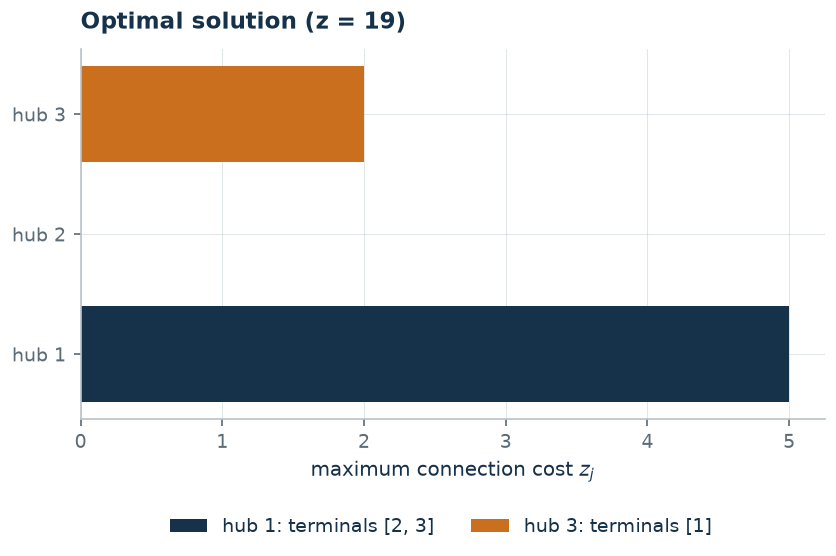
What the solver says. \(z(\mathit{LP})=25/2\), \(z(\mathit{LP}^+)=1015/78\approx13.0\). \(z(\mathit{MILP})=19\), with hubs 1 and 3 activated (not 1 and 2): terminal 1 alone on hub 3 (the cheapest for it), terminals 2 and 3 on hub 1. Heuristic gap \(5.3\%\).
| \(UB\) | \(LB\) (dual) | \(z(\mathit{LP})\) | \(z(\mathit{LP}^+)\) | \(z(\mathit{MILP})\) | heuristic gap |
|---|---|---|---|---|---|
| 20 | \(15/2\) | \(25/2\) | \(1015/78\) | 19 | \(5.3\%\) |
Additional considerations
- \(x_{ij} \le y_j\) (disaggregated) is implied by the aggregated activation constraint on integer points, not in the relaxation: adding it does not change \(z(\mathit{MILP})\) and raises \(z(\mathit{LP}^+)\) from \(1015/78\) to \(79/6\) (question 8.4.1).
- With \(M_j=\max_i c_{ij}\), \(z_j \le M_j y_j\) is not a valid inequality (the model allows \(z_j>0\) with \(y_j=0\)), but it is an optimality-preserving constraint: minimizing \(z_j\), the optimum zeroes it anyway when \(y_j=0\).
Additional modelling questions
8.4.1 — Disaggregated activation link
Add the disaggregated links \(x_{ij} \le y_j\) to the model. Does the optimum change? Does the relaxation change? And what happens if, instead of adding them, one replaces the aggregated constraint by them?
A worked variant: forbidden connection
Terminal 1 cannot be connected to hub 2 (a security requirement).
Fix the variable to zero with the linear constraint
(one linear constraint). On the instance the optimum of problem 8.4 does not already use \(x_{12}\) (terminal 1 is connected to hub 3), so the additional constraint is not binding and the optimum stays \(19\).
Forbidding a connection means removing a column from the primal, hence removing a constraint from the dual: \(\alpha_1\) no longer has to stand the comparison with the forbidden hub and can rise. It is given one \(\gamma\) on each of the hubs left to it — each hub has a budget of \(1\) and no other terminal uses it — and the bound grows. This is the case where one more constraint in the primal improves the certificate, instead of leaving it still.
| value | what it is | |
|---|---|---|
| \(\mathit{UB}\) | \(20\) | heuristic solution |
| \(\mathit{LB}\) | \(\frac{21}{2}\) | dual certificate built by hand |
| \(z(\mathit{LP})\) | \(\frac{25}{2}\) | relaxation without the bounds |
| \(z(\mathit{LP}^+)\) | \(\frac{79}{6}\) | relaxation with the bounds |
| \(z(\mathit{MILP})\) | \(19\) | optimum of the MILP |
Code
Full script —
python/fam08_4_hub.py
(reproducible with python3 python/fam08_4_hub.py from the python/
folder, calls next_fit from euristiche.py). Notebook —
notebooks/fam08_4_hub.ipynb
— opens in Colab from the badge at the top of the page.
Show the complete script — python/fam08_4_hub.py (250 lines)
"""Problem 8.4 -- Hub location with maximum connection cost.

Two links: activation (aggregated, as in scheduling 7.2) and a maximum
variable z_j = max_i {c_ij : x_ij = 1} (same pattern as the processing time 7.4).
The
next-fit heuristic is the generic one from euristiche.py: hubs are the
"machines" (capacity k) and terminals the "jobs" (unit time, independent of
the machine).
"""
import gurobipy as gp
import pandas as pd
from gurobipy import GRB

from euristiche import matrice, next_fit
from mip import (ammissibile, dualita_forte, due_rilassamenti, frazione,
                 nuovo_modello, registra_bound, rilassamenti, rilassamento, risolvi,
                 stampa_soluzione, valuta)
from stile import intestazione, plt, salva_dati, salva_figura
from esteso import salva_modello

R = range

# ---------- 1. MODEL AND INSTANCE ----------

intestazione("4. Hub location: activation and maximum connection cost")
c4 = [[5, 10, 2], [5, 4, 6], [5, 4, 6]]   # connection cost terminal i -> hub j
f4 = [5, 6, 7]                             # activation cost of hub j
k4 = 2                                     # capacity of each hub
n, m = 3, 3
salva_dati(pd.DataFrame([{"terminal": i + 1, "hub": j + 1, "c": c4[i][j]}
                         for i in R(n) for j in R(m)]), "fam08_4_costi")
salva_dati(pd.DataFrame({"hub": R(1, m + 1), "f": f4}), "fam08_4_attivazione")


def modello_4(c, f, k):
    n, m = len(c), len(f)
    mod = nuovo_modello("hub_max")
    x = mod.addVars(n, m, vtype=GRB.BINARY, name="x")
    y = mod.addVars(m, vtype=GRB.BINARY, name="y")
    z = mod.addVars(m, name="z")
    mod.setObjective(gp.quicksum(f[j] * y[j] for j in R(m)) + z.sum(), GRB.MINIMIZE)
    mod.addConstrs((gp.quicksum(x[i, j] for j in R(m)) == 1 for i in R(n)), name="assignment")
    mod.addConstrs((-gp.quicksum(x[i, j] for i in R(n)) + k * y[j] >= 0 for j in R(m)), name="activation")
    mod.addConstrs((-c[i][j] * x[i, j] + z[j] >= 0 for i in R(n) for j in R(m)), name="maximum")
    return mod, x, y, z


def duale_4(c, f, k):
    """max sum_i alpha_i;  alpha_i - beta_j - c_ij gamma_ij <= 0;  k beta_j <= f_j;
    sum_i gamma_ij <= 1;  alpha free, beta,gamma >= 0."""
    n, m = len(c), len(f)
    dl = nuovo_modello("duale_hub")
    alpha = dl.addVars(n, lb=-GRB.INFINITY, name="alpha")
    beta = dl.addVars(m, name="beta")
    gamma = dl.addVars(n, m, name="gamma")
    dl.setObjective(alpha.sum(), GRB.MAXIMIZE)
    dl.addConstrs((alpha[i] - beta[j] - c[i][j] * gamma[i, j] <= 0 for i in R(n) for j in R(m)), name="rc_x")
    dl.addConstrs((k * beta[j] <= f[j] for j in R(m)), name="rc_y")
    dl.addConstrs((gp.quicksum(gamma[i, j] for i in R(n)) <= 1 for j in R(m)), name="rc_z")
    return dl


m4, x4, y4, z4 = modello_4(c4, f4, k4)
salva_modello(m4, "fam08_4_primale")

# ---------- 2. THE LP RELAXATION ----------
zlp4, zlp4r, _ = rilassamenti(m4)

# ---------- 3. THE DUAL OF THE RELAXATION (LOWER BOUND) ----------

d4 = duale_4(c4, f4, k4)
salva_modello(d4, "fam08_4_duale")
beta_mano = [f4[j] / k4 for j in R(m)]     # the largest value allowed by k*beta_j <= f_j
alpha_mano = min(beta_mano)                # must hold for EVERY hub j, not only the most convenient one
mano = {f"gamma[{i},{j}]": 0.0 for i in R(n) for j in R(m)}
mano.update({f"beta[{j}]": beta_mano[j] for j in R(m)})
mano.update({f"alpha[{i}]": alpha_mano for i in R(n)})
lb4, viol = valuta(d4, mano)
assert viol <= 1e-9, viol
print(f"Hand-built dual solution: gamma = 0, beta_j = f_j/k = {[frazione(b) for b in beta_mano]}, "
      f"alpha_i = min_j beta_j = {frazione(alpha_mano)}  ->  lb = {frazione(lb4)}")
dualita_forte(d4, zlp4)

# ---------- 4. CONSTRUCTIVE HEURISTIC (UPPER BOUND) ----------

print("Next-fit heuristic: hubs are filled one at a time up to k terminals,")
print("then the algorithm moves to the next one (the same generic heuristic as scheduling).")
t4 = matrice([1] * n, m)   # unit time for every terminal, independent of the hub
a4 = [k4] * m               # residual capacity of each hub
esito4 = next_fit(t4, a4)
esito4.traccia.stampa()
assert esito4.ok
ye = esito4.y
ze = [0.0] * m
for j in R(m):
    if ye[j]:
        ze[j] = max(c4[i][j] for i in R(n) if esito4.x.get((i, j)) == 1)
ub4 = sum(f4[j] * ye[j] for j in R(m)) + sum(ze)
print(f"  y = {ye}, z = {ze}  ->  ub = {frazione(ub4)}")

# ---------- 5. OPTIMAL SOLUTION OF THE MILP ----------

z4v = risolvi(m4)
print("Optimal solution of the MILP:")
stampa_soluzione(m4, solo_non_nulle=True)
riga = registra_bound("4 hub", ub4, lb4, zlp4, zlp4r, z4v, senso="min")
salva_dati(pd.DataFrame([riga]), "fam08_4_bound")

# ---------- 6. ADDITIONAL MODELLING QUESTIONS ----------

varianti = {}


def variante(nome, mod):
    z = risolvi(mod)
    print(f"  {nome:70s} z = {frazione(z)}")
    return z


# 4a: the disaggregated links x_ij <= y_j are ADDED to the aggregated constraint
mod, x, y, z = modello_4(c4, f4, k4)
mod.addConstrs((x[i, j] <= y[j] for i in R(n) for j in R(m)), name="disaggregated_activation")
varianti["4a"] = variante("4a. Disaggregated links ADDED to the aggregated one (x_ij <= y_j)", mod)
zlp_4a, _, _ = rilassamento(mod, rafforzato=True)
zlp_base, _, _ = rilassamento(modello_4(c4, f4, k4)[0], rafforzato=True)
print(f"      relaxation: z(LP+) goes from {frazione(zlp_base)} to {frazione(zlp_4a)}: the")
print("      disaggregated links are valid inequalities implied by the aggregated one on")
print("      integer points, but not by the relaxation, and they tighten it.")

# 4a-bis: the trap. REPLACING the aggregated constraint by the disaggregated links
# alone also loses the capacity k: the model is no longer the one of the problem.
# The capacity must be kept explicitly, or one speaks of addition, not replacement.
mod, x, y, z = modello_4(c4, f4, k4)
mod.update()
mod.remove([cc for cc in mod.getConstrs() if cc.ConstrName.startswith("activation")])
mod.update()
mod.addConstrs((x[i, j] <= y[j] for i in R(n) for j in R(m)), name="disaggregated_only")
varianti["4a_without_capacity"] = variante(
    "4a'. REPLACING the aggregated one by the disaggregated links (capacity lost)", mod)
mod, x, y, z = modello_4(c4, f4, k4)
mod.update()
mod.remove([cc for cc in mod.getConstrs() if cc.ConstrName.startswith("activation")])
mod.update()
mod.addConstrs((x[i, j] <= y[j] for i in R(n) for j in R(m)), name="disaggregated_only")
mod.addConstrs((gp.quicksum(x[i, j] for i in R(n)) <= k4 for j in R(m)), name="capacity")
varianti["4a_with_capacity"] = variante(
    "4a\'\'. Correct replacement: disaggregated links + separate capacity", mod)
assert varianti["4a_without_capacity"] < varianti["4a"], "without the capacity the optimum drops"
assert varianti["4a_with_capacity"] == varianti["4a"], "with the capacity the optimum is unchanged"
# 4b: terminal 1 cannot be connected to hub 2
mod, x, y, z = modello_4(c4, f4, k4)
mod.addConstr(x[0, 1] == 0, name="terminal1_not_hub2")
varianti["4b"] = variante("4b. Terminal 1 cannot connect to hub 2 (x_12 = 0)", mod)
salva_dati(pd.DataFrame({"variant": list(varianti), "z": list(varianti.values())}), "fam08_4_varianti")

# ---------- 7. THE SANDWICH ON THE VARIANT 4b ----------
intestazione("4b. The sandwich on the variant: terminal 1 cannot use hub 2")

VIETATA = (0, 1)      # (terminale, hub) proibito


def modello_4b(c, f, k, vietata=VIETATA):
    mod_, xx, yy, zz = modello_4(c, f, k)
    mod_.addConstr(xx[vietata] == 0, name="connessione_vietata")
    return mod_, xx, yy, zz


def duale_4b(c, f, k, vietata=VIETATA):
    """Forbidding a connection means removing a column from the primal, hence
    removing the corresponding constraint from the dual: alpha_1 no longer has
    to stand the comparison with hub 2, and can rise."""
    nn, mm = len(c), len(f)
    dl = nuovo_modello("duale_hub_4b")
    alpha = dl.addVars(nn, lb=-GRB.INFINITY, name="alpha")
    beta = dl.addVars(mm, name="beta")
    gamma = dl.addVars(nn, mm, name="gamma")
    dl.setObjective(alpha.sum(), GRB.MAXIMIZE)
    dl.addConstrs((alpha[i] - beta[j] - c[i][j] * gamma[i, j] <= 0
                   for i in R(nn) for j in R(mm) if (i, j) != vietata), name="rc_x")
    dl.addConstrs((k * beta[j] <= f[j] for j in R(mm)), name="rc_y")
    dl.addConstrs((gp.quicksum(gamma[i, j] for i in R(nn)) <= 1 for j in R(mm)), name="rc_z")
    return dl


m4b, x4b, y4b, z4b = modello_4b(c4, f4, k4)
salva_modello(m4b, "fam08_4b_primale")

# -- feasible heuristic: the base one, moving the forbidden terminal --
print("Constructive heuristic: start from the solution of the base problem and, if the")
print("forbidden terminal sits on the forbidden hub, move it to the cheapest hub with room.")
ass_4b = {i: j for (i, j), v in esito4.x.items() if v == 1}
ti, hj = VIETATA
if ass_4b.get(ti) == hj:
    carichi = {j: sum(1 for q, jj in ass_4b.items() if jj == j and q != ti) for j in R(m)}
    nuovo_hub = min((j for j in R(m) if j != hj and carichi[j] < k4), key=lambda j: c4[ti][j])
    print(f"  terminal {ti + 1} was on hub {hj + 1}: it moves to hub {nuovo_hub + 1}")
    ass_4b[ti] = nuovo_hub
else:
    print(f"  terminal {ti + 1} was not on hub {hj + 1}: nothing to repair")
y_4b = [1 if any(j == q for q in ass_4b.values()) else 0 for j in R(m)]
z_4b = [max([c4[i][j] for i, q in ass_4b.items() if q == j] + [0.0]) for j in R(m)]
ub4b = sum(f4[j] * y_4b[j] for j in R(m)) + sum(z_4b)
sol_4b = ({f"x[{i},{j}]": (1 if ass_4b[i] == j else 0) for i in R(n) for j in R(m)}
          | {f"y[{j}]": y_4b[j] for j in R(m)} | {f"z[{j}]": z_4b[j] for j in R(m)})
assert ammissibile(m4b, sol_4b), "the heuristic solution of the variant must be feasible"
print(f"  ub = {frazione(ub4b)}")

# -- dual certificate: without that column, alpha_1 rises --
d4b = duale_4b(c4, f4, k4)
salva_modello(d4b, "fam08_4b_duale")
beta_4b = {j: f4[j] / k4 for j in R(m)}
# the forbidden terminal can spend one gamma on every hub left to it: each hub
# has a budget of 1 and no other terminal uses it in the recipe
mano_4b = {f"beta[{j}]": beta_4b[j] for j in R(m)}
mano_4b.update({f"gamma[{i},{j}]": 0.0 for i in R(n) for j in R(m)})
mano_4b.update({f"gamma[{ti},{j}]": 1.0 for j in R(m) if j != hj})
alpha_vietato = min(beta_4b[j] + c4[ti][j] for j in R(m) if j != hj)
alpha_altri = min(beta_4b.values())
mano_4b.update({f"alpha[{i}]": (alpha_vietato if i == ti else alpha_altri) for i in R(n)})
lb4b, viol_4b = valuta(d4b, mano_4b)
assert viol_4b <= 1e-9, viol_4b
print("Dual solution by hand: beta_j = f_j/k as in the base problem. For the free")
print("  terminals alpha_i = min_j beta_j. The forbidden terminal, instead, no longer has to")
print("  stand the comparison with the forbidden hub: it is given one gamma on each of the")
print("  hubs left to it (each hub has budget 1 and nobody else uses it), and then")
print(f"  alpha_{ti + 1} = min_(j != {hj + 1}) (beta_j + c_{ti + 1}j) = {frazione(alpha_vietato)}")
print(f"  instead of {frazione(alpha_altri)}.")
print(f"  ->  lb = {frazione(lb4b)}  (the recipe of the base problem would give "
      f"{frazione(n * alpha_altri)})")
zlp4b, zlp4br, _ = due_rilassamenti(m4b, d4b)
z4b_val = risolvi(m4b)
riga_4b = registra_bound("4b forbidden connection", ub4b, lb4b, zlp4b, zlp4br, z4b_val)
salva_dati(pd.DataFrame([riga_4b]), "fam08_4b_bound")
assert lb4b <= zlp4b <= z4b_val <= ub4b + 1e-9

# ---------- 8. FIGURES ----------

fig, ax = plt.subplots(figsize=(6.4, 3.2))
colori = ["#16324A", "#0E7490", "#CA6F1E"]
for j in R(m):
    if y4[j].X > 0.5:
        assegnati = [i + 1 for i in R(n) if x4[i, j].X > 0.5]
        ax.barh(j, z4[j].X, color=colori[j % 3], label=f"hub {j + 1}: terminals {assegnati}")
ax.set_yticks(R(m))
ax.set_yticklabels([f"hub {j + 1}" for j in R(m)])
ax.set_xlabel("maximum connection cost $z_j$")
ax.set_title(f"Optimal solution (z = {frazione(z4v)})")
ax.legend(fontsize=7, loc="lower right")
salva_figura(fig, "cap08_hub_ottimo")
print("Fine.")