p-median: at most \(k\) locations
Class: BIP · Links: disaggregated activation · Script: python/fam08_2_pmedian.py
Difficulty: ★★☆☆☆ · Time: 30–45 min

Problem 8.2
A company must choose at most \(k \in \mathbb{Z}_{\ge 1}\) locations, among \(m \in \mathbb{Z}_{\ge 1}\) candidates, and assign each of the \(n \in \mathbb{Z}_{\ge 1}\) clients to the most convenient open location. For each location \(l\) and client \(c\), \(d_{lc} \in \mathbb{Q}_{>0}\) is the distance. We want to minimize the sum of client-location distances.
The problem in words. We decide which locations to open (at most \(k\)) and which open location to assign each client to. The objective: minimum sum of distances. The constraints: every client to exactly one open location; at most \(k\) open locations. The classic p-median problem.
Model
Data.
| Symbol | Type | Meaning |
|---|---|---|
| \(m\) | \(\in \mathbb{Z}_{\ge 1}\) | number of locations, \(l \in \{1, 2, \dots, m\}\) |
| \(n\) | \(\in \mathbb{Z}_{\ge 1}\) | number of clients, \(c \in \{1, 2, \dots, n\}\) |
| \(d_{lc}\) | \(\in \mathbb{Q}_{>0}\) | distance between location \(l\) and client \(c\) |
| \(k\) | \(\in \mathbb{Z}_{\ge 1}\) | maximum number of open locations |
Decision variables. \(m\) binaries \(x_l\) (location open) and \(m\,n\) binaries \(y_{lc}\) (client \(c\) served by \(l\)).
- the objective minimizes the sum of client-location distances;
- the first constraint assigns every client to one location (\(n\) constraints);
- the second caps open locations at \(k\) (one constraint);
- the third links assignment and opening, in disaggregated form (\(m\,n\) constraints).
The link. If \(y_{lc}=1\) then \(x_l=1\): from the CNF of \(y_{lc} \Rightarrow x_l\), i.e. \(\neg y_{lc} \lor x_l\), we get \(x_l \ge y_{lc}\), imposed directly. Unlike problem 8.1, there is no opening cost that would discourage open-but-unused locations: the opposite direction is neither imposed nor guaranteed by optimality.
The model in gurobipy
mod = gp.Model("p_median")
x = mod.addVars(m, vtype=GRB.BINARY, name="x")
y = mod.addVars(m, n, vtype=GRB.BINARY, name="y")
mod.setObjective(gp.quicksum(dist[l][c] * y[l, c] for l in range(m) for c in range(n)), GRB.MINIMIZE)
mod.addConstrs((y.sum("*", c) == 1 for c in range(n)), name="assign")
mod.addConstr(x.sum() <= k, name="number_of_locations")
mod.addConstrs((x[l] - y[l, c] >= 0 for l in range(m) for c in range(n)), name="link")
The instance
\(m = 3\) locations, \(n = 3\) clients, \(k = 2\):
| \(d_{lc}\) | \(c=1\) | \(c=2\) | \(c=3\) |
|---|---|---|---|
| \(l=1\) | 5 | 6 | 10 |
| \(l=2\) | 3 | 12 | 9 |
| \(l=3\) | 10 | 9 | 4 |
The model written on the data of the instance:
Constructive heuristic: the primal bound
The first \(k\) locations open; every client goes to the nearest open location. Opening locations 1 and 2: client 1 → location 2 (dist. 3), client 2 → location 1 (dist. 6), client 3 → location 2 (dist. 9). Value \(3+6+9=18\): \(z(\mathit{MILP}) \le \mathit{UB} = 18\).
LP relaxation and dual: the dual bound
The dual of the linear relaxation, one variable per constraint of the primal:
The same dual, written on the data of the instance:
With \(\bar\varrho=0\), \(\bar\pi_{lc}=0\) and \(\bar\mu_c = \min_l d_{lc}\) (the distance to the nearest location overall):
of value \(13\). By weak duality, \(\mathit{LB}=13 \le z(\mathit{LP}) \le z(\mathit{MILP}) \le \mathit{UB}=18\).
What the solver says. \(z(\mathit{LP}) = z(\mathit{LP}^+) = 15\): the relaxation is already integral on this instance. \(z(\mathit{MILP}) = 15\), with locations 1 and 3 open (not 1 and 2 as in the heuristic): heuristic gap \(20.0\%\).
| \(UB\) | \(LB\) (dual) | \(z(\mathit{LP})\) | \(z(\mathit{LP}^+)\) | \(z(\mathit{MILP})\) | heuristic gap |
|---|---|---|---|---|---|
| 18 | 13 | 15 | 15 | 15 | \(20.0\%\) |
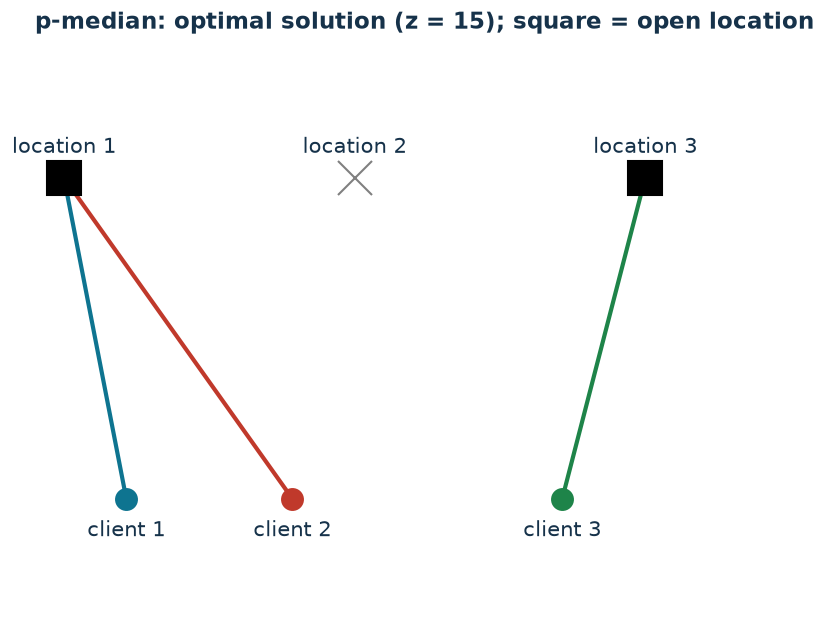
Additional considerations
- The constraint is "at most \(k\)", not "exactly \(k\)": question 8.2.1 checks that the optimum does not change when equality is imposed.
- \(\sum_c y_{lc} \le n\, x_l\) is an aggregated valid inequality, weaker than the disaggregated one used in the model.
Additional modelling questions
8.2.1 — Proximity coverage for one client
Client 1 must be served within distance \(4\). How is this modelled? What is the new optimum?
A worked variant: exactly \(k\) open locations
For organisational reasons, exactly \(k\) locations must be open (not at most).
It suffices to add the linear constraint
which together with the already-present constraint imposes equality (one more linear constraint). On the instance, the optimum of problem 8.2 already opens exactly \(2 = k\) locations, so the additional constraint is not binding and the optimum stays \(15\).
Imposing exactly \(k\) sites instead of at most \(k\) adds \(\sigma \ge 0\) with right-hand side \(k\) to the dual. The algebra settles it in one line: the column of the \(x_l\) imposes \(\varrho + \sigma \le 0\), and the objective contains \(k(\varrho + \sigma)\), which is therefore never positive. The maximum is at \(\varrho + \sigma = 0\) and the value is \(\sum_c \mu_c\) again: the relaxation does not move — and here the integer optimum does not move either: it stays \(15\). That is not an accident of the instance: with no opening cost one more site cannot worsen the assignment, so from a solution with fewer than \(k\) sites one always gets an equally good one with exactly \(k\). The equality constraint is redundant; it bites only when opening costs something.
| value | what it is | |
|---|---|---|
| \(\mathit{UB}\) | \(18\) | heuristic solution |
| \(\mathit{LB}\) | \(13\) | dual certificate built by hand |
| \(z(\mathit{LP})\) | \(15\) | relaxation without the bounds |
| \(z(\mathit{LP}^+)\) | \(15\) | relaxation with the bounds |
| \(z(\mathit{MILP})\) | \(15\) | optimum of the MILP |
Code
Full script —
python/fam08_2_pmedian.py
(reproducible with python3 python/fam08_2_pmedian.py from the python/
folder). Notebook —
notebooks/fam08_2_pmedian.ipynb
— opens in Colab from the badge at the top of the page.
Show the complete script — python/fam08_2_pmedian.py (211 lines)
"""Problem 8.2 -- Location with a maximum number of facilities (p-median).

Disaggregated activation link between x_l (location open) and y_lc (client c
served by l), derived from the CNF of a Boolean implication as in problem
7.5, but here the number of open locations is bounded by k rather than by a
time budget.
"""
import gurobipy as gp
import pandas as pd
from gurobipy import GRB

from mip import (ammissibile, dualita_forte, due_rilassamenti, frazione,
                 nuovo_modello, registra_bound, rilassamenti, risolvi,
                 stampa_soluzione, valuta)
from stile import CICLO, intestazione, plt, salva_dati, salva_figura
from esteso import salva_modello

R = range

# ---------- 1. MODEL AND INSTANCE ----------

intestazione("2. p-median: at most k locations, every client served by the nearest open one")
dist2 = [[5, 6, 10], [3, 12, 9], [10, 9, 4]]   # distance location l -> client c
k2 = 2
m, n = 3, 3
salva_dati(pd.DataFrame([{"location": l + 1, "client": c + 1, "d": dist2[l][c]}
                         for l in R(m) for c in R(n)]), "fam08_2_distanze")


def modello_2(dist, k):
    m, n = len(dist), len(dist[0])
    mod = nuovo_modello("p_median")
    x = mod.addVars(m, vtype=GRB.BINARY, name="x")
    y = mod.addVars(m, n, vtype=GRB.BINARY, name="y")
    mod.setObjective(gp.quicksum(dist[l][c] * y[l, c] for l in R(m) for c in R(n)), GRB.MINIMIZE)
    mod.addConstrs((y.sum("*", c) == 1 for c in R(n)), name="assign")
    mod.addConstr(x.sum() <= k, name="number_of_locations")
    mod.addConstrs((x[l] - y[l, c] >= 0 for l in R(m) for c in R(n)), name="link")
    return mod, x, y


def duale_2(dist, k):
    """max sum mu_c + k varrho;  varrho + sum_c pi_lc <= 0;  mu_c - pi_lc <= d_lc;
    mu free, varrho <= 0, pi >= 0."""
    m, n = len(dist), len(dist[0])
    dl = nuovo_modello("duale_p_median")
    mu = dl.addVars(n, lb=-GRB.INFINITY, name="mu")
    varrho = dl.addVar(lb=-GRB.INFINITY, ub=0.0, name="varrho")
    pi = dl.addVars(m, n, name="pi")
    dl.setObjective(mu.sum() + k * varrho, GRB.MAXIMIZE)
    dl.addConstrs((varrho + gp.quicksum(pi[l, c] for c in R(n)) <= 0 for l in R(m)), name="rc_x")
    dl.addConstrs((mu[c] - pi[l, c] <= dist[l][c] for l in R(m) for c in R(n)), name="rc_y")
    return dl


m2, x2, y2 = modello_2(dist2, k2)
salva_modello(m2, "fam08_2_primale")

# ---------- 2. THE LP RELAXATION ----------
zlp2, zlp2r, _ = rilassamenti(m2)

# ---------- 3. THE DUAL OF THE RELAXATION (LOWER BOUND) ----------

d2 = duale_2(dist2, k2)
salva_modello(d2, "fam08_2_duale")
mano = {"varrho": 0.0}
mano.update({f"mu[{c}]": min(dist2[l][c] for l in R(m)) for c in R(n)})
lb2, viol = valuta(d2, mano)
assert viol <= 1e-9, viol
print("Hand-built dual solution: pi = 0, varrho = 0, mu_c = min_l d_lc = "
      + ", ".join(frazione(mano[f"mu[{c}]"]) for c in R(n)) + f"  ->  lb = {frazione(lb2)}")
dualita_forte(d2, zlp2)

# ---------- 4. CONSTRUCTIVE HEURISTIC (UPPER BOUND) ----------

print("Heuristic: the first k locations are opened in natural order, then every client")
print("is served by the nearest open location.")


def euristica_2(dist, k):
    m, n = len(dist), len(dist[0])
    x = [1 if l < k else 0 for l in R(m)]
    y, passi = {}, []
    for c in R(n):
        md, sl = float("inf"), None
        for l in R(k):
            if dist[l][c] < md:
                md, sl = dist[l][c], l
        y[(sl, c)] = 1
        passi.append(f"Client {c + 1}: the nearest open location is {sl + 1} (distance {md}); "
                     f"y[{sl + 1}][{c + 1}] = 1.")
    return x, y, passi


xe, ye, passi = euristica_2(dist2, k2)
print(f"  The first k = {k2} locations are opened: x = {xe}.")
for i, s in enumerate(passi, 1):
    print(f"  Step {i}. {s}")
ub2 = sum(dist2[l][c] for (l, c) in ye)
print(f"  ub = {ub2}")

# ---------- 5. OPTIMAL SOLUTION OF THE MILP ----------

z2 = risolvi(m2)
print("Optimal solution of the MILP:")
stampa_soluzione(m2, solo_non_nulle=True)
riga = registra_bound("2 p-median", ub2, lb2, zlp2, zlp2r, z2)
salva_dati(pd.DataFrame([riga]), "fam08_2_bound")

# ---------- 6. ADDITIONAL MODELLING QUESTIONS ----------

varianti = {}


def variante(nome, mod):
    z = risolvi(mod)
    print(f"  {nome:70s} z = {frazione(z)}")
    return z


# 2a: exactly k locations must be open (not at most k)
mod, x, y = modello_2(dist2, k2)
mod.addConstr(x.sum() >= k2, name="number_of_locations_exact")   # with "<= k" already in the model, together they impose "= k"
varianti["2a"] = variante("2a. Exactly k open locations (sum x_l = k)", mod)
# 2b: client 1 must be served within distance 4 (additional coverage)
mod, x, y = modello_2(dist2, k2)
mod.addConstrs((y[l, 0] == 0 for l in R(3) if dist2[l][0] > 4), name="max_distance_client1")
varianti["2b"] = variante("2b. Client 1 served within distance 4 (y_l1 = 0 if d_l1 > 4)", mod)
salva_dati(pd.DataFrame({"variant": list(varianti), "z": list(varianti.values())}), "fam08_2_varianti")

# ---------- 7. THE SANDWICH ON THE VARIANT 2a ----------
intestazione("2a. The sandwich on the variant: exactly k sites open")


def modello_2a(dist, k):
    mod_, xx, yy = modello_2(dist, k)
    mod_.addConstr(xx.sum() >= k, name="numero_sedi_esatto")
    return mod_, xx, yy


def duale_2a(dist, k):
    """To the dual of 8.2 one adds sigma >= 0 for the constraint sum_l x_l >= k
    (a >= direction in a minimisation). The right-hand side is k, so sigma
    enters the objective next to varrho, and the column of the x_l next to it."""
    mm, nn = len(dist), len(dist[0])
    dl = nuovo_modello("duale_p_mediana_2a")
    mu = dl.addVars(nn, lb=-GRB.INFINITY, name="mu")
    varrho = dl.addVar(lb=-GRB.INFINITY, ub=0.0, name="varrho")
    sg = dl.addVar(name="sigma")
    pi = dl.addVars(mm, nn, name="pi")
    dl.setObjective(mu.sum() + k * varrho + k * sg, GRB.MAXIMIZE)
    dl.addConstrs((varrho + sg + gp.quicksum(pi[l, c] for c in R(nn)) <= 0 for l in R(mm)),
                  name="rc_x")
    dl.addConstrs((mu[c] - pi[l, c] <= dist[l][c] for l in R(mm) for c in R(nn)), name="rc_y")
    return dl


m2a, x2a, y2a = modello_2a(dist2, k2)
salva_modello(m2a, "fam08_2a_primale")

# -- feasible heuristic: the same one, which already opens exactly k sites --
print("Constructive heuristic: the same as the base problem, opening the first k sites and")
print("sending every client to the nearest open one. Opening exactly k, it is already")
print("feasible for the variant.")
ub2a = sum(dist2[l][c] for (l, c) in ye)
sol_2a = ({f"x[{l}]": xe[l] for l in R(m)}
          | {f"y[{l},{c}]": (1 if (l, c) in ye else 0) for l in R(m) for c in R(n)})
assert ammissibile(m2a, sol_2a), "the heuristic solution of the variant must be feasible"
print(f"  ub = {frazione(ub2a)}")

# -- dual certificate: sigma cannot move --
d2a = duale_2a(dist2, k2)
salva_modello(d2a, "fam08_2a_duale")
mano_2a = {"varrho": 0.0, "sigma": 0.0}
mano_2a.update({f"mu[{c}]": min(dist2[l][c] for l in R(m)) for c in R(n)})
lb2a, viol_2a = valuta(d2a, mano_2a)
assert viol_2a <= 1e-9, viol_2a
print("Dual solution by hand: pi = 0 and mu_c = min_l d_lc as in the base problem. The new")
print("  sigma does not help, and the algebra says so in one line: the column of the x_l")
print("  forces varrho + sigma <= 0, and the objective contains k(varrho + sigma), which is")
print("  therefore never positive. The maximum is at varrho + sigma = 0, and the value is sum_c mu_c again.")
print(f"  ->  lb = {frazione(lb2a)}")
print("  Moral: imposing *exactly* k sites instead of *at most* k does not move the")
print("  relaxation, and on this instance not the integer optimum either: with no")
print("  opening cost one more site cannot worsen the assignment, so the equality")
print("  constraint is redundant.")
zlp2a, zlp2ar, _ = due_rilassamenti(m2a, d2a)
z2a = risolvi(m2a)
riga_2a = registra_bound("2a exactly k sites", ub2a, lb2a, zlp2a, zlp2ar, z2a)
salva_dati(pd.DataFrame([riga_2a]), "fam08_2a_bound")
assert lb2a <= zlp2a <= z2a <= ub2a + 1e-9

# ---------- 8. FIGURES ----------

fig, ax = plt.subplots(figsize=(5.5, 5))
xs = {"location": [0, 1.4, 2.8], "client": [0.3, 1.1, 2.4]}
for c in R(3):
    l = next(l for l in R(3) if y2[l, c].X > 0.5)
    ax.plot([xs["location"][l], xs["client"][c]], [1, 0], color=CICLO[c], lw=2, marker="o")
for l in R(3):
    marker = "s" if x2[l].X > 0.5 else "x"
    ax.plot(xs["location"][l], 1, marker=marker, ms=16, color="black" if x2[l].X > 0.5 else "gray")
    ax.annotate(f"location {l + 1}", (xs["location"][l], 1), textcoords="offset points", xytext=(0, 12), ha="center")
for c in R(3):
    ax.plot(xs["client"][c], 0, marker="o", ms=10, color=CICLO[c])
    ax.annotate(f"client {c + 1}", (xs["client"][c], 0), textcoords="offset points", xytext=(0, -18), ha="center")
ax.set_ylim(-0.4, 1.4)
ax.axis("off")
ax.set_title(f"p-median: optimal solution (z = {frazione(z2)}); square = open location")
salva_figura(fig, "cap08_pmediana_ottimo")
print("Fine.")