Total tardiness on one machine: sequencing with big-M
Class: MILP · Links: big-M and disjunctions, maximum variable · Script: python/fam07_7_tardiness.py
Difficulty: ★★★★★ · Time: 45–60 min

Problem 7.7
A company needs to execute \(n\) jobs on a single machine. For each job \(j\), \(t_j\) is the processing time and \(d_j\) the due date. The tardiness is \(\tau_j = \max\{0, \kappa_j - d_j\}\), where \(\kappa_j\) is the completion time. The machine processes one job at a time. Minimise the total tardiness.
The problem in words. We decide the order of the jobs. The objective: sum of the tardiness values. The constraints: for every pair, one precedes the other; whoever comes later finishes at least \(t\) minutes after the completion of whoever comes first. A disjunction ("either \(j\) before \(i\) or \(i\) before \(j\)"): linearised with a binary variable and a big-M.
Model
Variables. \(n(n-1)\) binary precedences \(s_{ji}\) (\(j\) precedes \(i\)) and \(2n\) continuous: completions \(\kappa_j\) and tardiness \(\tau_j\); \(M = \sum_j t_j\).
- the objective minimises the total tardiness;
- the order constraints: either \(j\) precedes \(i\) or vice versa (\(n(n-1)/2\));
- the precedence constraints with the big-M: if \(j\) precedes \(i\), \(i\) finishes at least \(t_i\) after \(\kappa_j\) (\(n(n-1)\)); \(M = \sum_j t_j\) suffices because there exists an optimal sequence with no idle time;
- the tardiness constraints, with \(\tau_j \ge 0\), define the tardiness (\(n\));
- the start constraints: \(\kappa_j \ge t_j\) (\(n\));
- the domain constraints.
Link between the variables
Precedence (big-M). \(s_{ji} = 1 \Rightarrow \kappa_i \ge \kappa_j + t_i\), contrapositive \(\kappa_i < \kappa_j + t_i \Rightarrow s_{ji} = 0\). The constraint \(\kappa_i \ge \kappa_j + t_i - M(1 - s_{ji})\): with \(s_{ji} = 1\) imposes the precedence; with \(s_{ji} = 0\) becomes \(\kappa_i \ge \kappa_j + t_i - M\). The model does not impose \(\kappa_j \le M\), so the constraint is not true at every feasible point; it is true at the ones that matter. With \(M = \sum_j t_j\) there is always an optimal solution with no idle time --- if the machine stops, the later jobs are pulled forward and no completion, hence no tardiness, gets worse --- and in such a solution every \(\kappa_j \le \sum_j t_j = M\). Then \(\kappa_j + t_i - M \le t_i \le \kappa_i\) and the constraint holds: the big-M "switches off" the constraint on all the solutions among which the optimum is sought.
Tardiness (maximum). \(\tau_j \ge \max\{0, \kappa_j - d_j\}\) is imposed directly by the two constraints (no implication: the link is the inequality). The optimality implication \(\kappa_j \le d_j \Rightarrow \tau_j = 0\) follows from the objective: lowering \(\tau_j\) to \(0\) stays feasible and reduces the objective. Synthesis: in every optimum \(\tau_j = \max\{0, \kappa_j - d_j\}\).
The model in gurobipy
M = sum(t)
m = gp.Model("tardiness");  m.Params.OutputFlag = 0
s = m.addVars([(j, i) for j in range(n) for i in range(n) if j != i],
              vtype=GRB.BINARY, name="s")
kappa = m.addVars(n, name="kappa");  tau = m.addVars(n, name="tau")
m.setObjective(tau.sum(), GRB.MINIMIZE)
m.addConstrs((s[j, i] + s[i, j] == 1 for j in range(n) for i in range(j + 1, n)),
             name="order")
m.addConstrs((-M * s[j, i] - kappa[j] + kappa[i] >= t[i] - M
              for j in range(n) for i in range(n) if j != i), name="precedence")
m.addConstrs((-kappa[j] + tau[j] >= -d[j] for j in range(n)), name="tardiness")
m.addConstrs((kappa[j] >= t[j] for j in range(n)), name="start")
m.optimize()
The instance
\(n = 3\), \(M = 15\).
| \(j=1\) | \(j=2\) | \(j=3\) | |
|---|---|---|---|
| \(t_j\) | 5 | 4 | 6 |
| \(d_j\) | 3 | 4 | 10 |
The model written on the data of the instance:
Constructive heuristic: the primal bound
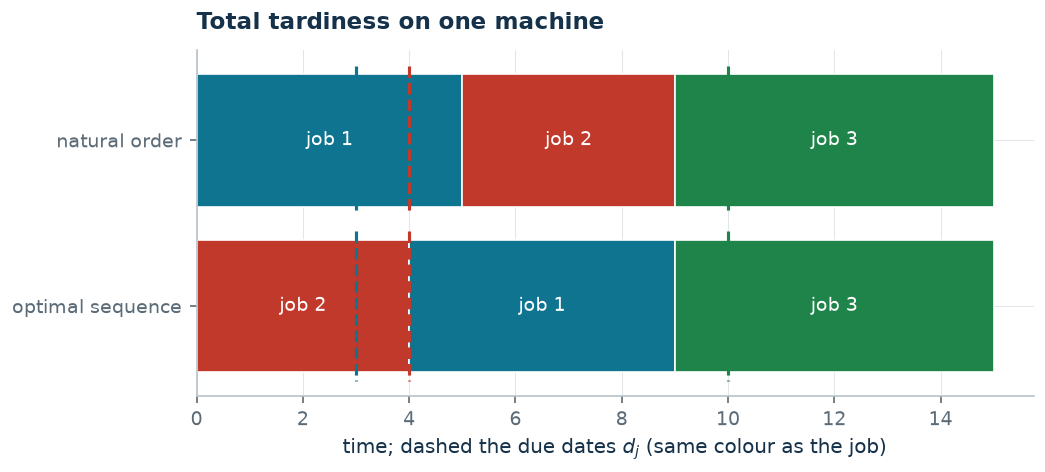
Given order \(1 \to 2 \to 3\):
- Step 1. \(\kappa_1 = 5\), \(\tau_1 = \max\{0, 5 - 3\} = 2\).
- Step 2. \(\kappa_2 = 9\), \(\tau_2 = 5\).
- Step 3. \(\kappa_3 = 15\), \(\tau_3 = 5\).
Value \(12\): \(z(\mathit{MILP}) \le 12\).
LP relaxation and dual: the dual bound
With \(\alpha_{ji}\) free (order), \(\beta_{ji} \ge 0\) (precedence), \(\gamma_j \ge 0\) (tardiness), \(\delta_j \ge 0\) (start):
The same dual, written on the data of the instance:
A hand-built dual solution. The \(\beta\) have negative coefficient: at zero, then \(\alpha = 0\); left are \(\delta_j \le \gamma_j \le 1\) and every job contributes at most \(t_j - d_j\), positive only if late even processed first: only job 1. \(\bar\gamma_1 = \bar\delta_1 = 1\), value \(-3 + 5 = 2\): \(2 \le z(\mathit{MILP}) \le 12\).
What the solver says. \(z(\mathit{LP}) = 2\): the relaxation of a big-M model is extremely weak (\(s_{ji} = 1/2\) releases the precedences). Integer optimum \(11\), sequence \(2 \to 1 \to 3\): \(\tilde\kappa = (9, 4, 15)\), \(\tilde\tau = (6, 0, 5)\).
| \(UB\) | \(LB\) (hand dual) | \(z(\mathit{LP})\) | \(z(\mathit{MILP})\) | heuristic gap |
|---|---|---|---|---|
| 12 | 2 | 2 | 11 | \(9.1\%\) |
Additional considerations
- Transitivity: \(s_{ji} \,\mathtt{AND}\, s_{ik} \Rightarrow s_{jk}\), i.e. \(s_{ji} + s_{ik} - s_{jk} \le 1\): valid inequalities (a precedence cycle is impossible) that cut the \(1/2\) solutions of the relaxation.
- \(M = \sum_j t_j\) is the smallest value that works in general; larger \(M\) leave the same integer set and a weaker relaxation.
Additional modelling questions
7.7.1 — Minimising the maximum tardiness
Minimise the tardiness of the latest job.
A worked variant: release dates
Job 2 cannot start before time \(\rho_2 = 2\) (the material arrives late); the others are available from the start.
A job starting no earlier than \(\rho_j\) completes no earlier than \(\rho_j + t_j\): it suffices to strengthen constraints to
(\(n\) constraints, with \(\rho_j = 0\) for the jobs available at once). Mind the big-M: the completions can now exceed \(\sum_j t_j\) (the machine may stay idle waiting), and \(M\) must be updated to \(\max_j \rho_j + \sum_j t_j\). On the instance the optimum becomes \(12\): the sequence \(2 \to 1 \to 3\) would force the machine to wait until \(2\), and with \(\kappa_2 = 6\), \(\kappa_1 = 11\), \(\kappa_3 = 17\) the tardiness values would be \(2 + 8 + 7\); the order \(1 \to 2 \to 3\) stays at \(12\) and is optimal.
The release dates add a family \(\varepsilon_j \ge 0\) to the dual, entering the objective with its right-hand side \(\rho_j + t_j\). With \(\gamma_j = 1\), the column of \(\kappa_j\) imposes \(\delta_j + \varepsilon_j \le 1\), and it pays to put all the weight on \(\varepsilon_j\): the release replaces the processing time. The heuristic is the same EDD rule, which now waits for the release.
| value | what it is | |
|---|---|---|
| \(\mathit{UB}\) | \(12\) | heuristic solution |
| \(\mathit{LB}\) | \(2\) | dual certificate built by hand |
| \(z(\mathit{LP})\) | \(4\) | relaxation without the bounds |
| \(z(\mathit{LP}^+)\) | \(4\) | relaxation with the bounds |
| \(z(\mathit{MILP})\) | \(12\) | optimum of the MILP |
Code
Full script: python/fam07_7_tardiness.py;
notebook: notebooks/fam07_7_tardiness.ipynb.
Show the complete script — python/fam07_7_tardiness.py (235 lines)
"""Problem 7.7 -- Total tardiness on one machine: sequencing with big-M.

The disjunction "either j before i or i before j" linearised with a binary
variable and the smallest big-M justifiable from the data (M = sum of the
times).
"""
import gurobipy as gp
import numpy as np
import pandas as pd
from gurobipy import GRB

from euristiche import best_fit, first_fit, matrice, next_fit
from mip import (ammissibile, dualita_forte, due_rilassamenti, frazione,
                 nuovo_modello, registra_bound, rilassamenti, risolvi,
                 stampa_soluzione, valuta)
from stile import CICLO, ROSSO, intestazione, plt, salva_dati, salva_figura
from esteso import salva_modello

R = range

# ---------- 1. MODEL AND INSTANCE ----------
t7 = [5, 4, 6]
d7 = [3, 4, 10]
salva_dati(pd.DataFrame({"job": R(1, 4), "t": t7, "d": d7}), "fam07_7_lavori")


def modello_7(t, d):
    n = len(t)
    M = sum(t)
    m = nuovo_modello("ritardo")
    s = m.addVars([(j, i) for j in R(n) for i in R(n) if j != i], vtype=GRB.BINARY, name="s")
    kappa = m.addVars(n, name="kappa")
    tau = m.addVars(n, name="tau")
    m.setObjective(tau.sum(), GRB.MINIMIZE)
    m.addConstrs((s[j, i] + s[i, j] == 1 for j in R(n) for i in R(j + 1, n)), name="ordine")
    m.addConstrs((-M * s[j, i] - kappa[j] + kappa[i] >= t[i] - M for j in R(n) for i in R(n) if j != i),
                 name="precedenza")
    m.addConstrs((-kappa[j] + tau[j] >= -d[j] for j in R(n)), name="ritardo")
    m.addConstrs((kappa[j] >= t[j] for j in R(n)), name="inizio")
    return m, s, kappa, tau, M


def duale_7(t, d):
    """Dual with alpha (free), beta, gamma, delta >= 0 — see the lecture notes."""
    n = len(t)
    M = sum(t)
    D = nuovo_modello("duale_ritardo")
    alpha = D.addVars([(j, i) for j in R(n) for i in R(j + 1, n)], lb=-GRB.INFINITY, name="alpha")
    beta = D.addVars([(j, i) for j in R(n) for i in R(n) if j != i], name="beta")
    gamma = D.addVars(n, name="gamma")
    delta = D.addVars(n, name="delta")
    D.setObjective(alpha.sum() + gp.quicksum((t[i] - M) * beta[j, i] for (j, i) in beta)
                   - gp.quicksum(d[j] * gamma[j] for j in R(n)) + gp.quicksum(t[j] * delta[j] for j in R(n)),
                   GRB.MAXIMIZE)
    D.addConstrs((alpha[j, i] - M * beta[j, i] <= 0 for (j, i) in alpha), name="rc_s_ji")
    D.addConstrs((alpha[j, i] - M * beta[i, j] <= 0 for (j, i) in alpha), name="rc_s_ij")
    D.addConstrs((-gp.quicksum(beta[j, i] for i in R(n) if i != j) + gp.quicksum(beta[i, j] for i in R(n) if i != j)
                  - gamma[j] + delta[j] <= 0 for j in R(n)), name="rc_kappa")
    D.addConstrs((gamma[j] <= 1 for j in R(n)), name="rc_tau")
    return D


def euristica_7(t, d, ordine=None):
    """Sequence in the given order (natural if absent): completions and tardiness."""
    n = len(t)
    ordine = list(R(n)) if ordine is None else ordine
    kappa, tau, fine, passi = [0] * n, [0] * n, 0, []
    for j in ordine:
        fine += t[j]
        kappa[j] = fine
        tau[j] = max(0, fine - d[j])
        passi.append(f"Job {j + 1}: kappa = {fine}, tau = max(0, {fine} - {d[j]}) = {tau[j]}.")
    return kappa, tau, passi


m7, s7, k7, tau7, M7 = modello_7(t7, d7)
salva_modello(m7, "fam07_7_primale")

# ---------- 2. THE LP RELAXATION ----------
zlp7, zlp7r, _ = rilassamenti(m7)

# ---------- 3. THE DUAL OF THE RELAXATION (LOWER BOUND) ----------
D7 = duale_7(t7, d7)
salva_modello(D7, "fam07_7_duale")
lb7, viol = valuta(D7, {"gamma[0]": 1, "delta[0]": 1})
assert viol <= 1e-9
print(f"Hand-built dual solution: gamma_1 = 1, delta_1 = 1, all the rest 0  ->  lb = {frazione(lb7)}")
dualita_forte(D7, zlp7)

# ---------- 4. CONSTRUCTIVE HEURISTIC (UPPER BOUND) ----------
print(f"Big-M = sum of the times = {M7}")
kappa_e, tau_e, passi = euristica_7(t7, d7)
print("Heuristic: natural order 1 -> 2 -> 3")
for i, s in enumerate(passi, 1):
    print(f"  Step {i}. {s}")
ub7 = sum(tau_e)
print(f"  ub = {ub7}")

# ---------- 5. OPTIMAL SOLUTION OF THE MILP ----------
z7 = risolvi(m7)
print("Optimal solution of the MILP:")
stampa_soluzione(m7, solo_non_nulle=True)
riga = registra_bound("7 tardiness", ub7, lb7, zlp7, zlp7r, z7)
salva_dati(pd.DataFrame([riga]), "fam07_7_bound")
ordine_ott = sorted(R(3), key=lambda j: k7[j].X)
riga = registra_bound("7 tardiness", ub7, lb7, zlp7, zlp7r, z7)
salva_dati(pd.DataFrame([riga]), "fam07_7_bound")
print("Optimal sequence:", " -> ".join(str(j + 1) for j in ordine_ott))

# ---------- 6. ADDITIONAL MODELLING QUESTIONS ----------


varianti = {}


def variante(nome, m):
    z = risolvi(m)
    print(f"  {nome:70s} z = {frazione(z)}")
    return z

# 7a: release dates
rho7 = [0, 2, 0]
m, s, kappa, tau, M = modello_7(t7, d7)
m.addConstrs((kappa[j] >= rho7[j] + t7[j] for j in R(3)), name="release")
varianti["7a"] = variante("7a. Job 2 available from time 2 (kappa_j >= rho_j + t_j)", m)
# 7b: minimise the maximum tardiness
m, s, kappa, tau, M = modello_7(t7, d7)
T = m.addVar(name="T")
m.addConstrs((T >= tau[j] for j in R(3)), name="max_tardiness")
m.setObjective(T, GRB.MINIMIZE)
varianti["7b"] = variante("7b. Minimise the maximum tardiness (min-max: T >= tau_j)", m)
salva_dati(pd.DataFrame({"variant": list(varianti), "z": list(varianti.values())}), "fam07_7_varianti")

# ---------- 7. THE SANDWICH ON THE VARIANT 7a ----------
intestazione("7a. The sandwich on the variant: release dates")


def modello_7a(t, d, rho):
    mm_, ss, kk, tt, MM = modello_7(t, d)
    mm_.addConstrs((kk[j] >= rho[j] + t[j] for j in R(len(t))), name="rilascio")
    return mm_, ss, kk, tt, MM


def duale_7a(t, d, rho):
    """To the dual of 7.7 one adds eps_j >= 0 for every release constraint
    kappa_j >= rho_j + t_j: it enters the objective with its right-hand side
    and the column of kappa_j next to delta_j."""
    nn = len(t)
    MM = sum(t)
    D = nuovo_modello("duale_ritardo_7a")
    alpha = D.addVars([(j, i) for j in R(nn) for i in R(j + 1, nn)], lb=-GRB.INFINITY, name="alpha")
    beta = D.addVars([(j, i) for j in R(nn) for i in R(nn) if j != i], name="beta")
    gamma = D.addVars(nn, name="gamma")
    delta = D.addVars(nn, name="delta")
    eps = D.addVars(nn, name="eps")
    D.setObjective(alpha.sum() + gp.quicksum((t[i] - MM) * beta[j, i] for (j, i) in beta)
                   - gp.quicksum(d[j] * gamma[j] for j in R(nn))
                   + gp.quicksum(t[j] * delta[j] for j in R(nn))
                   + gp.quicksum((rho[j] + t[j]) * eps[j] for j in R(nn)), GRB.MAXIMIZE)
    D.addConstrs((alpha[j, i] - MM * beta[j, i] <= 0 for (j, i) in alpha), name="rc_s_ji")
    D.addConstrs((alpha[j, i] - MM * beta[i, j] <= 0 for (j, i) in alpha), name="rc_s_ij")
    D.addConstrs((-gp.quicksum(beta[j, i] for i in R(nn) if i != j)
                  + gp.quicksum(beta[i, j] for i in R(nn) if i != j)
                  - gamma[j] + delta[j] + eps[j] <= 0 for j in R(nn)), name="rc_kappa")
    D.addConstrs((gamma[j] <= 1 for j in R(nn)), name="rc_tau")
    return D


m7a, s7a, k7a, tau7a, M7a = modello_7a(t7, d7, rho7)
salva_modello(m7a, "fam07_7a_primale")

# -- feasible heuristic: the same rule, with the release dates --
print("Constructive heuristic: the jobs in order of due date (EDD), each started as soon as")
print("the machine is free and the job has been released.")
istante = 0
ritardi = {}
for j in sorted(R(3), key=lambda j: d7[j]):
    inizio = max(istante, rho7[j])
    fine = inizio + t7[j]
    ritardi[j] = max(0, fine - d7[j])
    print(f"  job {j + 1}: released at {rho7[j]}, starts at {inizio}, ends at {fine}, "
          f"due date {d7[j]}  ->  tardiness {ritardi[j]}")
    istante = fine
ub7a = sum(ritardi.values())
ordine = sorted(R(3), key=lambda j: d7[j])
fine_cum, kappa_e7a = 0, {}
for j in ordine:
    fine_cum = max(fine_cum, rho7[j]) + t7[j]
    kappa_e7a[j] = fine_cum
sol_7a = ({f"kappa[{j}]": kappa_e7a[j] for j in R(3)}
          | {f"tau[{j}]": ritardi[j] for j in R(3)}
          | {f"s[{j},{i}]": (1 if ordine.index(j) < ordine.index(i) else 0)
             for j in R(3) for i in R(3) if j != i})
assert ammissibile(m7a, sol_7a), "the heuristic solution of the variant must be feasible"
print(f"  ub = {frazione(ub7a)}")

# -- dual certificate: the release replaces the processing time --
D7a = duale_7a(t7, d7, rho7)
salva_modello(D7a, "fam07_7a_duale")
# one job at a time: gamma_j = 1 and all the weight on eps_j, which is worth rho_j + t_j
# instead of t_j; the job giving the highest value is kept
candidato = max(R(3), key=lambda j: rho7[j] + t7[j] - d7[j])
mano_7a = {f"gamma[{candidato}]": 1, f"eps[{candidato}]": 1}
lb7a, viol_7a = valuta(D7a, mano_7a)
assert viol_7a <= 1e-9, viol_7a
print("Dual solution by hand: a single job is priced. With gamma_j = 1, the constraint")
print("  of the column of kappa_j gives delta_j + eps_j <= 1, and it pays to put all the")
print("  weight on eps_j, which in the objective is worth rho_j + t_j instead of t_j. One picks")
print(f"  the job with the largest rho_j + t_j - d_j: job {candidato + 1}, which gives")
print(f"  {rho7[candidato]} + {t7[candidato]} - {d7[candidato]} = {frazione(lb7a)}.")
zlp7a, zlp7ar, _ = due_rilassamenti(m7a, D7a)
z7a = risolvi(m7a)
riga_7a = registra_bound("7a release dates", ub7a, lb7a, zlp7a, zlp7ar, z7a)
salva_dati(pd.DataFrame([riga_7a]), "fam07_7a_bound")
assert lb7a <= zlp7a <= z7a <= ub7a + 1e-9

# ---------- 8. FIGURES ----------
# tardiness: Gantt of the natural and of the optimal sequence
fig, ax = plt.subplots(figsize=(7.2, 3.0))
for riga, (etichetta, ordine) in enumerate([("natural order (ub = 12)", list(R(3))),
                                             (f"optimal sequence (z = {frazione(z7)})", ordine_ott)]):
    fine = 0
    for j in ordine:
        ax.barh(riga, t7[j], left=fine, color=CICLO[j], edgecolor="white")
        ax.text(fine + t7[j] / 2, riga, f"job {j + 1}", ha="center", va="center", color="white", fontsize=9)
        fine += t7[j]
        ax.plot([d7[j], d7[j]], [riga - 0.45, riga + 0.45], color=CICLO[j], lw=1.5, ls="--")
ax.set_yticks([0, 1])
ax.set_yticklabels(["natural order", "optimal sequence"])
ax.set_xlabel("time; dashed the due dates $d_j$ (same colour as the job)")
ax.set_title("Total tardiness on one machine")
ax.invert_yaxis()
salva_figura(fig, "cap07_ritardo_gantt")

print("Done.")