Norms
Norms · Chapter 5 · Lecture notes (PDF) · Exercises: Norms · Slides (PDF) · App: Norms
1. Introduction to norms
- A norm is a mathematical function that assigns a non-negative length or size to vectors. While there are many different types of norms, they all share three essential properties that ensure they behave consistently and meaningfully.
Definition: Norm.
A function \(\|\cdot\|: \mathbb{R}^n \to \mathbb{R}\) is called a norm if it satisfies the following three properties for all vectors \({\boldsymbol p}, {\boldsymbol w} \in \mathbb{R}^n\) and all scalars \(\lambda \in \mathbb{R}\):
-
Non-negativity and definiteness:
\[ \|{\boldsymbol p}\| \ge 0 \quad \text{and} \quad \|{\boldsymbol p}\| = 0 \Longleftrightarrow {\boldsymbol p} = {\boldsymbol 0} \]The norm is always non-negative, and it equals zero if and only if the vector is the zero vector.
-
Absolute homogeneity (or scalability):
\[ \|\lambda \, {\boldsymbol p}\| = |\lambda| \, \|{\boldsymbol p}\| \]Scaling a vector by a scalar \(\lambda\) scales its norm by the absolute value \(|\lambda|\).
-
Triangle inequality (or subadditivity):
\[ \|{\boldsymbol p} + {\boldsymbol w}\| \le \|{\boldsymbol p}\| + \|{\boldsymbol w}\| \]The norm of the sum of two vectors is at most the sum of their norms.
-
Non-negativity and definiteness give the norm a reliable meaning as “size” or “length.” They ensure that the norm is never negative and that the only vector with zero length is the zero vector.
-
Absolute homogeneity ensures that scaling a vector scales its length proportionally. This matches intuition: stretching a vector makes it longer in the same proportion, while reversing its direction does not change its length.
-
Triangle inequality captures the idea that taking a detour cannot be shorter than going directly. In other words, combining two displacements cannot produce a length larger than the sum of their lengths, reflecting the “straight line is shortest” intuition behind distance.
-
Different norms may emphasize different aspects of a vector (e.g., its largest component, the sum of absolute values, or the geometric length), but they all respect these fundamental axioms.
2. \(\ell_1\) norm
Definition 1: \(\ell_1\) norm
The \(\ell_1\) norm (also called Manhattan norm) of a column vector
is the non-negative number defined as:
-
The \(\ell_1\) norm represents the sum of the absolute values of all components.
-
In \(\mathbb{R}^2\), the \(\ell_1\) norm corresponds to the Manhattan distance (the distance a taxi would travel on a grid-like street network).
-
The \(\ell_1\) norm is widely used in robust statistics and sparse optimization (e.g., Lasso regression).
Example 1: \(\ell_1\) norm
Consider the vectors:
Their \(\ell_1\) norms are:
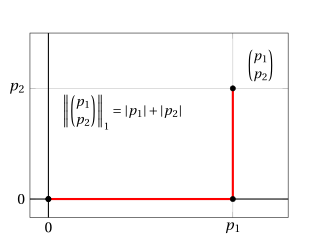
- The \(\ell_1\) norm of a column vector in \( \mathbb{R}^{n} \) represents the sum of the absolute values of its components. In \( \mathbb{R}^2 \), this corresponds to the Manhattan distance (the distance traveled along grid lines), as illustrated by the following picture:
-
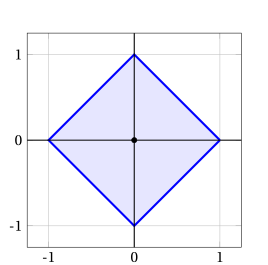
In two dimensions, all the points at \(\ell_1\) norm less than or equal to 1
\[ \{{{{\boldsymbol x}}} \in \mathbb{R}^2 : \|{{{{\boldsymbol x}}}}\|_1 \le 1\} \]are the points that lie on or inside a diamond shape (square rotated by 45°) centered at the origin.
2.1 Properties
- The \(\ell_1\) norm satisfies the three fundamental properties that define a norm.
Observation 1: Non-negativity and definiteness
For every column vector \({\boldsymbol p} \in \mathbb{R}^{n}\), we have:
Proof
From the definition \(\|{\boldsymbol p}\|_1 = \sum_{j=1}^n |p_j|\).
-
Non-negativity: Since \(|p_j| \ge 0\) for all \(j \in \{1,2,\ldots,n\}\), and the sum of non-negative numbers is non-negative, we have
\[ \|{\boldsymbol p}\|_1 = \sum_{j=1}^n |p_j| \ge 0 \quad \text{for all } {\boldsymbol p} \in \mathbb{R}^n. \] -
Definiteness:
-
(\(\Rightarrow\)) If \(\|{\boldsymbol p}\|_1 = 0\), then \(\sum_{j=1}^n |p_j| = 0\). Since each \(|p_j| \ge 0\), the sum equals zero only if \(|p_j| = 0\) for all \(j \in \{1,2,\ldots,n\}\), hence \(p_j = 0\) for all \(j \in \{1,2,\ldots,n\} \), i.e., \({\boldsymbol p} = {\boldsymbol 0}\).
-
(\(\Leftarrow\)) If \({\boldsymbol p} = {\boldsymbol 0}\), then \(p_j = 0\) for all \(j \in \{1,2,\ldots,n\}\), so
\[ \|{\boldsymbol p}\|_1 = \sum_{j=1}^n |0| = 0. \]
-
□
Observation 2: Absolute homogeneity
For every scalar \(\lambda \in \R\) and column vector \({\boldsymbol p} \in \mathbb{R}^{n}\), we have:
Proof
For every scalar \(\lambda \in \R\) and every column vector \({\boldsymbol p} \in \mathbb{R}^{n}\), we have:
□
Observation 3: Triangle inequality
For every pair of column vectors \({\boldsymbol p},{\boldsymbol w} \in \mathbb{R}^{n}\), we have:
Proof
For every pair of vectors \({\boldsymbol p}, {\boldsymbol w} \in \mathbb{R}^n\), we have:
□
3. \(\ell_2\) norm
Definition 2: \(\ell_2\) norm
The \(\ell_2\) norm (also called Euclidean norm) of a column vector
is the non-negative number defined as:
- When the subscript is omitted, i.e., when we write \(\|{\boldsymbol p}\|\) instead of \(\|{\boldsymbol p}\|_2\), the \(\ell_2\) norm is implied by default.
Example 2: \(\ell_2\) norm
-
Consider the two vectors:
\[ \begin{pmatrix} 1 \\ 4 \end{pmatrix} \in \mathbb{R}^{2} \qquad \text{and} \qquad \begin{pmatrix} 4 \\ 1 \end{pmatrix} \in \mathbb{R}^{2}, \]Their norms are:
\[ \left\| \begin{pmatrix} 1 \\ 4 \end{pmatrix} \right\|_2 = \sqrt{1^2 + 4^2} = \sqrt{1 + 16} = \sqrt{17}, \qquad \left\| \begin{pmatrix} 4 \\ 1 \end{pmatrix} \right\|_2 = \sqrt{4^2 + 1^2} = \sqrt{16 + 1} = \sqrt{17} \] -
Consider the four vertices of the diamond-shaped \(\ell_1\) unit ball in \( \mathbb{R}^2 \):
\[ \begin{pmatrix} 1 \\ 0 \end{pmatrix}, \quad \begin{pmatrix} 0 \\ 1 \end{pmatrix}, \quad \begin{pmatrix} -1 \\ 0 \end{pmatrix}, \quad \begin{pmatrix} 0 \\ -1 \end{pmatrix} \]Their norms are:
\[ \left\| \begin{pmatrix} 1 \\ 0 \end{pmatrix} \right\|_2 = \sqrt{1^2 + 0^2} = 1, ~ \left\| \begin{pmatrix} 0 \\ 1 \end{pmatrix} \right\|_2 = \sqrt{0^2 + 1^2} = 1, ~ \left\| \begin{pmatrix} -1 \\ 0 \end{pmatrix} \right\|_2 = \sqrt{(-1)^2 + 0^2} = 1, ~ \left\| \begin{pmatrix} 0 \\ -1 \end{pmatrix} \right\|_2 = \sqrt{0^2 + (-1)^2} = 1 \]
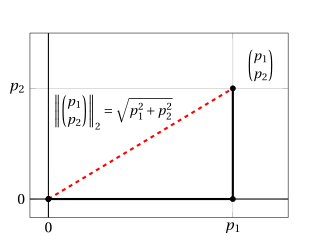
- The \(\ell_2\) norm of a column vector in \( \mathbb{R}^{n} \) represents its Euclidean distance from the origin. This interpretation follows from the Pythagorean theorem, as illustrated in \( \mathbb{R}^2 \) by the following picture:
-
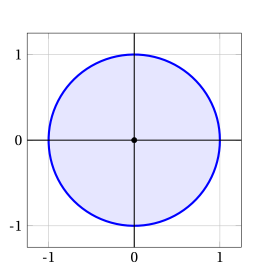
In two dimensions, all the points at \(\ell_2\) norm less than or equal to 1
\[ \{{{{\boldsymbol x}}} \in \mathbb{R}^2 : \|{{{{\boldsymbol x}}}}\|_2 \le 1\} \]are the points that lie on or inside the unit circle centered at the origin.
Given two column vectors
the norm of the difference of the two vectors is:
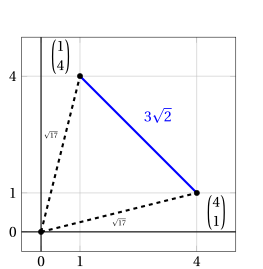
This quantity corresponds both to the Euclidean distance between the two points \( {\boldsymbol p} \) and \( {\boldsymbol w} \), and to the length of the diagonal of the parallelogram spanned by those points, starting from one and pointing to the other.
Example 3: \(\ell_2\) norm the difference of vectors
Consider the two vectors:
The norm of the difference of the two vectors is
Graphically, we have:
Given two column vectors
the norm of the sum of the two vectors is:
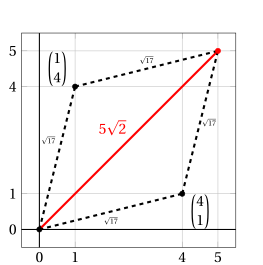
This quantity represents the length of the diagonal of the parallelogram spanned by the vectors \( {\boldsymbol p} \) and \( {\boldsymbol w} \), both originating from the origin.
Example 4: \(\ell_2\) norm of the sum of vectors
Consider the two vectors:
The norm of the sum of the two vectors is:
Graphically, we have:
3.1 Cauchy–Schwarz inequality
Observation 4: Cauchy–Schwarz inequality
For every pair of column vectors \({\boldsymbol p},{\boldsymbol w} \in \mathbb{R}^{n}\), we have:
Proof
If \( {\boldsymbol p} = {\boldsymbol 0} \) or \( {\boldsymbol w} = {\boldsymbol 0} \) (or both), the inequality clearly holds.
Assume \( {\boldsymbol p} \neq {\boldsymbol 0} \) and \( {\boldsymbol w} \neq {\boldsymbol 0} \). Consider the vector:
Then, for every \( \alpha, \beta \in \mathbb{R} \), we have:
Now choose:
Substituting, we get:
Since \( {\boldsymbol w}' \; {\boldsymbol w} = \|{\boldsymbol w}\|_2^2 > 0 \), dividing both sides yields:
□
3.2 Properties
- The \(\ell_2\) norm satisfies the three fundamental properties that define a norm.
Observation 5: Non-negativity and definiteness
For every column vector \({\boldsymbol p} \in \mathbb{R}^{n}\), we have:
Proof
From the definition \(\|{\boldsymbol p}\|_2 = \sqrt{{\boldsymbol p}' \, {\boldsymbol p}}\).
-
Non-negativity: Since \({\boldsymbol p}' \, {\boldsymbol p} = \sum_{j=1}^n p_j^2 \ge 0\) (as a sum of squares), and the square root function yields non-negative values, we have \(\|{\boldsymbol p}\|_2 \ge 0\) for all \({\boldsymbol p} \in \mathbb{R}^n\).
-
Definiteness:
-
(\(\Rightarrow\)) If \(\|{\boldsymbol p}\|_2 = 0\), then \(\sqrt{{\boldsymbol p}' \, {\boldsymbol p}} = 0\), hence \({\boldsymbol p}' \, {\boldsymbol p} = 0\), i.e.
\[ \sum_{j=1}^n p_j^2 = 0. \]Since each \(p_j^2 \ge 0\), the sum equals zero only if \(p_j^2 = 0\) for all \(j \in \{1,2,\ldots,n\}\), hence \(p_j = 0\) for all \(j \in \{1,2,\ldots,n\}\), i.e., \({\boldsymbol p} = {\boldsymbol 0}\).
-
(\(\Leftarrow\)) If \({\boldsymbol p} = {\boldsymbol 0}\), then \({\boldsymbol p}' \, {\boldsymbol p} = 0\), so \(\|{\boldsymbol p}\|_2 = \sqrt{0} = 0\).
-
□
Observation 6: Absolute homogeneity
For every column vector \({\boldsymbol p} \in \mathbb{R}^{n}\) and scalar \(\lambda \in \R\), we have:
Proof
For every scalar \(\lambda \in \R\) and every column vector \({\boldsymbol p} \in \mathbb{R}^{n}\), we have:
□
Observation 7: Triangle inequality
For every pair of column vectors \({\boldsymbol p},{\boldsymbol w} \in \mathbb{R}^{n}\), we have:
Proof
For every pair of vectors \( {\boldsymbol p}, {\boldsymbol w} \in \mathbb{R}^n \), we have:
Accordingly, we obtain:
□
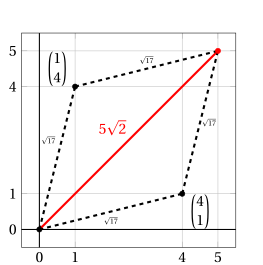
- In \(\R^2\), the triangle inequality states that for any triangle the sum of the lengths of any two sides must be greater than or equal to the length of the remaining side.
Example 5: triangle inequality
Consider the two vectors \(\begin{pmatrix} 1 \\ 4 \end{pmatrix} \in \R^2\) and \(\begin{pmatrix} 4 \\ 1 \end{pmatrix} \in \R^2\), we have:
-
Another form of the triangle inequality is:
\[\begin{equation} \|{\boldsymbol r}\|_2 \le \|{\boldsymbol r}-{\boldsymbol s}\|_2 + \|{\boldsymbol s}\|_2 {\rm ~~~~~that~is~~~~~} \|{\boldsymbol r}\|_2 - \|{\boldsymbol s}\|_2 \le \|{\boldsymbol r}-{\boldsymbol s}\|_2 , \quad \forall {\boldsymbol r},{\boldsymbol s} \in \mathbb{R}^n \label{CCCC} \end{equation}\]To obtain it, it suffices to set in \(\eqref{TTTTT}\):
\[ {\boldsymbol p} = {\boldsymbol r} - {\boldsymbol s}, \quad {\boldsymbol w} = {\boldsymbol s} \]
Observation 8: reverse triangle inequality
For every pair of column vectors \({\boldsymbol p},{\boldsymbol w} \in \mathbb{R}^{n}\), we have:
Proof
For every two vectors \( {\boldsymbol p}, {\boldsymbol w} \in \mathbb{R}^n \), we have:
Accordingly, we obtain:
□
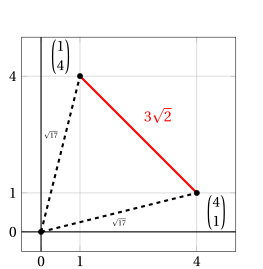
- In \(\R^2\), the reverse triangle inequality states that for any triangle the length of any side must be greater than or equal to the difference between the lengths of the other two sides.
Example 6: reverse triangle inequality
Consider the two vectors \(\begin{pmatrix} 1 \\ 4 \end{pmatrix} \in \R^2\) and \(\begin{pmatrix} 4 \\ 1 \end{pmatrix} \in \R^2\), we have:
4. Generalized \(\ell_2\) norm
Definition 3: generalized \(\ell_2\) norm
Given a symmetric positive definite matrix
the generalized \(\ell_2\) norm of a column vector
is the non-negative number defined as:
-
The generalized \(\ell_2\) norm extends the standard Euclidean norm by incorporating a positive definite matrix \(\boldsymbol{Q}\), which weights and potentially correlates the components of the vector.
-
When \(\boldsymbol{Q}\) is the identity matrix \(\boldsymbol{I}\), the generalized \(\ell_2\) norm reduces to the standard \(\ell_2\) norm.
-
The matrix \(\boldsymbol{Q}\) must be positive definite to ensure that \(\boldsymbol{p}' \boldsymbol{Q} \boldsymbol{p} \ge 0\) for all \(\boldsymbol{p} \in \mathbb{R}^n\), making the square root well-defined, and that \(\boldsymbol{p}' \boldsymbol{Q} \boldsymbol{p} = 0\) only for \(\boldsymbol{p} = \boldsymbol{0}\).
-
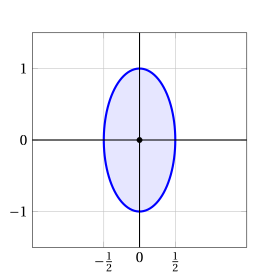
In two dimensions, all the points at generalized \(\ell_2\) norm less than or equal to 1
\[ \{{{{\boldsymbol x}}} \in \mathbb{R}^2 : \|{{{{\boldsymbol x}}}}\|_{\boldsymbol{Q}} \le 1\} \]are the points that lie on or inside an ellipse centered at the origin, whose size, shape, and rotation are determined by the matrix \(\boldsymbol{Q}\). In particular, the eigenvectors of \(\boldsymbol{Q}\) determine the principal axes and the orientation, while the eigenvalues determine the lengths of the semi-axes.
Example 7: generalized \(\ell_2\) norm
In \(\mathbb{R}^2\), we consider the following diagonal positive definite matrix
Since \(\boldsymbol{Q}\) is diagonal, the eigenvalues are the diagonal entries:
and the eigenvectors are the standard basis vectors:
Semi-axes lengths and orientation:
-
The semi-axes lengths are \(\frac{1}{\sqrt{\lambda_1}} = \frac{1}{\sqrt{4}} = \frac{1}{2}\) and \(\frac{1}{\sqrt{\lambda_2}} = \frac{1}{\sqrt{1}} = 1\).
-
Since the eigenvectors are aligned with the coordinate axes, the ellipse is not rotated.
-
The principal axes coincide with the \(x_1\) and \(x_2\) axes.
The set of points at generalized \(\ell_2\) norm \(\le 1\) from the origin is:
Example 8: generalized \(\ell_2\) norm
In \(\mathbb{R}^2\), we consider the following diagonal positive definite matrix
Since \(\boldsymbol{Q}\) is diagonal, the eigenvalues are the diagonal entries:
and the eigenvectors are the standard basis vectors:
Semi-axes lengths and orientation:
-
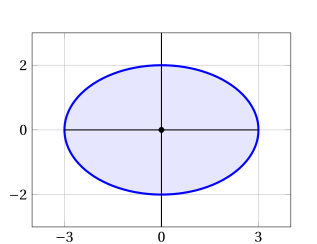
The semi-axes lengths are \(\frac{1}{\sqrt{\lambda_1}} = \frac{1}{\sqrt{1/9}} = 3\) and \(\frac{1}{\sqrt{\lambda_2}} = \frac{1}{\sqrt{1/4}} = 2\).
-
Since the eigenvectors are aligned with the coordinate axes, the ellipse is not rotated.
-
The principal axes coincide with the \(x_1\) and \(x_2\) axes.
The set of points at generalized \(\ell_2\) norm \(\le 1\) from the origin is:
Example 9: generalized \(\ell_2\) norm
In \(\mathbb{R}^2\), we consider the following symmetric positive definite matrix
The eigenvalues of \(\boldsymbol{Q}\) are found by solving the characteristic equation:
which gives:
The corresponding eigenvectors are:
Semi-axes lengths and orientation:
-
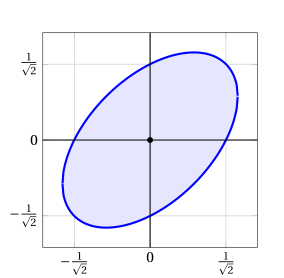
The semi-axes lengths are \(\frac{1}{\sqrt{\lambda_1}} = \frac{1}{\sqrt{1}} = 1\) and \(\frac{1}{\sqrt{\lambda_2}} = \frac{1}{\sqrt{3}}\).
-
Since the eigenvectors are not aligned with the coordinate axes, the ellipse is rotated.
-
The principal axes coincide with the directions of the eigenvectors.
The set of points at generalized \(\ell_2\) norm \(\le 1\) from the origin is:
4.1 Generalized Cauchy–Schwarz inequality
Observation 9: generalized Cauchy–Schwarz inequality
For every symmetric positive definite matrix \(\boldsymbol{Q} \in \mathbb{R}^{n \times n}\) and pair of column vectors \({\boldsymbol p},{\boldsymbol w} \in \mathbb{R}^{n}\), we have:
Proof
If \( {\boldsymbol p} = {\boldsymbol 0} \) or \( {\boldsymbol w} = {\boldsymbol 0} \) (or both), the inequality clearly holds.
Assume \( {\boldsymbol p} \neq {\boldsymbol 0} \) and \( {\boldsymbol w} \neq {\boldsymbol 0} \). Consider the vector:
Then, for every \( \alpha, \beta \in \mathbb{R} \), we have:
where we used \({\boldsymbol w}' \; {\boldsymbol Q} \; {\boldsymbol p} = {\boldsymbol p}' \; {\boldsymbol Q} \; {\boldsymbol w}\), which holds since \({\boldsymbol Q}\) is symmetric.
Now choose:
Substituting, we get:
Since \( {\boldsymbol w}' \; {\boldsymbol Q} \; {\boldsymbol w} = \|{\boldsymbol w}\|_{\boldsymbol Q}^2 > 0 \), dividing both sides yields:
□
4.2 Properties
- The generalized \(\ell_2\) norm satisfies the three fundamental properties that define a norm.
Observation 10: Non-negativity and definiteness
For every positive definite matrix \(\boldsymbol{Q} \in \mathbb{R}^{n \times n}\) and column vector \({\boldsymbol p} \in \mathbb{R}^{n}\), we have:
Proof
By definition, \(\|{\boldsymbol p}\|_{\boldsymbol Q} = \sqrt{{\boldsymbol p}' \, {\boldsymbol Q} \, {\boldsymbol p}}\). Since \({\boldsymbol Q}\) is positive definite, we have \({\boldsymbol p}' \, {\boldsymbol Q} \, {\boldsymbol p} > 0\) for all \({\boldsymbol p}\neq{\boldsymbol 0}\), and \({\boldsymbol 0}' \, {\boldsymbol Q} \, {\boldsymbol 0}=0\).
-
Non-negativity: For all \({\boldsymbol p} \in \mathbb{R}^n\), we have \({\boldsymbol p}' \, {\boldsymbol Q} \, {\boldsymbol p} \ge 0\). Therefore
\[ \|{\boldsymbol p}\|_{\boldsymbol Q} = \sqrt{{\boldsymbol p}' \, {\boldsymbol Q} \, {\boldsymbol p}} \ge 0. \] -
Definiteness:
-
(\(\Rightarrow\)) If \(\|{\boldsymbol p}\|_{\boldsymbol Q} = 0\), then
\[ \sqrt{{\boldsymbol p}' \, {\boldsymbol Q} \, {\boldsymbol p}} = 0 \quad \Longrightarrow \quad {\boldsymbol p}' \, {\boldsymbol Q} \, {\boldsymbol p} = 0, \]which implies \({\boldsymbol p} = {\boldsymbol 0}\) (by positive definiteness of \({\boldsymbol Q}\)).
-
(\(\Leftarrow\)) If \({\boldsymbol p} = {\boldsymbol 0}\), then
\[ {\boldsymbol p}' \, {\boldsymbol Q} \, {\boldsymbol p} = {\boldsymbol 0}' \, {\boldsymbol Q} \, {\boldsymbol 0} = 0, \]and therefore \(\|{\boldsymbol p}\|_{\boldsymbol Q} = \sqrt{0} = 0\).
-
□
Observation 11: Absolute homogeneity
For every positive definite matrix \(\boldsymbol{Q} \in \mathbb{R}^{n \times n}\), scalar \(\lambda \in \mathbb{R}\), and column vector \(\boldsymbol{p} \in \mathbb{R}^{n}\), we have:
Proof
For every scalar \(\lambda \in \R\) and every vector \({\boldsymbol p} \in \mathbb{R}^{n}\), we have:
□
Observation 12: Triangle inequality
For every positive definite matrix \(\boldsymbol{Q} \in \mathbb{R}^{n \times n}\) and pairs of column vectors \({\boldsymbol p}, {\boldsymbol w} \in \mathbb{R}^{n}\), we have:
Proof
For every \( {\boldsymbol p}, {\boldsymbol w} \in \mathbb{R}^n \), we have:
Accordingly, we obtain:
□
5. \(\ell_\infty\) norm
Definition 4: \(\ell_\infty\) norm
The \(\ell_\infty\) norm (also called maximum norm, supremum norm, or Chebyshev norm) of a column vector
is the non-negative number defined as:
-
The \(\ell_\infty\) norm represents the maximum absolute value among all components.
-
The \(\ell_\infty\) norm is half the side length of the smallest hypercube (aligned with the axes and centered at the origin) that contains the vector.
Example 10: \(\ell_\infty\) norm
Consider the vectors:
Their \(\ell_\infty\) norms are:
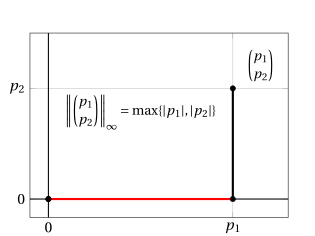
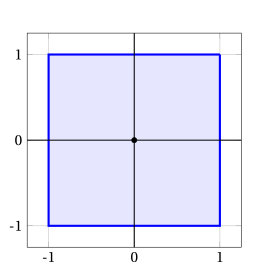
- The \(\ell_\infty\) norm of a column vector in \( \mathbb{R}^{n} \) represents the maximum absolute value of its components. In \( \mathbb{R}^2 \), this corresponds to the Chebyshev distance (the maximum of the absolute differences in coordinates), as illustrated by the following picture:
-
In two dimensions, all the points at \(\ell_\infty\) norm less than or equal to 1
\[ \{{{{\boldsymbol x}}} \in \mathbb{R}^2 : \|{{{{\boldsymbol x}}}}\|_\infty \le 1\} \]are the points that lie on or inside a square (axis-aligned) centered at the origin.
5.1 Properties
- The \(\ell_\infty\) norm satisfies the three fundamental properties that define a norm.
Observation 13: Non-negativity and definiteness
For every column vector \({\boldsymbol p} \in \mathbb{R}^{n}\), we have:
Proof
From the definition \(\|{\boldsymbol p}\|_\infty = \max\{|p_j| : j \in \{1,2,\ldots,n\}\}\).
-
Non-negativity: Since \(|p_j| \ge 0\) for all \(j \in \{1,2,\ldots,n\}\), and the maximum of non-negative numbers is non-negative, we have
\[ \|{\boldsymbol p}\|_\infty = \max\{|p_j| : j \in \{1,2,\ldots,n\}\} \ge 0 \quad \text{for all } {\boldsymbol p} \in \mathbb{R}^n. \] -
Definiteness:
-
(\(\Rightarrow\)) If \(\|{\boldsymbol p}\|_\infty = 0\), then
\[ \max\{|p_j| : j \in \{1,2,\ldots,n\}\} = 0. \]Since
\[ |p_j| \le \max\{|p_k| : k \in \{1,2,\ldots,n\}\} {\rm~~for~all~~} j \in \{1,2,\ldots,n\}, \]it follows that
\[ |p_j| \le 0 \text{ for all } j \in \{1,2,\ldots,n\}. \]But \(|p_j| \ge 0\) always holds, hence \(|p_j| = 0\) for all \(j\), i.e. \(p_j = 0\) for all \(j \in \{1,2,\ldots,n\}\), and therefore \({\boldsymbol p} = {\boldsymbol 0}\).
-
(\(\Leftarrow\)) If \({\boldsymbol p} = {\boldsymbol 0}\), then \(p_j = 0\) for all \(j \in \{1,2,\ldots,n\}\), so
\[ \|{\boldsymbol p}\|_\infty = \max\{|0| : j \in \{1,2,\ldots,n\}\} = 0. \]
-
□
Observation 14: Absolute homogeneity
For every scalar \(\lambda \in \R\) and column vector \({\boldsymbol p} \in \mathbb{R}^{n}\), we have:
Proof
For every scalar \(\lambda \in \R\) and every column vector \({\boldsymbol p} \in \mathbb{R}^{n}\), we have:
□
Observation 15: Triangle inequality
For every pair of column vectors \({\boldsymbol p},{\boldsymbol w} \in \mathbb{R}^{n}\), we have:
Proof
For every pair of vectors \({\boldsymbol p}, {\boldsymbol w} \in \mathbb{R}^n\), we have:
where in the second inequality we used the fact that
and
□
6. Comparison of the \(\ell_1\), \(\ell_2\) and \(\ell_\infty\) norms
- The \(\ell_1\), \(\ell_2\) and \(\ell_\infty\) norms of the same vector are, in general, different numbers. However, they are related by simple inequalities.
Observation 16: Inequalities between norms
For every column vector \({\boldsymbol p} \in \mathbb{R}^{n}\), we have:
and
Proof
Let \(k \in \{1,2,\ldots,n\}\) be an index such that \(|p_k| = \|{\boldsymbol p}\|_\infty\).
-
\(\|{\boldsymbol p}\|_\infty \le \|{\boldsymbol p}\|_2\): since all the terms \(p_j^2\) are non-negative, we have
\[ \|{\boldsymbol p}\|_\infty^2 = p_k^2 \le \sum_{j=1}^n p_j^2 = \|{\boldsymbol p}\|_2^2 \]and, taking the square root of both (non-negative) sides, \(\|{\boldsymbol p}\|_\infty \le \|{\boldsymbol p}\|_2\).
-
\(\|{\boldsymbol p}\|_2 \le \|{\boldsymbol p}\|_1\): expanding the square of the sum, we have
\[ \|{\boldsymbol p}\|_1^2 = \left(\sum_{j=1}^n |p_j|\right)^2 = \sum_{j=1}^n |p_j|^2 + \underbrace{\sum_{i=1}^n \sum_{\substack{j=1 \\ j \neq i}}^n |p_i| \, |p_j|}_{\ge 0} \ge \sum_{j=1}^n p_j^2 = \|{\boldsymbol p}\|_2^2 \]and, taking the square root of both (non-negative) sides, \(\|{\boldsymbol p}\|_2 \le \|{\boldsymbol p}\|_1\).
-
\(\|{\boldsymbol p}\|_1 \le n \, \|{\boldsymbol p}\|_\infty\): since \(|p_j| \le \|{\boldsymbol p}\|_\infty\) for all \(j \in \{1,2,\ldots,n\}\), we have
\[ \|{\boldsymbol p}\|_1 = \sum_{j=1}^n |p_j| \le \sum_{j=1}^n \|{\boldsymbol p}\|_\infty = n \, \|{\boldsymbol p}\|_\infty \] -
\(\|{\boldsymbol p}\|_1 \le \sqrt{n} \, \|{\boldsymbol p}\|_2\): consider the column vectors
\[ {\boldsymbol a} = \begin{pmatrix} |p_1| \\ |p_2| \\ \vdots \\ |p_n| \end{pmatrix} \in \mathbb{R}^n \qquad \text{and} \qquad {\boldsymbol 1} = \begin{pmatrix} 1 \\ 1 \\ \vdots \\ 1 \end{pmatrix} \in \mathbb{R}^n \]for which \({\boldsymbol 1}' \, {\boldsymbol a} = \|{\boldsymbol p}\|_1\), \(\|{\boldsymbol a}\|_2 = \|{\boldsymbol p}\|_2\) and \(\|{\boldsymbol 1}\|_2 = \sqrt{n}\). By the Cauchy–Schwarz inequality \(\eqref{norm_2}\), we get
\[ \|{\boldsymbol p}\|_1 = {\boldsymbol 1}' \, {\boldsymbol a} \le |{\boldsymbol 1}' \, {\boldsymbol a}| \le \|{\boldsymbol 1}\|_2 \; \|{\boldsymbol a}\|_2 = \sqrt{n} \; \|{\boldsymbol p}\|_2 \]
□
Example 11: inequalities between norms
Consider the vector:
Its norms are:
and, with \(n = 3\), we have:
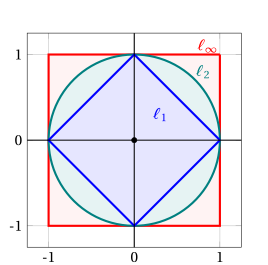
- In two dimensions, the inequalities \(\|{\boldsymbol x}\|_\infty \le \|{\boldsymbol x}\|_2 \le \|{\boldsymbol x}\|_1\) mean that the three unit balls are nested: the \(\ell_1\) diamond lies inside the \(\ell_2\) unit circle, which in turn lies inside the \(\ell_\infty\) square.
Try it in the lab
the same computation step by step: change the matrix and watch the steps change.
Exercises and lab
- Exercises · the exercise sheet of this chapter: 12 exercises with worked solutions
- Lab · Norms — The \(\ell_1\), \(\ell_2\), \(\ell_\infty\) norms and the one generalized by \(\boldsymbol Q\).